SARFAESI Auction: Everything You Need to Know
A SARFAESI auction is the sale of a secured asset under Section 13(4) of the SARFAESI Act, but several genuinely important questions sit beneath the basic process: whether it applies to property you co-own, what happens if the buyer misses a payment deadline, and what happens if insolvency proceedings begin midway through. This guide covers those in real depth, with the actual case law behind each answer, not just the bare text of the Act.

Mohit Juneja
Reviewed by FREED India, Debt Resolution Specialists
 4.7/5
4.7/5 ₹3,200Cr+
 20,000+
 20,00,000+4.7/5₹3,200Cr+20,000+20,00,000+
KEY TAKEAWAYS

A co-owner who never consented to the mortgage can challenge a SARFAESI auction of jointly held property under Section 17; courts have annulled sales on exactly this ground, and have also penalised banks for selling joint property as a single undivided unit.
The 15-day deadline for a winning bidder to pay the balance sale consideration isn't absolute; the Supreme Court has confirmed it can be extended by mutual written consent, and cancellation can only be triggered by the buyer's own genuine default.
If insolvency proceedings (CIRP) are admitted against the borrower under the IBC, the resulting moratorium overrides and halts SARFAESI proceedings, unless the sale stage was already reached beforehand, and a 2026 amendment extends this protection through liquidation too.
A sale notice requires a mandatory 30 days' clear notice before the sale itself, separate from the original 60-day demand notice, and generally can't simply be reused if that sale falls through, though courts have carved out an exception where the failure is attributable solely to the borrower's own delay tactics.
What "SARFAESI Auction" Covers, and What This Piece Adds
The basic mechanics of any SARFAESI auction, registration on an e-auction portal, EMD deposit, bidding on the scheduled date, and issuance of a sale certificate to the winning bidder, are largely standardised across banks and NBFCs. The practical, step-by-step process on a specific bank's own e-auction portal is covered in full mechanical detail elsewhere on this site, worth reading first if that's genuinely what you're looking for right now.
This piece exists as a separate, distinct resource for a specific reason. Most "how to bid" or "how the auction works" content stops exactly at the mechanical process, and never addresses the genuinely harder legal questions that arise once a real dispute, a joint owner, a missed payment deadline, an insolvency filing, actually enters the picture. This piece is written for that gap specifically, the moment a straightforward process suddenly isn't straightforward anymore.
Four questions get answered here in real depth, each grounded in an actual, citable legal decision rather than a general paraphrase of the Act: whether SARFAESI reaches jointly owned property, what happens when a winning bidder can't pay on schedule, how insolvency proceedings interact with an ongoing SARFAESI action, and what your actual revision and appeal options look like if you believe a sale was conducted improperly. Worth setting expectations honestly upfront: the law in several of these areas is still actively evolving through court decisions. This piece reflects the current, best-understood position, not a permanently fixed rule; always confirm the most current position for your specific situation with a qualified lawyer before acting on anything here.

Freed Expert Tip
If you're dealing with any of the situations covered in this piece, get the specific case facts reviewed by a lawyer as your very next step. General guidance here is a starting point for understanding your situation, not a substitute for advice tailored to your exact facts.
Talk to FREED's TeamThe Legal Basis: Section 13(4) and the Sale Notice Requirements
Section 13(4) is the formal enforcement stage of the SARFAESI process. It becomes available to the secured creditor only after a Section 13(2) demand notice has been issued, and the 60-day window has passed without the dues being cleared or a resolution being reached. At that point, the creditor can take possession of the secured asset and proceed to sell it, by auction or otherwise, to recover the outstanding amount.
There's a separate, often-overlooked sale notice requirement sitting on top of this. Courts have specifically held that a secured creditor must give the borrower at least 30 days' clear notice before actually effecting a sale or transfer of the asset; this is a distinct legal requirement from the original 60-day demand notice under Section 13(2), and exists specifically to give the borrower a final, meaningful window before the asset actually changes hands. The broader recovery framework these tribunals and timelines sit within is worth understanding too, since SARFAESI doesn't operate in isolation from the rest of India's debt recovery machinery.
This distinction matters practically to a borrower. If you discover that a sale actually took place on a date different from what was originally notified, without a fresh notice being issued for that new date, and the delay wasn't something you yourself caused, that's a genuine, substantive procedural defect worth raising, not a minor technicality. Whether any of this changes when the secured property happens to be jointly owned is worth walking through carefully next.

What the Law Says
Courts have held that a secured creditor must give at least 30 days' clear notice before effecting a sale under SARFAESI, and generally cannot rely on an earlier notice to conduct the sale on a different date if the originally notified sale doesn't go through, unless the failure is attributable solely to the borrower's own actions.
Understand My RightsIs SARFAESI Applicable to Jointly Held Property?
The general legal principle first: SARFAESI can, in principle, reach jointly held property, but only to the extent that the borrower or guarantor who created the mortgage actually had the legal right to encumber that specific share or interest. A person cannot mortgage more than what they legitimately own or control, and a bank accepting security over a joint asset needs to have properly verified this before proceeding.
The real, current precedent here is genuinely worth understanding in depth. In a 2026 decision from the DRT Chandigarh, Suresh Kumar v. Authorized Officer, Indian Bank and Ors., the underlying facts involved a father transferring a specific portion, 20 marlas, out of a larger jointly purchased parcel of land, 2 kanals, to create security for a loan. The applicant in the case was a co-owner in joint possession of the land who had never signed any of the transfer or mortgage documents at all. When the bank proceeded under Section 13 and sold the property in auction, this co-owner challenged the sale.
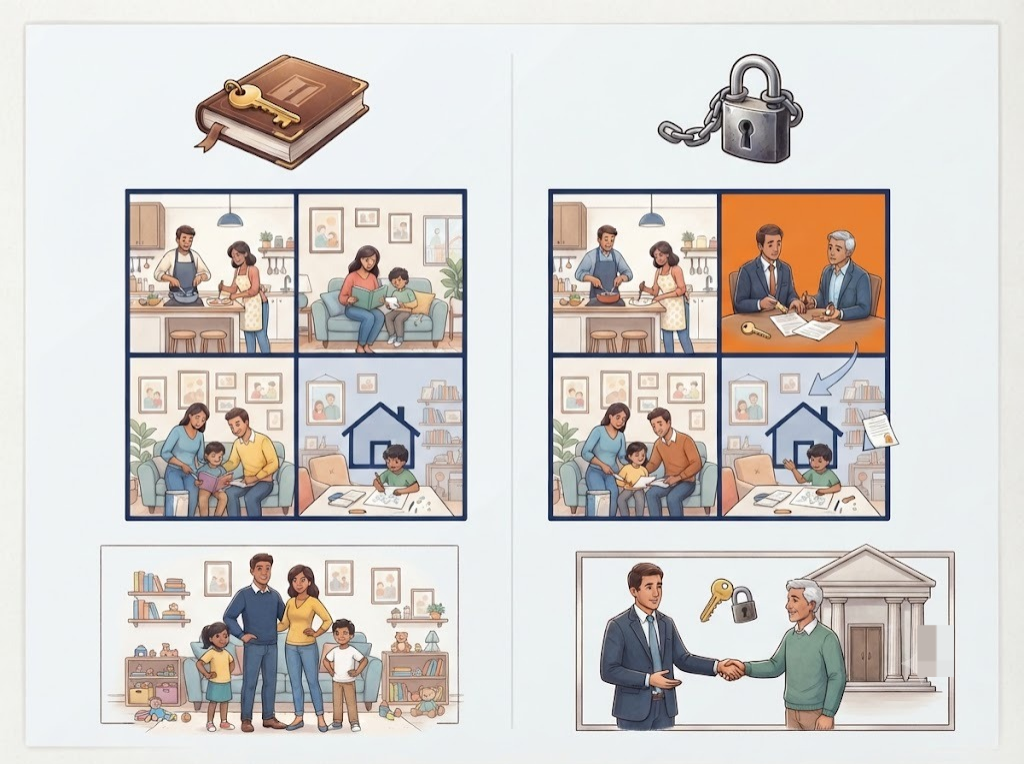
The tribunal's holding matters considerably. It found the applicant, despite being neither the original borrower nor a guarantor, was nonetheless an "aggrieved person" with proper standing to bring a challenge under Section 17, precisely because they were a genuine co-owner in possession who had never consented to or signed the underlying transfer. The tribunal further held that the transferor could not legally transfer a specific carved-out portion out of what was still a jointly held, undivided property without the other co-owners' consent, and, separately, that the bank had committed an additional error by selling the full 20 marlas as a single, undivided unit in the auction rather than properly identifying and separating out only the mortgaged share.
The practical takeaway for someone in a similar position today is genuinely significant. A co-owner whose rights are affected by SARFAESI measures may be able to challenge those measures under Section 17. The outcome will depend on the co-owner’s legal interest, the mortgage documents, and the facts of the particular case.Where an account actually sits in the NPA classification sequence before it ever reaches this stage is worth understanding too, since that earlier timeline shapes everything that follows. What happens on the buyer's side of the transaction if a sale does proceed but the payment timeline afterward runs into difficulty is worth understanding next.

Think a joint property was mortgaged without your consent?
Talk to FREED about your situation and your rights.
Book My Free CallWhat Happens If the Winning Bidder Can't Pay the Balance in Time
Under Rule 9(4) of the Security Interest (Enforcement) Rules, 2002, a winning bidder in a SARFAESI auction is generally required to deposit the balance sale consideration, the remaining amount after the initial deposit made at the time of the winning bid, within 15 days of the sale being confirmed.
The real, current Supreme Court precedent worth understanding in depth is IDBI Bank Ltd. v. Ramswaroop Daliya (2024), decided by the Court on October 16, 2024. The Court was asked to consider whether this 15-day period is an absolute, immovable deadline or something more flexible. The Court held clearly that this period is not rigid and can genuinely be extended by mutual written consent between the bank and the purchaser. In the specific facts of that case, since the delay in question was not attributable to any fault on the purchaser's part, the Court found the bank's decision to cancel the auction on that basis was unjustified.
The Court established a second, equally important principle alongside this. The Supreme Court has recognised that the Rule 9(4) payment period can be extended by written agreement between the parties. Whether a sale can be cancelled for delayed payment will depend on the applicable rules, agreed terms and circumstances of the delay. What this means practically for someone on either side of a transaction like this: a bank cannot simply and unilaterally cancel a confirmed sale over a payment delay if that delay was genuinely mutually agreed between the parties, or where the purchaser was not actually at fault. And conversely, a purchaser who has paid on the terms actually agreed, even if slightly outside the strict original 15-day window, holds real, court-recognised, protected rights once a sale has been properly confirmed. This protection exists specifically to encourage genuine participation and confidence in the SARFAESI auction system as a whole, rather than leaving every purchaser at the mercy of a bank's unilateral discretion after the fact.
Mutation After a SARFAESI Auction: What Buyers Need to Know
Mutation is a genuinely separate step from anything covered so far, and it's worth understanding clearly why. It's the formal process of updating the official land revenue records, or the relevant municipal property records for urban property, to reflect the buyer as the new, recorded owner. This is entirely distinct from receiving the sale certificate from the bank, which is a different document serving a different legal purpose entirely.
Each document does something specific. The sale certificate, issued and signed by the bank's authorised officer once the full sale consideration has been paid, is the buyer's core, foundational proof that a valid SARFAESI sale actually took place and that ownership has legally transferred. Mutation, by contrast, is what makes that change of ownership visible and recognised specifically within the government's own local record-keeping system, relevant for matters like future property tax assessment, utility connections, or a later resale of the same property.
Mutation is typically applied for at the relevant local revenue office or municipal corporation, using the sale certificate together with the registered sale deed as the core supporting documents. This application should be made reasonably promptly after the property's registration is complete, rather than treated as an afterthought. Worth being honest and precise about what delay in this step does and doesn't affect: a delay in completing mutation does not itself undo or threaten the underlying legal ownership already established through the sale certificate and registration, but it can create real, practical friction later, complications with local tax authorities, difficulty proving ownership quickly in an everyday transaction, or added delay if the property needs to be resold, that make it worth completing promptly rather than treating it as optional paperwork.
Also dealing with unsecured debt in the same household?
See your options on that separate piece
Check your optionsSARFAESI and Insolvency Law: What Happens If the Borrower Enters IBC Proceedings
If a Corporate Insolvency Resolution Process (CIRP) is admitted against a corporate borrower, a company, under Sections 7, 9, or 10 of the Insolvency and Bankruptcy Code, the Adjudicating Authority, the NCLT, is required to declare a moratorium under Section 14 of the IBC. This moratorium takes effect from the specific insolvency commencement date, not from some later administrative step.
The real, binding Supreme Court precedent that settled this question at the highest level is Indian Overseas Bank v. RCM Infrastructure Limited and Anr. (2022). The Supreme Court confirmed clearly and directly that once this moratorium is in force, it overrides and effectively halts any ongoing SARFAESI proceedings against that same corporate debtor's assets. This is because Section 14 explicitly and specifically extends to prohibit "any action to foreclose, recover or enforce any security interest," expressly including any action taken under the SARFAESI Act itself. The Court in this specific case went further and held that this bar applies even where a sale certificate had already been issued and a portion, 25%, of the total bid amount had already been paid by the auction purchaser before the moratorium began, the remaining balance could not lawfully be received while the moratorium remained in force.
There's an important boundary courts have separately recognised alongside this. Where the underlying mortgagor-mortgagee relationship for purposes of redemption is treated as existing only up until the date a sale notice is actually issued, this means that even where insolvency proceedings begin and a moratorium follows, this does not automatically revive rights the mortgagor had already lost before that point, nor does it cause a genuinely third-party-owned secured asset to somehow become part of the corporate debtor's own asset pool if it never legitimately belonged there.
Worth knowing about a further, current development here too. The Insolvency and Bankruptcy Code (Amendment) Act, 2026, which received Presidential assent on April 6, 2026, with the relevant Section 14 changes in force from May 26, 2026, The IBC (Amendment) Act, 2026 introduced a moratorium during liquidation for specified proceedings, subject to Section 52 and other statutory exceptions. Its effect on a secured creditor’s enforcement rights therefore depends on the applicable provisions and circumstances.” Since this entire framework is built around the IBC's Corporate Insolvency Resolution Process, it applies specifically to corporate, business borrowers, companies, not to individual retail borrowers, who are not subject to CIRP in this particular sense at all. The broader distinction between insolvency and bankruptcy as legal concepts is worth reading separately if this IBC overlap is genuinely new territory for you.
What the Law Says
Once CIRP is admitted against a corporate debtor under the IBC, the resulting Section 14 moratorium overrides and halts SARFAESI enforcement, including auction proceedings. The Supreme Court confirmed this extends even to a sale where part of the bid amount was already paid before the moratorium began.
Talk to FREED's TeamRevision and Appeal Options Under SARFAESI
Any person aggrieved by a measure taken by a secured creditor under Section 13, including the borrower, a guarantor, or, as established in the joint-property discussion above, an affected co-owner with genuine standing, can file a formal application under Section 17 before the jurisdictional Debt Recovery Tribunal (DRT, challenging that specific measure. This includes challenging the sale itself on grounds like the procedural defects discussed throughout this piece, a missing or defective notice, an improperly conducted sale of jointly held property, or a violation of the mandatory 30-day sale notice requirement.
A further appeal from a DRT order lies to the Debt Recovery Appellate Tribunal, DRAT, under Section 18, subject to the pre-deposit requirement that applies at that stage, typically a percentage of the amount in dispute, though this can be reduced by the DRAT itself for recorded reasons in appropriate cases. A High Court revision or writ remedy remains available in more limited circumstances, typically reserved for situations involving a genuine question of jurisdiction, or a fundamental, serious procedural violation, rather than functioning as a routine, everyday alternative to properly working through the DRT and DRAT process first.
The clear, practical takeaway this whole section builds toward: the DRT under Section 17 is the primary, statutorily intended forum for challenging virtually any SARFAESI action, including the specific joint-property and procedural issues discussed earlier in this piece. That route should generally be pursued and properly exhausted before looking toward the High Court as an alternative, rather than treating the writ jurisdiction as a shortcut around the process Parliament actually designed.
What Are Your Options If You Also Have Unsecured Debt
FREED does not act on SARFAESI auctions, joint-property disputes, insolvency proceedings, or DRT/DRAT matters of any kind; every one of these is a formal legal proceeding requiring qualified legal representation, not something a debt-resolution platform steps into.
The genuine, separate overlap with FREED's actual work often shows up elsewhere, though. If separate unsecured debt, personal loans, credit cards, BNPL, exists alongside a secured loan that has reached this stage, that unsecured debt is a genuinely distinct problem, running on its own separate legal track, that deserves its own separate solution rather than being left unaddressed while all the attention goes to the secured-property situation. Settlement, when it genuinely is the right fit, is not something a borrower chooses out of preference; banks and financial companies only consider it when someone is genuinely unable to repay in full. It remains a last resort, while consolidation into a single, lower monthly payment remains the better fit for someone still managing to pay but stretched thin across several separate unsecured obligations.
How FREED Helps
FREED does not handle secured loans, SARFAESI enforcement of any kind, insolvency matters, or property disputes; these all require qualified legal counsel with genuine expertise in that specific area, not a debt-resolution platform.
What FREED does help with, honestly and specifically, is the separate problem of unsecured debt that often sits alongside these more serious secured-asset or legal situations: personal loans, credit cards, BNPL, either through the Debt Consolidation Program for someone still able to keep up with payments but stretched across too many of them, or through the Debt Resolution Program for someone genuinely unable to repay in full.
Tips for Navigating a SARFAESI Auction Situation
If joint ownership is genuinely involved, gather clear proof of your ownership share and your non-consent to any mortgage as early as possible. Don't wait until an actual auction notice appears to start assembling this.
If you're a buyer running into a genuine payment-deadline issue beyond your control, request an extension in writing from the bank promptly and specifically, rather than assuming cancellation of the sale is automatic or inevitable.
If insolvency proceedings involving the borrower might be relevant to your situation, confirm the moratorium's exact current status directly with a lawyer rather than simply assuming SARFAESI action either can or cannot proceed.
Treat a Section 17 application before the DRT as your primary, properly intended channel for any genuine challenge, rather than skipping straight to the High Court as a first resort.
Throughout any of this, keep every document, notice, and piece of correspondence dated and organised. In every scenario covered in this piece, from joint-property disputes to payment-deadline disagreements, a clear, dated paper trail is what actually supports a genuine legal position later.
Freed Expert Tip
Every situation in this piece is genuinely fact-specific; the exact outcome in a real case depends heavily on the precise details involved. Get a qualified lawyer's read on your exact circumstances before acting on any of it.
Book My Free CallSources
Claim | Source |
Co-owner without consent can challenge SARFAESI sale of jointly held property under Section 17; bank erred in selling joint property as one undivided unit | Suresh Kumar v. Authorized Officer, Indian Bank and Ors., (2026) ibclaw.in 373, DRT Chandigarh (June 2026) |
Rule 9(4): 15-day balance payment period can be extended by mutual written consent; cancellation only for genuine purchaser default, not external factors | IDBI Bank Ltd. v. Ramswaroop Daliya and Ors., Supreme Court of India, decided October 16, 2024 |
30 days' clear sale notice mandatory; earlier notice generally cannot be reused for a later sale date, except where the failure is attributable solely to the borrower's own actions | Judicial interpretation of Section 13/Rule 9(1), SARFAESI Act, applied by the Supreme Court in Mathew Varghese and S. Karthik & Ors. v. [Bank] (2021) |
IBC Section 14 moratorium overrides SARFAESI proceedings once CIRP is admitted, even where partial payment has already been made | Indian Overseas Bank v. RCM Infrastructure Limited and Anr., Supreme Court of India (2022) |
Moratorium protection expressly extended through the liquidation stage | Insolvency and Bankruptcy Code (Amendment) Act, 2026, Presidential assent April 6, 2026, Section 14 changes in force May 26, 2026 |
Disclaimer
Rates, fees, tenures, and other loan-related information shown are indicative in nature and based on publicly available information and market inputs available at the time of publishing. The actual applicable interest rates, processing fees, eligibility criteria, loan amounts, repayment terms, and approval decisions are solely determined by the respective bank, NBFC, or financial institution based on the applicant’s individual profile, credit assessment, and prevailing internal policies.
FREED does not act as the lender and does not guarantee loan approval, final sanction terms, or accuracy of lender-specific policies that may be revised without prior notice. Financial institutions may modify their products, rates, and eligibility criteria from time to time at their sole discretion.
Users are advised to independently verify all applicable terms and conditions directly with the respective lender before making any financial decision or submitting an application. FREED shall not be held responsible for any discrepancy, rejection, revision, or decision taken by the lender in this regard.

Mohit Juneja
Mohit Juneja writes educational content at FREED on debt management, credit scores, loan repayment, and borrowing best practices. His content is shaped by expert insights and industry knowledge, helping readers better understand their financial options and make informed decisions.
mohit.juneja@freed.care

FREED is India's trusted loan management platform. Founded in 2020 and headquartered in Gurugram, FREED has counselled 20 lakh+ people on personal loans, credit cards, and app loans. FREED charges fees only on successful settlement, not upfront. FREED does not handle secured loans (home loans, car loans, gold loans).
Media Mentions