What Is Debt Settlement: When to Consider It and How It Works
Learn what debt settlement means, how the process works, when stressed borrowers may consider it, and what to know about credit score and repayment impact.
Mohit Juneja
Reviewed by FREED India, Debt Resolution Specialists

 4.7/5
4.7/5 ₹3,200Cr+
 20,000+
 20,00,000+4.7/5₹3,200Cr+20,000+20,00,000+
Key Takeaways

Loan settlement means closing an unsecured loan, credit card, personal loan, or loan app by paying a reduced lump sum, with the rest formally waived by the bank or NBFC.
Settlement is not something a borrower chooses out of preference. Banks only consider it when full repayment is genuinely not possible.
The 'Settled' status may affect future borrowing eligibility and remains visible on the credit report for an extended period.
Approximately 4% of Indian loan accounts are eventually settled rather than closed normally, according to CIBIL data cited in industry reports.
Settlement applies only to unsecured loans, credit cards, personal loans, BNPL (buy now pay later), and loan apps. Secured loans (home loans, car loans, gold loans) work differently.
FREED helps people in genuine financial difficulty negotiate settlements with banks and NBFCs across India, with fees only on successful settlement.
What Is Debt Settlement in India?
Settlement is not something a borrower chooses out of preference. Banks and financial companies only consider it when you are in genuine financial difficulty and are truly unable to repay the full amount. It is a last resort, not a shortcut.
When a bank agrees to settle a loan, it is making a business calculation. It has been decided that recovering a reduced amount now is better than recovering nothing from a borrower who genuinely cannot pay. You agree because the full amount owed has become impossible to manage. Neither side is doing the other a favor; it is a mutual commercial negotiation.
This is not a formal legal process like insolvency. Loan settlement in India is a mutual agreement governed by contract law and RBI guidelines. The bank makes the final call. Nothing is automatic.
A few important facts about the scale of this: approximately 4% of Indian loan accounts are eventually settled rather than paid in full (Finnable, 2026). That is millions of borrowers, across every income level and city size, who have gone through exactly this process.
Settlement applies only to unsecured loans, personal loans, credit cards, BNPL (buy now pay later) products, and loan apps. It does not apply to secured loans. Home loans, car loans, and gold loans involve collateral (an asset the bank can take back). The rules for those are completely different. FREED only works with unsecured loan settlements.
What Types of Loans Can Be Settled?
This is where many borrowers get confused and where being precise matters.
Loans that can be settled:
- Personal loans from banks and NBFCs (non-banking financial companies)
- Credit card outstanding balances
- BNPL (buy now pay later) products
- Loan apps and digital lending platforms
Loans that cannot be settled the same way:
- Home loans
- Car loans
- Gold loans
- Loans against property
These are secured loans, meaning the bank has an asset (your house, your car, your gold) as backing. If you default on a secured loan, the bank has the legal right under the SARFAESI Act (law that lets banks take back secured property) or a DRT (special government court for loan cases) to recover by seizing that asset. A standard OTS (one-time settlement, paying it once, and the matter ends) is not how secured loan defaults are typically resolved.
FREED handles only unsecured loan settlements. If you have a home loan or car loan problem, the process and the options are different, and you should speak to a legal professional.

FREED Expert Tip
If a large share of your income is already committed to debt repayments and you have missed 3 or more payments, it is worth getting a free counsellor assessment before the balance grows further.
Talk to a FREED ExpertHow Does Debt Settlement Work, Step by Step?
This is the general process, whether you go through it on your own or with help.
- Your Loan Is Classified as an NPA. After 90 days of missed EMIs, the bank officially classifies your loan as an NPA (loan marked as bad by the bank, usually after 90 days). The regular recovery team steps back. The bank's NPA or collections team takes over. Settlement discussions only happen after this classification.
- You Make a Formal Settlement Request. Contact the bank's NPA or collections team, not the general customer helpline. Tell them clearly that you are unable to pay the full amount due to genuine financial difficulty and would like to discuss an OTS (one-time settlement, paying it once, and the matter ends). Put this in writing. Email works. A letter works. A verbal conversation does not.
- You Submit Proof of Hardship. The bank will ask why you cannot pay. Pull together your documents: bank statements for the last 3 months, proof of income (or proof of job loss), and any medical or emergency records if relevant. The stronger your documentation of genuine hardship, the more realistic and meaningful a waiver becomes.
- Negotiation: The bank puts forward a settlement offer. Settlement discussions may involve multiple rounds of negotiation. Their first number is almost always higher than what they will eventually accept. You can counter, but only with a figure you can genuinely arrange as a lump sum. Do not agree to an amount you cannot actually pay on the agreed date. A missed payment after agreeing voids the settlement in most cases.
- Get the Settlement Letter Before Paying. Before transferring any money, get the formal settlement letter in writing from the bank's official email or on their letterhead. Check 3 things: the exact amount, the payment due date, and explicit confirmation that no further dues remain after payment.
- Pay and Collect the NDC Pay only to the bank's official account. Never give a recovery agent's personal account or any third-party number they give you over the phone. After payment, collect the NDC (clearance letter, called NOC) from the bank. Check your CIBIL report 30–45 days later to confirm the account has been updated to "Settled."
When Should You Consider Debt Settlement?
Settlement is not the answer every time repayment feels hard. It is appropriate in specific, serious situations.
Consider settlement when:
- You have missed 3 or more consecutive EMIs and have no realistic path to catching up
- The total outstanding balance has grown well above what you originally borrowed because of compounding interest and late fees adding up month after month
- You do not have a lump sum available to pay even a heavily reduced amount in one go
- You have already approached the bank for an EMI revision, tenure extension, or repayment plan and were not offered meaningful relief
- You have received legal notices or an arbitration summons related to the loan
Settlement is not the right call when:
- You are still paying, but finding it stressful; stress alone is not a settlement trigger
- You are thinking of taking another loan to "settle" a credit card; this almost always makes things worse
- One rough patch temporarily disrupted your income, but you have a realistic path back to repayment
FREED's honest position: if you can pay with some restructuring (loan plan change), do not settle. The CIBIL cost is real, and it stays with you. Settlement is for when repayment in full has become genuinely impossible, not when it has become uncomfortable.
What Is the Difference Between Debt Settlement and Debt Consolidation?
This confusion comes up constantly. The two options are not interchangeable; they serve different situations entirely.
Debt consolidation means combining multiple loans into one new loan, usually at a lower interest rate. You still pay the full amount you owe. Your CIBIL score is not damaged as long as you pay on time. But to get a consolidation loan, borrowers generally need a relatively healthy credit profile to qualify and the ability to service a new EMI. It is the right option when you can still pay but want to simplify one payment, one date, one amount.
Loan settlement means closing a defaulted loan by paying a reduced lump sum. The bank formally waives the rest. Your CIBIL score takes a hit of 75–100 points immediately, and the "Settled" mark stays for up to 7 years. But the total debt genuinely decreases. It is the option for when you genuinely cannot pay at all.
The honest summary: consolidation is for borrowers who are still paying but struggling to keep track. Settlement is typically the only option remaining after multiple defaults have brought the CIBIL score too low to qualify for a new loan. Settlement may become one of the options worth exploring due to missed EMIs; you probably cannot get a consolidation loan anyway, which means settlement may be the only realistic path.
How Does Debt Settlement Affect Your CIBIL Score?
This is where FREED insists on being completely straight with you because this part matters and no one benefits from you being surprised by it later.
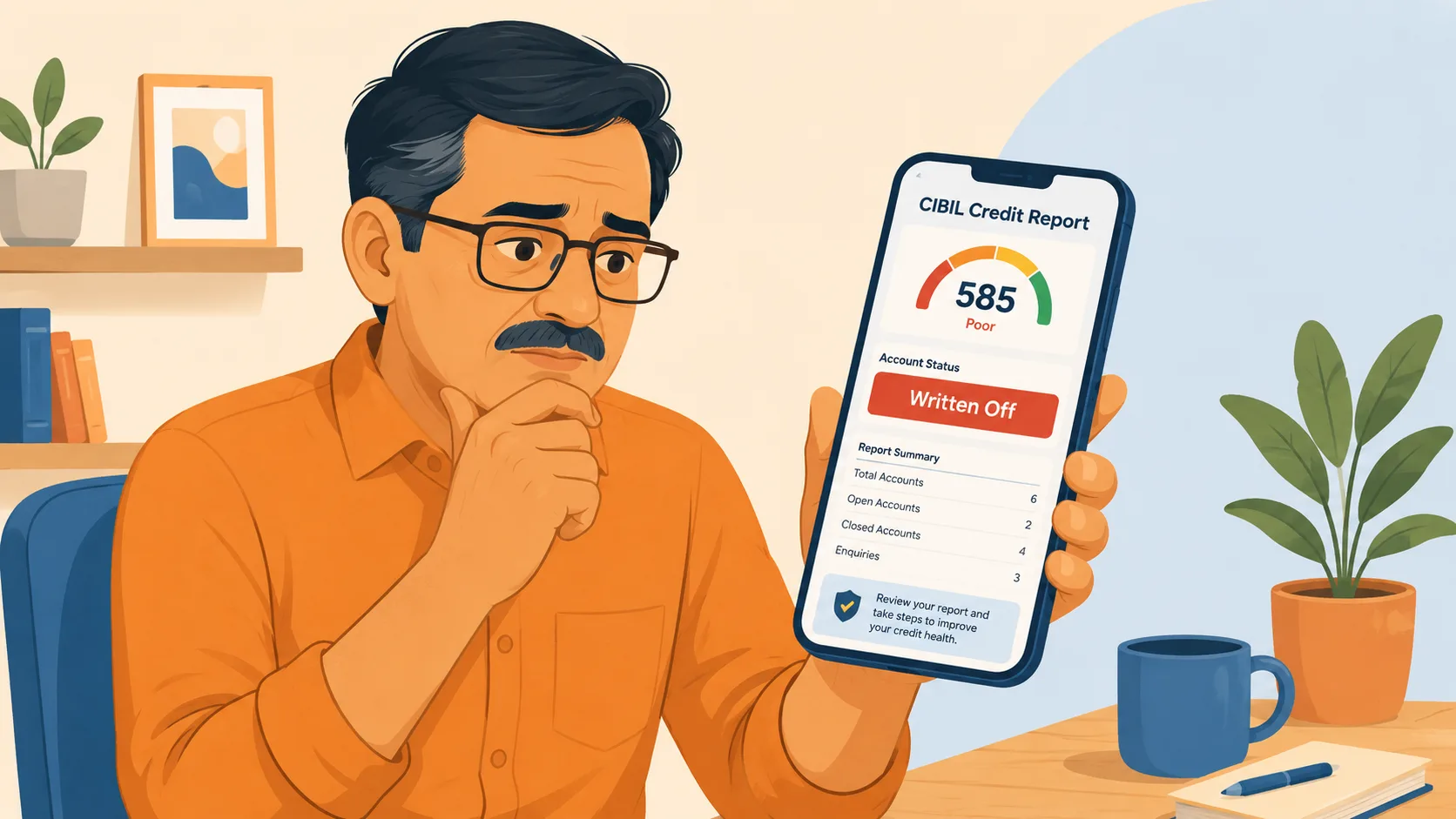
When a loan is settled, the account status on your CIBIL report changes from "Open" to "Settled." That mark stays for up to 7 years. The score itself drops by 75–100 points immediately at the time of settlement. Some lenders may assess future applications more cautiously. Future lenders and banks evaluating a home loan application, a new personal loan, or even a credit card, will see that mark and treat it as a caution signal.
Post-settlement, scores typically recover gradually over time with consistent credit behaviour paying all dues on time, keeping utilisation below 30%, and monitoring the CIBIL report every 3 months. The pace depends on the overall credit profile.
Now the honest comparison: if you continue defaulting without settling, your score stays below 400–500 indefinitely. The outstanding balance keeps growing with penalties. Legal notices follow. Settlement provides a formal resolution to the account.
Both sides deserve to be on the table. Approximately 4% of Indian loan accounts are settled rather than closed normally. Millions of borrowers have navigated the CIBIL impact and rebuilt afterwards.

What the Law Says
Under RBI's Framework for Compromise Settlements (June 2023), once a settlement is completed and the NOC issued, the bank's claim is formally extinguished. The bank cannot continue pursuing recovery on the settled amount. Keep the NOC permanently.
RBI Circular DOR.STR.REC.20/21.04.048/2023-24Are You in a Loan Trap? Quick Check
Move the slider to your total EMIs as a % of monthly salary. See your debt stress level instantly.
EMIs as % of Monthly Salary
What Are the Alternatives to Debt Settlement?
Before the settlement comes up, these options should be explored first. This is standing advice try these before anything else.
- Tenure extension: Ask the bank to add more months to your repayment schedule. The total amount owed stays the same, but the monthly EMI drops. No CIBIL impact if you continue paying.
- EMI reduction / revised repayment plan. Some banks will restructure (change the loan plan) based on your current income if you approach them early and in writing. A lower EMI buys time and stops the default clock.
- Moratorium (temporary payment pause). If your income has been disrupted temporarily due to a medical emergency, a job gap, or a business setback, some banks offer a moratorium (temporary pause). Interest may still accrue, but missed payments are officially paused.
- Debt consolidation. If your CIBIL is 650 or above, merging all loans into one lower EMI (consolidation) may be possible. One bank, one payment, one date. Covered in detail in the section above.
- Balance transfer: Moving credit card dues to a lower-interest product, if eligible.
If none of these options are available, or you have already tried them without success, settlement is worth exploring. It is not the best option; it is the option that remains when the others have genuinely run out.
How FREED Helps With Debt Settlement
FREED works on one side only, yours.
FREED supports borrowers during communication and settlement discussions with lenders. The calls stop coming directly to you. FREED's counsellors put together your hardship documentation, draft and send the settlement request letter on your behalf, handle the back-and-forth across multiple negotiation rounds, and verify the settlement letter before any payment is made to ensure the wording correctly protects your interests.
After settlement, FREED follows up on your CIBIL report to confirm the account has been correctly updated to "Settled."
FREED's model: fees are charged only on successful settlement, with no upfront cost. Across enrolled unsecured loans, the total outstanding can be brought down by up to 50%*. The actual figure depends on your bank or NBFC, how long the default has been running, and the specifics of your case.
What FREED does not do: FREED is not a lender. FREED does not give legal advice. FREED does not guarantee a specific settlement amount; the bank makes the final call. FREED also does not handle secured loans.
The free counsellor call is not a commitment. It is a 20-minute conversation to understand what options actually exist for your specific situation, what you owe, to whom, and what a realistic path forward looks like. That conversation costs nothing.
Tips for Going Through the Debt Settlement Process
Debt Settlement vs. Debt Consolidation vs. Full Repayment Key Differences
Option | What Happens to Your Debt | CIBIL Impact | Who It Works For | Key Condition |
Full Repayment | Paid in full; account marked "Closed" | Positive best outcome | Anyone who can pay in full | Must have funds to repay in full |
Debt Consolidation | Full amount combined into one new loan at a lower rate | Neutral to positive if paid on time | CIBIL 650+; can service a new EMI | Good credit required to qualify |
Tenure Extension / EMI Reduction | Full amount remains; monthly burden reduces | Neutral | Early-stage difficulty; income still coming in | Bank's approval needed |
Debt Settlement (OTS) | Reduced amount paid; rest waived; account marked "Settled" | Negative 75–100 point drop; mark stays up to 7 years | Genuine inability to repay after defaulting | Multiple missed EMIs; NPA classification |
About FREED
FREED is India's trusted Loan Management Platform, founded in 2020 and headquartered in Gurugram. FREED helps people with unsecured loan debt personal loans, credit cards, BNPL, and loan apps by handling the documentation, negotiation, and settlement process with banks and NBFCs. FREED has counselled 75,000+ customers and manages ₹1,000 crore+ in enrolled debt. Fees are charged only on successful settlement. FREED does not handle secured loans.

Mohit Juneja
Mohit Juneja writes educational content at FREED on debt management, credit scores, loan repayment, and borrowing best practices. His content is shaped by expert insights and industry knowledge, helping readers better understand their financial options and make informed decisions.
mohit.juneja@freed.care

FREED is India's trusted loan management platform. Founded in 2020 and headquartered in Gurugram, FREED has counselled 20 lakh+ people on personal loans, credit cards, and app loans. FREED charges fees only on successful settlement, not upfront. FREED does not handle secured loans (home loans, car loans, gold loans).
Media Mentions