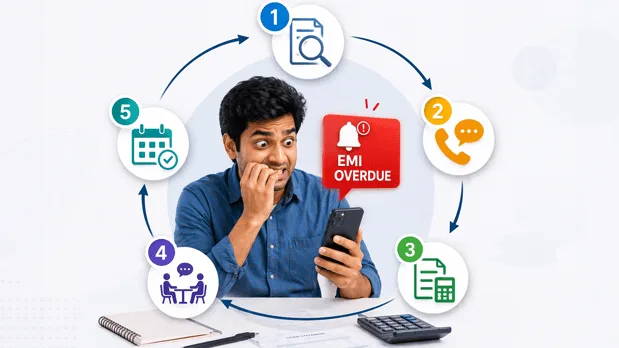
SARFAESI Act: Meaning, Applicability & Effects on Borrowers
SARFAESI Act is a law that lets banks and financial institutions recover dues on secured loans, like home loans or loan against property, by taking possession of the pledged asset without first going to court. It applies only when a loan has a specific asset backing it, not to personal loans or credit cards. Borrowers still get a notice period and the right to object before anything is taken.
Mohit Juneja
Reviewed by FREED India, Debt Resolution Specialists
 4.7/5
4.7/5 ₹3,200Cr+
 20,000+
 20,00,000+4.7/5₹3,200Cr+20,000+20,00,000+
KEY TAKEAWAYS

The SARFAESI Act (full form: Securitisation and Reconstruction of Financial Assets and Enforcement of Security Interest Act, 2002) applies only to secured loans.
Section 13(2) requires the notice to be in writing, and the 60-day period is a jurisdictional prerequisite. There is no discretion
A person aggrieved by measures taken under Section 13(4) may approach the DRT under Section 17 within the period prescribed by the Act, generally 45 days from the relevant measure.
Agricultural land is generally excluded from SARFAESI enforcement under Section 31, though whether a specific property qualifies depends on its actual use at the time the security was created, not just how it appears in revenue records
Personal loans, credit cards, and other unsecured debt are not covered by this Act, SARFAESI applies only where a security interest exists over a physical asset
What Is the SARFAESI Act?
The SARFAESI Act lets banks and financial institutions recover dues on secured loans by taking possession of the pledged asset, without going to court first. Its full form is the Securitisation and Reconstruction of Financial Assets and Enforcement of Security Interest Act, 2002, Act No. 54 of 2002, and it came into force as an Ordinance on 21 June 2002, then as a full Act that December.
Before that, a bank chasing a defaulted ₹40 lakh home loan had one option: file a civil suit and wait. So this law gave banks a faster route, but only for secured assets.
There's one condition, though. The loan account has to reach NPA classification first, loan marked bad by the bank, and that has its own stages before SARFAESI can even be triggered.
Personal loans and credit cards sit outside all of this, whatever the balance owed. That single distinction is worth holding onto, because it shapes almost everything below.

Have Other Debt on Your Mind Too?
Talk to FREED about your full financial picture, beyond this one loan.
Start My Free AssessmentWhy the SARFAESI Act Exists
A bank chasing a defaulted secured loan before 2002 had no fast option. The legislation was introduced against a backdrop of concerns about delays in recovery of secured debts and rising non-performing assets.
And non-performing assets kept piling up through the 1990s. India's banking sector opened up faster than its recovery systems could keep pace with. The legislation emerged during a period when policymakers were seeking faster mechanisms for recovery of stressed bank assets.
SARFAESI is what came out of that. Banks got a way to act on secured assets directly. Balance sheets stopped absorbing years of pending recovery cases, one lawsuit at a time.
Who and What Does the SARFAESI Act Apply To?
Home loans. Loan against property. Secured borrowing backed by eligible security interests may fall within the SARFAESI framework, subject to the Act's conditions and exclusions.
SARFAESI enforcement under Section 13(2) follows the applicable classification of the secured debt as an NPA and satisfaction of the Act's other requirements. For many standard loan accounts, RBI prudential norms use more than 90 days overdue as the NPA threshold.
The SARFAESI Act does not apply to personal loans, credit cards, BNPL, or any other unsecured borrowing. This is what most people searching this term actually want to know, and the answer is no. There's no specific asset behind these loans for a bank to take possession of.
Agricultural land is excluded too, under Section 31, even if it was pledged against the loan. Because this carve-out exists specifically to keep this recovery route away from farmers' land.
The notice-first process stays the same whether it's a bank, an NBFC, or an ARC enforcing the claim. Personal loans and credit cards, though, run on a completely different track. Your rights and options there are covered separately.

How SARFAESI Recovery Works, Step by Step
Once an account moves through the NPA classification stages, recovery follows a fixed sequence.
- Account classified as NPA. After sustained non-payment, 90 days overdue in most cases, the bank formally marks the loan account bad. This is the trigger point for everything below.
- Bank issues a demand notice under Section 13(2). Written notice, 60 days to clear the dues in full.
- Borrower can respond during that window. Raise objections, file a representation. If the bank rejects them, it has to answer in writing, not over the phone.
- If 60 days pass with no resolution, the bank can act under Section 13(4). If the borrower does not discharge the liability within the notice period, the secured creditor may take one or more measures permitted under Section 13(4), including taking possession of the secured asset, taking over management in applicable cases, or exercising other rights provided by the Act.
- The asset is sold or auctioned to recover the dues. Say the outstanding amount is ₹12 lakh and the property sells for ₹18 lakh. If the secured asset is sold for more than the amount legally recoverable, the surplus is dealt with according to the applicable statutory rules after accounting for the secured creditor's recoverable dues and relevant costs.
Every one of these steps carries a protection for the borrower, and that's the part worth knowing in detail.

What the Law Says
Under Section 13(2) of the SARFAESI Act, a bank must give a borrower 60 days' written notice before taking any enforcement action on a secured asset.
Talk to FREED's TeamYour Rights as a Borrower Under SARFAESI
Most write-ups on this law lean hard on fear. Fewer talk about the rights that come with it. But there are real ones, at every stage.
- Written notice, not a phone call. The 60-day notice under Section 13(2) has to spell out the exact dues and the asset involved.
- A chance to object. File a representation during that window. If the bank rejects it, written reasons are owed back to you.
- An appeal, if enforcement goes ahead anyway. The Debt Recovery Tribunal, under Section 17, within 45 days.
- A second appeal, if the first fails. The Debt Recovery Appellate Tribunal, under Section 18, within 30 days. This one has a real cost, though: a 50% pre-deposit of the due amount, reducible to 25% if the tribunal records specific reasons. On ₹10 lakh owed, that's ₹5 lakh just to be heard. Most guides skip that part.
- Fair valuation, before any sale. The sale process is subject to prescribed valuation and sale procedures.
One track covers the secured loan. Unsecured debt runs on a separate one entirely, with its own set of protections.

What SARFAESI Does Not Cover: Unsecured Debt
Zero collateral sits behind personal loans, credit cards, BNPL, and payday loans. So this Act can't touch them, no matter how large the balance has grown.
That doesn't make unsecured debt risk-free, though. What happens instead is a different track: recovery agent contact, written notices, and for larger amounts, a civil suit or a DRT filing on its own timeline. Your rights there are covered elsewhere on this site.
Plenty of Indian households carry both, a home loan and a couple of credit cards or a personal loan. These two tracks run in parallel. They don't intersect legally, and a SARFAESI notice landing on the home loan changes nothing about what's owed on the cards.
This is where FREED works, on the unsecured side. Consolidation for people still paying. Settlement for people who can't repay in full. FREED's programs described here relate to eligible unsecured debt; SARFAESI proceedings concerning secured loans remain between the borrower, secured creditor and applicable legal forums.
What to Do If You've Received a SARFAESI Notice
Six things, in order, the moment that notice lands in your hand.
- Read it and note the exact 60-day deadline. Don't assume more time, or less. Mark the actual date.
- Verify it's genuine. A real notice comes from the bank or NBFC, or its authorised officer, and names a specific loan account.
- Respond in writing if you have objections. If you have objections to the demand, put them in writing within the applicable period rather than relying on verbal communication.
- Get the outstanding amount and valuation in writing. Not a phone call.
- Ask about a revised structure, if full repayment isn't possible. You can ask the lender whether restructuring or another repayment arrangement is available, although approval is at the lender's discretion and may depend on the circumstances.
- Know the DRT route exists, but weigh the cost and time. It isn't automatically the next step.
Knowing what banks can and can't legally do here separates a legitimate notice from an overreach.

How FREED Helps With Your Broader Debt Picture
FREED stays out of secured loans and SARFAESI proceedings. That part sits between you and the bank, or the DRT if it gets that far.
Where FREED steps in is the unsecured side of the same household's debt. Say you're juggling three EMIs totalling ₹28,000 a month across two credit cards and a personal loan. FREED's Debt Consolidation Program can match you to a lending partner for one new loan that clears all three. One EMI, potentially lower than before, with repayment continuing under the new loan's terms. Consistent, on-time repayment may support your credit profile over time.
If repaying in full genuinely isn't an option, FREED's Debt Resolution Program works differently. A structured savings mechanism, built toward a negotiated settlement. Your CIBIL report carries a "Settled" tag for up to 7 years after settlement, and that applies only to the unsecured accounts FREED works on, never to a secured loan under a SARFAESI notice. And that applies only to the unsecured accounts FREED works on, never to a secured loan under a SARFAESI notice.
Left alone long enough, unsecured debt escalates into its own legal consequences too, a separate track from anything a secured-asset notice covers.
One track needs the bank or the DRT. FREED can take the other. You don't have to solve both alone.
One Lower EMI Instead of Several
See if consolidation could simplify your unsecured debt.
Explore Reduce My EMIWhat Helps During the Process
A few habits make the whole stretch easier, wherever you are in it.
- Don't go silent. Even just objecting keeps your position on record.
- Keep every document together. Notice, objection, valuation, physical and digital both.
- Don't assume the first valuation is final. You can push back on it if something looks off.
- Separate secured and unsecured debt in your head, and on paper. Different legal tracks. Mixing them up causes panic decisions.
- Get every term in writing before agreeing to anything, if a settlement or restructuring conversation opens with the bank.
- Recovery agents getting involved on the unsecured side too? Know your rights there as well, it's a separate process from what's covered here.
Sources
Claim | Source |
The SARFAESI Act, 2002 (54 of 2002) governs Section 13/13(4) asset enforcement, and ARCs registered with RBI operate under it | RBI Master Direction Reserve Bank of India (Asset Reconstruction Companies) Directions, 2025: https://www.rbi.org.in/Scripts/BS_ViewMasDirections.aspx?id=12930 (verified live, content confirmed to quote the Act, Section 13, and Section 13(4) directly) |

Mohit Juneja
Mohit Juneja writes educational content at FREED on debt management, credit scores, loan repayment, and borrowing best practices. His content is shaped by expert insights and industry knowledge, helping readers better understand their financial options and make informed decisions.
mohit.juneja@freed.care

FREED is India's trusted loan management platform. Founded in 2020 and headquartered in Gurugram, FREED has counselled 20 lakh+ people on personal loans, credit cards, and app loans. FREED charges fees only on successful settlement, not upfront. FREED does not handle secured loans (home loans, car loans, gold loans).
Media Mentions