Debt Relief and Repayment Solutions in India: What Actually Works for NRIs
For an NRI (Non-Resident Indian) with a loan, credit card, or other debt in India, distance doesn't remove the debt, but it does change how you actually deal with it. This guide covers what's genuinely different about resolving Indian debt from abroad: the power of attorney required, the FEMA rules around moving money, and what remote settlement actually looks like in practice.

Mohit Juneja
Reviewed by FREED India, Debt Resolution Specialists
 4.7/5
 ₹3,200Cr+
 20,000+
 20,00,000+4.7/5₹3,200Cr+20,000+20,00,000+
KEY TAKEAWAYS

The underlying Indian legal framework, DRT, SARFAESI, civil recovery, can apply to debt held by an NRI just as it does to domestic debt. But the exact remedy depends on the type of debt, whether it's secured, the lender, and the applicable statute. What's different for an NRI is mainly the procedural overlay: power of attorney, FEMA compliance, and remote representation.
A properly executed Power of Attorney may be needed when someone in India must represent you, negotiate with the lender or sign documents on your behalf. The execution, notarisation, apostille or consular-attestation requirements depend on the country and the document, so confirm them with the lender and a qualified professional.
The practical steps a lender may take against an NRI can depend on the amount owed, type of debt, available security, applicable jurisdiction and the lender's recovery strategy. Living abroad does not by itself eliminate the lender's remedies in India.
Depending on the lender, product and documentation requirements, some consolidation or settlement processes may be handled remotely through an appropriately authorised representative.
What Makes NRI Debt in India Genuinely Different
The underlying law doesn't change based on residency. Depending on the lender, amount and nature of the claim, recovery may involve proceedings under the applicable debt-recovery framework, SARFAESI where eligible security is involved, or civil remedies.
What genuinely differs is procedural. An NRI generally can't be physically present in India for every step, so resolving anything, disputing an entry, negotiating a settlement, closing an account, requires a properly authorised representative acting on their behalf. The fuller picture of how debt recovery actually proceeds in India is worth reading first if the DRT, SARFAESI, and civil recovery framework itself is unfamiliar. This piece covers the two pillars that actually make remote resolution work: Power of Attorney, who can act for you, and FEMA compliance, how money can legally move.
Understanding this distinction matters even though enforcement looks different from abroad, which is exactly where this piece goes next.

Freed Expert Tip
If you're an NRI with Indian debt, the procedural piece (who can act for you, and how) is usually the actual blocker, not the underlying settlement math itself. Want to Talk Through Your Situation?
Talk to FREEDWhy Distance Doesn't Make the Debt Go Away
Credit bureau reporting continues regardless of where you live. A defaulted or written-off account in India affects your CIBIL history the same way it would for anyone else, and can matter if you ever need Indian credit again, a property purchase, a family member's loan requiring your guarantee, or a future move back.
If a lender or recovery agent cannot reach you, they may attempt to contact people or contact details available to them, but recovery conduct remains subject to applicable RBI requirements, including restrictions on harassment, intimidation and inappropriate disclosure of the borrower's debt. This is a real, common practice, and a genuine source of distress for people who assumed distance would insulate their family too. Understanding your rights, and your family's, around this kind of contact is worth reading if this is already happening.
Unresolved debt can create practical complications in future dealings with the lender or in transactions involving the affected account or secured property. The consequences depend on the nature and status of the debt. None of this is meant to alarm, the point is that proactive resolution is genuinely simpler than reactive resolution, not that catastrophe is imminent.
The Power of Attorney: How NRIs Actually Resolve Debt From Abroad
A Power of Attorney, POA, is a legal document authorising a trusted person, often a lawyer, family member, or specialised representative, to act on your behalf in India, negotiate with a lender, receive settlement communication, and sign closure documents.
Depending on where you live and how the POA will be used in India, it may need local notarisation followed by apostille or Indian consular attestation. Confirm the required format with the receiving lender or an Indian legal professional before executing it. Requirements vary by country, worth confirming the current process for your specific location before assuming.
The POA should be specific rather than general where possible, naming exactly what the representative is authorised to do, negotiate, accept a settlement, receive a No Dues Certificate. A vague or overly broad POA is a common reason banks push back on recognising it. Once accepted by the lender, the representative may be able to handle many of the required steps without you travelling to India, although some lender-specific verification or documentation may still require your involvement. This sits alongside the broader landscape of debt relief options available in India, the mechanism for acting remotely, not a separate category of relief. Money moving as part of any settlement also has its own set of rules, worth understanding next.

FEMA and NRO Account Considerations for Settlement Payments
NRIs typically operate Indian bank accounts as NRO, Non-Resident Ordinary, accounts, which is where Indian-sourced funds and repayments would generally flow. FEMA governs foreign-exchange transactions involving NRI accounts. For NRO accounts, RBI permits eligible NRIs/PIOs to repatriate balances abroad up to USD 1 million per financial year, subject to applicable conditions. If you are bringing funds into India from abroad to repay or settle debt, confirm the appropriate banking and FEMA process with your authorised dealer.
If the settlement is being paid from funds already held in an Indian account, the foreign-exchange issue may be more limited, but the account-operation and lender requirements should still be confirmed. The consideration matters more if funds need to be brought in from abroad specifically to fund a settlement, worth confirming the current process with a bank or advisor rather than assuming it's straightforward.
This is a genuinely specialised area. This piece flags it so it's on your radar, not as a substitute for confirming your specific situation with a qualified professional.
What Indian Banks Can and Cannot Realistically Do From Abroad
Legally, Indian courts have jurisdiction over debts arising in India regardless of where the borrower now lives. DRT, SARFAESI, and civil recovery remain theoretically available to a lender against an NRI.
Practically, for an ordinary unsecured personal loan or credit card balance, pursuing formal cross-border litigation is expensive and slow relative to the amount typically owed, which is why lenders rarely take this route for standard retail debt. If a matter genuinely does escalate, understanding how the Debt Recovery Tribunal actually works is worth knowing regardless of where you're based, since the forum itself doesn't change for an NRI defendant.
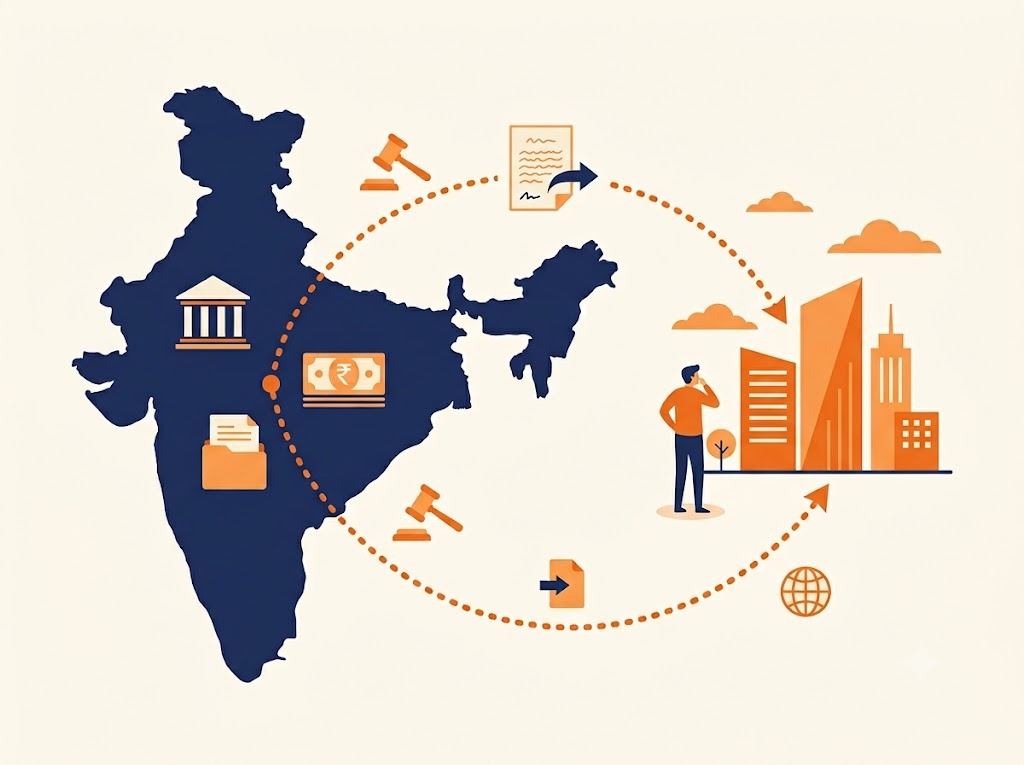
The responsible takeaway: since the debt doesn't disappear either way, and inaction has its own real costs, credit history, family stress, future complications, proactive remote settlement is genuinely the more sensible path than waiting to see what happens.

What the Law Says
Indian courts retain jurisdiction over debts arising in India regardless of the borrower's current residence, DRT, SARFAESI, and civil recovery remain legally available tools against an NRI debtor, the practical difference from abroad is procedural, not a difference in legal exposure. Want to Understand Your Real Position?
Talk to FREEDSigns It's Time to Address This Now, Not Later
A family member or relative in India has been contacted about your debt.
You're planning any future transaction in India, property, a joint loan, a guarantee for a family member, that your own credit history could affect. Joint liability works the same way for NRIs as it does for co-applicants living in India, worth reading if a joint loan is part of your situation.
You're aware of a growing overdue balance and have been deferring dealing with it specifically because you're abroad.
You're planning any future transaction in India, property, a joint loan, a guarantee for a family member, that your own credit history could affect.
You genuinely don't know the current status of an old Indian debt and have been avoiding finding out.
What Are Your Options as an NRI
For debt still current but stretched, consolidation, combining multiple unsecured Indian debts into one new loan, can typically be arranged with proper documentation, though eligibility and process specifics for NRIs are worth confirming directly. A negotiated settlement, where accepted by the lender, can potentially be handled remotely through an authorised representative, with the borrower obtaining the applicable settlement and account-closure documentation from the lender.
Either way, the Power of Attorney and, where relevant, FEMA considerations covered above Sapply. The underlying debt-management options may be similar, but an NRI can face additional documentation, KYC, FEMA and representative-authorisation requirements.
How FREED Helps NRIs Resolve Indian Debt Remotely
FREED's programs are designed to address eligible unsecured Indian debt. For NRIs, the availability of remote processing, required documentation and representative arrangements should be confirmed case by case.

Worth being plain that specific documentation requirements, POA validity, KYC verification for someone abroad, should be confirmed directly for each individual case. The different types of consolidation loans and where each genuinely fits is worth a read too, since eligibility can vary by loan type even before the NRI-specific documentation layer is added.

Managing Indian Debt From Abroad?
A free assessment shows your real options.
Start My Free AssessmentTips for NRIs Managing Indian Debt
Sources
Claim | Source |
Indian courts retain jurisdiction over debts arising in India regardless of the borrower's residence; DRT, SARFAESI, and civil recovery remain available tools | Recovery of Debts and Bankruptcy Act (RDDBFI Act), 1993; SARFAESI Act, 2002 |
NRO account repatriation is capped at USD 1 million per financial year for documented purposes | FEMA (Foreign Exchange Management Act), 1999, and associated RBI regulations on NRO account repatriation |

Mohit Juneja
Mohit Juneja writes educational content at FREED on debt management, credit scores, loan repayment, and borrowing best practices. His content is shaped by expert insights and industry knowledge, helping readers better understand their financial options and make informed decisions.
mohit.juneja@freed.care

FREED is India's trusted loan management platform. Founded in 2020 and headquartered in Gurugram, FREED has counselled 20 lakh+ people on personal loans, credit cards, and app loans. FREED charges fees only on successful settlement, not upfront. FREED does not handle secured loans (home loans, car loans, gold loans).
Media Mentions