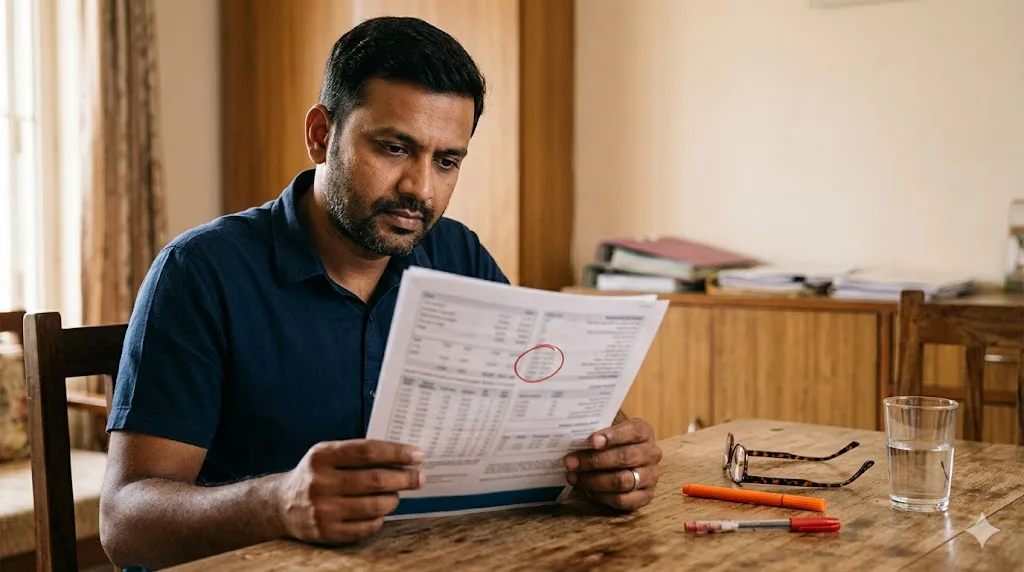
Negative Accounts on Your CIBIL Report: What They Mean
Negative accounts on a credit report are loans or cards that show a payment problem: late or missed payments, a settled status, a written-off status, or an account the lender has taken legal action on. Lenders read them as signs of risk. Some are accurate and stay as reported. Some are errors you can dispute.
Mohit Juneja
Reviewed by FREED India, Debt Resolution Specialists
 4.7/5
 ₹3,200Cr+
 20,000+
 20,00,000+4.7/5₹3,200Cr+20,000+20,00,000+
Key Summary

A negative account is one where the report shows a payment problem, such as late payments or a settled or written-off status.
CIBIL's Accounts section shows the lender, the type of credit, the balance and repayment history for up to 36 months, with Days Past Due as a marker.
CIBIL says a payment reported as Settled or Written off will affect your access to credit in the future.
CIBIL says overdue payments stay on the report for years, but the impact fades as newer positive actions are added.
A negative account that's accurate can't be removed on request. One that's wrong can be disputed online.
You're entitled to one Free Full Credit Report, including your score, once during January to December from each credit information company.
What Are Negative Accounts on a Credit Report?
They're the entries a lender worries about. A credit report lists each of your loans and cards, and every account carries a record of how you've paid. When that record shows trouble, the account turns negative in the way a lender reads it.
Negative information can appear in different parts of a credit account's record. Common examples include late-payment history, Settled or Written-off status, and suit-filed or wilful-default information where applicable. An account you do not recognise should also be investigated, as it may indicate a reporting error or identity misuse. The last one is a negative account on your credit report because someone else's behaviour, or a data error, has landed on your name.
The rest of this guide goes through each type, what it tells a lender and what you can do. If you only want to know whether you can remove one, the short answer is in the Key Summary: not if it's accurate, yes if it's wrong.
Where Do You See Negative Accounts on a CIBIL Report?
Negative account information is generally visible in the Accounts section of your CIBIL report. This section provides details such as the lender's name, credit type, account status, current balance and repayment history. CIBIL's report guide states that repayment history is displayed for up to the previous 36 months. Days Past Due (DPD) is one of the indicators used to show whether payments were made on time.
The Enquiries section is separate. It records each time a lender checked your report during a loan or card application, over the last 36 months. Enquiries aren't accounts, so they're not negative accounts on a credit report, but several in a short time may affect the score, per CIBIL.
To get your report, RBI's directions entitle you to one Free Full Credit Report, including your score, once during January to December from each credit information company. For reading it line by line, see our guide on how to read a CIBIL report.

Found a Negative Account You Don't Recognise?
See which options fit your situation on FREED.
See My Options on FREEDWhat Do Late Payments and DPD Mean on an Account?
DPD stands for Days Past Due. It indicates how many days a payment remains overdue beyond its due date. Lenders use this information to assess repayment behaviour. The DPD value shown in your report should be checked against your payment records, particularly if you believe a payment has been incorrectly reported as late.
A late or missed payment can appear in the account's repayment history and may affect your credit score. Lenders may view repeated delays as a sign of repayment difficulty. Any interest or late-payment charges depend on the applicable loan or credit card terms. For the idea in more depth, read our guide on what DPD means in CIBIL and how the late payment impact plays out.
A late payment is generally recorded against the account on which the payment was missed. It does not automatically mean that every other loan or credit card account will show a late payment. However, the missed payment may affect your overall credit score and how lenders assess your repayment history.
What Does a Settled Account Mean?
Settled means the lender accepted less than the full amount to close the account. It's not the same as paid in full. A lender reading your report sees that the account was closed for a smaller sum than the one you owed.
CIBIL's card-payment guide says that a payment reported as Settled or Written off will affect your access to credit in the future. We don't give a fixed number of years for how long it stays, because the CIBIL pages we read don't state one. Our guide on how lenders view settled accounts goes through what changes at the application desk.
If you believe a Settled status is incorrect, check the lender's name, settlement amount and date against your payment records and settlement documents. If you repaid the full amount but the account is still reported as Settled, contact the lender and raise a dispute with the credit bureau, providing supporting proof.
What Does Written Off Mean on a Credit Report?
Written off means the lender has treated the balance as a loss in its books. It doesn't mean you no longer owe the money. The debt can still be pursued, and the report keeps the status.
A Written-off status is a serious negative indicator because it shows that the lender classified the outstanding amount as a loss. It may affect how future lenders assess the borrower's creditworthiness. CIBIL's guide groups it with Settled when it says the status will affect your access to credit in the future.
If a written-off status is on your report and you've since paid, ask the lender how it will update the account, and in writing. Don't assume paying changes the status by itself. Our guides on what written off means and how to clear written-off status cover the process.
What Do Suit Filed and Wilful Default Mean?
Suit-filed and wilful-default information can have serious implications for a borrower's credit profile. A suit-filed entry indicates that legal proceedings have been initiated by the lender in connection with the outstanding dues. Wilful default is a specific classification that involves more than simply failing to make a payment. It must be assessed under the applicable regulatory criteria.
We haven't found a CIBIL page we can quote that gives exact definitions, so we don't invent them. What we can say is that they're serious flags, and a lender reading them will treat the account as a major risk. Our guide on suit filed, wilful default and written off in CIBIL covers the terms in more depth.
If you see either on an account you don't recognise, move fast. It's the type of entry where a dispute with proof matters most.
See Your Report in One Place
Check your credit report with FREED Credit Insights.
Check My Credit InsightsCan a Closed Account Still Be a Negative Account?
Yes. A closed account stays on the report, and its history stays with it. CIBIL's walk-through says the Accounts section lists each loan and card whether active or closed, with repayment history for up to the past 36 months.
That means an account you closed years ago can still show a late month from when it was open. Closing an account doesn't clean it. What changes is that no new late payments can be added, because nothing's due.
If the account was closed with a Settled or Written-off status, that status is part of the closed account's record, and CIBIL says it will affect your access to credit in the future.
What If the Negative Account Isn't Yours?
Treat it as urgent. It could be a mix-up of names or details, or someone using your identity. Either way, the entry sits on your report and a lender will read it as yours.
Raise a dispute with CIBIL for the unfamiliar account and contact the lender named in the report. Ask the lender to investigate the account and provide written confirmation of its findings. CIBIL states that dispute resolution may take approximately 30 days, depending on the credit institution's response. Keep copies of all communications and supporting documents. Keep copies of every message.
For the full process, read our guide on disputing and fixing wrong entries.
What If the Negative Account Looks Out of Date?
Check the dates first. A late marker from a month long ago may be accurate and simply old. CIBIL's walk-through says repayment history is shown for up to 36 months, and its mistakes guide says overdue payments stay on the report for years, but the impact fades as newer positive actions are added.
So an old negative isn't automatically an error. It's an old fact. The question to ask is whether the status shown today matches reality. If you paid an overdue account and it still shows overdue, that's a stale status, and it's worth raising with the lender.
How Do Lenders Read Negative Accounts?
As a pattern, not a single line. CIBIL's pages describe the signals: late payments and EMI defaults have a negative impact, minimum payments indicate difficulties in repaying dues, and a Settled or Written-off status affects access to credit in the future.
No page we read gives a formula, and lenders set their own rules. Axis Bank's personal loan FAQ, for example, says credit history issues can lead to rejection, along with high existing EMIs and incomplete documents. So a negative account may cost you an approval, a better rate or neither, depending on the lender and the rest of your profile.
The practical point is to look at your report the way a lender would: for the most recent months first, then the heavier statuses.
Can You Remove a Negative Account From Your Credit Report?
It depends on whether it's accurate. If it's wrong, dispute it and the lender has to confirm or correct it. If it's right, it can't be removed on request.
What you can do with an accurate negative account is change what comes next. Pay what's overdue. Keep every later payment on time. Keep card balances low. CIBIL says the impact of overdue payments fades as newer positive actions are added. For the longer plan, see our guide on how to build a credit score.
Your Rights if Something on Your Report Is Wrong
- You're entitled to one Free Full Credit Report, including your score, once during January to December from each credit information company.
- If a complaint about your credit information isn't resolved within 30 days, the company pays ₹100 a day. The lender has 21 days to send corrected details.
- Disputes about how a score is calculated are excluded.
Sources: RBI/DOR/2025-26/378 and cibil.com/freecibilscore
Is a Negative Account the Same as a Low Score?
No, and mixing them up causes a lot of worry. The score is one number from the bureau's model. A negative account is one line in the report. You can have a negative account and a score you're happy with, or a low score without a single negative account, for instance because of high card balances.
Lenders see both. Many look at the account detail, not just the number. That's why the score is a starting point and the report is the full story.
We don't give score bands, because lenders set their own. If you want to check what your own number means for a loan, read our guide on the CIBIL score for a personal loan.
How Do You Check Each Negative Account on Your Own Report?
Go account by account, with your own records beside you. For each one, write down the lender, the type of credit, the status, the last payment month and whether it's open or closed. Then ask five questions.
- Is it mine? Do you recognise the lender and the loan or card?
- Is the status right? Does a Settled or Written-off label match what happened?
- Are the dates right? When was it opened, and when was the last payment?
- Does the repayment history match your bank statements? CIBIL's walk-through says the report shows up to 36 months.
- Is the balance right? Does the balance shown match your latest statement?
Any "no" is a lead. Use your bank statements, closure letters and payment receipts as proof. Keep them in one folder so a dispute is one email, not a week of searching.

FREED Expert Tip
Make a one-page list of every account with its status, last payment month and whether it's open or closed. Compare it to your report once a year. A mismatch is the fastest way to spot a negative account that isn't yours.
Check My Credit InsightsWhat Should You Fix First Among Negative Accounts on a Credit Report?
Fix what's wrong, then what's current, then what's old.
- Wrong entries first. An account that isn't yours or a status that's incorrect is the quickest improvement, because the lender has to confirm or correct it.
- Overdue accounts next. If something is overdue today, bring it current. Nothing else matters as much, going by CIBIL's wording.
- Settled and written-off accounts after. These need a plan with the lender, and CIBIL says they affect access to credit in the future.
- Old, accurate late months last. They fade as newer positive history builds, per CIBIL's mistakes guide.
This order is our reading of CIBIL's wording, not an official rule. For habits that rebuild history, see our guide on how to improve your credit score fast.
What Mistakes Do People Make With Negative Accounts?
- Assuming every negative account is an error. Many are accurate, and a dispute without a basis wastes weeks.
- Paying a company to "delete" correct entries. No one can remove an accurate entry on request.
- Ignoring a small overdue amount. A small unpaid amount can still show as overdue.
- Closing the account and thinking it's gone. Closed accounts stay on the report with their history.
- Applying for new credit while the report is messy. CIBIL says too many enquiries may have a negative impact.
- Co-signing without checking. CIBIL's mistakes guide says co-signing can hurt your own score if the other person defaults.
- Not checking the report at all. You can't fix what you haven't read.
Not Sure Where to Start With Your Report?
See which options fit your situation on FREED.
See My Options on FREEDHow Does FREED Help You Understand Negative Accounts on Your Credit Report?
FREED Credit Insights helps you review your credit report and score and identify factors that may be affecting your credit profile. The score displayed may differ from your CIBIL score because different credit bureaus may hold different information and use different scoring models.
Over 30,000 borrowers have used Credit Insights, and over 20 lakh people trust FREED. FREED isn't a loan provider. Credit Insights explains your report. It doesn't remove accounts that are accurate. If something's wrong, you still dispute it with the bureau and the lender.
Use it next to your CIBIL report. If both show an account the same way, you can relax. If they differ, check the dates first. You can start on the Credit Insights page.
What If Your Negative Accounts Come From Debts You Can't Repay?
Then a dispute won't fix it, because the entries are true. Match the fix to your situation.
- Still paying, but stretched. If most of your salary goes towards paying multiple EMIs, FREED's Loan Consolidation Plan helps you combine multiple loans into a single monthly EMI. This can reduce your monthly EMI burden by up to 50%.* It's only for people who are still paying. Read more about the Loan Consolidation Plan.
- Cannot repay. Settlement is not something a borrower chooses out of preference. If you genuinely cannot repay your loans, FREED negotiates with your lenders to settle them for less than 50%* of your outstanding dues. Read more about the settlement programme.
Rates and ranges shown are indicative. Final terms decided by the bank/lender. FREED is not a Loan Provider. No outcome is guaranteed. Please verify directly with your bank.
All loan consolidation and settlement options are subject to eligibility, lender approval and applicable terms. Outcomes vary depending on the lender and borrower profile. No reduction, settlement percentage or repayment outcome is guaranteed. FREED is not a loan provider.
Settlement leaves a settled status on your report, which CIBIL says will affect your access to credit in the future. Weigh that before you choose it.

Mohit Juneja
Mohit Juneja is FREED’s Content & Communication Lead with 12+ years of experience across content, media, advertising and digital communications. He holds a postgraduate diploma in Communications from Xavier Institute of Communications, Mumbai, and has worked with organisations including NDTV, The Indian Express, McCann Worldgroup and NABARD.
At FREED, he leads content and communication across loan management, debt resolution, debt consolidation and financial well-being. His work combines research, storytelling and consumer-focused communication to make complex financial topics easier to understand and act on. He has also scripted and produced 11 documentaries on rural development and agriculture for NABARD, with film's selected for the Mumbai International Film Festival.
mohit.juneja@freed.care

FREED is India's trusted loan management platform. We help India settle their loans, consolidate their EMIs, improve their credit score, and manage their loans better. Over 20 lakh people trust FREED. We have managed more than ₹3,500 crore in loans and saved our users over ₹450 crore.
Media Mentions