How to Clear Written Off in CIBIL and Finally Move On
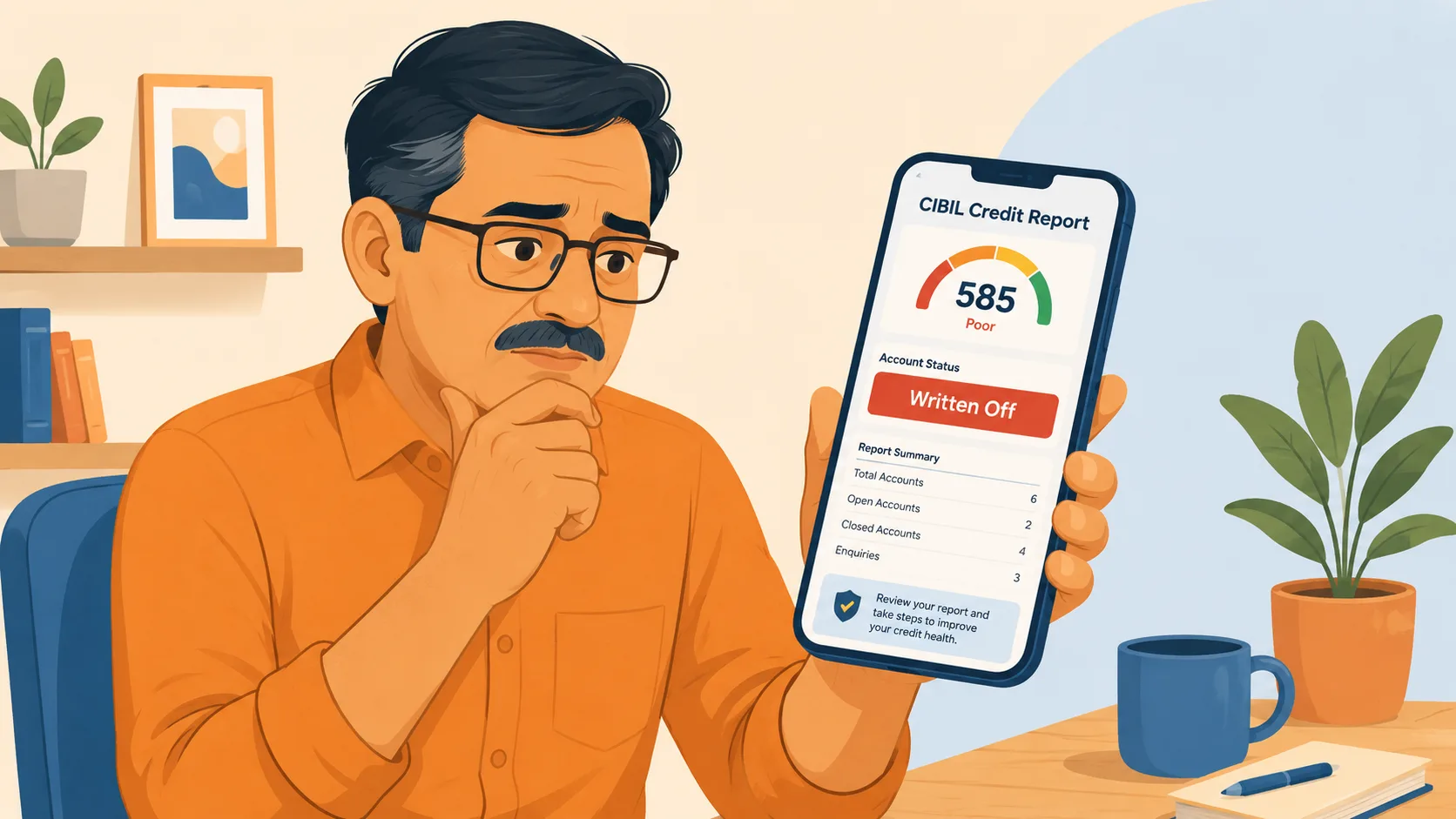
Clearing written off in CIBIL means getting a loan or credit card account that your bank marked as unpaid officially resolved on your credit report. This happens when you settle or repay the outstanding amount, collect a clearance letter (called NOC) from the bank, and ask them to update your CIBIL record. The status on your report will change, but it won't disappear overnight.
Mohit Juneja
Reviewed by FREED India, Debt Resolution Specialists
 4.7/5
4.7/5 ₹3,200Cr+
 20,000+
 20,00,000+4.7/5₹3,200Cr+20,000+20,00,000+
Key Takeaways

Knowing how to clear written off in CIBIL starts with understanding: the bank marked your account as a loss, but you still legally owe the money.
A written-off mark can drop your CIBIL score by 50–100 points and stays on your report for up to 7 years.
The only way to remove it is to repay or settle the outstanding dues, then get the bank to update CIBIL usually within 30–45 days.
After settlement, your report shows "Settled" (not "Closed") which is still negative, but far better than "Written Off."
If you cannot pay the full amount, a one-time settlement (OTS paying it once and the matter ends) is possible. Banks are often more flexible at this stage because any recovery is a gain for them.
What Does "Written Off" Mean in a CIBIL Report?
When a bank marks a loan as "Written Off" on your CIBIL report, it is doing two things at once and most people only understand one of them.
The first thing: the bank has removed that loan from its active accounts. It has accepted, internally, that it may not get the money back. This is an accounting move. It keeps the bank's books clean.
The second thing the part people miss: the debt still exists. You still legally owe every rupee. The bank can still send recovery agents. It can still take legal action. Write-off is not forgiveness.
Your CIBIL report shows this under the account status. It can appear as "Written Off (Total)" when the full outstanding amount is unpaid, or "Written Off (Principal)" when only the principal portion is being written off. Either way, the mark is severe.
Banks typically report an account as written off after 180 days (6 months) of missed EMIs. Before that, the loan is tagged as an NPA (loan marked as bad by the bank, usually after 90 days of missed EMI). The write-off comes later, when recovery still hasn't happened.
The score impact is direct: a written-off status can drop your CIBIL score by 50–100 points, depending on your credit history before the default. The mark stays on your report for up to 7 years.
Why Do Banks Mark a Loan as "Written Off"?
It helps to understand this from the bank's side.
Imagine a bank has been waiting on ₹2 lakh from you for 8 months. The EMIs have stopped. Recovery calls have gone unanswered. Legally, the bank can't sit on that amount in its active columns forever. So it moves the loan out of active books. Internally, it accepts the loss at least on paper.
That is what write-off means. It is a balance sheet clean-up. It is not a punishment, and it is not forgiveness.
The reasons people end up here are real: job loss, a medical emergency, a business that collapsed, income that dropped suddenly. These are not signs of carelessness. A write-off happens when someone's financial situation genuinely stopped working and kept not working long enough for the bank to stop waiting.
One thing worth knowing: even after the write-off, the bank keeps its own internal records. Those records are separate from your CIBIL report. Even after the 7-year CIBIL window closes, the bank may retain its history of the account. Recovery can technically continue beyond the CIBIL window.
If your EMIs have already started slipping one or two missed in recent months this is the time to act, before the write-off stage.
How Does Written Off Affect Your CIBIL Score and Loan Applications?
A written-off status hits your credit profile in three concrete ways.
- Your score drops. The average drop is 50–100 points, depending on your prior credit behaviour. If you had a score of 700 before the write-off, you could fall to 600–650. That range can make approvals more difficult with many lenders..
- Most new loan applications will be rejected. Banks especially private banks (HDFC, ICICI, Kotak, Axis) and most NBFCs (non-bank loan companies) run an automated check before a human even sees your file. A "Written Off" on your report is a flag that stops most applications at that first screen.
- If you are approved anywhere, expect a higher interest rate. Some secured credit options are gold loan or an FD-backed credit card remain accessible in the first 2–3 years after a write-off. But you'll pay more for them. Lenders may view a written-off status as a sign of higher repayment risk..
- There is a meaningful difference between "Written Off" and "Settled." "Written Off" tells a future bank: this borrower stopped paying and nothing was ever resolved. "Settled" tells a future bank: this borrower couldn't pay the full amount, but they negotiated and paid something. Not ideal but it shows effort.
Both statuses remain on your CIBIL report for up to 7 years, as required under India's Credit Information Companies (Regulation) Act. But a "Settled" status allows your score to recover faster than an unresolved "Written Off."

Find Out If Your Written-Off Loan Can Be Settled
Free assessment. No commitment. Real numbers not guesses.
Get Freed AssessmentWritten Off vs Settled in CIBIL What Is the Difference?
Status | What It Means | Who Triggered It | Score Impact | Can It Change? |
Written Off | Bank removed loan from books; debt still exists | Bank (after 180+ days of no payment) | Severe (50–100 point drop) | Yes repay or settle, then request update |
Settled | Partial payment made; bank accepted less than full dues | Mutual borrower and bank agreed | Negative (75–100 point drop) | Only by paying remaining balance in full |
Closed | Full dues paid; account properly closed | Borrower | No negative impact | Already resolved |
All negative statuses remain on your CIBIL report for up to 7 years. FREED charges fees only when settlement is successfully completed.
How to Clear Written Off in CIBIL Step by Step
This is the section that actually answers the question you came here with. Six steps, plain language, no shortcuts left out.
CIBIL cannot change your status on its own. It gets its information from the bank. So the process always starts with the bank and ends with CIBIL verifying what the bank reports. After the bank updates the status, CIBIL reflects it within 30–45 days.
- 1
Get Your CIBIL Report First
Download your full CIBIL report from cibil.com. You get one free report per year. Find the account marked "Written Off." Note the bank name, account number, and the outstanding amount shown. This is your starting point.
- 2
Contact the Bank Directly
Reach out to the bank not a recovery agent and ask for the exact amount you owe. That means the principal, interest added, and any late charges. Ask whether the bank has an OTS (one-time settlement paying it once and the matter ends) offer available. Most banks are open to this at the written-off stage.
- 3
Negotiate and Agree on an Amount
If you cannot pay the full amount, explain your situation honestly and ask for a reduced settlement. Once you and the bank agree, get the settlement terms in writing before making any payment. Never pay without a written confirmation.
- 4
Make the Payment and Collect Your NOC
Pay the agreed amount. After payment, ask the bank for a No Dues Certificate or NOC (clearance letter) this is your legal proof that the account is settled or closed. Store both a physical copy and a digital one.
- 5
Ask the Bank to Update CIBIL
Request the bank in writing to update the account status with CIBIL. They should do this within 30–45 days. If they don't, you can raise a dispute directly on cibil.com under the Dispute Centre section.
- 6
Verify the Change on Your Report
Check your CIBIL report again after 45 days. The status should now show "Settled" or "Closed" instead of "Written Off." If it still shows "Written Off," file a dispute with CIBIL and attach your NOC as proof. If you want help with the back-and-forth with the bank, FREED's counsellors can handle the process for you.

What the Law Says
Under India's Credit Information Companies (Regulation) Act, negative entries including "Written Off" and "Settled" must be retained on your credit report for a minimum of 7 years.
Talk to a FREED ExpertWhat If the Written-Off Status Is Wrong on Your CIBIL Report?
Not every "Written Off" entry is accurate. Banks make reporting errors. An account that was properly closed sometimes stays marked as written off. A loan that was paid in full might still show an old balance. DPD (Days Past Due the number of days an EMI has been overdue) figures can be wrong. These are real, documented issues and you have a right to dispute them.
Common errors people find: a closed account showing as written off, incorrect personal details, wrong DPD figures, or an outstanding balance that was never updated after payment.
The dispute process works like this:
Log in at cibil.com → go to Credit Reports → open Dispute Centre → click Dispute an Item → fill in the account details → attach your supporting documents. The right documents here are your NOC, payment receipts, and any written communication from the bank.
CIBIL cannot change the entry unilaterally. It contacts the bank, the bank verifies, and if the bank confirms the error, CIBIL updates the record. This typically takes 30 days from the date you file the dispute.
If the bank does not respond within the dispute window, CIBIL may mark the dispute as unresolved or under review depending on the case. Keep records of every step you take
How to Rebuild Your CIBIL Score After Clearing the Written-Off Status
Let's be honest about what happens after you clear the written-off entry.
The negative mark now showing "Settled" or "Closed" does not disappear from your CIBIL report. It stays for up to 7 years. What changes is the direction your score starts moving. And the pace of that movement depends almost entirely on what you do next.
Here is what actually helps:
- Pay every current EMI on time. This is the single most effective action. CIBIL updates monthly as banks report. Each on-time payment adds a positive data point that slowly offsets the negative history.
- Start with secured credit products. For the first 2–3 years after a write-off or settlement, most unsecured credit (personal loans, credit cards) is out of reach. The realistic starting points are a gold loan or an FD-backed credit card (a card secured against a fixed deposit). These are accessible even with a low score and help rebuild your repayment history.
- Keep your credit utilisation low. If you do get a credit card, use no more than 30% of the limit. High utilisation signals stress to the bureau.
- Check your CIBIL report every 3–6 months. Errors happen. Catch them early.
The honest timeline: with consistent repayment behaviour over time, your score may gradually begin improving. Recovery timelines vary from person to person depending on repayment behaviour, current obligations, and lender reporting. That is not a reason to feel hopeless. It is a reason to start now.
When Repaying the Full Amount Is Not Possible Debt Settlement as a Last Resort
Settlement is not something a borrower chooses out of preference. Banks and financial companies only consider it when you are in a genuine financial difficulty and are truly unable to repay the full amount. It is a last resort, not a shortcut.
That said if you are at the written-off stage and full repayment is genuinely not possible, settlement is the structured option available to you.
Here is what you need to know about it.
After a write-off, banks have already accepted the loss on paper. Any money they recover from you is above what they expected. That changes the negotiation. They are often more willing to accept a reduced lump-sum OTS (one-time settlement paying it once and the matter ends) at this stage than they were before the write-off.
The settlement process works like this: you and the bank agree on a reduced amount. You pay it in one go. The bank settles the account and updates the status with CIBIL. Your status changes from "Written Off" to "Settled."
The CIBIL impact is real and worth understanding before you proceed. "Settled" is still a negative mark. It stays on your report for up to 7 years. Future banks will see it. But a settled account looks far better than an unresolved written-off one. It shows you took responsibility and found a way to close the matter.
FREED works with banks to bring down your total outstanding debt by up to 50%* fees are charged only when settlement is successfully completed. FREED's counsellors handle the back-and-forth with the bank, help put your documents together, and get the settlement letter worded correctly so the updated status can reflect correctly on your credit report.. The first assessment is free.
About FREED
FREED is India's trusted loan management platform, founded in 2020 and based in Gurugram. FREED negotiates settlements on unsecured loans, credit cards, personal loans, BNPL products, and loan apps on behalf of enrolled customers. Fees are charged only when a settlement is successfully completed. FREED does not handle secured loans such as home loans, car loans, or gold loans.

Mohit Juneja
Mohit Juneja writes educational content at FREED on debt management, credit scores, loan repayment, and borrowing best practices. His content is shaped by expert insights and industry knowledge, helping readers better understand their financial options and make informed decisions.
mohit.juneja@freed.care

FREED is India's trusted loan management platform. Founded in 2020 and headquartered in Gurugram, FREED has counselled 20 lakh+ people on personal loans, credit cards, and app loans. FREED charges fees only on successful settlement, not upfront. FREED does not handle secured loans (home loans, car loans, gold loans).
Media Mentions