CIBIL Defaulter List 2026: Does It Really Exist? How to Check & Remove Your Name
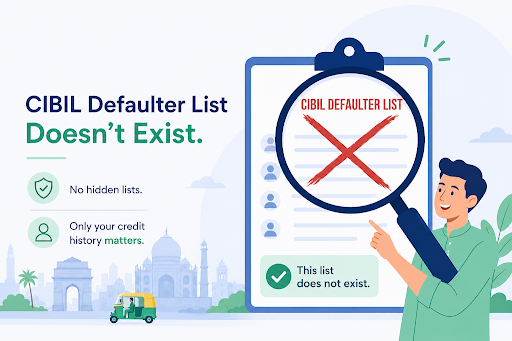
No. CIBIL does not keep a public defaulter list. Neither does Experian, Equifax or CRIF High Mark either. What you do have is your CIBIL report and any missed EMI, settlement or write-off remains on it for 7 years. Every bank or financial company will look at this before they give you your next loan. That’s what a “CIBIL defaulter” actually means, people say.

Mohit Juneja
Reviewed by FREED India, Debt Resolution Specialists
 4.7/5
4.7/5 ₹3,200Cr+
 20,000+
 20,00,000+4.7/5₹3,200Cr+20,000+20,00,000+
Key Takeaways

CIBIL keeps no public defaulter list. The "list" myth scares lakhs of Indians every month.
The RBI does maintain a Wilful Defaulter List, but only for amounts above ₹25 lakh, mostly for businesses, not regular borrowers.
Your missed payments show up on your CIBIL report for 7 years from the default date.
A "Settled" or "Written-off" tag is worse than people realise. It warns every future bank or financial company.
Settlement done properly through FREED can close the account and start the 7-year recovery clock cleanly.
What is the CIBIL Defaulter List? (The Honest Truth)
Let's clear this up straight away. There is no public list. Anywhere. Online or offline.
CIBIL is just a record-keeper. It does not sit and judge people. It collects what your bank reports each month, whether you paid your EMI, missed it, settled the account, or it got written off. Banks and financial companies read this when you apply for a new loan. That is all.
So when someone says "my name is on the CIBIL defaulter list", what they really mean is "my CIBIL report has bad marks against my name". Two different things. The first does not exist. The second is what you can actually fix.
India has four credit bureaus that banks and financial companies use: TransUnion CIBIL, Experian, Equifax, and CRIF High Mark. None of them maintain any public list. Your data is private and only shared with banks and NBFCs when they check your file.
At FREED, we look at your full CIBIL report first. Most people don't even know what is actually on it. Once you see your report clearly, the fear of a "list" usually goes away. The real work begins on fixing what's there.
Is There Any "Real" Defaulter List in India?
Yes, but not the one most people fear. Here is what actually exists:
● RBI Wilful Defaulter List Only for loans of ₹25 lakh or more where the borrower had the money but chose not to repay. Mostly companies and large business loans. Not for someone struggling with a ₹3 lakh personal loan or credit card bill.
● Suit-filed accounts If a bank files a legal case for recovery, this may appear as 'Suit Filed' on your CIBIL report. This is visible to other banks and financial companies when they check your file.
● Internal bank blacklists Every bank has its own internal list of customers it will not lend to again. This is not public and not shared with other banks.
As per RBI's Master Direction on Wilful Defaulters, banks and financial companies must report wilful default accounts above ₹25 lakh to all credit bureaus. This is the only "list" with any real legal weight.
If your loan is under ₹25 lakh and you genuinely couldn't pay because of a job loss, medical emergency, or family crisis, you are NOT a wilful defaulter. This is important to know. The law sees a clear difference between someone who couldn't pay and someone who didn't want to.
How Do You Land in the "Defaulter" Zone?
Most people don't realise their credit health is slipping until the damage is already done. These are the five things that put a "defaulter" mark on your CIBIL report:
1. You missed an EMI by 30+ days This gets reported to CIBIL as DPD (Days Past Due). Your score can drop 50 to 100 points from just one missed payment.
2. Paying only the minimum due every month keeps your account current and you are not defaulting. But your outstanding balance keeps growing, and the interest keeps adding up. This is a warning sign for a growing debt problem, not a CIBIL default.
3. You stopped paying app loans or instant loans These NBFCs report to CIBIL the same day they send your account to recovery. There is no grace period like with most banks.
4. Your account was marked "Settled" This tag appears when you paid less than the full amount you owed, and the bank or financial company agreed to close the account on those terms. It stays on your CIBIL report for up to 7 years. It is different from a default; a settlement is the step taken after a missed payment situation, not the missed payment itself.
5. Your account was "Written Off" The bank gave up trying to recover from you. This is the most damaging tag on a CIBIL report. Future banks and financial companies see this as the biggest red flag.

FREED Expert Tip
A "Settled" tag is not the end of the road. It just means banks and financial companies will look harder before approving you. At FREED, we help structure settlements that protect your future loan eligibility, not just close the old one. The wording on the settlement letter matters more than people think.
Talk to a FREED counsellor for free →How to Check if You're a "Defaulter" on Your CIBIL Report
You can do this in 5 minutes. No expert needed for this part.
01. Get your CIBIL report free once a year directly from CIBIL’s website. You can check it on your bank app as well.
02. Review the “Accounts” Section This is where you’ll find every loan and credit card you’ve ever had and its current status.
03. Check the DPD Column Numbers like 30, 60, 90, 180 shows how many days you missed. STD means standard, which is good.
04. Red Flag Tags Search for words like “Settled”, “Written Off”, “Suit Filed” and “Post WO Settled” These are the real “defaulter” tags.
05. Look At The Score Itself Anything Below 600 means banks and financial companies think you are a high risk. Most banks and financial companies will auto-reject your application below 550.
How to Remove Your Name from CIBIL "Defaulter" Status
This is where most people get stuck. Doing it alone often costs you more money and more time. Here is how FREED handles the full process for you:
01. Get Your Full CIBIL Picture First FREED pulls your report (we work directly with credit bureaus including Equifax and Experian) and shows you every account hurting your score.
02. Identify the Real Problem Accounts Not every default needs settlement. Some need a dispute, some need a closure letter, some need negotiation. We sort this for you.
03. Negotiate Settlement With Your banks and financial companies Banks rarely offer their best deal in the first call. We have settled over 20,000+accounts and know what each bank will actually agree to.
04. File Disputes for Wrong Entries If your report shows a loan you never took, or an EMI you paid is marked unpaid, that needs a formal CIBIL dispute. We handle the paperwork.
05. Track the Update on Your Report CIBIL updates take 30 to 45 days after settlement. We follow up with the bank or financial company till the status reflects correctly on your report.
Why You Shouldn't DIY This Settling alone often means paying more than needed, getting a worse status tag, or settling the wrong account first. The order in which you settle and the wording on the settlement letter both matter. One mistake here costs you 3 years of credit recovery.
Settled vs Written-Off vs Closed: Know the Difference
These three words sound similar but they mean very different things on your CIBIL report. Here is the clear picture:
CLOSED
● You paid the full amount
● Account shut cleanly
● Best possible outcome
● No negative impact on your CIBIL score
● No future bank or financial company concerns
SETTLED
● You paid partial, bank or financial company agreed
● Stays on report for 7 years
● Will impact your CIBIL score, but it can be rebuilt over time
● Future banks and financial companies ask questions
● Better than written-off
WRITTEN-OFF
● bank or financial company gave up trying to recover
● Stays on report for 7 years
● Major red flag for new loans
● Hardest to recover from
● Often the worst possible tag
When the settlement is done and the bank or financial company confirms it, CIBIL updates the account status to 'Settled'. FREED follows up to make sure this update happens correctly and on time, and that no wrong entries remain on your report.
How long does a “Defaulter” status stay on your CIBIL report?
7 years. That’s the short of it. As per the RBI guidelines on reporting of credit information, closed, settled or written-off accounts can be retained for a period of seven years from the date of closure / settlement / write-off.
Most blogs won't tell you this. The 7 year clock starts on the date of closure and not the default date. So if you defaulted in 2024 but closed it 2027 then your 7 years start in 2027 and not 2024.
That is why it’s so important to close the account quickly. The longer it stays open by default, the more damage will be done. The sooner you close or settle the account, the better it is. The 7-year clock starts from the date of closure or settlement, not from when you first missed a payment. Acting sooner means the negative entry leaves your report sooner.
What the Law
Says Under the Credit Information Companies (Regulation) Act, 2005, credit bureaus must keep your credit history for 7 years. After that, the negative entry must be removed automatically. You do not need to apply for removal. The bureau is legally required to clean it up. [Know your full rights as a borrower →

Stuck with one or more loans you can't repay?
FREED has helped 60,000+ Indians close their accounts cleanly, settle for less, and start their CIBIL recovery the right way.
Get My Free Debt AssessmentCommon Myths About the CIBIL Defaulter List
There is a lot of wrong information floating around. Here are five myths we hear every single week at FREED:
MYTH

You can search a public CIBIL defaulter list online.
Once you are a CIBIL defaulter, you can never get a loan again.
Closing a loan is the same as settling it.
If you do not apply for a loan, your defaulter status will quietly go away.
Banks or financial companies can tell your family or employer that you are a defaulter.
FACT

No such list exists anywhere. Your CIBIL report is private and can only be accessed by you and by banks or financial companies you authorize.
With the right steps, your score can recover in 18 to 36 months. Many people get loans again after that.
These are different. A closed account means you paid the full amount. A settled account means you paid a partial amount by agreement. The tag on your CIBIL report and the impact on future loans are different for each.
It will not. The entry stays on your report for 7 years regardless of whether you apply for anything. The clock starts only when the account is closed or settled not when you stop applying.
No bank, financial company, or credit bureau can legally share your credit information with your family, employer, or anyone else without your written permission.

Mohit Juneja
Mohit Juneja writes educational content at FREED on debt management, credit scores, loan repayment, and borrowing best practices. His content is shaped by expert insights and industry knowledge, helping readers better understand their financial options and make informed decisions.
mohit.juneja@freed.care

FREED is India's trusted loan management platform. Founded in 2020 and headquartered in Gurugram, FREED has counselled 20 lakh+ people on personal loans, credit cards, and app loans. FREED charges fees only on successful settlement, not upfront. FREED does not handle secured loans (home loans, car loans, gold loans).
Media Mentions