Interest on Credit Card Outstanding Balance Explained
Interest on outstanding balance is the finance charge a card issuer adds on the amount you still owe, after payments, refunds and reversals. It’s worked out per day at the card’s yearly rate, once you don’t clear the full bill by the due date.
Mohit Juneja
Reviewed by FREED India, Debt Resolution Specialists
 4.7/5
 ₹3,200Cr+
 20,000+
 20,00,000+4.7/5₹3,200Cr+20,000+20,00,000+
Key Takeaways

Interest on outstanding balance runs from the transaction date once you skip full payment by the due date.
RBI says interest is charged on the outstanding amount, adjusted for payments and refunds, not the total amount due.
Cash advances carry a fee, and in one bank’s terms, interest from the withdrawal date.
In our example, ₹11,000 of payments and refunds is followed by ₹4,331.40 of interest and GST.
Unpaid taxes and charges can’t be charged interest (RBI).
How Is Interest on Outstanding Balance Calculated on a Credit Card?
Credit card interest is generally calculated using the applicable interest rate, the eligible outstanding amount and the number of days for which it remains unpaid. A simplified calculation is: Principal amount × Annual interest rate × Number of days ÷ 365. The actual method, including the applicable rate and day-count convention, depends on your card issuer’s terms. Check your statement and Most Important Terms and Conditions (MITC) document for the calculation method.
Try it on a small amount. Say ₹10,000 stays unpaid for 20 days at 42% a year. That’s 20 ÷ 365 × 10,000 × 0.42, which comes to ₹230.14. A monthly rate of 3.5% is equivalent to a nominal annual rate of 42% when multiplied by 12. However, this does not necessarily represent the effective annual rate. Check whether your issuer quotes a monthly or annual rate and use the calculation method specified in its terms.
Three plain facts sit behind it.
- Pay the full total amount due by the due date, and you pay no interest on purchases. That’s the interest-free period, which many people call the grace period.
- Miss that, and interest can be charged from the date of each transaction. RBI’s FAQ (Query 6) says so. So the clock starts well before the due date.
- The base is the outstanding amount after payments and refunds, not the headline total on the statement. This is the part that confuses people, and the next sections explain it.
One honest note. The details differ by bank, and your card’s terms decide the exact working. A gap of ₹1 or ₹2 between your sum and your statement is normal.
One more thing to keep in mind. The interest isn’t a flat charge on the bill. It’s a running daily cost, so the day a payment or refund lands changes the total. We’ll come back to that in the section on payments and refunds.
If you’ve ever paid a big chunk and still seen interest, you’re not imagining things. Interest on outstanding balance keeps running on whatever is left, and it counts days from when each purchase was made. To see why, you first need to know which of the numbers on your statement is the “outstanding” one.

Several Card Dues Growing Every Month?
FREED’s Loan Consolidation Plan combines multiple loans into one EMI.
Reduce My EMIWhat Counts as Your Credit Card Outstanding Balance?
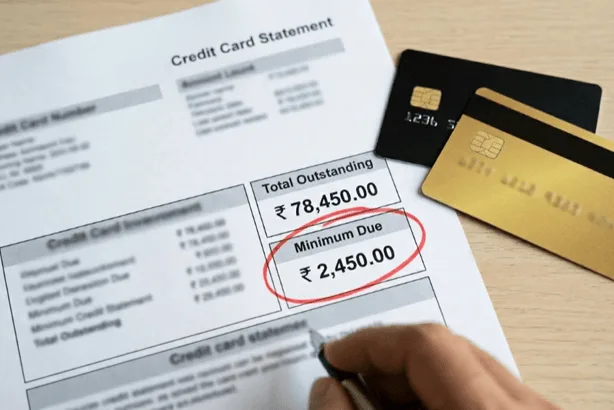
Your statement shows several numbers, and they aren’t the same thing. Here’s what each one means and whether interest is charged on it.
| Term on your statement | What it means | Is interest charged on it? |
|---|---|---|
| Total amount due | What you must pay to clear the bill, net of credits in the cycle | Pay it in full by the due date and there’s no interest on purchases |
| Minimum amount due | The least you can pay to avoid an overdue mark | No. It’s a payment level, not the interest base |
| Outstanding amount | What you still owe after payments, refunds and reversals | Yes. This is what interest is charged on |
| Unbilled purchases | Spending since the last statement | Depends. The interest-free period holds only if the earlier bill was cleared in full |
What sits inside the outstanding balance? Purchases, cash advances, EMI instalments, fees, GST (Goods and Services Tax), and any interest already added. Payments, refunds and reversed transactions come off the top.
RBI’s credit card directions (RBI/2022-23/92, updated 7 March 2024) define two of these terms. The total amount due is the amount payable on the statement, net of credit received in the cycle (para 3(a)(xxi)). The minimum amount due is the smallest part of the bill you must pay to avoid an overdue mark (para 3(a)(xvii)). The rules use “outstanding amount” without a separate definition, so the table above is a plain-words reading.
Why does the difference matter? Because the minimum due can look like the number that decides your interest, and it isn’t. It only decides whether your account is marked overdue. The interest is charged on what you still owe.
For the meaning of the balance and how it shows on your credit report, see FREED’s guide to what total outstanding on a credit card is. This guide stays on interest only.
A good habit: when a statement figure confuses you, ask which row of the table it belongs to. Most confusion about interest on outstanding balance comes from mixing up the total due and the outstanding amount.
Does Interest Apply to the Outstanding Balance or the Total Amount Due?
RBI’s directions require interest to be calculated on the eligible outstanding amount, adjusted for payments, refunds and reversed transactions as they are credited. If you do not pay the total amount due by the payment due date, the interest-free period may be withdrawn and interest may be charged from the relevant transaction dates. The calculation must follow the applicable RBI directions and the card issuer’s disclosed terms.
Two related rules sit alongside it.
- Late payment fees apply only on the outstanding amount after the due date, not on the whole bill (para 9(b)(v)).
- Issuers must give you at least a fortnight after the bill to pay before interest starts (para 10(a)). A fortnight is 14 days, and it’s a minimum.
RBI also gives its own illustration in the Annex. Say ₹10,000 is outstanding and isn’t paid by the due date. At 2% a month, interest adds ₹200. Add about ₹50 of tax and charges (RBI calls this figure indicative), and the minimum due can’t be less than ₹250, so interest and charges don’t just pile onto the balance. That ₹250 is an illustration, not a rule.
The point to take from it: the interest is worked out on the ₹10,000 that’s still owed. It isn’t worked out on some bigger or smaller headline figure.
Here’s why that helps you. The total amount due and the minimum due are about what you must pay. The outstanding amount is about what you still owe. FREED’s guide to how minimum due differs from the amount you owe goes through that gap in more detail.
So the number on the bill’s front page and the base for interest on outstanding balance can differ. When you see a figure, check which one it refers to. If a payment or refund hasn’t shown up yet, the base is higher than you expect, and so is the interest.

How Is Interest Charged on Each Part of the Outstanding Balance?
One balance, but each part of it is treated differently. Here’s the split.
| Part of the balance | How interest is charged | Watch for |
|---|---|---|
| Purchases | From the transaction date if the earlier bill wasn’t cleared in full | The interest-free period is lost |
| Cash advances | In one bank’s terms, from the withdrawal date, with no interest-free period, plus a fee | Fee and GST on top |
| Unpaid taxes, levies and charges | Not capitalised, so no interest on them (RBI) | Interest still runs on the unpaid purchases |
| EMI instalments | As per the EMI terms | Check the rate on your EMI, not the card rate |
| Interest and GST already billed | Added to the outstanding | Bank terms decide whether interest compounds |
“Capitalised” means added to the balance on which interest is charged. RBI says unpaid taxes, levies and charges can’t be capitalised for amounts billed from 1 October 2022 (para 9(b)(ii); FAQ Query 7).
RBI also says issuers must quote the APR for different situations, such as retail purchases, balance transfers, cash advances and non-payment of the minimum due (para 9(b)(i)). So your statement should show more than one rate. If you see only one, look at your card’s Most Important Terms and Conditions (MITC) document.
As one bank-specific example, Indian Overseas Bank’s published credit card terms state that cash advances do not receive an interest-free period and carry a transaction fee of 2.25%. On a ₹10,000 withdrawal, this would amount to a fee of ₹225, before applicable taxes. The published document does not show an issue date, so check the bank’s current terms before relying on these figures. Other issuers may apply different fees and interest rates.
Why does this table matter for interest on outstanding balance? Because a ₹10,000 cash withdrawal and a ₹10,000 shopping bill can sit in the same balance and cost very different amounts. The purchase costs nothing if you clear the bill. The cash advance usually isn’t.
For cash withdrawals in general, FREED’s guide to things to know about credit cards is a useful read. And your statement’s charges section is the place to see each part split out.
See What Your Salary Can Carry
Check how much of your pay goes to EMIs and card dues.
Check My EMI ScoreHow Is Interest Calculated on a ₹60,000 Outstanding Balance?
Let’s put numbers on all of this. Treat the case below as an illustration with the method simplified, not a quote from any bank. (Illustrative example.)
- The card charges 42% a year.
- Your statement on 30 September shows an outstanding balance of ₹60,000. That’s ₹50,000 of purchases, all made on 1 September, plus a ₹10,000 cash advance withdrawn on 20 September.
- The due date is 20 October. The next statement is on 30 October.
- On 10 October, a ₹5,000 refund on one purchase is credited.
- On 20 October, you pay ₹6,000 (we assume 10% of the bill, as one bank’s terms define the minimum due) and it goes against purchases. You spend nothing new.
| Part | Working | Interest |
|---|---|---|
| ₹5,000 refunded on 10 Oct (39 days from 1 Sep) | 5,000 × 39 ÷ 365 × 0.42 | ₹224.38 |
| ₹6,000 paid on 20 Oct (49 days) | 6,000 × 49 ÷ 365 × 0.42 | ₹338.30 |
| ₹39,000 of purchases still unpaid on 30 Oct (59 days) | 39,000 × 59 ÷ 365 × 0.42 | ₹2,647.73 |
| ₹10,000 cash advance, 20 Sep to 30 Oct (40 days) | 10,000 × 40 ÷ 365 × 0.42 | ₹460.27 |
| Total interest | Add the four lines | ₹3,670.68 |
| GST at 18% (bank-terms example, confirm on your statement) | 3,670.68 × 0.18 | ₹660.72 |
| New outstanding balance | 39,000 + 10,000 + 3,670.68 + 660.72 | ₹53,331.40 |
Look at what happened. You brought the balance down by ₹11,000 (the ₹5,000 refund plus the ₹6,000 payment). Yet ₹4,331.40 of interest and GST came back, which is about 39% of the reduction (₹4,331.40 ÷ ₹11,000). The balance fell, and interest on outstanding balance still took a big bite.
Two more lines, to keep the picture honest.
- The cash advance fee isn’t in the table. At 2.25%, it’s ₹225, plus GST of ₹40.50, so ₹265.50 in all.
- Suppose the ₹10,000 had been repaid in full on 20 October. Interest would be ₹345.21 (30 days). Add the ₹265.50 fee and GST, and it’s about ₹610.71, before GST on the interest. The same ₹10,000 spent on purchases and paid by the due date, with the earlier bill cleared, would cost nothing.
Your bank’s method for refunds, payment allocation and compounding decides the real figure. Some banks treat refunds and the order of payments differently, so use this as a way to read your own statement, not as a promise.
Combine Your Card Dues Into One EMI
FREED’s Loan Consolidation Plan can reduce your monthly EMI burden by up to 50%.* Rates and ranges shown are indicative. Final terms decided by the bank. FREED is not a Loan Provider. No outcome is guaranteed. Please verify directly with your bank.
Check My EMI ScoreHow Do Payments, Refunds and Reversals Change the Interest?
The date a credit lands changes the interest on outstanding balance. RBI says interest is charged on the outstanding amount adjusted for payments, refunds and reversed transactions “as and when credited” (FAQ Query 6). So the day matters, not just the amount.
Three practical points follow.
- Pay as early as you can inside the due date. Each day a rupee stays unpaid costs interest, so a payment made a week sooner saves a week of it.
- Keep a record of refunds and the date each one is credited. Then check they show on the statement. A refund that’s missing from the statement means a higher base for your interest.
- Ask your bank how a payment is applied across purchases, the cash advance, fees and interest. The order can change which part keeps charging interest after you pay. It’s bank policy, not an RBI rule, so ask rather than guess.
One bank’s terms (Indian Overseas Bank) say that if you pay the full total due before the due date, the interest applied for the remaining period is refunded. Don’t assume yours does. Check your card’s terms, and never count on a refund you haven’t seen in writing.
How should you ask? Keep it short and specific. Name the card, the statement date and the line you’re asking about. Ask for the answer in writing so you have something to refer back to.
For the idea behind a balance that carries from month to month, see FREED’s guide to what revolving credit is. It helps to know why a partly paid balance behaves differently from a fully paid one, and how that shapes your interest on outstanding balance.

FREED Expert Tip
It tells you which part keeps charging interest. See how each account shows before you write.
Check My Credit InsightsDoes Interest on a Credit Card Outstanding Balance Compound?
It depends on the bank’s terms. That’s the honest answer, and here are two examples of how it varies.
- One bank’s published terms (Indian Overseas Bank) state that finance charges compound monthly.
- Another bank’s page (ICICI Bank) says interest “may compound daily, depending on the issuer’s policy”, and its worked example doesn’t show compounding. So for that card, the page doesn’t confirm it either way.
Compounding means interest is added to the balance, and the next round of interest is charged on the bigger number. A small illustration shows the size of it. Say ₹10,000 is unpaid for 2 months at 3.5% a month. Simple interest is ₹700 (10,000 × 0.035 × 2). With monthly compounding, it’s ₹712.25 (10,000 × 1.035² − 10,000). The gap is ₹12.25. Over a longer stretch, or on a bigger balance, it grows. (Illustrative example.)
What does RBI say? Two things. Unpaid taxes, levies and charges can’t be capitalised for charging interest (para 9(b)(ii)). And every statement must carry a warning that paying only the minimum can stretch repayment over months or years, with compounded interest (para 9(b)(iii)).
That second point tells you something. RBI expects compounding to exist on cards, and wants you warned about it. The rule doesn’t say interest on interest is banned.
How do you check your own card? Find “finance charges” in your card’s MITC document. Then look for the word “compound”. If it’s there, note whether it says monthly or daily.
Fees are a separate line from interest, and they differ a lot by bank. FREED’s guide to credit card late payment charges compared shows the spread. Check your own statement for current figures, since fees change.

Want to See What You Can Afford Each Month?
Check how much of your salary your EMIs take.
Check My EMI ScoreWhich Part of the Outstanding Balance Should You Pay Down First?
You can pay more than the minimum, but not the whole bill. So where should the extra money go? Here’s a simple way to decide.
Compare the applicable interest rates for purchases, cash advances and other transaction types. After paying at least the minimum amount due, you may want to reduce the balance attracting the highest interest rate first. However, check how your issuer allocates payments across purchases, cash advances, fees and other amounts. You may not be able to choose which specific balance receives your payment.
If the rates are equal, look at the other differences. In the ₹60,000 example, the cash advance has no interest-free period at all, so it costs from day one. The 2.25% fee is already charged, so paying the advance early saves interest but not the fee. If rates differ, the rate decides.
Here are the steps.
- Find each rate on the statement. Note the one for purchases and the one for cash advances.
- Ask the bank how payments are applied. The answer tells you where your extra rupee lands.
- Think about EMI conversion for a large purchase. It gives a fixed amount and a fixed end date. Compare the rate and fees first, and read FREED’s guide to credit card EMI conversion.
- Think about a balance transfer. Read the fees carefully, and see balance transfer credit cards in India.
Does paying only the minimum ever make sense? It keeps your account from being marked overdue, and that matters. But it leaves most of the outstanding balance, and the interest on it, in place. FREED’s guide to what paying only the minimum really costs shows the longer-term effect.
You don’t need to stop using the card to follow any of this. It’s about knowing which part of the interest on outstanding balance is charging you most. And if repaying has become genuinely impossible, a different path exists for that situation only. The last section explains it.
Genuinely Unable to Repay Your Card Dues?
FREED negotiates with your banks to settle for less than 50%* of your outstanding dues. Rates and ranges shown are indicative. Final terms decided by the bank. FREED is not a Loan Provider. No outcome is guaranteed. Please verify directly with your bank.
Settle My LoansWhat If the Interest on Your Outstanding Balance Looks Wrong?
The interest on your statement doesn’t match your own working. Before you worry, go through these steps.
- Re-run the formula. Use your statement’s rate and dates, as in the examples above.
- Ask the bank to explain the interest line in writing. Name the statement date and the amount you’re asking about.
- Use the grievance officer. The officer’s name and contact details must appear on your bills and statements (para 26(a)).
- If you get no reply in 30 days, you can go to the RBI Ombudsman (the official who handles complaints against banks). Filing costs nothing, and the window is 90 days (RB-IOS 2026).
Allow for small rounding and day-count differences. Don’t start from the idea that your bank is wrong. A gap often comes from a date, a fee or a payment that was applied in an order you didn’t expect.
Now suppose the interest on outstanding balance is right, and the problem is the size of it. Card dues are growing across several cards, and every month the total looks worse. “If most of your salary goes towards paying multiple EMIs, FREED’s Loan Consolidation Plan helps you combine multiple loans into a single monthly EMI. This can reduce your monthly EMI burden by up to 50%.*” It’s for people who are still paying. If you’ve missed payments, talk to your bank or get guidance first.
You can also see how your payments stack up against your pay with the EMI Score. For a wider look at clearing card debt, FREED’s guide to how to get rid of credit card debt covers the main routes.
*Rates and ranges shown are indicative. Final terms decided by the bank. FREED is not a Loan Provider. No outcome is guaranteed. Please verify directly with your bank.
How FREED Helps With a Credit Card Balance That Keeps Growing
You can check the interest yourself, and the steps above fix a lot. FREED is for when the balance is already beyond that.
Loan Consolidation Plan, For People Still Paying
If most of your salary goes towards paying multiple EMIs, FREED’s Loan Consolidation Plan helps you combine multiple loans into a single monthly EMI. This can reduce your monthly EMI burden by up to 50%.*
Here’s how it runs. FREED assesses your profile and matches you to a lending partner. The partner disburses one new loan that pays off your existing dues. FREED handles the process end to end.
There’s no FREED fee to the customer, and the lending partner’s fees may apply. Your credit score doesn’t drop with consolidation.
Loan Settlement Plan, Only If You Can’t Repay
Settlement is not something a borrower chooses out of preference. If you genuinely cannot repay your loans, FREED negotiates with your lenders to settle them for less than 50%* of your outstanding dues.
The process starts with an assessment and a personalised plan. You save a fixed monthly amount into an SPA (settlement account) in your own name, held by an independent trustee. FREED negotiates with each bank once enough is saved. The bank decides the terms. No bank is paid until you authorise it, and you receive a settlement letter from the bank at the end.
Expect the first settlement within about 4 months, and the full programme to take around 1.5 years. Fees are success-based, and the evaluation fee is non-refundable. A “Settled” mark can stay on your credit report for up to 7 years. The Loan Settlement Plan is only for people who can’t repay.
The founding team of FREED brings over 50 years of combined experience in the US loan settlement industry. So far, 33,000+ accounts have been settled, with ₹500 Cr+ in settlement amount.
*Rates and ranges shown are indicative. Final terms decided by the bank. FREED is not a Loan Provider. No outcome is guaranteed. Please verify directly with your bank.
Combine Your Loans Into One EMI With FREED
One monthly EMI instead of several, with the process handled for you.
Reduce My EMI
Mohit Juneja
Mohit Juneja is FREED’s Content & Communication Lead with 12+ years of experience across content, media, advertising and digital communications. He holds a postgraduate diploma in Communications from Xavier Institute of Communications, Mumbai, and has worked with organisations including NDTV, The Indian Express, McCann Worldgroup and NABARD.
At FREED, he leads content and communication across loan management, debt resolution, debt consolidation and financial well-being. His work combines research, storytelling and consumer-focused communication to make complex financial topics easier to understand and act on. He has also scripted and produced 11 documentaries on rural development and agriculture for NABARD, with film's selected for the Mumbai International Film Festival.
mohit.juneja@freed.care

FREED is India's trusted loan management platform. We help India settle their loans, consolidate their EMIs, improve their credit score, and manage their loans better. Over 20 lakh people trust FREED. We have managed more than ₹3,500 crore in loans and saved our users over ₹450 crore.
Media Mentions