Credit Card Debt Management App Options
A credit card debt management app is an app that shows your card balances, due dates and interest in one place, and may remind you to pay. It helps you see your debt clearly. It doesn’t lower what you owe.
Mohit Juneja
Reviewed by FREED India, Debt Resolution Specialists
 4.7/5
 ₹3,200Cr+
 20,000+
 20,00,000+4.7/5₹3,200Cr+20,000+20,00,000+
Key Summary

A credit card debt management app shows what you owe; it doesn’t reduce it.
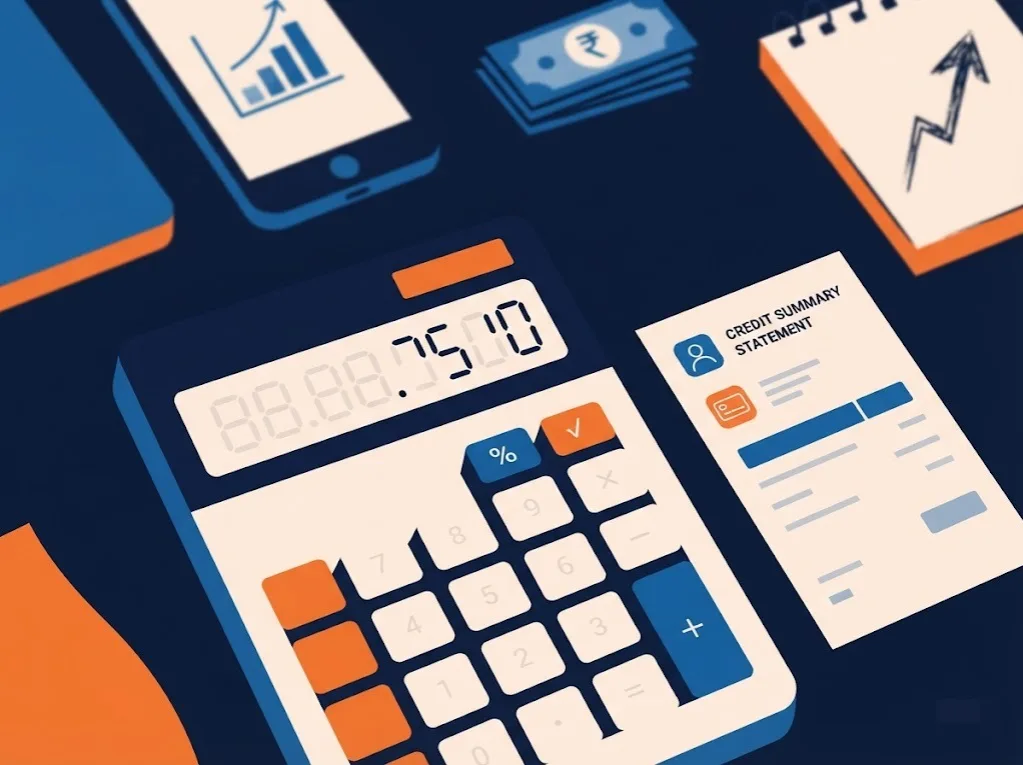
In our example, 62.7% of a ₹7,500 minimum payment on ₹1,50,000 goes to interest.
An RBI directory listing does not mean that the app has been registered, authorised or endorsed by RBI.
RBI gives you one full credit report a year per credit bureau, at no charge.
Ask what access an app wants, and why, before you connect any card.

Paying Several EMIs and Want One?
FREED’s Loan Consolidation Plan combines multiple loans into one EMI.
Reduce My EMIWhat Does a Credit Card Debt Management App Do?
A credit card debt management app gathers your cards in one place. It shows balances and due dates, and it may remind you before a payment is due. That’s useful, and it’s also where its job ends.
Here’s what these apps usually do.
Show balances. You see what you owe on each card without opening several statements.
Remind you of due dates. A credit card due date reminder app can help you avoid late fees.
Track spending. Some sort your purchases by type, so you can see where the money goes.
Suggest a payoff order. A few rank your cards by rate or balance and tell you which one to pay extra on.
Here’s what they don’t do. They don’t lower what you owe, and they don’t change your rate. A reminder tells you a payment is due. It doesn’t create the money to pay it.
That’s worth saying early, because the app stores are full of listings that promise more. Some are trackers, some pay bills, some offer rewards, and some offer loans. They’re different tools with different goals, and we’ll sort them out in a moment. We don’t name or rank any app in this guide, because we found no neutral data that would let us do that fairly.
So how should you judge one? The rest of this guide covers what a good app should show, how to check it’s safe, what it can’t do, and what to do when an app isn’t enough. If you want the wider picture first, our guide on debt payoff tools compared covers spreadsheets, worksheets and tool types. Our pillar guide explains how tools alongside counselling fit together. Let’s start with what a good app should show you.
Want Every Loan and Card on One Page?
See your accounts and balances in plain words.
Check My Credit InsightsWhat Should a Good Card Debt App Show You?
Due dates matter, but interest matters more. A due date tells you when to pay. The interest line tells you what the debt is costing you, and that’s the number that decides how long you’ll be in it.
Use this show-me checklist on any app, spreadsheet or statement.
Total owed on each card. You should see every balance, not just the combined figure.
The annual rate. It should be shown for each card, in annual terms.
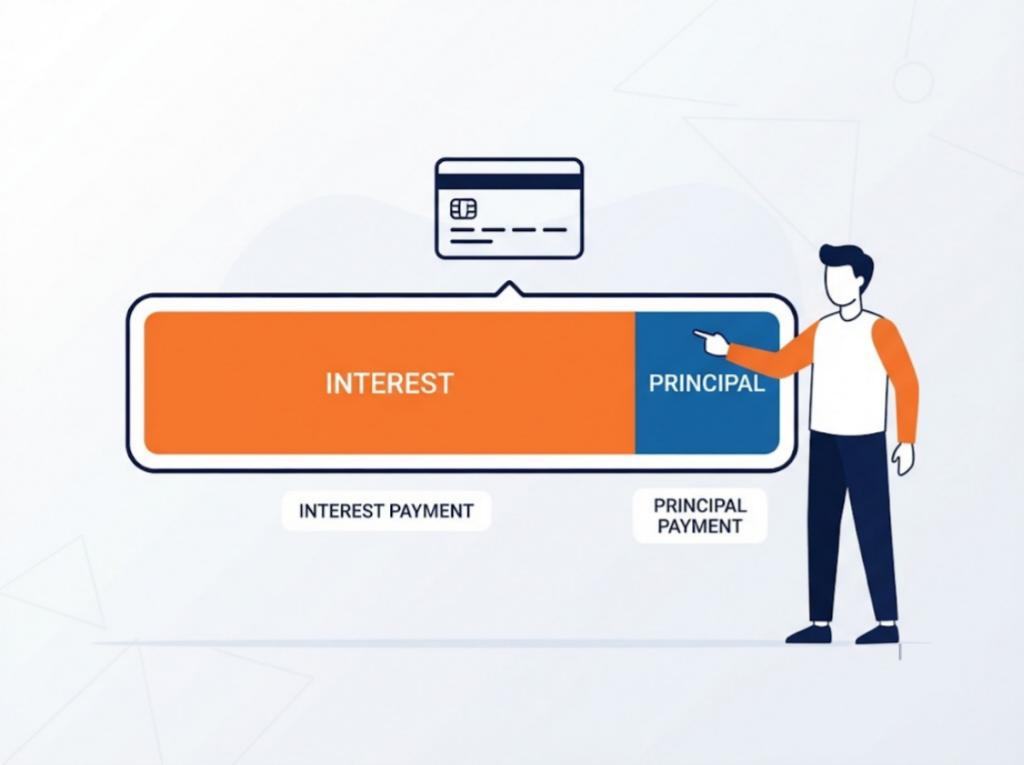
How much of this month’s payment goes to interest. And how much goes to what you owe (the principal).
The date you’d be clear. Based on your current monthly payment, not a hopeful guess.
The cost of paying only the minimum. Minimum due is the smallest payment the bank asks for, and it’s the costliest way to carry a balance.
Here’s an illustrative example. The figures are invented, and the 5% minimum is an assumption, not any bank’s rule.
Balance | Annual rate | Interest a month | Minimum due (5%, assumed) | Reduces what you owe | |
|---|---|---|---|---|---|
Card A | ₹70,000 | 42% | ₹2,450 | ₹3,500 | ₹1,050 |
Card B | ₹50,000 | 36% | ₹1,500 | ₹2,500 | ₹1,000 |
Card C | ₹30,000 | 30% | ₹750 | ₹1,500 | ₹750 |
Total | ₹1,50,000 | ₹4,700 | ₹7,500 | ₹2,800 |
Of the ₹7,500 minimum, ₹4,700 is interest. That’s 62.7%. Only ₹2,800, or 37.3%, reduces the balance.
Here’s what the example shows.
A minimum payment mostly feeds interest. In this case, nearly two-thirds of it.
An app that shows only due dates hides this. You’d pay on time every month and barely move the balance.
The split is the number to ask for. If an app can’t show it, check your statement instead.
We aren’t saying every bank sets its minimum at 5%. Banks differ, so use your own statement’s figures. To see how banks work out the minimum, read our guide on the meaning of minimum due. Next, let’s look at the kinds of apps on offer.
See What Share of Your Salary Goes to EMIs
Check how much of your pay your EMIs take today.
Check My EMI ScoreWhat Types of Credit Card Debt Apps Are There?
Apps differ in what they sell, and that tells you what they push. A tool built to earn from offers will show you offers. A tool built to earn from a subscription will want you to subscribe. Neither is wrong, but you should know which one you’re using.
Here’s a simple way to sort them. “Often earns from” is a general pattern, so ask each app how it makes money.
Type | What it does | Often earns from |
|---|---|---|
Tracker and reminder apps | Show balances and due dates; some link to your accounts | Offers, rewards or partners |
Bill-pay and rewards apps | Let you pay card bills and collect points | Fees or partners |
Loan-matching and balance-transfer apps | Offer you a new loan to move your balance | Payment from the lender |
Payoff planners | Suggest which card to pay first | Subscriptions |
Counselling or settlement platforms | Provide a service on your debt | A fee for the service |
Notice how the goal changes. A tracker wants you to keep opening it. A loan-matching app wants you to take a loan. A counselling or settlement platform wants you to use its service. None of these is a trick, and each is the right tool for someone.
The question is whether the app’s goal matches yours. If you only want to see your balances, a tracker is enough. If you want a way out of a heavy balance, a tracker alone won’t give you one. And an app that offers a loan on its first screen is telling you what it hopes you’ll do.
Many people search for the “best app for credit card debt”, and we understand why. But “best” depends on your situation, and we found no neutral way to rank apps. So we’ve given you the questions to ask instead. For a wider look at tool types, our guide on debt payoff tools compared goes further. Next, let’s look at safety.
Your Accounts, One Plain-Language Page
Credit Insights shows your loans and cards with a personalised action plan.
Check My Credit InsightsIs It Safe to Give an App Access to Your Cards and Messages?
Connect only what the app needs. Many apps ask for more access than the job requires, and you can often say no to part of it. A few questions before you connect can save you a lot of trouble.
Here’s a permission checklist.
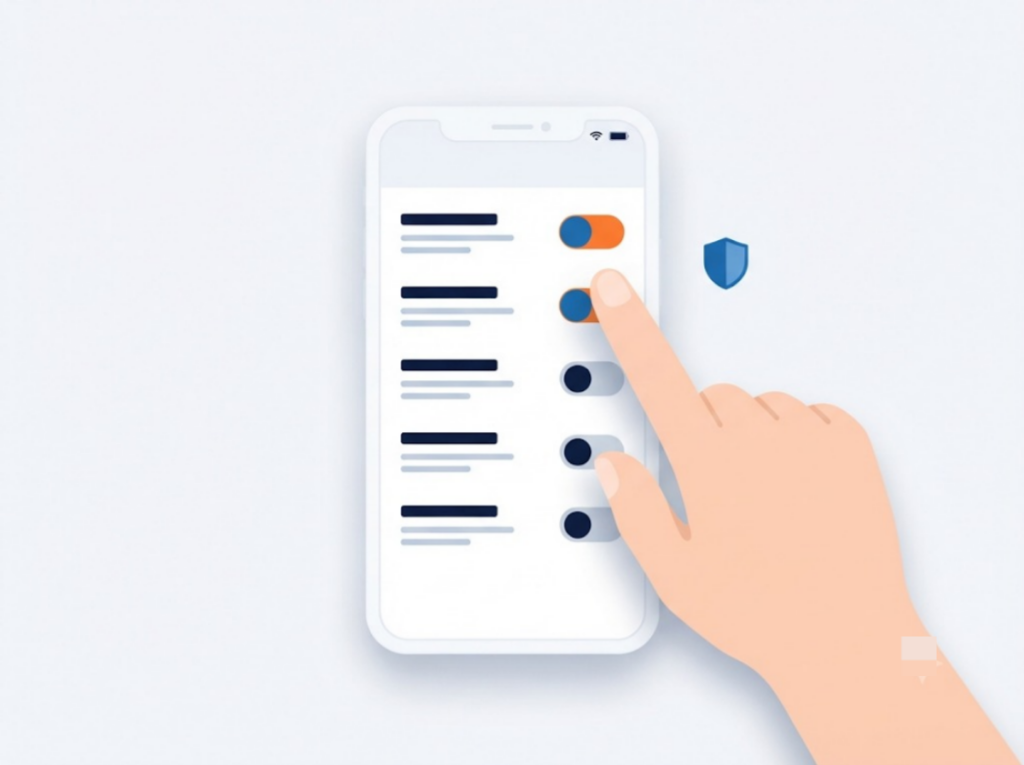
Does it need your SMS, or only a card number? Reading messages gives an app a lot of your private data. Ask why it needs them.
Is the access read-only? An app that only reads your balances is different from one that can make payments.
Can you delete your data? Look for a clear way to remove your data and your account.
Is there a clear privacy page? It should say what’s collected, why, and who it’s shared with.
Does it ask for money or a card PIN? That’s a red flag. A tracker doesn’t need your PIN.
Here’s what RBI says, and what it doesn’t. Under the RBI Digital Lending Directions, 2025, inclusion in RBI’s directory of digital lending apps does not mean that RBI has registered, authorised or endorsed an app. RBI also states that it does not verify the information submitted for the directory. The directory should therefore not be treated as a guarantee of an app’s safety or legitimacy. So a listing is a starting point for your own checks. It isn’t a seal of approval.
For digital lending arrangements covered by the RBI Directions, fees payable to a lending service provider for services provided under the arrangement are paid by the regulated lender. The lender cannot pass those LSP fees to the borrower as a separate charge or have the LSP collect them separately. This rule does not mean that every fee associated with every financial app or loan product is prohibited. So if a loan app asks you for a separate “service fee” on top, ask why, and ask for it in writing. These rules apply to digital lending apps of regulated lenders. They don’t cover every card tracker, so ask each app what applies.
There’s also a yearly step. RBI requires each credit information company to provide an individual with one free full credit report, including the credit score, once during a calendar year, on request and after identity verification. Check it for cards you don’t recognise and balances that look wrong.
We aren’t saying any app is unsafe. We’re saying you should check before you connect, and that’s easy to do. For safe card habits more widely, read our guide on using your credit cards wisely.

What the Law Says
Under RBI’s Digital Lending Directions, 2025, inclusion in the directory of digital lending apps does not mean that RBI has registered, authorised or endorsed the app. Check your EMI share before you connect anything.
Check My EMI ScoreWhat Can’t a Credit Card Debt App Do?
An app shows the problem. It doesn’t solve it. That’s the honest limit of any credit card debt management app, and it’s true of even the best-built one.
Here are the limits.
It doesn’t lower your balance or your rate. The bank sets both, and an app only reports them.
A reminder doesn’t create the money. If the payment is more than your pay can carry, a notification can’t change that.
It can’t negotiate with your bank. Only you, or someone acting for you, can ask a bank for a new plan.
It can’t stop recovery calls. If payments have been missed, the calls come from the bank or its agents, not from your tracker.
None of this is a criticism. A tracker that shows your balances clearly is doing its job. The trouble starts when people expect it to do the next job as well, and months pass while the balance grows.
So ask yourself a simple question. Is my problem that I forget to pay, or that I can’t afford to pay? If it’s the first, a reminder app is the answer. If it’s the second, the gap between your salary and your EMIs is the problem, and the fix is a plan, not a notification. Our pillar guide covers what apps can’t replace, and where counselling helps.
For the full set of payoff routes, read our guide on how to get rid of credit card debt. Next, let’s match the option to your situation.
Not Sure What Your Salary Can Carry?
Check your EMIs as a share of your salary before you pick a tool.
Check My EMI ScoreWhich Option Fits Your Card Debt?
Match the option to where you are. The right step for someone who pays on time is different from the right step for someone who has missed payments. Use this table, and start with the first row that fits.
Where you are | What usually fits |
|---|---|
Still paying on time, want to see it clearly | A tracker or a spreadsheet |
Still paying, but interest eats most of your payment | A balance transfer or an EMI conversion; consolidation if several loans are involved |
Missed payments | Talk to your bank first, then a FREED expert about your options |
Genuinely cannot repay in full | Settlement, as a last resort |
The order matters. Tracking and plan changes come first, because they cost the least and keep the most options open. A balance transfer or EMI conversion comes next, if the cost falls. To compare them, read our guides on a balance transfer credit card and credit card EMI conversion. Check the fees and the total you’d repay before you choose. If late charges are part of the problem, our guide on credit card late payment charges compared shows what banks charge.
If several loans make your month heavy, and you’re still paying on time, consolidation can bring them into one EMI. It isn’t for anyone who has missed payments, and we say that clearly. A personal loan to clear cards can also work, but only if the total cost falls, and our guide on using a personal loan to pay off credit cards shows how to check.
If you have missed payments, contact your bank first. Ask for the overdue amount, applicable charges and available repayment options in writing. Consider a new loan only after comparing eligibility, interest, fees and the total amount repayable. FREED’s team can then talk through your options with you.
And for the person who genuinely cannot repay, settlement exists. Settlement is not something a borrower chooses out of preference. It’s a last resort, with real effects on your credit report and future borrowing, and the bank decides. Our guide on how credit card settlement works explains the steps and the trade-offs.
Can’t Repay Your Cards in Full?
If you genuinely cannot repay your loans, FREED negotiates with your lenders to settle them for less than 50%* of your outstanding dues.
Settle My LoansHow Do You Track Card Debt Without an App?
A notebook or a spreadsheet works if you’d rather avoid permissions. It’s an app to track credit card debt that you control, and nothing leaves your phone or your desk. Some people find it easier to stick with, too, because they built it themselves.
Set up five columns.
Card name. One row per card.
Balance. What you owe today, from the latest statement.
Annual rate. The rate printed on your statement.
Minimum due and due date. Both, so you see what’s coming.
What you paid. The amount you actually paid this month.
Then follow three monthly steps.
Update balances on the same day each month. Pick a date and keep it.
Mark the split between interest and what you owe. Your statement shows the interest charged, so subtract it from your payment.
Note the one card you’ll put extra on. Usually the one with the highest rate.
It takes about 15 minutes, and it costs nothing. A credit card debt tracker like this also shows the thing most apps skip, which is how little of your payment reaches the balance. Watch that figure for three months. If it isn’t moving, that’s useful information.
For a ready-made layout, read our credit card payoff plan template. A sheet won’t send you a reminder, so set a calendar alert for each due date, and turn on auto-pay for at least the minimum if your bank offers it. Auto-pay doesn’t replace the monthly check. It only stops a missed payment while you do it.

FREED Expert Tip
Check the interest line on your statement before you check the due date. If interest takes most of your payment, a reminder won’t fix it. Check your EMI share in minutes.
Check My EMI ScoreWhere FREED Fits, and What It Isn’t
FREED isn’t a card-reminder app, and it charges for its services. Over 20 lakh people trust FREED, India’s trusted loan management platform. This section sets out what FREED does, and for whom.
Numbers first. Credit Insights shows your loans and cards with a personalised action plan. EMI Score shows what share of your salary your EMIs take. Both help you see where you stand before you decide anything.
For people still paying. If most of your salary goes towards paying multiple EMIs, FREED’s Loan Consolidation Plan helps you combine multiple loans into a single monthly EMI. This can reduce your monthly EMI burden by up to 50%.*
Here’s how it works.
FREED assesses your financial profile.
FREED matches you to a lending partner from its network.
The partner disburses one new loan that pays off your existing eligible unsecured loans and card dues.
FREED handles the process end to end, 100% online.
You’re left with one loan, one EMI and one due date.
Your credit score isn’t hurt by consolidation, and it tends to improve as you pay on time. FREED doesn’t charge you a fee for consolidation. The lending partner’s processing or foreclosure fees may apply, so check the Key Facts Statement. This is only for people who are still paying. If you’ve missed payments, don’t use it.
For people who cannot repay. Settlement is not something a borrower chooses out of preference. If you genuinely cannot repay your loans, FREED negotiates with your lenders to settle them for less than 50%* of your outstanding dues. The bank decides, no percentage is guaranteed, and the process takes time.
Your settlement savings sit in an account in your own name.
Not sure where you stand? FREED’s team can assess your situation and tell you what options are available. To see what the first weeks look like, read our guide on what happens when you join a debt relief program.
Rates and ranges shown are indicative. Final terms decided by the bank/lender. FREED is not a Loan Provider. No outcome is guaranteed. Please verify directly with your bank.
Outcomes vary by lender and borrower profile. Settlement terms are decided by the lender. No percentage is guaranteed.
Combine Your Loans Into One EMI With FREED
One monthly EMI instead of several, with the process handled for you.
Get Started on FREED
Mohit Juneja
Mohit Juneja is FREED’s Content & Communication Lead with 12+ years of experience across content, media, advertising and digital communications. He holds a postgraduate diploma in Communications from Xavier Institute of Communications, Mumbai, and has worked with organisations including NDTV, The Indian Express, McCann Worldgroup and NABARD.
At FREED, he leads content and communication across loan management, debt resolution, debt consolidation and financial well-being. His work combines research, storytelling and consumer-focused communication to make complex financial topics easier to understand and act on. He has also scripted and produced 11 documentaries on rural development and agriculture for NABARD, with film's selected for the Mumbai International Film Festival.
mohit.juneja@freed.care

FREED is India's trusted loan management platform. We help India settle their loans, consolidate their EMIs, improve their credit score, and manage their loans better. Over 20 lakh people trust FREED. We have managed more than ₹3,500 crore in loans and saved our users over ₹450 crore.
Media Mentions