How to Calculate and Plan Your Credit Card Payoff (With Spreadsheet Template)
A credit card payoff plan is a calculated schedule showing exactly how much to pay each month to clear a balance by a target date, and how much interest that actually costs along the way. It's different from paying only the minimum due, which can take much longer to clear a balance and may result in substantially more interest. This guide walks through the calculation with a worked example and a spreadsheet template you can copy directly.

Mohit Juneja
Reviewed by Mohit Juneja, Debt Resolution Specialists
 4.7/5
4.7/5 ₹3,200Cr+
 20,000+
 20,00,000+4.7/5₹3,200Cr+20,000+20,00,000+
KEY TAKEAWAYS

Credit card interest rates can be high and the amount charged depends on the card's stated rate and the issuer's interest-calculation method.
A payoff plan works backward from a target payoff date, or forward from a fixed monthly payment, either way, it's a specific number, not a guess.
Paying only the minimum due, usually 5% of the balance, keeps an account current but can take years to clear and multiplies the total interest paid.
A simple month-by-month spreadsheet, balance, interest, payment, new balance, shows exactly where a fixed payment plan lands, most people are surprised by how much interest a "reasonable-looking" balance actually accrues.
What a Credit Card Payoff Plan Actually Means
A payoff plan targets zero balance by a specific date. Minimum due targets "stay current this month" with no end date in mind at all, that distinction is the whole difference between the two.
There are two ways to build a payoff plan, and both use the same underlying math. You can decide a target date and calculate the required monthly payment, or decide a monthly payment and calculate the resulting payoff date. Either direction gets you to the same kind of concrete number.
For this worked example, assume a ₹75,000 balance and a monthly interest rate of 3.5%. Always use the rate stated for your own card when calculating your payoff plan. This example carries through the rest of this guide. Worth knowing upfront that credit card math works differently from a loan EMI, and that difference is worth understanding before calculating anything at all.

Freed Expert Tip
Pull your actual current balance and your card's stated monthly interest rate before reading further, both are on your last statement, and this guide uses them at every step. Want to Talk Through Your Numbers?
Talk to FREEDWhy Credit Card Interest Works Differently From a Loan EMI
An EMI is calculated once, upfront, on a fixed principal, tenure, and rate. The number doesn't change month to month, that's the entire point of an EMI schedule.
Credit card interest compounds monthly on whatever balance remains. If you carry a balance, interest continues to accrue according to the card issuer's stated calculation method, so carrying the balance from one billing cycle to the next can make the debt expensive to repay. Credit card interest rates can be considerably higher than rates offered on some personal loans, although the actual rate varies by issuer, card, borrower and loan product.
For concrete grounding, without singling any one issuer out unfairly: Credit card interest rates vary by issuer and card variant. Check the monthly rate stated in your own card's terms or statement before using a payoff calculation. The mechanics of minimum due specifically are covered in full elsewhere on FREED's site, worth reading alongside this if that part still feels unclear. With the rate mechanics understood, here's the actual calculation.
How to Calculate Your Payoff Plan, Step by Step
- Confirm your inputs. Current balance, monthly interest rate (annual rate ÷ 12), and either a target payoff timeframe or a fixed monthly payment amount.
- If working from a fixed payment: each month, calculate interest on the current balance, add it to the balance, subtract your payment, the remainder becomes next month's starting balance. Repeat until it reaches zero.
- If working from a target date: For a simplified estimate, you can use a standard loan-payment formula to estimate the payment needed over a target number of months. Your card's actual interest calculation, billing dates, fees and any new spending can change the result.
- The critical rule either way: the payment must exceed the interest charged each month, or the balance never shrinks, no matter how long you keep paying.
This makes far more sense with actual numbers behind it.

Worked Example: Turning a Balance Into a Payoff Timeline
Take the ₹75,000 balance at 3.5% monthly interest, with a fixed ₹8,000 paid every month.
Month 1: interest charged is ₹2,625, and after the ₹8,000 payment, the balance drops to ₹69,625. Month 2: interest on that new balance comes to ₹2,437, and after another ₹8,000 payment, the balance falls to ₹64,062. Notice the interest portion shrinks a little each month as the balance drops, meaning slightly more of each fixed payment goes toward the principal over time, similar in spirit to loan amortisation, but recalculated fresh every month rather than fixed upfront.
Under this simplified monthly-interest model, the ₹75,000 balance would be cleared in 12 months, with approximately ₹17,500 in interest. Your actual card statement may differ because issuers calculate interest according to their specific billing terms.
Contrast that briefly with a minimum-due-only path on the same balance. Minimum due is typically 5% of the outstanding balance, or a fixed minimum amount, whichever is higher.
Freed Expert Tip
Notice how much of the early payments go toward interest rather than balance. Under the same interest assumptions, reducing the balance earlier can reduce the amount of interest that accrues afterward. Want a Fuller Picture First?
Book My CallThe Credit Card Payoff Spreadsheet Template
Month | Starting Balance | Interest (3.5%) | Payment | Ending Balance |
1 | ₹75,000 | ₹2,625 | ₹8,000 | ₹69,625 |
2 | ₹69,625 | ₹2,437 | ₹8,000 | ₹64,062 |
3 | ₹64,062 | ₹2,242 | ₹8,000 | ₹58,304 |
4 | ₹58,304 | ₹2,041 | ₹8,000 | ₹52,345 |
5 | ₹52,345 | ₹1,832 | ₹8,000 | ₹46,177 |
6 | ₹46,177 | ₹1,616 | ₹8,000 | ₹39,793 |
7 | ₹39,793 | ₹1,393 | ₹8,000 | ₹33,186 |
8 | ₹33,186 | ₹1,161 | ₹8,000 | ₹26,347 |
9 | ₹26,347 | ₹922 | ₹8,000 | ₹19,269 |
10 | ₹19,269 | ₹674 | ₹8,000 | ₹11,944 |
11 | ₹11,944 | ₹418 | ₹8,000 | ₹4,362 |
12 | ₹4,362 | ₹153 | ₹4,514 (final) | ₹0 |
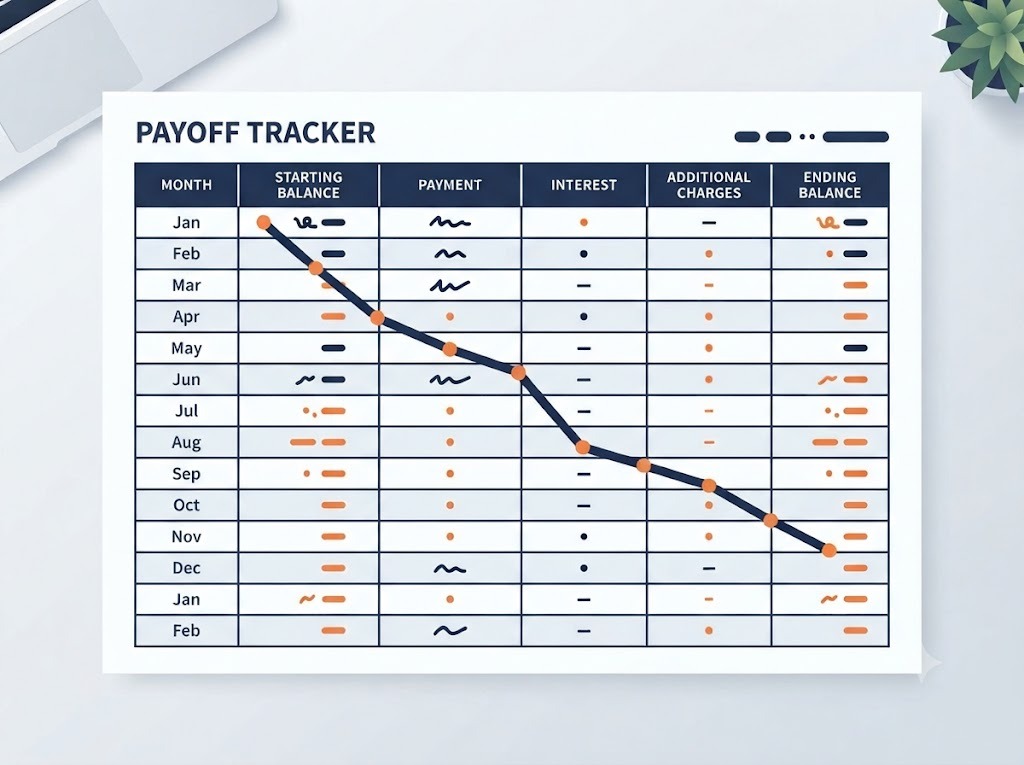
To use it: enter your actual balance and monthly rate in row 1, apply the same formula down every row, starting balance × monthly rate = interest; starting balance + interest − payment = ending balance, and adjust the payment amount up or down until the balance reaches zero at a timeframe that genuinely works for your budget. This works in any spreadsheet tool, no special software needed, and a fixed payment of at least the interest amount plus something extra is the only way the balance actually moves toward zero rather than sitting flat.
Minimum Due vs a Fixed Payoff Plan: Comparing the Real Cost
Minimum due is typically 5% of the outstanding balance, or a fixed minimum amount, whichever is higher. Paying only the minimum can reduce the principal slowly because a significant portion of the payment may go toward interest and other applicable charges.
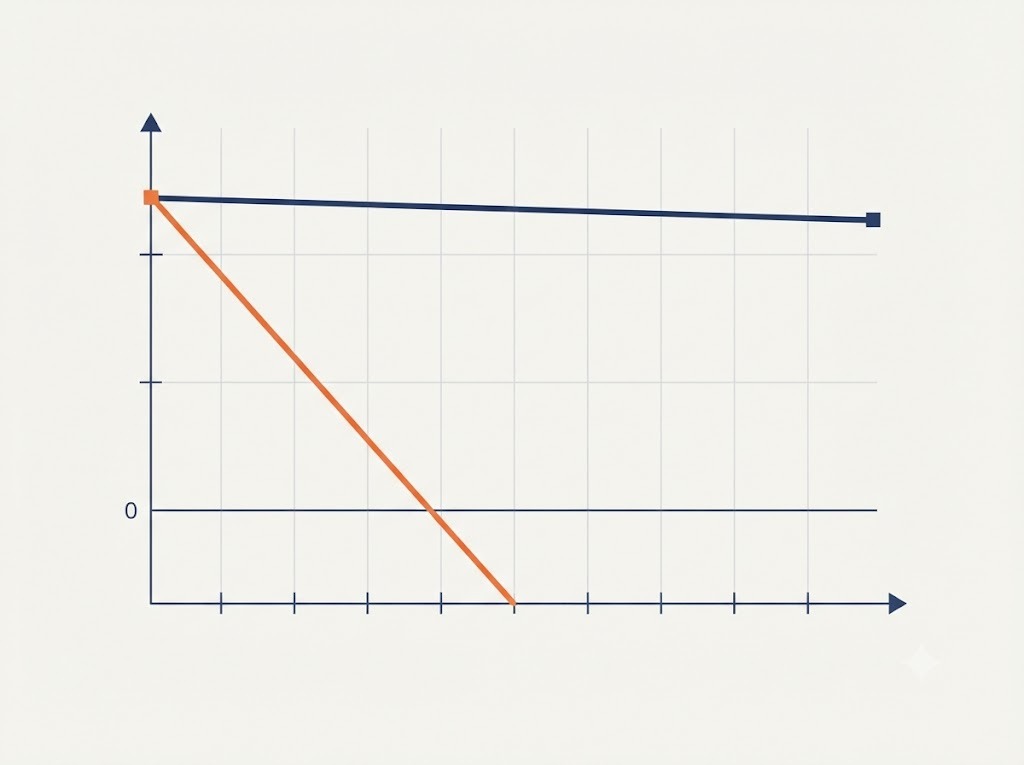
Using the same ₹75,000 example, a minimum-due-only path takes close to 13 years to clear and costs well over ₹1,40,000 in total interest, versus roughly ₹17,500 in the fixed ₹8,000-a-month plan worked through above, a difference of well over ₹1,20,000 for the exact same starting balance.
Under the same balance, interest-rate and spending assumptions, paying the balance down faster will generally reduce the total interest paid. The size of the fixed payment itself is a budget decision, but "some deliberate plan" beats "minimum due indefinitely" in nearly every situation.

Balance Feels Too Large for a Fixed Plan?
See if consolidation could bring the cost down.
Check My Consolidation OptionsWhat to Do If the Payoff Plan Doesn't Fit Your Budget
If the calculated fixed payment for a reasonable timeframe is more than your budget can genuinely absorb, that's useful information, not a failure. It means the balance itself needs a different approach, not a longer spreadsheet trying to force the same numbers to work.
For a single card, a balance transfer may reduce interest costs, but compare the transfer fee, promotional period, post-promotional rate and other applicable charges before switching. For several cards and unsecured loans, an eligible consolidation loan may replace multiple revolving balances with a single EMI. Depending on the new rate, fees and tenure, this can make repayment easier to plan. For genuine, sustained inability to repay even a reduced plan, settlement is the separate, last-resort option, with its own distinct CIBIL impact worth weighing honestly.
How FREED Helps When a Payoff Plan Alone Isn't Enough
For readers whose calculated payoff plan, even a reasonable one, still doesn't fit their budget, often because multiple cards' interest is compounding at the same time, FREED's Debt Consolidation Program, "Reduce My EMI," replaces several revolving card balances with one new loan at one fixed, typically lower, monthly payment.
This can simplify repayment into one scheduled EMI and due date, making the payment easier to plan and track. For genuine, sustained inability to repay even a consolidated amount, FREED's Debt Resolution Program is the separate, later-stage path built for that situation instead.
Tips for Sticking With Your Payoff Plan
Freed Expert Tip
Recheck your actual ending balance against the spreadsheet's projection every month. Small gaps are normal, a growing gap usually means new spending crept back onto the card. Ready to See Your Full Options?
Start My Free AssessmentSources
Claim | Source |
American Express charges 3.5% monthly (42% annually) finance charges on most Indian credit cards | American Express India Most Important Terms and Conditions (MITC), Interest Calculation |
Worked payoff example (₹75,000 at 3.5% monthly, ₹8,000/month fixed payment vs. 5% minimum-due-only path) | Calculated directly for this piece using standard compound-interest amortisation; not a third-party claim requiring an external source. |

Mohit Juneja
Mohit Juneja writes educational content at FREED on debt management, credit scores, loan repayment, and borrowing best practices. His content is shaped by expert insights and industry knowledge, helping readers better understand their financial options and make informed decisions.
mohit.juneja@freed.care

FREED is India's trusted loan management platform. Founded in 2020 and headquartered in Gurugram, FREED has counselled 20 lakh+ people on personal loans, credit cards, and app loans. FREED charges fees only on successful settlement, not upfront. FREED does not handle secured loans (home loans, car loans, gold loans).
Media Mentions