Benefits of Debt Consolidation: A Clear, No-Nonsense Guide
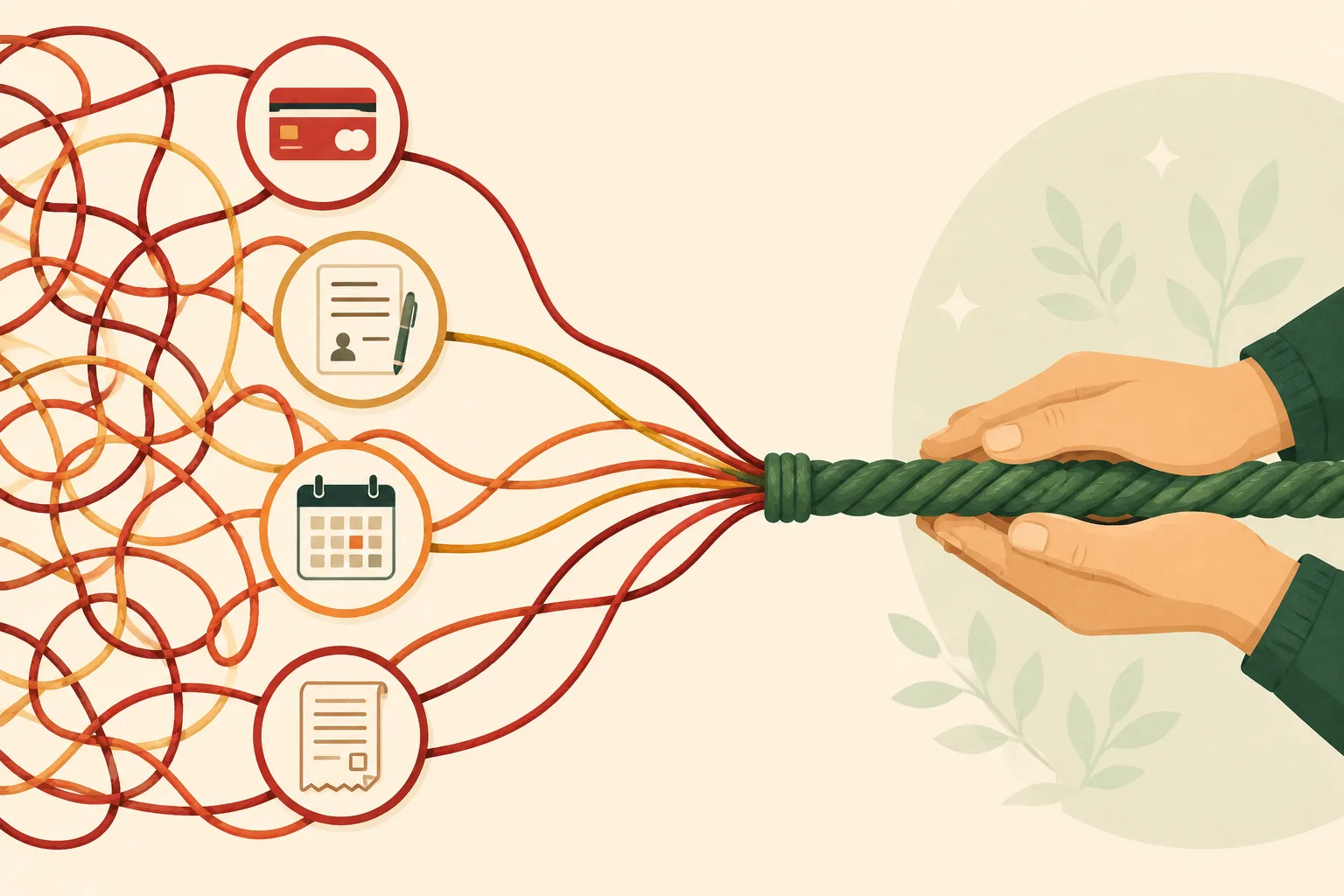
Benefits of debt consolidation come from replacing several debts with one new loan. You pay one EMI on one date, and you may pay less interest if the new rate is lower than your old ones. It does not reduce what you owe, so each benefit depends on the terms you get.

Mohit Juneja
Reviewed by FREED India, Debt Resolution Specialists
 4.7/5
 ₹3,200Cr+
 20,000+
 20,00,000+4.7/5₹3,200Cr+20,000+20,00,000+
KEY TAKEAWAYS

Benefits of debt consolidation: 1 EMI (monthly instalment), 1 due date, and 1 lender instead of several.
Interest can fall only if the new rate is lower than your blended rate today.
A longer tenure can lower the EMI, but it usually raises total interest.
Paying on time after consolidation can help your credit record over time.
RBI requires a Key Facts Statement showing the APR (annual percentage rate, which includes all charges) before you sign a retail loan.
What Are the Benefits of Debt Consolidation?
The benefits of debt consolidation come down to 5 things:
One EMI, one due date, one lender.
A possibly lower interest rate.
A possibly lower monthly outgo.
A simpler budget and less mental load.
A chance to build your credit record with steady on-time payments.
One EMI, one due date. Instead of 4 payments on 4 dates, you make 1. That holds only if the new loan clears every due date you planned.
A possibly lower rate. If the new rate beats the rate you pay today, interest falls. It depends entirely on the offer you get.
A possibly lower monthly outgo. One EMI can be smaller than the total of several. A longer tenure often does this, though, and it can raise total interest.
A simpler budget. One number to plan around is easier than five. It helps only if new dues stop piling up.
A steadier credit record. Paying 1 EMI on time, month after month, builds your record. A missed payment works the other way.
Here is the plain truth. Consolidation rearranges debt. It does not reduce it. The total you owe stays the same, so no benefit here is guaranteed.
If you want the wider picture, read how debt consolidation improves financial management. The pros and cons of each loan type are worth a look too.
First, why several debts feel so heavy.

Freed Expert Tip
Compare the APR, not just the interest rate. APR includes fees, so it shows the real yearly cost.
Check your optionsWhy Do Several Dues Feel So Heavy to Manage?
Think of a normal month. A card bill on the 5th. A personal loan EMI on the 10th. A BNPL (buy now pay later) instalment on the 15th. Each takes a slice of salary, on a different day.
The strain is partly the money. It is also partly the tracking. Remembering dates, checking balances and moving money between accounts is its own load. It follows you into the evening.
There is a cost side too. A card balance carried month to month is called revolving credit (borrowing that rolls over into next month). It tends to carry the highest rate of all your debts. So the card quietly decides how long the whole pile lasts.
How do people get here? A medical bill. A festival month. A gap between jobs. Sometimes one loan was fine, and then a second one felt reasonable, and a third one followed. Nobody plans this.
None of it is a character flaw. Several debts are simply harder to carry than one, even when the total is the same.
That is why people look at consolidation. It aims to shrink the juggling first, and the cost second. For more on how this builds, see monthly financial stress and what helps with it.
The next section looks at who gains the most.
Who Gets the Most From Debt Consolidation?
The benefits are not equal for everyone. Here is a quick check you can run on your own situation.
It tends to help most when:
Dues sit on several cards or loans. More dues mean more dates to track and more rates to beat, so merging them does more.
The new rate is clearly lower than your blended rate today. Your blended rate is the average yearly rate across all your dues, and the new loan has to beat it.
Payments are still current. Lenders look at your repayment record, so a steady run helps your offer.
You can stop adding new dues after consolidating. The benefit lasts only if the cleared cards stay clear.
It tends to help less when:
Only 1 balance is high-interest. In that case, a balance transfer may fit better, since the other dues are already cheap.
The fee eats the savings. A processing fee plus GST can cancel a small rate gap, so check the rupee figure.
A longer tenure raises total interest more than it saves. A smaller EMI feels light each month, but the total can climb.
EMIs already take more than 50% of your take-home salary. Check your own load with EMI Score, because a heavy load needs a closer look at any new loan.
No pressure here. If you see yourself in the first list, the steps come next.
How Do You Get the Benefits of Debt Consolidation, Step by Step?
The benefits only show up if the steps below are done in order.
List Every Debt and Its Rate
Write each balance, its yearly rate, and its EMI. You cannot judge a new loan without this.Work Out Your Blended Rate
Multiply each balance by its rate, add them, and divide by the total. This one number is what the new loan must beat.Collect Offers With the APR
Ask for the Key Facts Statement from each lender. APR includes all charges, so offers compare fairly.Compare Total Cost, Not EMI
A lower EMI can come from a longer tenure. Check total interest too.Check What Gets Paid Off
Confirm the payout clears every due date you planned. Any due left out keeps its old rate.Set Autopay for the New EMI
One missed payment can undo months of progress. Autopay (auto-payment permission) removes the risk of forgetting.
A debt consolidation calculator does the sums for steps 2 and 4. Keep your list from step 1 open while you use it.
Next, those sums in rupees.

What the Law Says
RBI requires banks and NBFCs (non-bank finance companies) to give a Key Facts Statement with the annual percentage rate, including all charges, before you sign a new retail loan.
Talk to FREED's TeamHow Much Can the Benefits of Debt Consolidation Be Worth in Rupees?
Benefits are only real once you put your own numbers in. Here is a worked example. It is hypothetical and illustrative. The 16% is an example, not a FREED rate or offer.
Due | Balance | Yearly rate |
Card A | ₹60,000 | 42% (3.5% a month) |
Card B | ₹40,000 | 40% |
Personal loan | ₹1,00,000 | 18% |
Total | ₹2,00,000 | Blended 29.6% |
The blended rate is (60,000 x 42 + 40,000 x 40 + 1,00,000 x 18) ÷ 2,00,000, which is 29.6%. Holding balances flat, first-year interest on these dues is ₹59,200. At a hypothetical 16%, it is ₹32,000. The difference is ₹27,200.
Now the fee. At 2%, it is ₹4,000, plus ₹720 GST (tax charged on the fee), so ₹4,720. The net first-year gap is ₹22,480. The fee is about 17% of the ₹27,200 saved.
Here is a rule of thumb. If fees run past about a third of the first-year interest saved, rethink the move.
Tenure changes the picture. On ₹2,00,000 at 16%:
24 months: about ₹9,790 a month, with about ₹35,000 in interest.
36 months: about ₹7,030 a month, with about ₹53,000 in interest.
The lower EMI is real. It also costs about ₹18,000 more over the loan. Real figures shift as you repay, so run your own numbers. Start by working out your own blended rate.
Rates and ranges shown are indicative. Final terms decided by the bank. FREED is not a Loan Provider. No outcome is guaranteed. Please verify directly with your bank.
What Are the Limits, and What Are Your Other Options?
Three honest limits first:
Consolidation does not reduce what you owe. The total stays the same. Only the number of dues, and possibly the rate, change.
A longer tenure can mean more total interest. A lighter EMI today can cost more over the full loan.
It works only if new dues stop piling up. If the cleared cards fill up again, the benefit disappears.
The table puts 4 ways to ease several dues side by side. Read the "What to check" column first, since that is where the cost hides.
Four Ways to Ease Several Dues
Route | Best for | What it covers | What to check | Who arranges it |
Ask your bank for EMI changes | 1 loan that feels heavy while others are fine | The loan you ask about | Whether total interest rises with a longer tenure | You ask your bank |
Card balance transfer | One expensive card balance you can clear soon | The balance on 1 card, up to the new limit | Fee, GST, offer window and the rate after it | You apply to the new bank |
Personal loan from a bank or NBFC | People who want several dues cleared by 1 loan | Several dues, paid from the loan amount | Key Facts Statement, APR and total interest | You apply to a bank or NBFC |
With FREED: Debt Consolidation Program | Dues on several cards or loans, still paid on time | Several unsecured dues merged into 1 new loan, 1 lower EMI, credit score starts to improve | Eligibility and final terms depend on the lending partner's assessment | FREED matches you to a lending partner, who disburses the loan |
Rates and ranges shown are indicative. Final terms decided by the bank. FREED is not a Loan Provider. No outcome is guaranteed. Please verify directly with your bank.
In practice, the first 3 routes each rest on you doing the work with 1 bank. The 4th is built for people holding several dues at once. The right pick depends on your balances, your budget and how many due dates you hold.
A balance transfer credit card suits 1 expensive balance. The low rate lasts for a set window, so plan to clear it before then.
A personal loan to consolidate debt clears several dues with 1 new EMI. It brings its own fees, so compare the total cost.
Several dues across cards and loans are what consolidation is built for. The next section shows how.
If you are new to the idea, start with what loan consolidation means and how it works in practice.

Several Cards or Loans? See If One EMI Fits
Check whether FREED can match you to one lower EMI.
Check If I QualifyHow FREED Helps If Your Dues Are Spread Across Several Cards and Loans
For people who can still repay but need a smarter way to manage their debt.
If your dues sit on several cards and loans, FREED's Debt Consolidation Program is built for that. FREED has counselled 20,00,000+ customers.
Here is what FREED does for you:
FREED assesses your profile and matches you to a lending partner from its network.
The partner disburses 1 new loan. It pays off your eligible dues instantly, including card dues, personal loans, BNPL, and similar unsecured credit.
You are left with 1 loan, 1 lower EMI, and 1 due date.
FREED handles the process from assessment to payout. You do not have to chase each lender on your own.
Your credit score does not drop with consolidation. It starts to improve as old dues are cleared and you pay 1 loan on time.
FREED's fee is success-based. It is charged only when the consolidation is completed.
Maybe you have missed a payment or two, or you are not sure where you stand. If you are unsure whether you qualify, FREED's team can assess your situation in a free call and let you know what options are available.
Eligibility and final terms depend on the lending partner's assessment. FREED is not a Loan Provider.
Are You in a Loan Trap? Quick Check
Move the slider to your total EMIs as a % of monthly salary. See your debt stress level instantly.
EMIs as % of Monthly Salary
What Helps You Keep the Benefits After Consolidating?
The benefits last only if a few habits are followed. These 6 tips keep them in place.
Set autopay for the new EMI on day one. One missed payment can undo months of progress, and autopay removes the chance of forgetting.
Keep new spends off the cleared cards until the new loan is repaid. Fresh swipes rebuild the pile you just cleared.
Do not close old cards in a hurry. Check the effect on your credit record first, since closing a card changes how much of your limit you use.
Pay a little extra when you can. It shortens the loan and cuts interest. On the ₹2,00,000 example, 24 months costs about ₹35,000 in interest, while 36 months costs about ₹53,000.
Keep every payoff letter and receipt. They prove each old due is cleared if a question comes up later.
Check your credit report a month later. It shows whether the old dues appear as cleared. You can check your credit report in a few minutes.
Plenty of common myths float around, such as the idea that consolidation wipes out what you owe. It does not, so plan for every rupee of the new EMI.
If the numbers still feel tight after all this, the previous sections cover other routes.
Want a Second Opinion on Your Dues?
One call. No pressure. Clear answers on your options.
Book My Free CallSources
Claim in blog | Source |
Banks and NBFCs must give a Key Facts Statement, with APR including all charges, before the borrower signs | RBI circular, Key Facts Statement (KFS) for Loans & Advances (RBI/2024-25/18, 15 April 2024), paras 4 and 6: https://www.rbi.org.in/Scripts/NotificationUser.aspx?Id=12663&Mode=0 |
Applies to new retail and MSME term loans sanctioned on or after 1 October 2024 | Same page, para 11 |

Mohit Juneja
Mohit Juneja is FREED’s Content & Communication Lead with 12+ years of experience across content, media, advertising and digital communications. He holds a postgraduate diploma in Communications from Xavier Institute of Communications, Mumbai, and has worked with organisations including NDTV, The Indian Express, McCann Worldgroup and NABARD.
At FREED, he leads content and communication across loan management, debt resolution, debt consolidation and financial well-being. His work combines research, storytelling and consumer-focused communication to make complex financial topics easier to understand and act on. He has also scripted and produced 11 documentaries on rural development and agriculture for NABARD, with film's selected for the Mumbai International Film Festival.
mohit.juneja@freed.care

FREED is India's trusted loan management platform. Founded in 2020 and headquartered in Gurugram, FREED has counselled 20 lakh+ people on personal loans, credit cards, and app loans. FREED charges fees only on successful settlement, not upfront. FREED does not handle secured loans (home loans, car loans, gold loans).
Media Mentions