SBI EMI Bounce: What Happens Next and How to Fix It
SBI EMI bounce charges apply when your loan EMI auto-debit fails. SBI’s published service-charge schedule lists a fee of ₹250 plus applicable GST for a failed standing instruction in a loan account. SBI’s personal-loan information also lists penal charges on overdue amounts. The charges that apply to your account depend on the applicable loan terms and the reason for the failed payment, so confirm the amount with SBI.
Mohit Juneja
Reviewed by FREED India, Debt Resolution Specialists
 4.7/5
 ₹3,200Cr+
 20,000+
 20,00,000+4.7/5₹3,200Cr+20,000+20,00,000+
KEY TAKEAWAYS

SBI’s service charges list ₹250 plus GST for a failed standing instruction in a loan account.
SBI’s personal loan page lists penal charges of 2.40% a year on the overdue amount, for up to 60 days.
Beyond 60 days, the same page lists 5% a year on the irregular (overdue) portion.
A bounce can reach the credit bureaus if the EMI stays unpaid.
RBI says penal charges must be disclosed to you and cannot attract further interest.
What Happens When Your SBI EMI Bounces?
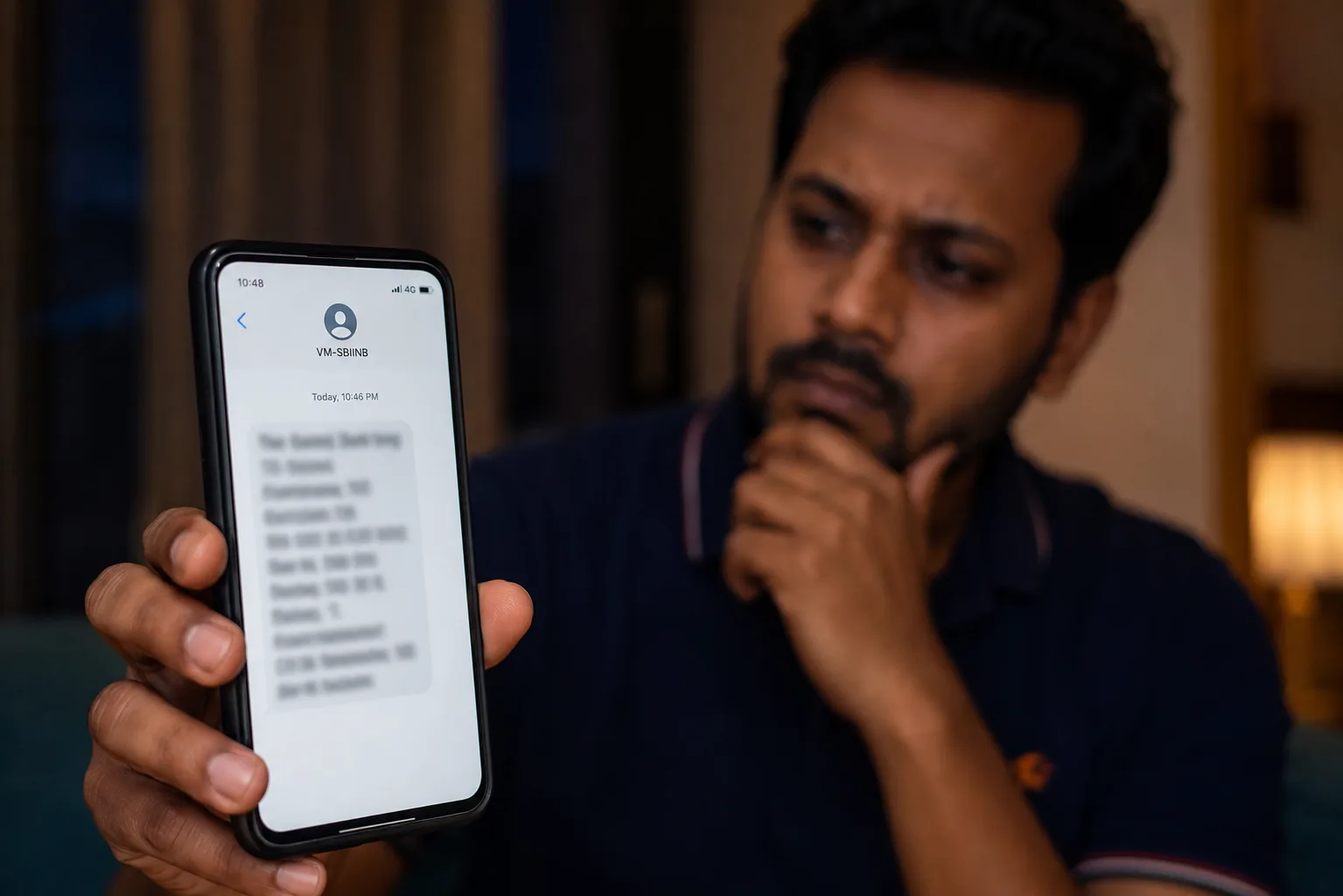
Your salary lands on the 4th. Your SBI personal loan EMI was due on the 2nd. On the morning of the 3rd, an SMS says the auto-debit did not go through.
That is an EMI bounce. The bank tried to collect your EMI, and your account could not pay it.
It feels awful for about an hour. Then you realise thousands of salaried people deal with this every month, often because of a simple date mismatch. An SBI personal loan EMI bounce is common, and it is fixable when you handle it early. SBI EMI bounce charges stay small if you clear the dues fast. They grow the longer the EMI sits unpaid.
Here is what usually follows, in this order:
A failed-debit alert. You get an SMS or email saying the debit instruction failed. This often arrives within a day.
A failed-instruction charge. The bank adds a small fee for the failed debit, usually to your savings account.
A penal charge on the overdue amount. This keeps adding up, day by day, until you pay the EMI.
Reminders. The bank calls or messages you to ask for the payment. In the first few days, these are routine.
Reporting to the credit bureau. If the EMI stays unpaid, your loan can show as overdue on your credit report.
Acting quickly can limit the time an EMI remains overdue. However, paying after the due date does not guarantee that the missed payment will never be reported to a credit bureau.
It helps to see a bounce for what it is. One failed debit is a missed payment. It is not a default yet, and your loan is not “bad” in the bank’s books. What turns a bounce into a bigger problem is time. A few days overdue is a small mark. Several weeks overdue is a different story.
A quick word on scope. This guide covers SBI unsecured personal loans only. Secured loans, such as home loans or car loans, follow different terms and are outside what FREED works on.
If you want the picture across all banks, our guide on what happens when your EMI bounces covers it. Here, we stay with SBI. And the first useful question is why it bounced at all.

Still Paying, But the EMIs Feel Heavy?
See if one lower EMI on one date can work for you.
Reduce My EMIWhy Does an SBI EMI Bounce?
Most bounces have a boring cause. A date that does not line up. A form that never went through. Very few have anything to do with being careless.
These are the 6 reasons that come up again and again:
Not enough balance on the debit date. Even ₹500 short is enough for the debit to fail. The bank tries to take the full EMI in one go, not part of it. So an account holding ₹9,600 against a ₹10,000 EMI bounces just the same as an empty one.
Salary arrived after the EMI date. Say your company pays on the 5th and the EMI is due on the 2nd. You are racing the calendar every month. One late salary and the debit fails.
The auto-debit mandate was rejected or never registered. A NACH mandate (auto-payment permission) lets SBI pull the EMI from your account. Sometimes it gets rejected over a signature or detail mismatch. Often nobody tells you until the first debit fails.
The mandate limit is lower than the EMI. When you signed the NACH form, you set a maximum amount. If the EMI is higher than that limit, the debit fails. It fails even with plenty of money in the account.
Your salary account changed or closed. New job, new bank account. But the mandate still points to the old account, which may now be empty or shut.
A bank holiday or technical issue delayed the debit. Occasionally the system does not process it on time. You did nothing wrong here.
Sometimes the bank will call a failed debit “technical.” In plain words, a mandate problem caused it. Your balance was not the issue. Ask SBI which one it was, because the fix is different for each.
This table puts the causes side by side, so you can match yours quickly.
Cause | How to spot it | What fixes it |
Low balance | Balance on the due date was below the EMI | Fund the account 2 days early |
Salary after EMI date | Salary credit date is later than EMI date | Ask SBI to move the EMI date |
Mandate rejected or missing | Bank says “technical” or “mandate” failure | Register a fresh NACH mandate |
Mandate limit too low | EMI is higher than the limit on your NACH form | New mandate with a higher limit |
Account changed or closed | Debit went to an old bank account | Point the mandate to your current account |
Holiday or system issue | Money was in the account, debit still failed | Ask SBI to confirm and reverse charges |
It also helps to know what your EMI is made of. A short read on how banks calculate your EMI shows why the amount is what it is. It also shows why a change in date or tenure can make it easier to pay.
None of these reasons make you a bad borrower. They make you someone whose dates and limits need a quick fix. And fixing the cause matters, because SBI EMI bounce charges come back every time the same problem does.
How to Know If Your SBI EMI Has Bounced?
Usually the bank tells you. But the message can be easy to miss, especially if it lands among 20 promotional SMS.
Check for these 5 signs:
An SMS or email about a failed debit. SBI usually sends this soon after the due date. If you rely on email, check the spam folder as well. Search your SMS inbox for words like “unsuccessful” or “failed” near your due date.
A failed-instruction charge on your account statement. Look for a small debit with a short description near your EMI date. If you see one, the EMI most likely did not go through. The charge often lands a day or two after the failed attempt.
Overdue status on your loan account. Open the YONO app or SBI internet banking and check the loan account itself. An overdue amount means the EMI is still unpaid. This is the most reliable check of the five.
A reminder call or message from the bank. A polite reminder in the first few days is normal. It is the bank’s routine, not a sign that something serious has started.
Your balance did not drop on the due date. This one is quick. If the EMI amount is still sitting in your account the next day, the debit has probably failed.
One RBI rule is useful here. RBI’s 2023 circular covers penal charges. It says reminders for an overdue loan must mention the penal charges that apply. The bank must also tell you the reason whenever it levies such a charge.
So if your SMS or call only says “please pay” with no detail, you are allowed to ask. Write to SBI and request a breakup of every charge added to your loan. A short message is enough. Mention your loan account number, the EMI date that failed, and ask for each charge with its reason.
Keep that reply safe. If a charge later looks wrong, or the overdue mark does not clear, this is your proof.
Spotting a bounce early is how you keep SBI EMI bounce charges at their smallest. And once you know, the fix takes less time than the worry does.
How to Fix an SBI EMI Bounce Step by Step?
Paying the overdue EMI can stop further overdue accumulation, subject to the applicable loan terms. It may not reverse charges already applied or immediately update your credit report. But that is only part of the fix. If the cause stays, next month looks the same. These 6 steps handle both the money and the reason behind it.
Find the reason for the bounce.
Check whether it was low balance, a low mandate limit or a failed mandate.Pay the overdue EMI.
Use the YONO app, SBI internet banking or your branch to pay the full overdue amount.Save proof of payment.
Keep the receipt, UTR number or a screenshot until your statement shows the EMI cleared.Check your auto-debit mandate.
If the mandate failed or its limit is too low, ask SBI to register a fresh one.Ask for a charge breakup.
The bank must show what it charged and why, so ask for it in writing.Check your credit report later.
After your next cycle, check your SBI CIBIL score for free to confirm the overdue mark cleared.
A small point on step 2. Pay the full overdue amount, not just part of it. A part payment still leaves an overdue balance, and the penal charge keeps running on what is left.
If you are short of money that week, think twice before borrowing from an instant loan app to cover the EMI. It can solve one due date and create two more. Talking to SBI about the delay is usually the safer first move.
If SBI does not reply, or you think a charge is wrong, write to the bank’s grievance officer. Attach your payment proof, the charge breakup and any SMS you received. If that still does not settle it, you can take the complaint to the RBI Ombudsman.
Want to See What a Bounce Did to Your Credit?
Get your score, what is pulling it down and steps to improve it.
Check My Credit InsightsHow Much Are SBI EMI Bounce Charges?
Here is the part that surprises people. SBI does not list one single fee called an “EMI bounce charge” for personal loans. What you pay comes from 2 or 3 different charges, listed in different SBI documents.
This table shows how SBI EMI bounce charges break down in SBI’s own documents. All figures were checked on 13 October 2026.
Charge | As listed by SBI (before GST unless stated) | Where listed |
Failed standing instruction in a loan account | ₹250 + GST | SBI Service Charges list |
Failed NACH mandate | ₹250 + GST | SBI Service Charges list |
Penal charge, overdue up to 60 days | 2.40% a year on the overdue portion, plus applicable tax | SBI personal loan page (updated 06-05-2026) |
Penal charge, overdue continuously beyond 60 days | 5% a year on the overdue portion | SBI personal loan page |
Separate late fee | Not listed | SBI personal loan terms |
So when people search for SBI NACH return charges, the ₹250 plus GST line is the one they usually mean.
A quick word on “overdue portion.” This is the unpaid EMI amount, not your whole loan. So if you owe ₹3 lakh in total and one ₹10,000 EMI is unpaid, the penal charge runs on ₹10,000 only.
Two worked examples make this real. Both use GST at 18%.
Failed standing instruction on a ₹10,000 EMI: ₹250 + ₹45 GST = ₹295.
Penal charge on a ₹10,000 EMI overdue for 30 days: ₹10,000 × 2.40% × 30 ÷ 365 = about ₹20, plus applicable tax.
Here is how the penal charge grows with time, at 2.40% a year, for 3 common EMI sizes:
Unpaid EMI | 7 days overdue | 30 days overdue | 60 days overdue |
₹10,000 | about ₹5 | about ₹20 | about ₹39 |
₹15,000 | about ₹7 | about ₹30 | about ₹59 |
₹25,000 | about ₹12 | about ₹49 | about ₹99 |
Penal charge only, before applicable tax. The failed-instruction charge of ₹250 + GST is separate.
Look at those numbers again. On one missed EMI, SBI EMI bounce charges come to a few hundred rupees. Irritating, yes. Ruinous, no.
The bigger cost lives on your credit report. An EMI that stays unpaid for weeks can be reported as overdue, and every bank you apply to later can see it. A recorded repayment delay may affect future lending decisions, depending on the lender’s assessment and your overall credit profile.
Two cautions before you add anything up. SBI’s service charges list does not say which ₹250 charge applies to a personal loan EMI in your case. And the personal loan page lists SBI penal charges on personal loans with “applicable taxes,” without stating a GST figure. Confirm both with SBI for your own loan before assuming a total. If the debit fails more than once in a month, ask SBI whether a second charge applies.
Rates and ranges shown are indicative. Final terms decided by the bank. FREED is not a Loan Provider. No outcome is guaranteed. Please verify directly with your bank.
If your issue is a credit card bill and not a loan EMI, different rules apply. Our guide on SBI credit card late payment charges and CIBIL impact covers that.

Freed Expert Tip
Keep your EMI amount plus the failed-instruction charge in the account 2 days before the due date.
Fund the account 2 days early.What If You Keep Missing SBI EMIs?
One SBI late EMI payment is a blip. A pattern is different, and repeated SBI EMI bounce charges are usually the first sign of one. When EMIs bounce month after month, the EMIs themselves are often too heavy for the income coming in.
A simple test helps. Add up every EMI you pay, including credit card dues. Divide that by your take-home salary. If a large share of your take-home pay goes towards EMIs and card repayments, your budget may have little room for unexpected expenses. Review your total monthly debt payments alongside essential living costs and savings. For example, ₹34,000 of EMIs on a ₹60,000 salary is about 57%. At that level, one late salary or one hospital bill can tip things over.
There is a sensible order to work through.
Start with the cause. If the problem is a date gap or a low mandate limit, fixing that one thing may stop the bounces completely. Try this first, because it costs you nothing.
Ask SBI about a plan change. If the EMI amount itself is the problem, ask SBI whether it can change your loan plan. One route is SBI’s loan restructuring process (changing the loan plan). Another is an SBI EMI moratorium (a temporary pause), which has its own rules and costs. Approval is the bank’s decision. A longer repayment time also usually means more interest paid overall.
Look at consolidation if you have several loans. If you are still paying them, debt consolidation can help. Debt consolidation may combine eligible debts into a single repayment, if a lender approves the application. Compare the proposed EMI, interest rate, fees, tenure and total amount repayable before deciding. FREED’s Loan Consolidation Plan is built for this, and the next section explains how it works.
Settlement, only when repaying has become impossible. Settlement is not something a borrower chooses out of preference. Banks only consider it when someone is truly unable to repay. For those cases, FREED’s Debt Resolution Program can bring the total down by up to 50%*. The trade-off: a Settled mark stays on your credit report for up to 7 years.
Here is how the options compare:
Option | Who it suits | Effect on your EMI | Effect on your credit report | Who decides |
Fix the date or mandate | Bounces caused by timing or paperwork | Same EMI | None, once paid on time | You and SBI |
Change the loan plan | One SBI loan with an EMI that is too high | Lower EMI, longer repayment time | May be noted on your report | SBI |
EMI moratorium | A short, temporary cash gap | Pause for a period | Depends on how the bank records it | SBI |
Consolidation | Several loans, still paying | One lower EMI | Score starts to improve once payments are regular | Lending partner |
Settlement | Genuinely unable to repay | Lump sum, no EMI | Settled mark for up to 7 years | Bank |
If bounces keep happening, this is what they can lead to:
Overdue reporting. Each month an EMI stays unpaid can show on your credit report. A longer delay looks worse than a short one.
Recovery calls. As dues build up, the bank and its agents will contact you more often.
Legal action, for cheque-based repayment. If you pay your EMI by cheque and it bounces, legal action is possible. This falls under Section 138 of the NI Act (the law on cheque bounce). Our guide on how a bounced cheque affects your CIBIL score explains more.
How Can FREED Help If EMIs Keep Bouncing?
Maybe you pay on time most months. But your SBI personal loan EMI of ₹9,000 is due on the 2nd. A credit card bill of ₹6,500 is due on the 10th, and a loan app EMI of ₹5,000 on the 15th. Salary lands on the 7th. One late salary, something bounces, and fresh SBI EMI bounce charges land on top.
That is ₹20,500 going out across 3 dates, with 3 chances to miss. When that keeps happening, the trouble usually comes from too many dates and too much going out each month. So the fix is one EMI, on one date, at a lower amount.
That is what FREED’s Loan Consolidation Plan does. It is for people who can still repay but need a smarter way to manage their debt. The idea is to step in before things get worse, not after.
It works in 3 steps:
Share your loans on the FREED app. Add each loan and card, with its EMI and the amount left to pay.
Get matched to a lending partner. FREED looks at your financial profile. It then matches you with a suitable lending partner from its network.
One new loan pays off the old ones. The old loans are cleared, and you pay one EMI to one lender.
The EMI amount is reduced, which leaves more room in your salary each month. With one date to track, the scramble before every due date goes away. You can set that one date just after salary day, so the bounce problem has nowhere to start.
If one lending partner says no, FREED tries other partners that match your profile. One rejection does not end the process.
Making repayments on time can support a healthier credit history over time, but the effect on your credit score depends on your overall credit profile and how lenders report the accounts. Be clear on one thing, though. Consolidation prevents new bounces. It does not erase old ones from your report. Those fade as your on-time record grows longer.
FREED does not charge you a fee for consolidation. If the new loan has a processing charge, that belongs to the lending partner. The whole process runs online.
Not sure how stretched you are right now? Your EMI Score shows how much of your salary goes to EMIs. Full details sit on the Loan Consolidation Plan page.
Already missed an EMI or two and unsure if you qualify? FREED’s team can look at your situation and tell you which options are open to you.
Rates and ranges shown are indicative. Final terms decided by the bank. FREED is not a Loan Provider. No outcome is guaranteed. Please verify directly with your bank.
Missing EMIs Because the Total Is Too High?
See if one lower EMI can replace them all.
Reduce My EMIHow Much Does an EMI Bounce Affect Your CIBIL Score?
Honest answer: it depends, and mostly on time. A bounce you pay within a few days matters far less than one left overdue for weeks.
Two things decide the effect. How long the EMI stays unpaid, and how often it happens.
Banks report how many days past due (DPD, the number of days a payment is late) your account is. Think of DPD as a counter. It starts the day after your due date and stops the day you pay. Pay on day 4, and the counter stops at 4. Leave it, and it climbs to 30, 60, 90 and beyond. Lenders reading your report pay close attention to how high that counter went.
SBI’s personal loan terms say the bank may share your loan information with credit bureaus. So an overdue EMI can reach your report. And RBI is moving lenders to weekly reporting of credit data. That means an overdue mark may show up faster than it used to.
There is a good side to faster reporting too. After you pay, the lender’s next reporting update may reflect the payment. Check your credit report after allowing time for processing, and dispute any information that remains inaccurate. Paying SBI EMI bounce charges is the easy part. Keeping the overdue days low is what protects your score.
What pulls a score down over time is the pattern. One cleared bounce in 2 years tells a lender very little. A bounce every second month tells them a lot. It suggests your income and your EMIs are not matching, and that worries a new lender more than any single late payment.
What if you paid, but the report still shows the EMI as overdue? This happens sometimes. Raise a dispute with the credit bureau and attach your payment proof. Also write to SBI and ask it to send corrected data to the bureau.
You will not find a fixed “points lost” figure here. Anyone quoting an exact drop for one bounce is guessing, because it depends on your whole credit history. Our explainer on the impact of a late payment on your credit score goes into more detail.
Want a rough idea for your own case? The simulator below shows an indicative range.
Are You in a Loan Trap? Quick Check
Move the slider to your total EMIs as a % of monthly salary. See your debt stress level instantly.
EMIs as % of Monthly Salary
How to Stop EMI Bounces in Future?
The good news? Most bounces are preventable with a few small habits. Fewer bounces means no SBI EMI bounce charges to pay at all. None of these habits take more than 10 minutes to set up.
Ask the bank to move your EMI date to just after salary day. Even a 3-day shift can end the monthly scramble. Not every bank allows it, so ask SBI directly. If your salary comes on the 1st, an EMI on the 5th gives you a cushion every month.
Keep the EMI amount in the account 2 days early. That buffer covers a late salary credit, a holiday or a slow transfer. Some people keep one extra EMI parked in the account as a safety cushion.
Check that your mandate limit is at least the EMI. If your EMI has gone up since the loan started, the old limit may no longer cover it. Ask SBI what limit your NACH mandate carries.
Turn on SMS and app alerts for debits. You will know the same day if a debit fails. Paying the next day keeps penal charges close to zero.
Set a calendar reminder before the due date. 3 days before works well. A quick balance check takes less than a minute.
Keep proof of every payment. Save receipts and screenshots in one folder on your phone. If there is ever a dispute, you have the answer ready.
Update the mandate when you change jobs or banks. Do it in the same week you open the new salary account. This one step prevents a bounce many people never see coming.
Reminder calls are normal when an EMI is overdue. But if a call ever turns abusive or threatening, you do not have to handle it alone. FREED Shield is open to everyone, enrolled or not. It helps you understand your rights as a borrower and document and report harassment through the right channels.
One bounce does not define your loan, or you. Pay it, fix the reason behind it, and the next due date can go through quietly.
Sources
Claim | Source | Link |
Penal charge 2.40% a year on irregular portion up to 60 days; 5% a year beyond 60 days. Page “Last Updated On 06-05-2026” (re-verified 13 Oct 2026) | SBI Personal Loan page | https://sbi.bank.in/web/personal-banking/loans/personal-loans/sbi-personal-loan |
Failed standing instruction in a loan account ₹250 + GST; failed NACH mandate ₹250 + GST | SBI Service Charges list (document says updated as on 30.09.2025) | |
Bank may share loan information with credit bureaus; no separate late fee listed; penal charges plus applicable taxes | SBI Personal Loans MITC | |
Penal charges not penal interest; no further interest on them; disclosure in agreement; reminders must state charges and reason; credit cards excluded | RBI/2023-24/53, Fair Lending Practice, Penal Charges in Loan Accounts | https://www.rbi.org.in/Scripts/NotificationUser.aspx?Id=12527 |
RBI moving lenders to weekly credit data submission | RBI press release, Dec 4, 2025 | https://rbi.org.in/Scripts/BS_PressReleaseDisplay.aspx?prid=61742 |

Mohit Juneja
Mohit Juneja is FREED’s Content & Communication Lead with 12+ years of experience across content, media, advertising and digital communications. He holds a postgraduate diploma in Communications from Xavier Institute of Communications, Mumbai, and has worked with organisations including NDTV, The Indian Express, McCann Worldgroup and NABARD.
At FREED, he leads content and communication across loan management, debt resolution, debt consolidation and financial well-being. His work combines research, storytelling and consumer-focused communication to make complex financial topics easier to understand and act on. He has also scripted and produced 11 documentaries on rural development and agriculture for NABARD, with film's selected for the Mumbai International Film Festival.
mohit.juneja@freed.care

FREED is India's trusted loan management platform. Founded in 2020 and headquartered in Gurugram, FREED has counselled 20 lakh+ people on personal loans, credit cards, and app loans. FREED charges fees only on successful settlement, not upfront. FREED does not handle secured loans (home loans, car loans, gold loans).
Media Mentions