Remove Negative Items From Your CIBIL Report
How to remove negative items from a credit report: you can't remove an entry that's correct. You can dispute one that's wrong, and you can change what's reported by paying the dues and getting the lender to update the account status. CIBIL lets you raise a dispute online, and says it may take about 30 days to resolve.

Mohit Juneja
Reviewed by FREED India, Debt Resolution Specialists
 4.7/5
 ₹3,200Cr+
 20,000+
 20,00,000+4.7/5₹3,200Cr+20,000+20,00,000+
Key Summary

A correct negative entry can't be removed on request. A wrong one can be disputed.
CIBIL's FAQ says you can raise a dispute online, and dispute more than one field in a single dispute.
While a dispute is open, CIBIL marks the item "Under Dispute". It may take approximately 30 days to resolve.
Under RBI rules, the lender has 21 days to send corrected details, and the bureau pays ₹100 a day when a complaint isn't resolved in 30 days.
Anyone who promises to delete correct entries for a fee is promising something they can't deliver.
Paying dues and keeping later payments on time is the route that works for entries that are accurate.
Can You Remove Negative Items From Your Credit Report?
It depends on whether the entry is true. If it's wrong, yes, you can fight to have it corrected. If it's right, no, not on request.
That's the honest answer to how to remove negative items from a credit report, and it's the one that saves you money. A credit report is a record of what lenders reported. A bureau can't delete a true record because you'd like it gone, and neither can anyone who charges you to try.
What you can do, when you ask how to remove negative items from a credit report, is split your problem in two. First, find the entries that are actually wrong: a loan that isn't yours, a payment marked late when you paid, a closed account still shown open. Dispute those. Second, for the entries that are true, fix the account and let time and good payments do the work.
What Counts as a Negative Item on a CIBIL Report?
Negative items are entries that tell a lender you had trouble paying. The common ones are:
- Late payments on a loan or card.
- Defaults where an account went seriously overdue.
- Settled status, meaning the lender accepted less than the full amount.
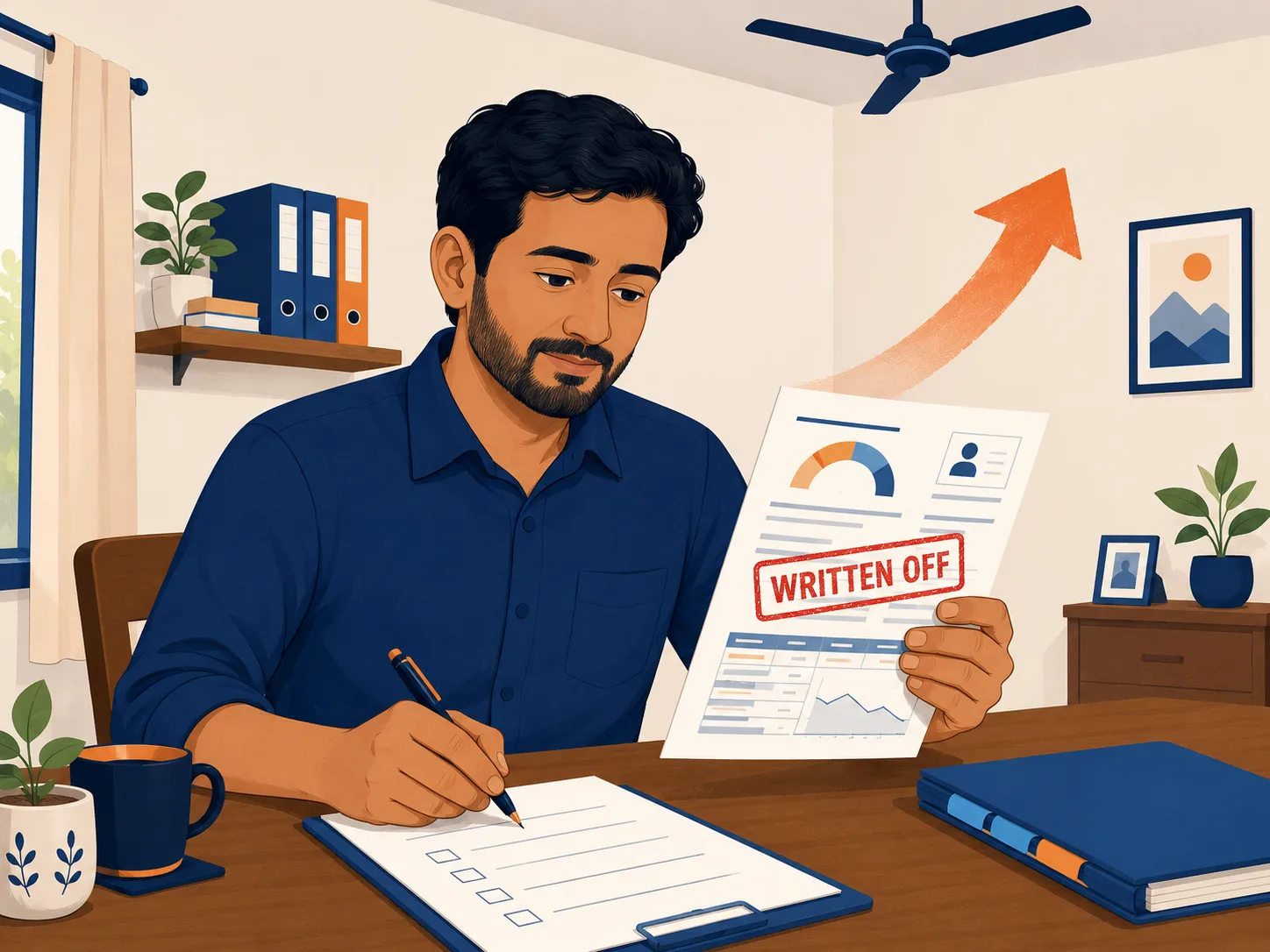
- Written-off status, where the lender has treated the balance as a loss.
- Too many enquiries in a short time.
- High card balances against the limit.
CIBIL's card-payment guide says that a payment reported as "Settled" or "Written off" will affect your access to credit in the future. It also says part-payments and minimum payments indicate difficulties in repaying dues. For the terms in detail, see our guides on what written off means and suit filed and wilful default.

Not Sure Which Entries Are Wrong?
See which options fit your situation on FREED.
See My Options on FREEDHow Do You Spot an Entry That's Wrong?
Start by getting your report. RBI's directions give you one Free Full Credit Report, including your score, once during January to December from each credit information company. CIBIL's FAQ says the same in its own words: one CIBIL Score and Report without any charge once a year. Then check line by line.
Look for:
- Accounts you don't recognise, which may mean identity misuse or a mix-up.
- Payment status that doesn't match your records: a bill you paid on time shown as late.
- Closed accounts shown as open, or the reverse.
- Wrong balances or limits.
- Duplicate accounts, where one loan appears twice.
- Enquiries you didn't authorise.
- Personal details that are wrong: name, PAN, address, date of birth.
Keep your own proof ready: bank statements, closure letters, no-dues certificates and payment receipts. A dispute without proof is a request. A dispute with proof is a case. For reading the report itself, see our guide on how to read a CIBIL report.
How Do You Dispute a Wrong Entry With CIBIL?
How to remove negative items from a credit report starts with a dispute. CIBIL's FAQ says you can raise disputes online when you find discrepancies or inaccuracies. The steps its page names:
- Log in to your CIBIL account and open your report.
- Raise a dispute online for the field or account that's wrong.
- Combine fields if needed. CIBIL says you can dispute multiple fields and information in a single dispute.
- Track it. CIBIL marks the relevant field, account or section on your report as "Under Dispute" while it's open.
CIBIL states that dispute resolution takes approximately 30 days, depending on how quickly the concerned credit institution responds. The disputed information remains marked as "Under Dispute" in the report until the dispute is resolved. For the full process, read our guide on disputing wrong entries.
What Does the Lender Have to Do?
The bureau doesn't own the data. The lender reports it, so the lender has to confirm or correct it. RBI's directions say the lender has 21 days to send corrected details, and the bureau pays ₹100 a day if a complaint isn't resolved within 30 days. Disputes about how a score is calculated are excluded.
In practice, write to the lender too. Attach your proof, ask for the correction to be reported to all bureaus, and keep the reference number. Then check the report again once the reply arrives. If you're still stuck, our guide on soft vs hard enquiries will help you sort enquiry questions from true errors.

See Your Report in One Place
Check your credit report with FREED Credit Insights.
Check My Credit InsightsCan Paying Off the Dues Remove a Negative Entry?
Paying overdue dues can bring an account up to date, but it does not erase accurate repayment history. Once you clear the outstanding amount, the lender can update the account status in the credit report. Any previously reported late payments may remain visible. Check your report after the lender has submitted the updated information to ensure the account status is correct.
For credit cards, RBI directions require the issuer to update the account status with the credit information company within 30 days of settlement if the cardholder settles the dues after being reported as a defaulter. So after you pay, check the report in about a month. If the old status is still there, write to the lender with proof of payment.
This is the part many people get wrong. They pay and assume the report cleans itself. It only updates when the lender sends the new data.
What Is a Settled or Written-Off Entry, and Can It Be Changed?
A settled entry means the lender accepted less than the full outstanding amount as settlement. A written-off entry means the lender has classified the outstanding amount as a loss for accounting purposes. Neither status means that the original repayment obligation has automatically disappeared. Both can affect how future lenders assess your credit profile.
CIBIL's card-payment guide says that a payment reported as "Settled" or "Written off" will affect your access to credit in the future. We don't give a fixed number of years, because the CIBIL pages we read don't state one. For the practical steps, read our guides on clearing a written-off entry and how lenders view settled accounts.
If the entry is accurate, it can't be removed on request. What you can do is keep every later payment on time, so the newer history carries more weight over time.
How Long Do Negative Items Stay on Your Report?
CIBIL's own wording is the best guide we found. Its card-payment guide says a missed payment can affect your score for as far ahead as the next two years, and that it will remain visible on the report for 36 months. The page is undated, so check CIBIL's current wording before you quote it.
We haven't found a CIBIL page that gives a single period for every kind of negative entry, so don't assume one. Settled and written-off entries in particular should be checked against CIBIL's current guidance.
Your Rights if Something on Your Report Is Wrong
- You're entitled to one Free Full Credit Report, including your score, once during January to December from each credit information company.
- If a complaint about your credit information isn't resolved within 30 days, the company pays ₹100 a day. The lender has 21 days to send corrected details.
- Disputes about how a score is calculated are excluded.
Sources: RBI/DOR/2025-26/378 and cibil.com/freecibilscore
Should You Pay Someone to Remove Negative Items?
Be careful with anyone selling how to remove negative items from a credit report. If an entry is correct, nobody can have it deleted on request, and a company that says otherwise is selling something it can't deliver. If an entry is wrong, you can dispute it yourself, online, at no cost to you beyond your time.
Warning signs: a guaranteed score, an upfront fee, a request to hand over your CIBIL login or OTP, or a promise to "delete" settled or written-off status. Don't share your OTP, PAN or login details with anyone who contacts you first.
What If the Lender Won't Correct a Wrong Entry?
Escalate in writing if your attempt to remove negative items from a credit report stalls. Send the lender your proof and ask for a written reply with a reference number. Then check whether CIBIL has marked the item "Under Dispute", and whether the 30-day period CIBIL mentions has passed.
If the lender still doesn't act, use the bank's grievance route and then the regulator's complaint route. Keep copies of everything. A dated paper trail is the strongest thing you can bring.
Does Disputing an Entry Hurt Your Score?
The CIBIL FAQ pages we read don't say that raising a dispute lowers your score. They say the relevant field is marked "Under Dispute" while it's open. What we haven't found is how lenders treat that marker, so we don't claim anything there.
A wrong entry that stays does more harm than a dispute that runs, so don't hold back if you've got proof.

FREED Expert Tip
Dispute everything that's wrong in one go. CIBIL says you can dispute multiple fields and information in a single dispute, so one proof pack can cover all of them.
Check My Credit InsightsCan You Remove Enquiries From Your Report?
Only the wrong ones. A correct enquiry reflects a real application and stays as the bureau records it. CIBIL says too many loan enquiries may have a negative impact on your score, so the practical fix is to apply less often.
If you find an enquiry you didn't authorise, write down the lender, the date and the reference and dispute it. Don't assume it's a mistake until you've checked your own records, because a comparison site you used may have triggered one. For the difference between enquiry types, read our guide on hard enquiries.
What If There's an Account You Never Opened?
Treat it as a priority. It could be a data mix-up or someone using your identity. Raise a dispute with CIBIL for that account and write to the lender named on it, with a request to investigate and confirm in writing.
How Do You Rebuild After Negative Entries?
When you can't remove negative items from a credit report, you rebuild with new, good history. A correct negative entry stays as the record shows it. What changes is what comes after it.
- Pay every EMI and card bill on time. This is the heaviest lever, going by CIBIL's wording.
- Keep card balances low against the limit. CIBIL says high utilisation may hurt.
- Apply sparingly, since too many enquiries may hurt.
- Clear small overdue dues so they stop appearing as fresh problems.
- Check your report every few months to see what changed.
Our guides on how to build a credit score and steps to rebuild after a loan default cover the day-to-day habits.
Does CIBIL Keep a Defaulters List You Can Be Removed From?
CIBIL says it doesn't keep one. Its loan-rejection FAQ states that it doesn't maintain a defaulters list. What lenders see is your report, with each account's status as the lender reported it.
That's why "remove my name from the CIBIL list" is the wrong goal. The right goal is a report where every entry is accurate and the recent ones show on-time payments.
Why Does an Entry Come Back After a Dispute?
Because the lender may have confirmed it. A dispute asks the lender to check; if the lender confirms the data is right, the entry stays. CIBIL's FAQ says resolution time depends on the credit institution's response.
If that happens, ask for the lender's reason in writing. Compare it with your proof. If you still disagree, escalate through the lender's grievance route.
What Mistakes Make It Harder to Remove Negative Items From Your Credit Report?
- Paying a company to "delete" correct entries.
- Disputing an entry without proof.
- Disputing one field at a time when CIBIL lets you dispute several in one.
- Not checking after paying off dues, so a stale overdue status stays.
- Applying for credit during the dispute, which adds enquiries.
- Sharing OTPs or logins with anyone who offers to help.
How Does FREED Help You Clean Up Your Credit Report?
FREED Credit Insights shows your credit report and score and points to what's holding the score back, which helps you spot entries worth disputing. It reads your Experian report, so the number can differ from your CIBIL score.
Over 30,000 borrowers have used Credit Insights, and over 20 lakh people trust FREED. FREED isn't a loan provider. Credit Insights explains your report. It doesn't remove correct entries. For wrong ones, you raise the dispute with the bureau and the lender.
You can start on the Credit Insights page.
What If the Negative Entries Come From Debts You Can't Repay?
Then no dispute will fix it, because the entries are true. Match the fix to your situation.
- Still paying, but stretched. If most of your salary goes towards paying multiple EMIs, FREED's Loan Consolidation Plan helps you combine multiple loans into a single monthly EMI. This can reduce your monthly EMI burden by up to 50%.* It's only for people who are still paying. Read more about the Loan Consolidation Plan.
- Unable to repay your loans in full? If you are facing serious repayment difficulties, you may explore loan settlement as a possible option. Under this arrangement, the lender may agree to accept a reduced amount towards the outstanding dues. Settlement terms depend on the lender's decision and the borrower's circumstances. Remember that a settled status can affect your future access to credit.
Rates and ranges shown are indicative. Final terms decided by the bank/lender. FREED is not a Loan Provider. No outcome is guaranteed. Please verify directly with your bank.
Outcomes vary by lender and borrower profile. Settlement terms are decided by the lender. No percentage is guaranteed.
Settlement leaves a settled status on your report, which CIBIL says will affect your access to credit in the future. Weigh that before you choose it.


Mohit Juneja
Mohit Juneja is FREED’s Content & Communication Lead with 12+ years of experience across content, media, advertising and digital communications. He holds a postgraduate diploma in Communications from Xavier Institute of Communications, Mumbai, and has worked with organisations including NDTV, The Indian Express, McCann Worldgroup and NABARD.
At FREED, he leads content and communication across loan management, debt resolution, debt consolidation and financial well-being. His work combines research, storytelling and consumer-focused communication to make complex financial topics easier to understand and act on. He has also scripted and produced 11 documentaries on rural development and agriculture for NABARD, with film's selected for the Mumbai International Film Festival.
mohit.juneja@freed.care

FREED is India's trusted loan management platform. We help India settle their loans, consolidate their EMIs, improve their credit score, and manage their loans better. Over 20 lakh people trust FREED. We have managed more than ₹3,500 crore in loans and saved our users over ₹450 crore.
Media Mentions