Payday Loan Settlement in India: Is It Possible and How It Works
Payday loan settlement is a negotiated arrangement in which a lender agrees to accept a reduced amount to resolve specified outstanding dues, subject to written terms and conditions. A settlement is not guaranteed, and the lender decides whether to make an offer based on its applicable policy and the borrower’s circumstances. If you borrowed through a loan app, identify the lender named in your loan agreement and Key Fact Statement (KFS) before discussing settlement.
Mohit Juneja
Reviewed by FREED India, Debt Resolution Specialists
 4.7/5
4.7/5 ₹3,200Cr+
 20,000+
 20,00,000+4.7/5₹3,200Cr+20,000+20,00,000+
KEY TAKEAWAYS

Payday loan settlement is possible in India only when an RBI-registered bank or NBFC stands behind the app.
RBI’s public directory of digital lending apps helps you check which regulated lender runs your app.
A settled loan carries a “Settled” mark on your credit report for up to 7 years.
Settlement can bring the amount down by up to 50%*, but the bank or NBFC makes the final call.
RBI rules bar digital lending apps from reading your contact list, call logs or files.
What Is Payday Loan Settlement?
Payday loan settlement means the regulated lender behind your loan app agrees to accept less than the full dues as the final payment. Once you pay that amount, the matter on that loan ends. Your credit report then shows a Settled mark, which is different from a loan paid back in full.
The word “payday loan” comes from the US, where people borrow against their next salary. In India, most people say “instant loan app” or just “loan app”. The product works in a similar way:
A small, short-term unsecured loan. Unsecured means nothing is pledged against it, unlike a gold or home loan. Amounts are often a few thousand rupees, sometimes a few tens of thousands.
Given through an app. Approval can take minutes, often with very little paperwork. That speed is what makes these loans popular in an emergency.
Repaid in one go, usually within a few weeks. Many of these loans are not split into monthly EMIs. The full amount plus fees falls due on a single date.
Here is how a payday loan usually differs from a regular personal loan:
Payday / instant app loan | Regular personal loan | |
Amount | Small, often a few thousand rupees | Larger, often lakhs |
Repayment | Usually one lump sum within weeks | Monthly EMIs over months or years |
Approval | Minutes, mostly through an app | Days, with more paperwork |
Cost | Fees can be high relative to the amount | Interest spread across the term |
What settlement means for these loans. The bank or NBFC (non-banking finance company) behind the app agrees to accept a smaller amount as “full and final”. After you pay, the account is marked “Settled”, not “Closed”.
Closure vs settlement. Repaying a loan in full is generally reported differently from settling it for less than the full amount, but earlier missed payments may still appear in your credit history.
A settlement means the lender accepted less, and the Settled mark on your credit report shows that for years.
Settlement is not something a borrower chooses out of preference. Banks and financial companies only consider it when you are in a genuine financial difficulty and are truly unable to repay the full amount.
A worked example. Say you have ₹42,000 outstanding across 3 app loans: ₹12,000, ₹18,000 and ₹12,000. Your income has dropped, and paying all 3 in full is out of reach. Say the lender behind the ₹18,000 loan agrees to a lower one-time amount of ₹11,000. Once you pay it, that loan is settled. The other 2 loans still need their own handling, with their own lenders. (Example figures only. Each lender decides its own terms.)
A lender may agree to waive part of the outstanding dues, but the amount depends on its decision and the circumstances of the loan. Do not assume a particular reduction will be offered before receiving a written settlement proposal.
For the wider picture of how loan settlement works across all loan types, read our complete guide.
So why do such small loans become so hard to repay so quickly? That comes next.

Missed Payments on Loan Apps? Get a Plan to Settle Them
Talk through your loans with a FREED counsellor.
Start My Debt AssessmentWhy Do Payday Loans Become So Hard to Repay?
A ₹8,000 loan for a hospital bill. Due in 30 days. Salary came late.
That is how it starts for many people. Nothing reckless, just a rough patch at the wrong moment. Then the way these loans are built makes it hard to catch up.
The full amount plus fees is due at once. There is no small EMI to manage. If your salary is late by even a week, the whole repayment is suddenly out of reach.
A second app loan repays the first. It feels like a quick fix. But now there are 2 loans, each with its own fees and its own due date.
Late charges and extension fees pile up. Each missed date adds charges. Some apps offer to push the due date for a fee, which adds cost without reducing what you owe.
Within a few months, 3 or 4 loans run together. Each one looks small on its own. Together, they eat a big part of your salary.
Short due dates leave no breathing room. A regular loan gives you a month between EMIs. A payday loan may give you only 2 or 3 weeks to find the full amount.
An illustration of how it grows. These figures are only an example, not any app’s actual rates.
Month | What happens | Total owed |
1 | Borrow ₹10,000; ₹1,800 fees and interest due with it | ₹11,800 |
2 | Cannot pay; extension fee and late charges added | about ₹13,500 |
3 | Take a second app loan to pay part; its fees added | about ₹15,500 |
4 | Another late month on what remains | about ₹17,000 |
In 4 months, a ₹10,000 loan has become about ₹17,000 of total dues, spread across 2 apps. This cycle of rolling one loan into another is how a debt trap forms.
A line worth watching. If your loan dues and EMIs together take more than 50% of your take-home salary, you are heading into trouble. Here is what that line looks like at different salaries:
Take-home salary | 50% line | If loan dues are above this |
₹20,000 | ₹10,000 | Too little left for rent and food |
₹25,000 | ₹12,500 | Essentials start getting squeezed |
₹35,000 | ₹17,500 | One emergency can tip things over |
None of this means you did something wrong. These loans are built to be fast and easy. That same speed makes a small gap grow quickly.
Before thinking about settlement, though, there is a more basic question. Is the app you borrowed from even a legal lender?
Is Payday Loan Settlement Possible in India?
A borrower may request settlement of an instant loan, but the lender decides whether to offer it and on what terms. If you borrowed through an app, first identify the bank or NBFC named in your loan agreement and Key Fact Statement (KFS).
Some apps operate as digital platforms or work with a regulated lender. Check your loan documents to establish which entity provided the credit and which official channel handles repayment, complaints and settlement requests. Obtain any settlement offer from an authorised lender channel and verify its terms before paying.
Here is how the roles usually split:
The loan app | The regulated lender (bank or NBFC) | |
What you see | The app name and screens | Often only in your loan papers |
What it does | Takes applications, sends reminders | Lends the money, sets the terms |
Who you settle with | Not the app alone | Yes, the lender decides |
Who issues the settlement letter | Not the app alone | The lender |
To find the lender, check these in order:
Your loan agreement. It names the bank or NBFC that lent you the money. Look near the top or in the signature section.
Your Key Fact Statement (KFS, the one-page summary of your loan). It shows the lender, the charges and the total cost.
The sanction SMS or email. Many approvals name the lender at the bottom of the message.
RBI’s directory of digital lending apps. It sits under the Citizen’s Corner on RBI’s website. It has been live since 1 July 2025 and shows which regulated lender is linked to which app.
Once you know the lender, write to its grievance or collections team. This is the team that can make a real settlement offer.
If Your App Is Not Registered With RBI
Some apps lend without any regulated lender behind them. Settling with such an app is risky. There is no regulated lender to issue a valid settlement letter, and no proper reporting to a credit bureau. Money paid may not be recorded anywhere you can rely on.
These signs suggest an app may not be backed by a regulated lender:
No lender name appears anywhere in your loan papers or messages.
The app does not appear in RBI’s directory of digital lending apps.
You were asked to pay into a personal account or a personal UPI ID.
In this situation, the right move is to report the app, not to negotiate with it. Our guides on filing a fake loan app harassment complaint and illegal app loans in India explain the steps. This is general awareness, not legal advice for your specific case.
What About Harassment?
Many app borrowers face calls to family members or people in their contact list. That can feel deeply embarrassing. RBI’s Digital Lending Directions, 2025, say apps must not access your contact list, call logs or phone files. The lender must also share the recovery agent’s details with you before the agent contacts you.
If calls turn abusive or threatening, FREED Shield, available to everyone, helps borrowers document and report harassment through the right channels.
So before any payday loan settlement, find your lender. Everything else depends on that answer.

What the Law Says
RBI’s Digital Lending Directions, 2025, contain requirements on access to mobile-phone resources by digital lending apps. Check the relevant provisions to understand the applicable restrictions and responsibilities.
Get Help With HarassmentWhen Should You Think About Payday Loan Settlement?
Settlement is for one situation only: when repaying in full is no longer possible.
Go through these signs honestly. Tick each one that fits you.
Payments have slipped for a few months, not one day. A one-day delay is a timing problem. Months of missed payments point to something deeper than timing.
You take new app loans only to repay old ones. None of the new money reaches your daily needs. It goes straight to the last lender, and the total keeps rising.
Loan dues plus EMIs cross 50% of your take-home pay. On a ₹30,000 salary, that means more than ₹15,000 a month goes to loans. There is too little left for life.
Essentials are being skipped. Rent is late, school fees are pending or medicines are being cut. When basics suffer, the loans have taken over.
No realistic income change is coming. You cannot see a raise, a new job or any other money arriving in the next few months.
You cannot arrange even one full repayment. Not this month, and not with help from family either.
How to read your ticks:
Ticks | What it usually means |
0 to 1 | A timing problem. Ask the lender for more time first. |
2 to 3 | You are stretched. Consolidation may fit if you are still paying. |
4 or more | Full repayment may no longer be realistic. Payday loan settlement may be your path. |
This is a rough guide, not a rule. Your full situation matters more than any count.
If you are still making repayments but struggling to keep up, ask your lender about possible adjustments before deciding on settlement. Consolidation may be an option if you qualify, but compare the interest rate, fees, tenure and total repayment amount. Neither a revised repayment plan nor consolidation guarantees a particular credit-report outcome.
Settlement leaves a mark for years, so it makes sense only when nothing else will work.
If you land in the middle, that is normal too. Many people do. A conversation with someone who sees these cases every day can help you see which side you are on.
Once you are sure settlement is the right path, here is how it works.
How Does Payday Loan Settlement Work, Step by Step?
A payday loan settlement follows a clear order. You can follow these steps yourself, one loan at a time.
Find the real lender.
Check your loan papers or RBI’s app directory for the bank or NBFC name.List every app loan.
Note the amount borrowed, interest added and late fees for each, separately.Work out what you can pay.
Count a one-time amount you can arrange without new borrowing.Write to the lender, not the agent.
Email the NBFC’s grievance or collections team and explain your situation.Share proof of difficulty.
Attach salary slips, a job loss letter or medical bills, whatever applies.Get the offer in writing.
Never pay on a phone promise; wait for a signed settlement letter.Pay through official channels and keep the letter.
Pay only to the lender’s account, then save the receipt and letter. If this feels like too much to handle alone, FREED’s counsellors can help.
Step 2 in practice. A simple list keeps you clear-headed. For example:
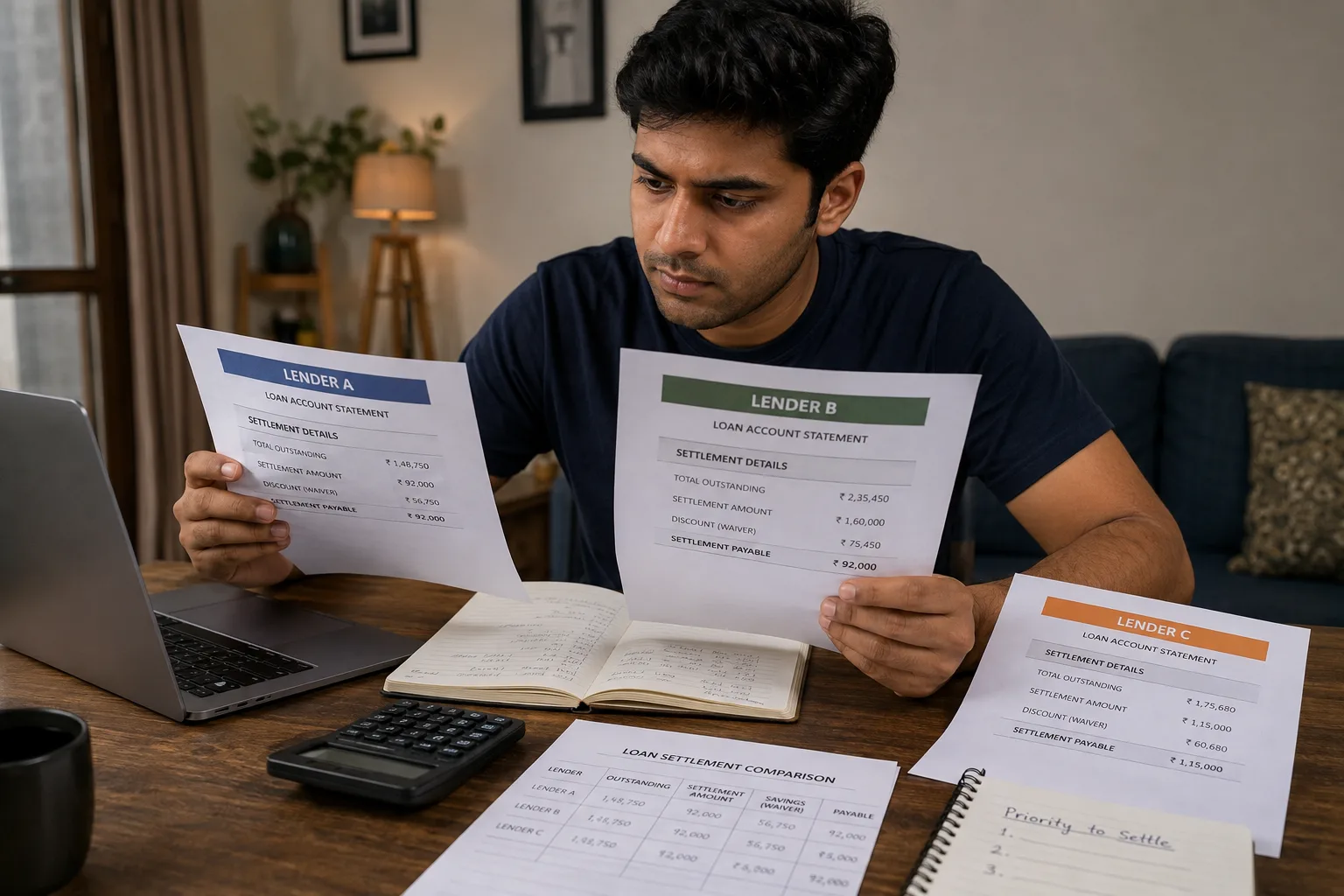
App loan | Borrowed | Interest and fees added | Late charges | Total shown |
Loan A | ₹10,000 | ₹1,800 | ₹1,700 | ₹13,500 |
Loan B | ₹15,000 | ₹2,400 | ₹1,100 | ₹18,500 |
Loan C | ₹8,000 | ₹1,200 | ₹800 | ₹10,000 |
(Example figures only.) This tells you what each lender is really asking for, and where the extra amounts came from.
Step 4 in practice. A short, honest email works best. Include:
Your full name, registered mobile number and loan account number.
The name of the app and the lender.
What changed, in 1 or 2 lines, such as a job loss or a medical bill.
The one-time amount you can realistically arrange.
A clear request: “Please share any settlement offer in writing.”
Step 5 in practice. Match the proof to your situation:
Your situation | Proof that usually helps |
Job loss | Termination or relieving letter, last salary slips |
Pay cut | Old and new salary slips |
Medical emergency | Hospital bills, discharge summary |
Business slowdown | Bank statements showing the drop |
The written settlement offer is key evidence of the agreed terms. Keep it with the payment receipt, bank record and related correspondence. Before paying, check that the document identifies the lender and account, specifies the agreed amount and deadline, explains any conditions, and states how the lender will treat the outstanding dues once those conditions are met.
Check what a valid settlement letter should include before you pay a single rupee of any payday loan settlement.

Freed Expert Tip
Pay only after the settlement letter names the lender, the exact amount and “full and final settlement”.
Settle My LoansHow Does Payday Loan Settlement Affect Your CIBIL Score?
Your account will show as “Settled”, not “Closed”, and your score will drop. That is the honest trade-off of any payday loan settlement.
Here is what to expect, in order:
The Settled mark stays for up to 7 years. Any lender who checks your report during that time will see it.
The score drop is often significant. A drop of around 75 to 100 points is commonly seen, though it is not a fixed rule. The real figure depends on your full credit history.
New loans get harder for a while. Lenders read “Settled” as a sign that the full amount was not paid. Approvals may be slower, and rates may be higher, in the short term.
The same lender may not lend to you again soon. Under RBI’s 2023 settlement framework, there must be a gap of at least 12 months before the same bank or NBFC lends to you again.
Recovery is possible. On-time payments on what remains, low credit card use and checking your report for errors all help over time.
A worked comparison. Think of 2 versions of the same ₹15,000 app loan:
Unpaid and overdue | Settled | |
Each new month | Adds another missed-payment mark | No new missed-payment marks |
Recovery calls | Usually continue | Should stop on that account |
What lenders see | An account still being missed | An account that ended with a Settled mark |
Your next step | The problem keeps growing | You can start rebuilding |
Neither is ideal. But an overdue loan keeps hurting every month, while a settled one stops adding new damage.
What rebuilding looks like. Recovery is slow but real. In the months after settlement, these steps help:
Pay every remaining EMI and bill on time. Each on-time payment adds fresh, positive history.
Keep any credit card use low. Use a small part of the limit and clear it in full.
Avoid many loan applications at once. Each one can show up as an enquiry, and a cluster makes lenders cautious.
Check your report a couple of months after paying. Make sure the account shows Settled, not overdue. Dispute any error with your settlement letter attached.
Read more on how the Settled mark affects your score, and on rebuilding your score after a default.
To track your report as it updates, FREED’s Credit Insights shows what is affecting your score, with step-by-step suggestions.
What Are Your Options Before Payday Loan Settlement?
Settlement is the last step, not the first. Look at these options in this order.
1. Ask the lender for more time. If your income is coming back soon, ask the lender to change the loan plan. That could mean a later due date or paying in smaller parts. Put the request in writing, give your reason in 1 or 2 lines, and keep the reply.
Example: your salary is delayed by 3 weeks because of a job change. A new due date 1 month later may be all you need.
2. The Loan Consolidation Plan. This is for people still paying but stretched across several app loans. A lending partner gives you one new loan that pays off your existing app loans and other unsecured dues. You are left with one loan, one lower EMI and one due date. Your CIBIL score is not hurt, and it can improve as you pay on time.
Think back to the 3 loans in the step-by-step table above. Instead of 3 lump sums on 3 dates, you would have one EMI on one date. FREED’s Loan Consolidation Plan is built for this. If you are unsure whether you qualify, FREED’s team can look at your situation on a call.
3. Settlement. Only when repaying in full is genuinely impossible. The lender accepts a reduced one-time amount, and the Settled mark stays on your report for years.
Payday Loan Options Compared
Asking for More Time | Loan Consolidation Plan | Payday Loan Settlement | |
Who it suits | Short cash gap, income returning soon | Still paying, several app loans | Genuinely unable to repay in full |
What you pay | Full amount, later | Full amount, one lower EMI | Reduced one-time amount (up to 50%* less) |
CIBIL effect | Limited if agreed and kept | Score can improve over time | “Settled” mark for up to 7 years |
Decided by | Your lender | Lending partner after FREED’s matching | Your lender |
With FREED | Not applicable | FREED matches you to a lending partner and gets it done | FREED negotiates with lenders once your savings fund is ready |
Rates and ranges shown are indicative. Final terms decided by the bank. FREED is not a Loan Provider. No outcome is guaranteed. Please verify directly with your bank.
In practice, the left column fits the shortest problems and the right column fits the deepest ones. The earlier you act, the more of these doors stay open.
How FREED Helps If Payday Loans Have Become Unpayable
This section is for people whose app loans and other unsecured dues have become genuinely unpayable. The FREED Loan Settlement Plan (“Settle My Loans”) helps you move from financial distress to a structured path for resolving your debt.
Here is how it works:
FREED looks at your full picture. Every loan and app, your income and your essential costs, like rent, food and school fees.
You get a personalised plan. It sets a fixed monthly saving that fits your real budget, not an ideal one.
You save into a separate account in your name. The account is held by an independent trustee, not by FREED. FREED cannot use the money without your approval.
FREED negotiates once enough is saved. It talks to each bank or NBFC on your behalf and handles the back-and-forth and the paperwork.
You approve or decline every offer. Nothing is paid without your say.
On approval, payment goes to the lender. You then receive a settlement letter from the lender, on its letterhead.
Before your first call, keep these ready:
A list of every app loan and other unsecured loan, with the amount owed on each.
Your take-home income and your fixed monthly costs.
Any notices, recovery messages or emails you have received.
This takes time. Savings build first, and negotiation follows. It is not an overnight fix. A plan that promises instant results deserves caution.
The fee is success-based, charged only when a settlement is done. Waivers can go up to 50%*, depending on the lender and your situation.
The plan covers payday loans, loan apps, BNPL (buy now, pay later) dues and credit cards. It does not cover secured loans, such as home or car loans. App loans are often small, so talk to FREED’s team. They will check which of your loans fit the plan.
After each settlement, collect the settlement letter and check your credit report once it updates. That paperwork protects you for years.
If recovery calls turn abusive or threatening at any point, FREED Shield support is available to anyone.
So far, FREED has settled 20,000+ accounts, counselled 20,00,000+ people and managed ₹3,200 Cr+ of debt. Read more on the Loan Settlement Plan page.
Rates and ranges shown are indicative. Final terms decided by the bank. FREED is not a Loan Provider. No outcome is guaranteed. Please verify directly with your bank.
How Much Could Payday Loan Settlement Save You?
The calculator below gives you an estimate only. The real payday loan settlement amount is always decided by your lender, based on your situation and your proof of difficulty. Use it to plan, not to predict.
Here is one illustration. Say your total app dues are ₹45,000. If a lender accepted ₹27,000 as full and final, you would save ₹18,000 against the full dues. To build ₹27,000 over 18 months, you would need to set aside ₹1,500 a month.
The same ₹45,000 can look very different depending on the figure the lender accepts and how long you take to save:
If the lender accepts | One-time amount | Saved vs full dues | Monthly saving over 12 months | Monthly saving over 18 months |
80% of dues | ₹36,000 | ₹9,000 | ₹3,000 | ₹2,000 |
70% of dues | ₹31,500 | ₹13,500 | ₹2,625 | ₹1,750 |
60% of dues | ₹27,000 | ₹18,000 | ₹2,250 | ₹1,500 |
(Illustrative figures only. No lender is bound by any of these percentages.)
Notice how a longer saving period lowers the monthly amount. That is why a realistic plan matters more than a fast one.
Change the inputs below to match your own loans and timeline.
Are You in a Loan Trap? Quick Check
Move the slider to your total EMIs as a % of monthly salary. See your debt stress level instantly.
EMIs as % of Monthly Salary
Tips for a Smoother Payday Loan Settlement
A few habits make the whole process safer and calmer. Some take a minute, others take discipline.
Talk only to the lender’s official team. Note the date, time and name for every call. If a dispute comes up later, that log is your proof.
Get every offer in writing. It should come on the lender’s letterhead or from its official email. A WhatsApp message from an unknown number is not enough, however friendly it sounds.
Never pay into a personal UPI ID or an agent’s account. Genuine lenders collect money into their own accounts. A request to pay “my account, it’s faster” is a warning sign, however urgent the caller sounds.
Do not take a new app loan to fund the settlement. It solves one loan and starts another. Save the amount instead, even if it takes longer.
Settle one lender at a time, with paperwork for each. Every loan needs its own written offer and its own letter. Mixing them up can leave one account open by mistake.
Keep all papers in one folder. Loan agreement, KFS, emails, offer letters and receipts. Keep copies on your phone as well.
Check your credit report a couple of months after paying. Confirm the account shows as Settled, not overdue. Our guide on how lenders view settled accounts explains what they look for. If anything is wrong, dispute it with your settlement letter attached.
Uninstall the app once the loan is settled. Remove any phone permissions you gave it. It is a small step that protects your contacts and files from here on.
A payday loan settlement done carefully, in writing and through official channels, lets you put that loan behind you for good.
Different Ways to Consolidate Debt in India
There is no single way to consolidate. Here are the most common options available in India, each with its own advantages.
- 1
Personal Loan for Debt Consolidation
The most straightforward option. Drag Drag You take a new personal loan at a lower interest rate and use it to pay off all your existing loans and credit cards at once. Drag Drag Best for: People with a stable income and a credit score of 680 and above. Drag Drag Typical interest rate: 10-18% per annum. Drag Drag Watch
- 2
Loan Against Property (LAP)
If you own a home or any property, you can use it as collateral to get a large loan at a low interest rate. Drag Drag Use that loan to clear all your existing debts. Drag Drag Best for: People with significant outstanding debt and owned property. Drag Drag Typical interest rate: 9–13% per annum, much lower than personal loans.
- 3
Balance Transfer
If most of your debt is in credit cards, a balance transfer moves your outstanding to a new card or loan with a lower interest rate. Drag Drag Many banks offer 0% or very low interest for a promotional period of 3-12 months. Drag Drag Best for: People with large credit card dues who can pay off within the promotional
- 4
Employer Salary Advance or Loan
Some employers, especially larger companies, offer salary advance or low-interest loan schemes to employees. Drag Drag Best for: Salaried employees whose company offers this benefit. Drag Drag Typical interest rate: Very low, sometimes 0%. Drag Drag Watch out for: Usually limited to smaller amounts. Check your company's HR policy. Drag Drag Comparison at a Glance
Sources
Claim | Source | Link |
Apps must not access contact list, call logs, files (para 12(i)); recovery agent details shared before contact (para 8(v)) | RBI Digital Lending Directions, 2025 | https://www.rbi.org.in/Scripts/NotificationUser.aspx?Id=12848&Mode=0 |
RBI public directory of digital lending apps, live from 1 July 2025 | RBI press release | https://rbi.org.in/Scripts/BS_PressReleaseDisplay.aspx?prid=60403 |
Board-approved settlement policy required; 12-month minimum before fresh lending after compromise settlement | RBI/2023-24/40 | https://www.rbi.org.in/Scripts/NotificationUser.aspx?Id=12513 |

Mohit Juneja
Mohit Juneja writes educational content at FREED on debt management, credit scores, loan repayment, and borrowing best practices. His content is shaped by expert insights and industry knowledge, helping readers better understand their financial options and make informed decisions.
mohit.juneja@freed.care

FREED is India's trusted loan management platform. Founded in 2020 and headquartered in Gurugram, FREED has counselled 20 lakh+ people on personal loans, credit cards, and app loans. FREED charges fees only on successful settlement, not upfront. FREED does not handle secured loans (home loans, car loans, gold loans).
Media Mentions