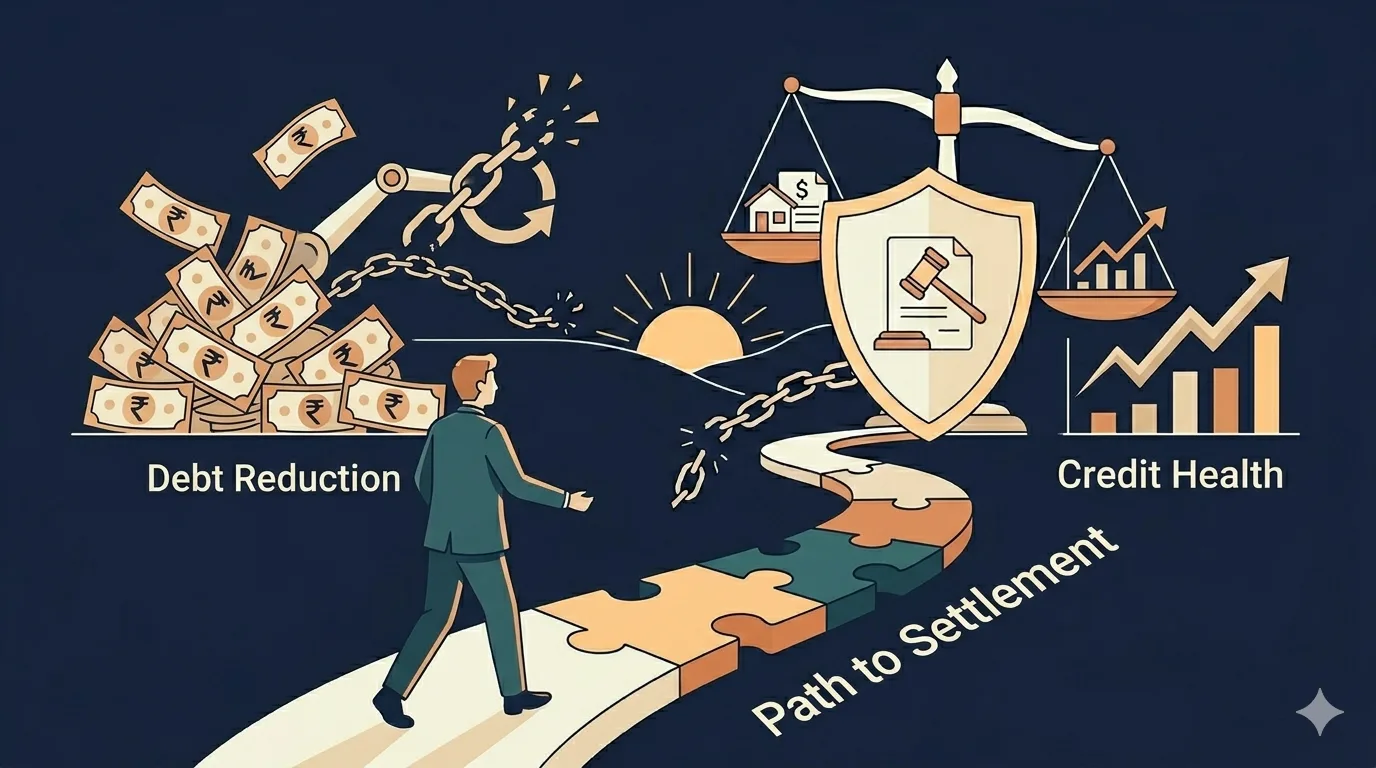
Borrowed From Multiple Unsecured Lenders? How to Settle All at Once
Settling with multiple unsecured lenders means negotiating a reduced final payment with each bank or NBFC separately, one account at a time, until every outstanding personal loan or credit card is marked settled. It is for borrowers who are genuinely unable to repay in full, not a shortcut for anyone juggling loans comfortably.

Mohit Juneja
Reviewed by FREED India, Debt Resolution Specialists
 4.7/5
4.7/5 ₹3,200Cr+
 20,000+
 20,00,000+4.7/5₹3,200Cr+20,000+20,00,000+
Key Summary

When you owe multiple lenders, settlement is generally handled separately with each lender. Each bank or NBFC decides whether to offer a settlement and what terms to offer.
Settlement is generally considered when genuine financial hardship makes full repayment difficult or unrealistic. Whether a lender offers settlement depends on its own policy and assessment.
A bounced EMI cheque can trigger Section 138 NI (Negotiable Instruments) Act, a criminal complaint is possible, up to 2 years jail or a fine up to twice the cheque amount.
The "Settled" mark stays on your CIBIL report for up to 7 years, across every lender you settle with.
Settling in the wrong order can leave your most damaging accounts unresolved the longest.
What Does It Mean to Settle with Multiple Unsecured Lenders
Settlement is not chosen out of preference. Banks only consider it when a borrower is in genuine financial difficulty and truly unable to repay, not because a reduced final payment sounds more appealing than continuing to service a loan that's still, in fact, manageable.
Each lender, whether it's a bank, an NBFC (Non-Banking Financial Company), or a card issuer, runs its own entirely independent settlement decision. There's no single combined settlement that covers everything you owe across every institution at once, each account gets its own negotiation, its own terms, and its own timeline, disconnected from what's happening on your other accounts.
What this looks like in practice with multiple lenders differs from a single-lender settlement mainly in sequencing and cash planning, not in the underlying mechanics of any one individual negotiation. The hardship letter, the offer, the counteroffer, the signed settlement letter, all of that stays the same whether you're settling with one lender or four. What genuinely changes is the order you approach them in, and how you stretch your limited monthly savings across several negotiations rather than funding just one.
Before any of that sequencing can happen, though, you need a clear-eyed view of exactly which lenders you're actually dealing with, since "multiple unsecured loans" can mean very different things depending on the mix.

What the Law Says
Under RBI's guidelines for unsecured loans, settlement terms are decided by each bank or NBFC individually, there is no regulator-mandated combined settlement process.
Read RBI recovery guidelines
What Types of Unsecured Personal Loan Companies Do Borrowers Usually Owe
Unsecured debt in India generally falls into four broad categories, and it's worth knowing which ones apply to your specific situation, since their settlement approach tends to differ meaningfully.
- Public and private sector banks. These tend to move slower and require more documentation, given their internal approval processes and larger, more bureaucratic collections structures.
- NBFCs (Non-Banking Financial Companies). Often known for faster loan approval and comparatively higher interest rates, NBFCs can sometimes negotiate settlements more quickly than traditional banks, particularly on smaller ticket sizes.
- Digital lending apps and fintech personal loan companies. These have grown rapidly as a borrowing source, and their settlement processes vary widely, from genuinely straightforward to frustratingly opaque, depending on the specific company and its actual regulatory backing.
- Credit card issuers. Technically a form of revolving credit rather than a fixed-term loan, credit card debt is generally grouped alongside other unsecured lenders for settlement purposes, since the fundamental mechanics, hardship, negotiation, a written offer, work the same way.
Regardless of which category a particular lender falls into, the same core settlement process applies to each one individually. What differs is how quickly each type tends to move, and how much documentation each one is likely to ask for before a serious conversation starts.

Signs You Are Dealing with Genuine Multi-Lender Debt Stress
- Your EMIs already eat more than 50% of your take-home salary across every lender combined. This isn't an official regulatory or lender threshold, but it's a commonly used rule of thumb, and it's worth checking the actual figure rather than going on a general feeling of being stretched.
- One or more loans have already missed two or more payments. A single slipped payment can happen to anyone. Two or more, especially across different lenders, points toward a genuine capacity problem rather than a one-off cash flow hiccup.
- Recovery calls have started from at least one lender. Once a lender's collections process has actively kicked in, that's a real marker that the account has moved past routine follow-up.
- New loan applications are getting rejected everywhere, even for small amounts. This signals your credit profile is already visibly stretched to other lenders, who are seeing something in your file that's making them cautious.
The trigger that genuinely matters here is inability to pay, not simply the number of loans you happen to be carrying. Plenty of people manage several loans comfortably. What separates genuine multi-lender debt stress from ordinary busy money management is the concrete signs above, missed payments, an unmanageable EMI ratio, active recovery contact, not the raw count of accounts on your name.
What Are Your Options Before Settlement
Settlement sits at the end of a ladder, and it's worth working through the earlier rungs honestly before assuming it's the right move for every loan you're carrying.
Balance transfer comes first, moving one specific loan to a bank offering a lower rate. This only works if your credit score is still healthy enough to actually qualify for the transfer, so it's really an option for someone still current rather than someone already deep in missed payments.
Debt consolidation comes next. FREED's Debt Consolidation Program merges all your eligible unsecured loans into a single, lower monthly EMI, built specifically for borrowers still paying but genuinely stretched across too many separate accounts. Consolidation can simplify repayments, but its effect on your CIBIL profile depends on the new facility, how existing accounts are reported and your repayment behaviour.
Settlement becomes the relevant option only if neither of the two rungs above applies, specifically because you're genuinely unable to repay at all, not simply because settlement sounds like the more direct route.
These two paths, consolidation and settlement, are never equal options for the same reader in the same situation. One is for someone still able to pay, just stretched thin across too many accounts. The other is for someone whose repayment capacity has already been genuinely outpaced by what's owed.
Comparison Table: Balance Transfer vs Debt Consolidation vs Loan Settlement
Option | Who It's For | CIBIL Impact | What Happens |
Balance Transfer | Still paying, good credit score | No negative impact | One loan moves to a bank with a lower rate |
Debt Consolidation | Still paying, over-leveraged across multiple loans | Score improves | New loan pays off all existing eligible loans, one lower EMI |
Loan Settlement | Genuinely unable to repay in full | Score drops, "Settled" mark up to 7 years | Bank accepts a reduced lump sum as full and final payment |
Rates and ranges shown are indicative. Final terms decided by the bank. FREED is not a Loan Provider. No outcome is guaranteed. Please verify directly with your bank.
How to Settle Multiple Unsecured Loans, Step by Step
Step 1: List every unsecured loan you owe.
Write down the lender type, bank, NBFC, or app, the outstanding amount, and how many EMIs have been missed on each one. This gives you one clear, complete picture instead of several scattered worries competing for your attention.
Step 2: Sort them by risk, not by amount.
Accounts that are significantly overdue or have entered formal collection or legal escalation may require urgent attention. Review any legal notice carefully and consider appropriate legal advice rather than ignoring it. A smaller loan that's about to escalate matters more right now than a larger one that's still current and unescalated.
Step 3: Assess what you can realistically save each month.
Add up what's genuinely left after essential expenses. This number becomes your monthly settlement fund, the amount you can consistently set aside toward negotiating with lenders one at a time.
Step 4: Approach lenders one at a time, starting with the highest-risk account.
Contact the bank or NBFC directly, or through a service that negotiates on your behalf. Explain the genuine hardship and propose a lump sum. Don't promise a timeline you can't actually keep.
FREED's counsellors handle this back and forth with each bank or NBFC on the customer's behalf, once enough has been saved in the SPA (Systematic Payment Approach).
Step 5: Get every settlement in writing before paying.
Do not rely on a verbal agreement. Obtain written settlement confirmation from the lender before making payment. Insist on a signed settlement letter stating the exact amount and terms before any payment leaves your account.
Step 6: Move to the next lender once one account is resolved.
Repeat the process. Once one settlement is completed, reassess the amount you can realistically allocate toward the remaining accounts.

FREED Expert Tip
Settle your highest-risk account first, not your largest one, a loan closer to default causes more damage the longer it waits.
See how settlement priority works
How FREED Helps When You Owe Several Unsecured Lenders
FREED's Loan Settlement Plan, also known as the Debt Resolution Program or "Settle My Loans," is built for exactly this situation, several unsecured lenders, each needing its own carefully sequenced negotiation rather than a single blanket approach.
The mechanism is straightforward. The fee is success-based, charged only once a settlement actually completes. FREED negotiates with each lender only once the corpus in that account is sufficient to fund a credible offer, and you authorise every single settlement before any payout happens, nothing moves without your explicit sign-off.
It's worth being genuinely upfront that this takes time. Savings build first, and negotiation happens lender by lender after that, not all at once and not instantly. FREED isn't drawing on some insider knowledge banks quietly keep from borrowers, it's doing the prioritisation and negotiation legwork on your behalf, following the same risk-based ranking covered throughout this article, applied consistently across every account you're carrying.
What Helps During the Settlement Process
Get every offer in writing before paying. A phone call, however reassuring it sounds, carries no weight if a dispute comes up later. Written settlement confirmation gives you an important record of the agreed terms and should be obtained before making payment.
Keep a folder of every communication with each lender, dated. A simple, organised record, digital or physical, makes it far easier to track where each negotiation actually stands, especially once you're juggling more than one at a time.
Don't pay one lender using funds meant for another. This is worth stating plainly, since it's one of the fastest ways to collapse an otherwise well-sequenced plan, borrowing from one account's fund to cover another leaves both negotiations weaker than either would have been alone.
Check your CIBIL report after each settlement closes to confirm it reflects correctly. Don't assume the update happened automatically just because you paid and received your closure letter, bureau reporting delays are common enough that this check genuinely matters every time.
Each of these habits protects the overall plan, not just the individual negotiation in front of you, and they matter more, not less, the more lenders you're working through in sequence.
What Happens to Your CIBIL Score After Settling Multiple Loans
A settlement can negatively affect your credit profile because the account may be reported as "Settled" rather than showing that the full contractual amount was repaid. The effect varies by individual credit history, the accounts involved and how your remaining credit is managed.
There is no fixed number of points your score will fall after settlement and no guaranteed recovery timeline. Consistent, on-time repayment on active accounts and responsible use of credit can support your credit profile over time.

Are You in a Loan Trap? Quick Check
Move the slider to your total EMIs as a % of monthly salary. See your debt stress level instantly.
EMIs as % of Monthly Salary
Source
Claim | Source |
A bounced cheque given toward an EMI can trigger Section 138 of the Negotiable Instruments Act, a criminal complaint punishable with imprisonment up to 2 years, a fine up to twice the cheque amount, or both | Negotiable Instruments Act, 1881, Section 138 |
Settlement terms for unsecured loans are decided by each bank or NBFC individually under RBI's regulatory framework, there is no regulator-mandated combined settlement process | RBI/2023-24/40, DOR.STR.REC.20/21.04.048/2023-24, Framework for Compromise Settlements and Technical Write-offs, June 8, 2023 |
Score-drop figures and recovery timelines are industry convention, not RBI-codified, and are framed as "typically" throughout the body text.

Mohit Juneja
Mohit Juneja writes educational content at FREED on debt management, credit scores, loan repayment, and borrowing best practices. His content is shaped by expert insights and industry knowledge, helping readers better understand their financial options and make informed decisions.
mohit.juneja@freed.care

FREED is India's trusted loan management platform. Founded in 2020 and headquartered in Gurugram, FREED has counselled 20 lakh+ people on personal loans, credit cards, and app loans. FREED charges fees only on successful settlement, not upfront. FREED does not handle secured loans (home loans, car loans, gold loans).
Media Mentions