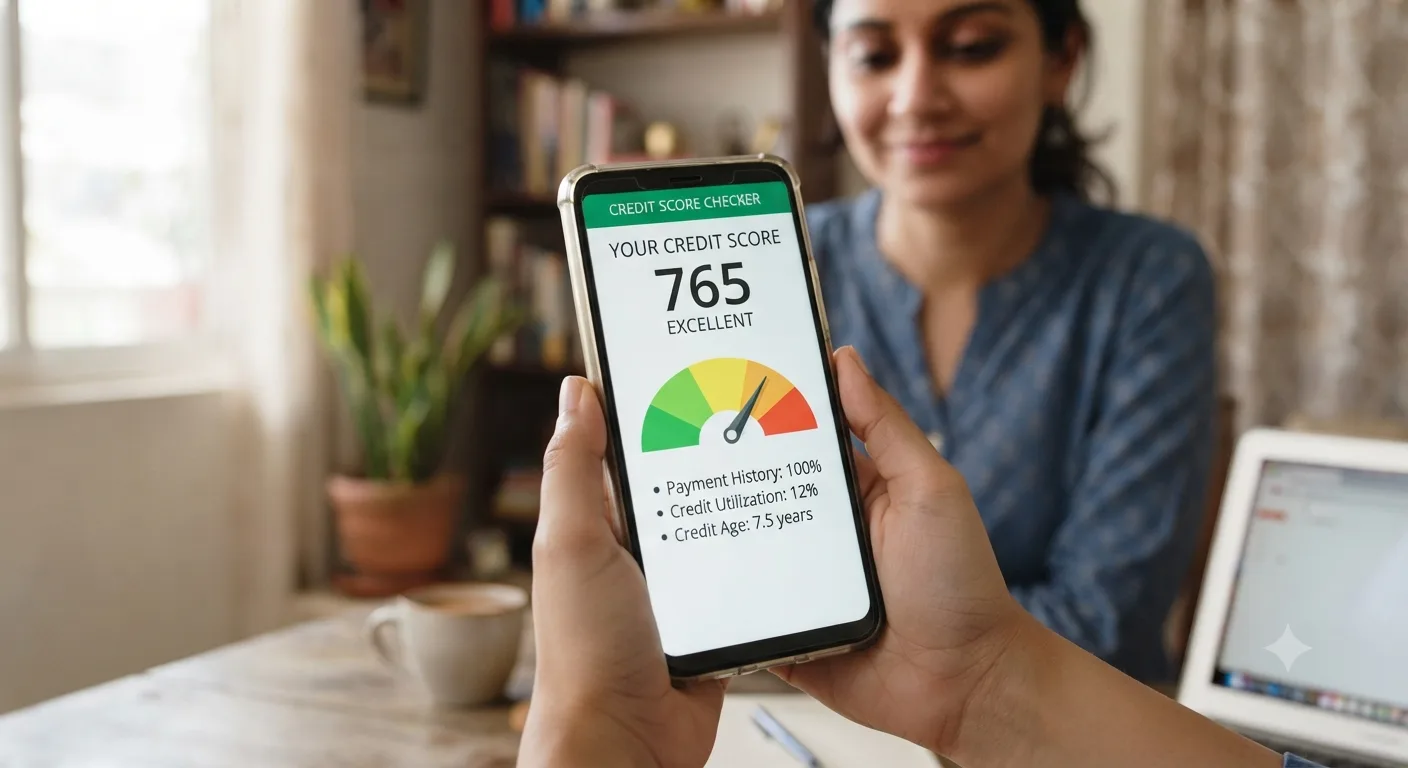
How to Check Why Your Credit Score Dropped
How to check why your credit score dropped: get your full credit report, then compare it with an earlier one. Look for a new missed payment, a card balance that jumped, a new enquiry, a closed account or an entry you don't recognise. The report shows what changed. The score alone doesn't.
Mohit Juneja
Reviewed by FREED India, Debt Resolution Specialists
 4.7/5
 ₹3,200Cr+
 20,000+
 20,00,000+4.7/5₹3,200Cr+20,000+20,00,000+
Key Summary

The score is a number. The reason is in the report, so start with the Free Full Credit Report you're entitled to once during January to December.
CIBIL names four factors that affect the score: payment history, credit utilisation, credit mix and enquiries.
RBI's directions say a credit information company must send an SMS or email alert when your report is accessed by a lender, where your contact details are available.
Two bureaus can show two scores for the same person. A gap between bureaus isn't automatically a drop.
A wrong entry can be disputed online. CIBIL says it may take about 30 days.
If nothing on the report explains the fall, ask the bureau, since the score model is the bureau's own.
How Do You Check Why Your Credit Score Dropped?
To investigate a score drop, look beyond the number and review the information in your credit report. A change in reported account information, a different reporting date or a report from another bureau may explain why the score differs. Comparing two reports from the same bureau can help you identify what changed.
So the method is simple. Get your latest full report. Put it beside an earlier one if you have it. Go through the report in the order of the factors CIBIL names: payments, utilisation, mix and enquiries. Then check for entries that don't belong.
That's how to check why your credit score dropped without guessing. The rest of this guide gives you the checklist, the common causes and what to do about each.
What Do You Need Before You Start?
Three things.
- Your latest full report. RBI's directions entitle you to one Free Full Credit Report, including your score, once during January to December from each credit information company. CIBIL's FAQ says the same in its own words, with a report from My Account.
- An earlier report or score, if you've got one. Even a screenshot of last year's score helps you see which accounts are new.
- Your own records: card statements, loan statements and bank statements for the last few months.
If you don't have an earlier report, review the repayment history shown for each account. CIBIL's report walk-through describes repayment history covering up to the previous 36 months. This can help you identify reported late payments, although it may not explain every reason for a score change. For getting the report, see our guide on checking your score on the CIBIL website.

Score Fell and You Don't Know Why?
See which options fit your situation on FREED.
See My Options on FREEDWhat Are the Most Common Reasons a Credit Score Drops?
CIBIL's explainer names four things that affect the score, and its other guides add detail. Here's how they map to a drop.
| What changed | What it might look like on the report | What CIBIL says |
|---|---|---|
| A late or missed payment | A late marker or DPD on a month | Late payments and EMI defaults have a negative impact |
| A card balance jumped | A balance close to the limit | A high credit utilisation limit may negatively impact your score |
| New applications | One or more new enquiries | Too many loan enquiries may have a negative impact |
| A different mix of accounts | A new loan or a closed one | A balanced mix of secured and unsecured loans is likely positive |
| A wrong entry | An account or status you don't recognise | You can dispute it online |
A late payment or a higher reported card balance may contribute to a score drop. These changes are not always immediately obvious, so compare the repayment history and reported balances with your bank and card statements. We don't give point values for any of them because CIBIL doesn't publish weightings.
How Do You Check for a New Missed Payment?
Open the Accounts section and read the repayment history on each account. CIBIL's walk-through says it covers up to the past 36 months and uses Days Past Due as a marker. Look for any month that's marked late, then match it to your bank statement.
Two cases: you did pay late, or you didn't. If you did, the entry is accurate, and the fix is to keep every payment on time from here. If you didn't, it's an error, and you can dispute it. For that, read our guide on removing missed payments from a credit report and our note on what DPD means.
How Do You Check for a Credit Card Balance That Jumped?
Compare each card's balance with its limit. CIBIL says a high credit utilisation limit indicates a rising debt burden over time and may negatively impact the score.
Here's an example with made-up numbers. Last report: a ₹20,000 balance on a ₹1,00,000 limit, which is 20%. This report: ₹70,000 on the same limit, which is 70%. Nothing was missed, but the number shifted a lot, and the score may have followed.
The balance reported by the lender may reflect the amount outstanding on its reporting date. As a result, a large purchase could appear in your credit report even if you paid it off a few days later. Check the reported balance against your statement and the lender's reporting details. For more, see our guide on credit utilisation.
How Do You Check for New Enquiries?
Open the Enquiries section. CIBIL's walk-through says it records each time a lender checked your report during a loan or card application, over the last 36 months, and each entry typically shows the lender's name, the date and the type of credit you applied for.
Read each one and ask whether you applied. CIBIL says several applications in a short period can create multiple hard enquiries and may affect your score, while a single enquiry usually has little impact. An enquiry you don't recognise is worth checking, because someone may have used your details.
RBI's directions also say that a credit information company must send an SMS or email alert when your report is accessed by a lender, where your contact details are available, and only when the enquiry shows in your report. So check your messages for alerts around the date of the drop. For the difference between enquiry types, see our guide on soft vs hard enquiries.
See Your Credit Report in One Place
Check your credit report with FREED Credit Insights.
Check My Credit InsightsDid Closing a Card or Loan Cause the Drop?
It can. CIBIL's guide on closing a card points to three things: utilisation, the length of your history and your credit mix. Closing a card removes its limit, so the same balances on your other cards make up a bigger share of the total limit.
Check the report for any account that now shows closed. If the account closure appears around the time your score changed, review whether it affected your overall credit utilisation, account history or credit mix. However, the timing alone does not prove that closing the account caused the drop.
A closed loan can change your credit mix in the same way, since CIBIL says a balanced mix of secured and unsecured loans is likely to have a positive impact. We don't give a point change for either, because CIBIL doesn't publish one.
Could a New Loan or Card Have Caused It?
Yes, in more than one way. A new application leaves an enquiry. A new account adds a new balance and a new limit, and starts a history with no length yet. A new EMI can also strain how you pay your other accounts.
Look at the Accounts section for anything opened recently. Check the opening date and the amount. If you didn't open it, treat it as a possible identity issue and dispute it.
Is the Drop Real, or Are You Comparing Two Bureaus?
It may not be a drop at all. Each bureau uses its own model, so the same person can see two different numbers on the same day. RBI's directions say scores are calibrated from 300 to 900, which gives a common scale, but that doesn't make two bureaus' numbers identical.
Before you worry, check that you're comparing the same bureau and the same type of report. If one number came from a free app and the other from a lender's check, the model or the date may differ. Our guide on why your score varies between bureaus explains the gap.
Could the Drop Be Caused by an Error?
It can. A late marker on a month you paid, a balance that's too high, an account you don't recognise or a closed account still shown open can all lower a score without you doing anything.
If you find one, CIBIL's FAQ says you can raise disputes online, dispute multiple fields in a single dispute and that it may take approximately 30 days to resolve. Gather proof first: bank statements, closure letters and payment receipts. For the full process, read our guide on fixing wrong entries.
Your Rights if Something on Your Report Is Wrong
- You're entitled to one Free Full Credit Report, including your score, once during January to December from each credit information company.
- If a complaint about your credit information isn't resolved within 30 days, the company pays ₹100 a day. The lender has 21 days to send corrected details.
- Disputes about how a score is calculated are excluded.
Sources: RBI/DOR/2025-26/378 and cibil.com/freecibilscore
What If Nothing on the Report Explains the Drop?
Then the cause may sit in the model. The score is the bureau's own calculation, and CIBIL's pages describe it as proprietary and give no weightings. A change in how your accounts age, or in how the reported data is read, can move the number even when no single line looks wrong.
In that case, note the date and the number, then check again after the next reporting cycle, since RBI's directions say lenders report as on the 9th, 16th, 23rd and the last day of each month, or at shorter intervals. If the score hasn't recovered and you still can't see why, ask the bureau for an explanation. Disputes about how a score is calculated are excluded from RBI's compensation rule, so don't expect payment for this one.
How Often Should You Check Your Score and Report?
Often enough to catch a change early. CIBIL's free score page says checking your own credit score doesn't impact it, so looking more than once is safe, as far as that page goes. The Free Full Credit Report is a once-a-year entitlement from each credit information company, so save it for when you need the full detail.
A sensible rhythm is to check the score every month or two and pull the full report once a year, plus any time the score moves sharply or before you apply for a loan. For ways to check, see our guide on checking your credit score with a PAN card.
What Should You Do Once You Know the Cause?
Match the fix to what you found.
| Cause you found | What to do |
|---|---|
| A late or missed payment that's accurate | Bring the account current, set up auto-debit and keep every payment on time |
| A late payment that's wrong | Gather proof and dispute it with the bureau and the lender |
| A card balance close to its limit | Pay it down before the statement date; avoid new spends on it |
| Several new enquiries | Pause applications; apply once with a lender you've checked |
| A closed card or loan | Check utilisation and mix; avoid closing more cards for now |
| An account you don't recognise | Dispute it and write to the lender, with a request to investigate |
| Nothing that explains it | Check again after the next reporting cycle; ask the bureau |
None of these is a promise of a particular score. They're the steps that fit what the report shows. For a longer plan, see our guide on how to improve your credit score fast.

FREED Expert Tip
The next time you see a score, screenshot it with the date. Next time it moves, you'll have something to compare against, and you'll find the cause in an afternoon, not a week.
Check My Credit InsightsFound the Cause and Want a Plan?
See which options fit your situation on FREED.
See My Options on FREEDHow Long Does a Score Take to Recover After a Drop?
It depends on the cause, and no CIBIL page we read gives a single timeline. A wrong entry can be corrected in about 30 days if the dispute succeeds, per CIBIL's FAQ. A lower card balance can show on the next report. A missed payment, per CIBIL's card-payment guide, can affect the score for as far ahead as the next two years. That page is undated.
So recovery isn't one clock. It's several, and some run faster than others. The best thing you can do is stop adding new causes. Reports update on the lender reporting dates, which RBI's directions put at the 9th, 16th, 23rd and last day of each month, or at shorter intervals, so changes aren't instant.
What Mistakes Do People Make When a Score Drops?
- Reacting to the number only. The number tells you something changed, not what.
- Applying for new credit to "fix" it. CIBIL says too many enquiries may have a negative impact.
- Comparing two different bureaus' scores. The models differ.
- Paying a service to "boost" the score. No one can change what's reported.
- Ignoring an unfamiliar account or enquiry. It may be an error or identity misuse.
- Checking only once a year, so a problem sits for months.
- Closing cards in a panic. CIBIL's guide says closing can change utilisation, history length and mix.
How Does FREED Help You See Why a Score Dropped?
FREED Credit Insights shows your credit report and score and points to what's holding the score back, which gives you a place to start when a number falls. It reads your Experian report, so the number can differ from your CIBIL score.
Over 30,000 borrowers have used Credit Insights, and over 20 lakh people trust FREED. FREED isn't a loan provider. Credit Insights explains your report. It doesn't change what lenders report, and a wrong entry still has to be disputed with the bureau and the lender.
Use it next to your CIBIL report. If both show an account the same way, you can relax. If they differ, check the dates first. You can start on the Credit Insights page.
What If a Debt Burden Is Behind the Drop?
Sometimes the cause isn't one entry. It's a load that keeps tipping payments over. Match the fix to your situation.
- Still paying, but stretched. If most of your salary goes towards paying multiple EMIs, FREED's Loan Consolidation Plan helps you combine multiple loans into a single monthly EMI. This can reduce your monthly EMI burden by up to 50%.* It's only for people who are still paying. Read more about the Loan Consolidation Plan.
- Cannot repay. Settlement is not something a borrower chooses out of preference. If you genuinely cannot repay your loans, FREED negotiates with your lenders to settle them for less than 50%* of your outstanding dues. Read more about the settlement programme.
Rates and ranges shown are indicative. Final terms decided by the bank/lender. FREED is not a Loan Provider. No outcome is guaranteed. Please verify directly with your bank.
Outcomes vary by lender and borrower profile. Settlement terms are decided by the lender. No percentage is guaranteed.
Settlement leaves a settled status on your report, which CIBIL says will affect your access to credit in the future. Weigh that before you choose it.

Mohit Juneja
Mohit Juneja is FREED’s Content & Communication Lead with 12+ years of experience across content, media, advertising and digital communications. He holds a postgraduate diploma in Communications from Xavier Institute of Communications, Mumbai, and has worked with organisations including NDTV, The Indian Express, McCann Worldgroup and NABARD.
At FREED, he leads content and communication across loan management, debt resolution, debt consolidation and financial well-being. His work combines research, storytelling and consumer-focused communication to make complex financial topics easier to understand and act on. He has also scripted and produced 11 documentaries on rural development and agriculture for NABARD, with film's selected for the Mumbai International Film Festival.
mohit.juneja@freed.care

FREED is India's trusted loan management platform. We help India settle their loans, consolidate their EMIs, improve their credit score, and manage their loans better. Over 20 lakh people trust FREED. We have managed more than ₹3,500 crore in loans and saved our users over ₹450 crore.
Media Mentions