Check Credit Score in HDFC Bank: Free Ways That Work
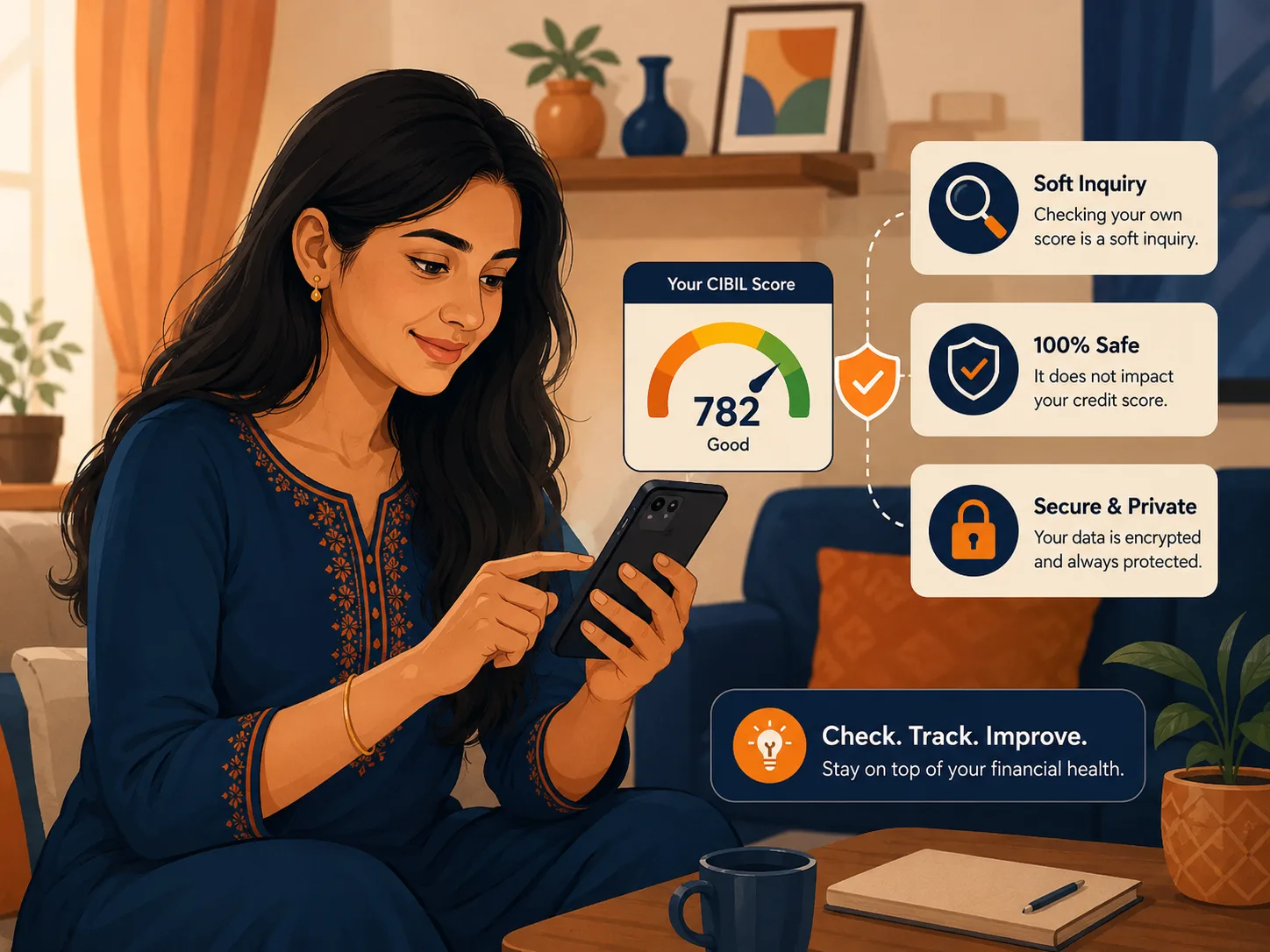
To check your credit score as an HDFC Bank customer, register on CIBIL’s website with your identity details and verify with an OTP. CIBIL says it gives one score and report free once a year. Checking your own score does not lower it.
Mohit Juneja
Reviewed by FREED India, Debt Resolution Specialists
 4.7/5
 ₹3,200Cr+
 20,000+
 20,00,000+4.7/5₹3,200Cr+20,000+20,00,000+
Key Summary

You can check your credit score as an HDFC customer on CIBIL’s official website, after OTP verification.
CIBIL gives one free score and report a year.
A self-check does not lower your score.
Check your HDFC loan and card lines for errors.
What Does Checking Your Credit Score With HDFC Bank Mean?
To check your credit score as an HDFC Bank customer, the route that works for everyone is CIBIL’s own website. HDFC’s own guide to checking a score walks you through that website and describes no separate HDFC tool. CIBIL gives one free report a year, and checking your own score doesn’t lower it. This page shows the steps, how to read the HDFC lines on your report, and what to do if something is wrong.
It means you look at your own score and report, as someone who banks with HDFC, holds an HDFC card or has an HDFC loan. It doesn’t mean HDFC is checking you. When you check your own score, nobody is making a decision about you. You’re reading the same record that a lender would read when you apply for something new.
Your credit score is generated by a credit bureau, not by HDFC Bank. The bureau maintains credit information reported by lenders, including eligible loan and credit card accounts. Your report may therefore include HDFC accounts as well as credit accounts from other lenders, depending on what has been reported and matched to your details. That’s why the steps to check your credit score in HDFC Bank are mostly the steps for any bank. They run through the bureau, not through the bank.
There are two common reasons to look. Some people want a quick number before they apply for a new card or loan. Others want to be sure their HDFC accounts show correctly. A third group wants to understand why a card or loan application was turned down. All three are covered here.
If you’re comparing banks, our pillar guide on a free CIBIL score check for bank customers explains the same idea for SBI. And one boundary to keep in mind. This page is about how to check. If you want to know what score HDFC looks for, we have a separate page on that, and we link to it below. Next, here’s what HDFC itself offers.

Not Sure Which Option Fits You?
Open the FREED app, add your details and see which plan fits your situation.
See My Options on FREEDWhat Shows on Your Report for Each Type of HDFC Customer?
It depends on what you have with HDFC. A credit report tracks credit, which means loans and cards. It doesn’t track your everyday banking. So what you see, and what you should check, differs by customer type.
Savings or current account only. A deposit account usually doesn’t appear on a credit report, because it isn’t credit. If that’s all you have with HDFC, you won’t see an HDFC line at all. That’s normal.
Credit card holder. Each card shows as a line, with your limit, balance and payment record.
Loan customer. A personal, home, car or other loan shows as a line, with the amount, balance and EMI record.
More than one. You’ll see a line for each card and loan, and you should check each one.
This matters because many people look for an HDFC line, don’t find one, and worry. If you only have a savings account, that’s expected. If you have a card or loan and still see no HDFC line, that’s worth a closer look, and we cover it below.
Your report will also show lenders other than HDFC. That’s the point of a bureau record. It’s one view of everything you’ve borrowed, not a record of HDFC alone.
Does HDFC Bank Show Your Credit Score in Net Banking or the App?
We couldn’t confirm that it does. HDFC’s own article on checking a CIBIL score, dated 6 August 2025, lists six steps, and all of them are on the official CIBIL website. Its body doesn’t mention net banking, MyCards, the HDFC app or any HDFC free offer. Those names appear only in the site menu.
HDFC did once offer a free CIBIL report through a CIBIL sign-up link with an HDFC code. CardExpert, a card review site, reported the offer in 2020 and later added a note, “This service has been discontinued at the moment”. It gives no date for that. That’s one third-party site’s note, so treat it as a lead, not a fact. Don’t go looking for an HDFC code, because it may no longer work.
Here’s what to do while you check.
Open net banking and the app yourself. Look for any credit score or “CIBIL” option.
Write down the exact path if you find one, and the date.
Check which bureau gives the score. It may not be CIBIL.
Read the consent text before you tick anything.
If you find nothing, use the CIBIL website below.
If HDFC shows a score from a different bureau, the number can differ from a CIBIL score. That’s normal, because each bureau uses its own model. Next, here’s how to check on the CIBIL website.
How Do You Check It Free on the CIBIL Website?
Go to CIBIL’s own website. CIBIL’s FAQ says it provides “one CIBIL Score and Report without any charge once a year”. HDFC’s guide says the same thing in softer words: access to your score is “often” free once a year, with fees for extra reports. Here are the steps.
If you’re new to CIBIL
Open the official CIBIL website. Type the address yourself.
Use the sign-up link. CIBIL’s FAQ points non-members to it.
Give your details. Expect your name, PAN and mobile number, and an OTP to confirm. HDFC’s guide lists these as registering, giving personal details and verifying identity.
Pick the free option. HDFC’s guide has a step for payment “if applicable”, so choose the free report, not a paid plan.
View your score and report.
If you already have a myCIBIL account
Log in to myCIBIL.
Open “My Account”.
Click “Get your Free Report”.
If CIBIL can’t verify you online, its FAQ says to call CIBIL customer support to finish. That can happen if your details don’t match what the bureau holds, for example an old mobile number or a different spelling of your name. For more detail, read our guide to the official CIBIL score check website.
What Should You Have Ready Before You Check?
Have your PAN, your mobile number and a phone you can answer right now. The OTP goes to that number and expires after a short time. If the number on your bank account is old, use the one you have today, and be ready for a verification step.
Use the same name and date of birth as on your PAN card, so the details match. Have these documents to hand too, because you’ll compare them with the report.
Your HDFC card statement. It shows your limit, balance and due date.
Your loan statement or EMI schedule. It shows the amount, EMI and tenure.
Your last payment receipts. They help if a payment shows as late.
Any no-dues or closure letter from HDFC for an account you’ve closed.
Save or screenshot the report on the day you check, and write down the date. The next report may look different, and you’ll want the first one to compare. Keep the file somewhere private, because it holds personal details.
Want Your Full Report, Not Just a Number?
See your Experian report with FREED Credit Insights.
Check My Credit Insights
What Other Free Ways Can HDFC Customers Use?
You can use any route that goes through a bureau, and none needs an HDFC account. Here they are side by side.
Route | Cost | Bureau | Score or full report | Needs an HDFC account? |
|---|---|---|---|---|
HDFC net banking or app | Not confirmed [writer to state] | Not confirmed | Not confirmed | Yes, if it exists |
CIBIL website | One free score and report a year, per CIBIL’s FAQ | TransUnion CIBIL | Score and full report | No |
Other free platforms | Many show a score at no charge | Varies by platform | Usually score only | No |
FREED Credit Insights | Check the page for current terms | Experian | Report and score, with an action plan | No |
Notice how little depends on your bank. Your HDFC card and loan will show on the report whichever route you pick, because the report comes from the bureau.
A few things help you choose.
If you want the CIBIL number lenders may see, use the CIBIL website.
If you want a quick look, a free platform may do, though it often shows only a score.
If you want the report explained, Credit Insights shows a second bureau’s view and points out what’s holding the score back.
If you want to compare, check two routes and write down the bureau and date on each.
Different routes can give different numbers. That’s not a mistake. It’s the bureau, the date and the data each one holds. Pick one route as your main one, and use the others as a cross-check.
How Do You Stay Safe While You Check Your Score?
Score checks ask for your PAN and mobile number, which makes them a favourite bait for fraud. A few habits keep you safe.
Type the website address yourself. Don’t tap a link in a message, email or social post.
Check you’re on the real site. Look at the address, not just the page design.
Never share your OTP with anyone, including a caller who says they’re from a bank or a score service.
Never enter a card PIN, CVV or net banking password. A genuine score check doesn’t ask for them.
Be wary of anyone who charges to “fix” or “boost” a score. Nobody can remove correct entries.
Log out and close the tab when you’re done, especially on a shared device.
If something feels off, stop and close the page. A score check takes a few minutes, and nothing is lost by pausing to verify. If you think you’ve shared details with a fake site, tell your bank and check your report for accounts you don’t recognise.
Does Checking Your Own Score Lower It?
Checking your own credit score or accessing your own credit report generally does not affect your score. This is different from a lender checking your credit report when you apply for a loan or credit card. Confirm the enquiry type in the relevant service’s terms before proceeding.
A lender’s check when you apply for a card or loan is different. That’s a hard enquiry, and it can have a small, temporary effect on your score. One or two over a year isn’t a problem. Several in a few weeks can look like you’re short of money.
So look at your report as often as you like. Be careful about applying again and again, especially if you’ve just been turned down. Each new application adds an enquiry, and a rushed second try can make things worse. For the difference in detail, see Related below.

What the Law Says
Checking your own score does not lower it. Each credit bureau must give you one free full credit report with your score every calendar year. If a wrong entry isn't fixed within 30 days of your complaint, you may get ₹100 for each day of delay.
Check My EMI ScoreWhat Should You Check on Your HDFC Loan or Card Line?
Find each HDFC account on your report, and check the details against your papers. Here’s the walkthrough.
Account type. A credit card, personal loan, home loan or other type, matching what you took.
Limit or sanctioned amount. The card limit, or the loan amount you were approved for.
Current balance. It should match your latest statement.
Days past due. If you paid on time, this should show zero.
Status. Look for Standard, Closed, Settled or Written Off, and check it matches the account.
Date reported. This tells you how recent the entry is.
Take one account at a time, and tick each item against your statement. Write down anything that doesn’t match. The three things to flag are a wrong balance, a status that’s worse than your account, and an account you don’t recognise.
Check how many HDFC lines you see. If you hold one card and the report shows two, look closer. It could be a card you forgot, a replacement card, or an error. Match the limit and the start date to your papers.
Late payment charges on a card are a separate matter from what shows on your report. For how HDFC card charges work, see Related below.

FREED Expert Tip
If you converted a card bill to EMI, check that it shows as one account, not a missed card payment.
Check My EMI ScoreHow Do You Read the Payment History, Month by Month?
The payment history is the part lenders look at most closely. Each account shows a row of months, and each month is marked as paid on time, late, or not due. It reads like a calendar.
Here’s how to read it.
A run of on-time months shows steady repayment. That’s what you want to see.
A late month shows a delay. Check whether it matches a payment you actually made late.
A gap or “not due” can mean the account was closed or not yet active.
A recent late mark matters more than an old one, as a general guide, so fix recent errors first.
Pick three months at random and check them against your bank statement. If a month shows late but your statement shows an on-time payment, write down the month and the date you paid. That’s the evidence you’ll need for a dispute.
A single late month is a record, not a verdict. Lenders look at the whole pattern. If you’ve paid on time since, the pattern keeps improving, month by month.
How Is a Card Line Different From a Loan Line?
A loan has a fixed amount and a fixed EMI. A card has a limit, and your balance moves each month. That changes what you look for on the report.
For a loan, look at the balance coming down over time, and at the payment record. It should fall steadily, and every EMI should show as paid on time.
For a card, look at the limit and the balance together. A balance close to the limit can hold your score back, even if you pay on time. So the report shows two things for a card: how you pay, and how much of your limit you use. Pay before the statement date where you can, so a lower balance is what gets reported.
Both kinds count towards your record. A missed card payment and a missed EMI both go in the diary. So give each the same attention. If you’re not sure which line is which, the account type column tells you.
How Do You Fix a Wrong HDFC Entry?
Raise it with the bureau and with HDFC, in writing, and keep every reference number. Here are four steps.
Raise a dispute with the bureau online. Use the dispute option on your report. CIBIL’s FAQ says a dispute may take approximately 30 days to resolve, depending on the lender’s response.
Write to HDFC. Use its grievance channel, and keep a copy.
Keep every reference number. Note the date and what you reported.
Check again after the bureau replies. Look at the report once the dispute is closed.
In your message, be specific. Say which account, which month and what the entry should say. Attach your statement or receipt. A clear, short message with proof moves faster than a long complaint.
Here’s the timing from RBI. If a credit information complaint isn’t resolved within 30 days, the bureau pays ₹100 for each day of delay. The lender has 21 days to send the corrected details, and the bureau gets the remaining days. It doesn’t cover disputes about how a score is calculated.
Don’t count on compensation, and don’t expect a fix overnight. Each case differs. For the full process, read our guide on fixing wrong entries on your report.
Not Sure Which Option Fits You?
Open the FREED app, add your details and see which plan fits your situation.
See My Options on FREEDWhat Should You Do After You Pay Off or Close an HDFC Account?
Request a no-dues certificate or account-closure confirmation, as applicable, and keep it safely. The lender must report the relevant account update to the credit bureau. Allow time for the lender’s reporting cycle and the bureau’s processing before checking your report again.
Here’s a simple routine.
Ask HDFC for a no-dues or closure letter in writing, and keep a copy.
Save your last payment receipt.
Wait a month or two for the update to reach the bureau.
Check your report. The account should show as closed, with a zero balance.
If it doesn’t, dispute it, using the steps above and your letter as proof.
For a card, make sure you’ve paid the full outstanding amount, including any charges, before you close it. A small unpaid balance can keep the account open on the report.
Don’t close an old card only to look tidier. Closing it cuts your total limit, so your balance on other cards can look larger against what’s left. If the card has a fee you don’t want to pay, ask HDFC about a no-fee option before you close.
What Mistakes Do People Make When They Check?
Most of them are small. Watch for these five.
Judging by the number alone. The report tells you why the number is what it is.
Comparing scores from different bureaus and dates. They rarely match exactly.
Disputing a gap that isn’t an error. Check the dates first.
Paying someone to “improve” the score before looking. Nobody can remove correct entries.
Forgetting to save the report. Without a copy, you can’t show what changed.
A good habit is to check, note and then act. Check the report, write down what you find, and only then decide whether to dispute or change a habit. That order saves you from fixing things that aren’t broken.
What Score Does HDFC Look For?
HDFC sets its own cut-offs, and it also looks at income, existing EMIs and repayment history. A strong score alone doesn’t guarantee approval. We cover the score bands and what different HDFC products usually need on a separate page, so we don’t repeat them here. See HDFC CIBIL score and loan eligibility.
How Often Should You Check Your Score?
Reviewing your credit report periodically can help you identify errors and monitor changes. It is also useful to check your report before applying for a new credit card or loan. Choose a review frequency that helps you keep track of your accounts without relying on score changes alone to judge your financial health.
Check after you close or pay off a loan, once the lender has had time to report. Check if you get a message about an account you don’t recognise. And use each bureau’s free yearly report for a deeper look. Write down the date, the bureau and the score each time, so you can see the trend.
A short notebook entry is enough. Date, bureau, score, and one line on anything that changed. After a year, you’ll know what’s working, and you’ll spot a problem quickly.
How Does FREED Help You Track Your Score?
FREED Credit Insights shows your credit report and score, and points to what’s holding the score back. It reads your Experian report, so the number can differ from your CIBIL score. Each bureau uses its own model, so a gap between two numbers is normal.
Over 30,000 borrowers trust Credit Insights, and over 20 lakh people trust FREED. FREED isn’t a loan provider. Credit Insights explains your report, and it doesn’t remove entries that are correct. If something on your report is wrong, you still raise the dispute with the bureau and the lender.
Use it next to a CIBIL check, not instead of one. The CIBIL report shows what lenders may see, and a second bureau shows whether the picture matches. If both show your HDFC accounts the same way, you can relax. If they differ, check the dates first. You can start on the Credit Insights page.
Track Your Score in One Place
Check your Experian report with FREED Credit Insights.
Check My Credit Insights
What If Your Score Is Too Low or Your EMIs Are Too High?
Match the fix to the cause. Here are three routes.
Errors on the report. Dispute them, using the steps above.
Still paying, but stretched. If most of your salary goes towards paying multiple EMIs, FREED’s Loan Consolidation Plan helps you combine multiple loans into a single monthly EMI. It’s only for people who haven’t missed payments. Read more about the Loan Consolidation Plan.
Cannot pay an HDFC loan. Settlement is not something a borrower chooses out of preference. If you genuinely cannot repay your loans, FREED negotiates with your lenders to settle them for less than 50%* of your outstanding dues. See how the HDFC personal loan settlement process works.
Rates and ranges shown are indicative. Final terms decided by the bank/lender. FREED is not a Loan Provider. No outcome is guaranteed. Please verify directly with your bank.
Outcomes vary by lender and borrower profile. Settlement terms are decided by the lender. No percentage is guaranteed.
Don’t take new loans or cards just to raise a score. Each application adds an enquiry, and new debt adds pressure. Your report shows whether you have missed payments, and that decides which option is open to you. Before you act, add up your EMIs and compare them with your monthly take-home pay. That one number often makes the next step clear.
Not Sure Which Option Fits You?
Open the FREED app, add your details and see which plan fits your situation.
See My Options on FREED
Mohit Juneja
Mohit Juneja is FREED’s Content & Communication Lead with 12+ years of experience across content, media, advertising and digital communications. He holds a postgraduate diploma in Communications from Xavier Institute of Communications, Mumbai, and has worked with organisations including NDTV, The Indian Express, McCann Worldgroup and NABARD.
At FREED, he leads content and communication across loan management, debt resolution, debt consolidation and financial well-being. His work combines research, storytelling and consumer-focused communication to make complex financial topics easier to understand and act on. He has also scripted and produced 11 documentaries on rural development and agriculture for NABARD, with film's selected for the Mumbai International Film Festival.
mohit.juneja@freed.care

FREED is India's trusted loan management platform. We help India settle their loans, consolidate their EMIs, improve their credit score, and manage their loans better. Over 20 lakh people trust FREED. We have managed more than ₹3,500 crore in loans and saved our users over ₹450 crore.
Media Mentions