Soft Inquiry Credit Score: Is Checking Your Own Score Safe?
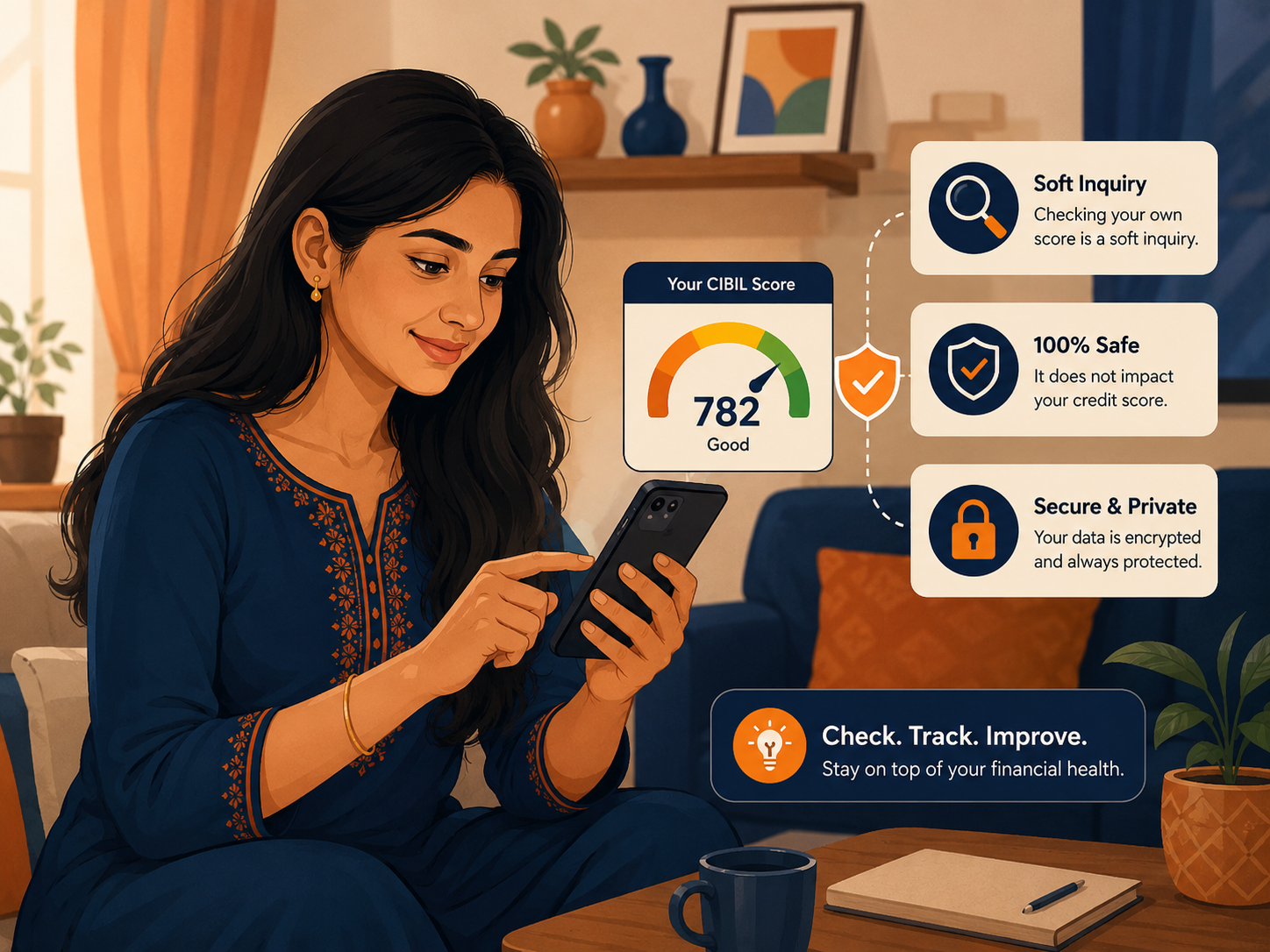
A soft inquiry is when your credit report gets checked without you applying for a loan or credit card, like when you check your own score. It never lowers your credit score, no matter how many times you do it. A hard inquiry can have a small negative effect on your credit score, although the impact varies by credit profile and scoring model.
Mohit Juneja
Reviewed by FREED India, Debt Resolution Specialists
 4.7/5
4.7/5 ₹3,200Cr+
 20,000+
 20,00,000+4.7/5₹3,200Cr+20,000+20,00,000+
Key Summary

A soft inquiry credit score check never lowers your score, however many times you do it.
Checking your own CIBIL, Experian, or Equifax score always counts as soft, never hard.
A hard inquiry generally occurs when a lender checks your credit as part of a new credit application.
Pre-approved offers and background checks by employers also count as soft, not hard.
Soft inquiries do not affect the credit score used by lenders for a new credit application.
What Is a Soft Inquiry on Your Credit Report
A soft inquiry happens whenever your credit report gets checked without you actually applying for anything. No loan application, no credit card form, no active request for new credit sitting behind it, just a look at your file.
Several things can trigger one:
- You checking your own score, whether through a bureau's own site or an app like FREED's free credit check.
- A bank reviewing your profile to send you a pre-approved offer, before you've expressed any interest in taking it.
- An employer running a background credit check as part of a job application process.
The defining feature across all three is the same: no active credit application is involved. That's the entire test, and it's worth holding onto as you read the rest of this article.
This applies consistently across every bureau operating in India, CIBIL, Experian, Equifax, and CRIF High Mark, four RBI-licensed Credit Information Companies, each running the same soft-versus-hard distinction on their own reports. FREED's own Credit Insights tool, which pulls from Experian, works within this exact same framework, a self-check through it is soft, the same way a self-check through any bureau's own site is.
So if a soft inquiry is this harmless, what's actually the check that can affect your score? That's a genuinely different category, and it's worth understanding clearly so the two never get confused.
Soft Inquiry vs Hard Inquiry: What's the Real Difference
A hard inquiry happens when a lender pulls your credit report because you've formally applied for a loan or credit card. That single distinction, an actual application behind the check, separates it entirely from everything covered in the previous section.
Worth being precise about how the damage from hard inquiries actually accumulates, since this is where a lot of confusion comes from. One hard inquiry, on its own, typically costs somewhere around 5 to 10 points, a small dip most people barely notice. The real damage comes from stacking several close together. Multiple hard inquiries in a short period can affect your credit profile, although the impact depends on the type of credit, timing and scoring model. Avoid making unnecessary applications simply to compare offers.
A soft inquiry never adds to that stack, no matter how many times it's repeated. Even frequent self-checks do not turn into hard inquiries simply because you repeat them.

What the Law Says
RBI's credit reporting framework requires lenders to report data to bureaus periodically, so score changes reflect updates on a lag, not the inquiry itself.
See when your CIBIL score updatesComparison Table: Soft Inquiry vs Hard Inquiry
Soft Inquiry | Hard Inquiry | |
What triggers it | You check your own score, pre-approved offer, employer check | You formally apply for a loan or credit card |
Score impact | None | Can lower score by roughly 5 to 10 points |
Visible to other lenders | No | Yes |
How long it stays on report | Stays but carries no weight | Visible around 24 months |
Does Checking Your Own CIBIL Score Reduce It
No. A self-check is always classified as a soft inquiry, and that holds true consistently across CIBIL, Experian, and Equifax, every bureau treats it the same way.
It's worth addressing the fear directly, since it's precisely why a lot of people avoid checking their own score at all, worried that looking too often will somehow drag the number down. That worry, while understandable, isn't backed by how credit reporting actually works. There's no mechanism by which your own self-check counts against you, ever, regardless of frequency.
If anything, regular self-checks are a genuinely good habit rather than a risk. Checking your report periodically means you catch errors early, an account that isn't yours, a payment marked late that was actually on time, before any of that turns into a rejected loan application months down the line, at exactly the moment you can least afford the surprise.
There's one more area worth clearing up, since it trips up almost as many people as the self-check question does: what actually happens with pre-approved offers, the kind that arrive by SMS or email seemingly out of nowhere.
Do Pre-Approved Offers or Employer Checks Count as Hard Inquiries
Two common sources of confusion, worth resolving cleanly.
A bank checking your profile to send you a pre-approved offer is soft. You haven't applied for anything at the point that offer lands in your inbox, the bank has simply reviewed your existing profile to decide whether you're a candidate worth targeting. The moment you accept that offer and formally apply, submitting documents and going through the actual application process, that's when it becomes a hard inquiry, not a moment before.
An employer running a background credit check is soft too. Even though it feels like a formal, high-stakes process, no application for credit is involved, so it doesn't touch your score in any way.
The practical rule is that checks connected to a new credit application are generally treated as hard inquiries, while self-checks and certain non-credit checks are generally soft.
How to Check Your Credit Score Without Hurting It
Step 1: Use an official or bureau-linked source.
Go through CIBIL, Experian, Equifax, or a platform they directly power, like FREED's free credit check, which pulls from Experian.
Step 2: Confirm it says "soft inquiry" or "self-check."
Most apps state this clearly on the results screen. If it's unclear, the check is still safe, since self-checks are soft by definition regardless of how the platform labels it.
Step 3: Check every few months, not obsessively.
Checking periodically can help you spot errors early. The right frequency depends on how actively you use credit and whether you're monitoring a specific issue.
Step 4: Read the full report, not just the number.
Look for wrong entries, accounts you don't recognise, or old loans still showing as active when they've actually closed.

FREED Expert Tip
Checking your own score once a quarter through a bureau-linked tool costs you nothing and catches report errors early.
Check My CreditWhat Actually Hurts Your Credit Score
If soft inquiries are off the table entirely, it's worth redirecting attention to what genuinely does move your score, since that's the part actually worth watching.
- Missed or late EMI payments. Payment history is an important factor in your credit profile, so consistently paying EMIs and card dues on time matters. Consistent, on-time payments across every loan and card you hold do more to protect your score than anything else on this list.
- Credit utilisation above 30-40% of your limit. Carrying a high balance relative to your credit limit signals heavy reliance on borrowed money, which reads as a risk factor to lenders and bureaus alike.
- Too many hard inquiries stacked in a short window. As covered above, this is where genuine damage accumulates, several loan or card applications close together, not a single soft check.
- High total unsecured debt relative to income. A high overall debt or repayment burden can be a sign of financial stress and may affect how lenders assess your ability to take on additional credit.
A soft inquiry never appears on this list, and that's really the whole point of this article. The things that genuinely affect your score are all about how you manage credit you already hold, not how often you look at your own number.
Are You in a Loan Trap? Quick Check
Move the slider to your total EMIs as a % of monthly salary. See your debt stress level instantly.
EMIs as % of Monthly Salary
How FREED Helps You Stay on Top of Your Credit Score
FREED's free credit check, Credit Insights, powered by Experian, is a safe, soft-inquiry way to monitor your score regularly, exactly the kind of periodic check covered throughout this article, without any risk of it counting against you.
If what your score reveals points to a heavier problem, several loans stretching your monthly budget thin, or an EMI burden that's already crossed into stressful territory, FREED's team can walk through your options in a free call. That's a separate conversation from anything covered in this piece, and it's worth having only if your own numbers actually point that way.

Source
Claim | Source |
Banks and NBFCs report credit information to bureaus on a periodic, fortnightly basis, so score updates lag behind the actual event | RBI (Credit Information Companies) Amendment Directions, 2025, effective July 1, 2026, Reserve Bank of India |
Hard inquiry point-drop figures (5-10 points) and the 24-month visibility window are industry convention, not RBI-codified, and are framed as "typically" or "roughly" throughout the body text rather than treated as fixed, guaranteed figures.

Mohit Juneja
Mohit Juneja writes educational content at FREED on debt management, credit scores, loan repayment, and borrowing best practices. His content is shaped by expert insights and industry knowledge, helping readers better understand their financial options and make informed decisions.
mohit.juneja@freed.care

FREED is India's trusted loan management platform. Founded in 2020 and headquartered in Gurugram, FREED has counselled 20 lakh+ people on personal loans, credit cards, and app loans. FREED charges fees only on successful settlement, not upfront. FREED does not handle secured loans (home loans, car loans, gold loans).
Media Mentions