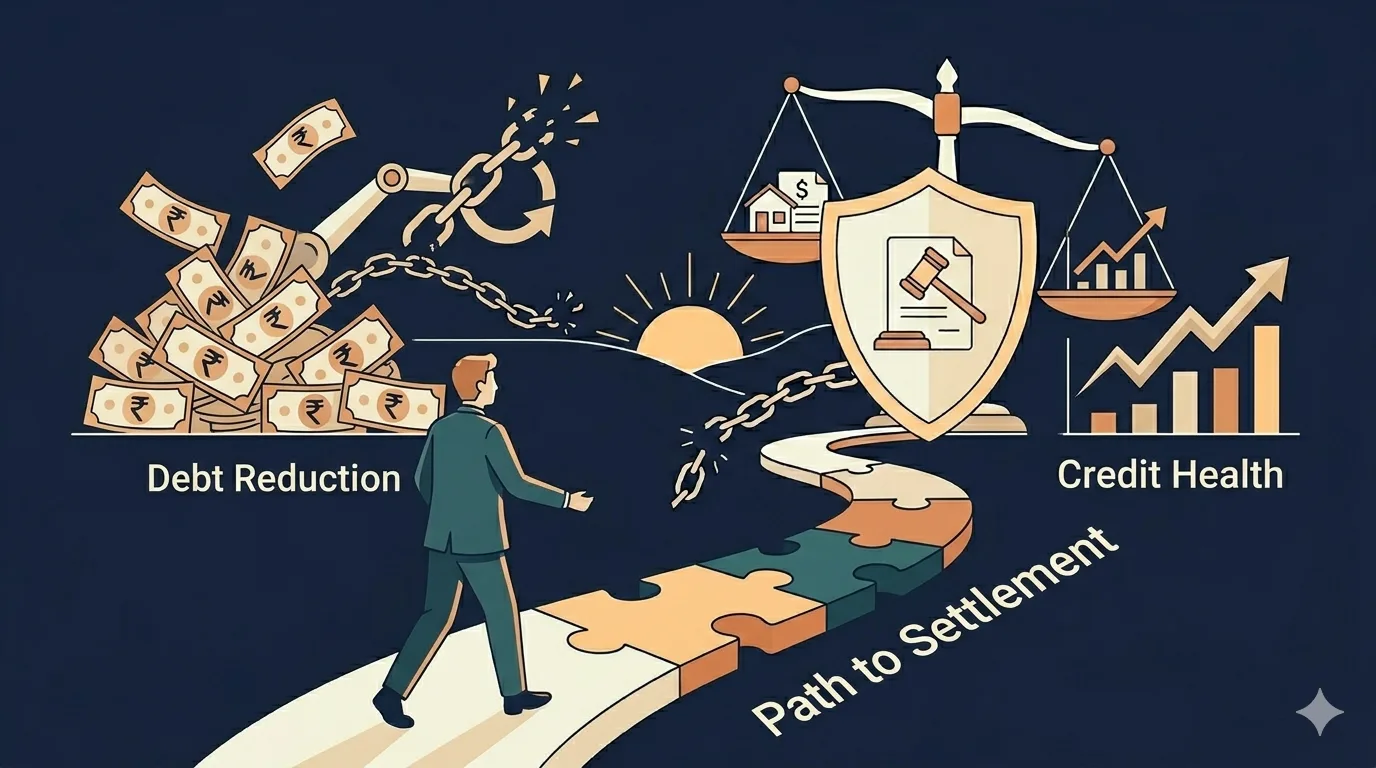
HDFC Personal Loan Settlement: Process, Timeline and What to Say
HDFC personal loan settlement is when HDFC Bank agrees to accept a smaller lump sum than the full amount you owe, and marks your loan as "Settled." This happens only when you are facing a genuine financial difficulty and are unable to repay in full. The loan is not "Closed," it is "Settled," and these are not the same thing on your credit report. Settlement is the option that exists for a difficult situation, not a routine choice.

Mohit Juneja
Reviewed by FREED India, Debt Resolution Specialists
 4.7/5
4.7/5 ₹3,200Cr+
 20,000+
 20,00,000+4.7/5₹3,200Cr+20,000+20,00,000+
Key Takeaways

HDFC considers personal loan settlement only when you are genuinely unable to pay, usually once a loan has been overdue for 90 days or more
After settlement, your credit report will generally show the account as "Settled," which may affect future borrowing decisions.
You will need to arrange a lump sum. HDFC typically does not accept settlement in part-payments
The time it takes to complete a settlement depends on your individual circumstances and the bank's review process.
Having your hardship documents ready before you approach the bank helps the process move faster
What Is HDFC Personal Loan Settlement?
HDFC personal loan settlement is when the bank agrees to close your account after you pay less than the full outstanding amount. This is different from foreclosure (closing your loan early), where you pay everything you owe and the loan is marked "Closed" with no harm to your credit report. In a settlement, the bank accepts a reduced amount because you have shown that paying in full is genuinely not possible right now.
Inside the bank, this is sometimes called a one-time settlement (OTS), meaning the lump sum is paid once, and the matter ends there. It is not a discount scheme or something HDFC offers as a feature. It is an outcome that the bank agrees to only after reviewing your situation.
Settlement is not something a borrower chooses out of preference. Banks and financial companies only consider it when you are in a genuine financial difficulty and are repaying the full amount, which is no longer realistic.
Loan settlement cases have grown across Indian banks in recent years, and personal loans make up a large share of them. Most banks, including HDFC, treat a "Settled" account as a better outcome than one marked "Written Off," since it shows the matter was resolved rather than left unpaid.
When Does HDFC Bank Consider a Settlement Request?
HDFC generally looks at a settlement request only when there is a clear, genuine reason you cannot pay. The three situations the bank typically recognises are a job loss, a serious illness or medical emergency that has used up your savings, and a business that has shut down or stopped earning. These are situations that happen to people. They are not choices.
HDFC will not agree to settle if it believes you are simply choosing not to pay while still having the means to. The hardship has to be real, and it has to be demonstrable through documents.
Timing matters too. HDFC usually treats a loan as NPA (a loan marked as bad by the bank, usually after 90 days of missed EMI) before it will seriously consider a settlement conversation. Asking for a settlement too early, after only one or two missed payments, is more likely to be turned down and can sometimes increase the pressure from the bank's recovery team rather than ease it.
Most banks become open to a settlement conversation only after several months of missed EMIs, once it is clear the difficulty is not temporary.
What Documents Do You Need for HDFC Loan Settlement?
Before you approach HDFC, it helps to have your papers ready. None of this needs to be complicated, just complete.
- Loan account statement – shows your outstanding balance and payment history.
- KYC documents – your Aadhaar and PAN card copies.
- Proof of your financial difficulty – a termination letter if you lost your job, medical bills or reports if illness is the reason, or business closure documents and bank statements showing your income has dropped.
- Recent bank statements – usually the last 3 to 6 months, to show your current financial position.
- Loan agreement copy – the original document you signed when you took the loan.
Of all of these, the proof of hardship matters the most. Without it, HDFC has no real basis to consider a settlement. Think of it as putting together your papers in one folder, not preparing a legal case.
How Does the HDFC Personal Loan Settlement Process Work, Step by Step?
Step 1: Work Out What You Can Pay
Check your bank account, your monthly income after essential expenses, and any savings. The lump sum you offer must be realistic, what you can actually arrange, not a number you hope to negotiate down to later.
Step 2: Gather Your Hardship Documents
Collect your loan account statement, Aadhaar, PAN, and proof of your financial difficulty, such as a termination letter, medical bills, or bank statements showing the income drop. Having these ready means the bank can review your case faster.
Step 3: Contact HDFC Bank in Writing
Go to your branch or call customer care. Write a formal letter or email, not a WhatsApp message, stating your loan account number, the hardship, and the amount you can pay. Avoid making any payment before getting a written response from the bank.
Step 4: Wait for the Bank's Response
HDFC's collections or settlement team will review your application and documents. The review time varies depending on the bank and your individual circumstances.They may come back with a counteroffer. This is normal, and one or two rounds of back and forth are common.
Step 5: Get the Settlement Letter Before You Pay
Once a figure is agreed, ask for HDFC's official settlement letter on bank letterhead, stating the agreed amount and the date by which it must be paid. Read it carefully for any clauses about remaining dues or conditions. If at any point this feels like a lot to manage on your own, FREED's counsellors are available to look at this letter with you before you proceed.
Step 6: Pay and Collect Your NOC
Make the payment directly into your loan account, by bank transfer or demand draft. Never pay in cash, and never pay an agent. After payment, follow up with the bank if you haven't received your NOC to collect your clearance letter (called NOC). This is your proof that the loan is fully and finally settled.
The full process, from your first contact with the bank to receiving your NOC, usually takes 2 to 4 months. HDFC's initial review alone can take 15 to 30 days. Cases with complete documents tend to move faster than cases without them.
What to Say to HDFC Bank When You Ask for Settlement
What you say, and what you put in writing, matters as much as the process itself.
When you speak to HDFC or write to them, cover four things clearly. First, state your loan account number and the total outstanding amount. Second, explain the hardship in plain terms, with dates, whether it is job loss, illness, or a drop in income. Third, state the lump sum you can pay and roughly when you can pay it. Fourth, ask for the settlement to be confirmed in writing before you make any payment.
One rule matters more than any other: never agree to anything verbally. A verbal promise from a bank official has no legal standing if things go wrong later. Always get the final figure on paper. And never make a payment to an agent, however convincing they sound. Payments go directly to your loan account every time.
If you are writing a letter, a simple structure works well: a subject line mentioning your loan account number, one or two lines on your hardship, the amount you are proposing, and a clear request for written confirmation before payment. Keep it short and factual.
What Are Your Options Before Choosing Settlement?
How Does HDFC Personal Loan Settlement Affect Your CIBIL Score?
This is the part most people worry about, so it is worth being direct rather than soft about it.
Settlement can affect your credit profile and may influence future borrowing decisions, sometimes more, depending on your overall credit profile. The "Settled" mark stays on your credit report for up to 7 years. This is different from "Written Off," which is a worse mark. A "Settled" status tells future lenders the matter was resolved with the bank's agreement, while "Written Off" suggests the bank gave up trying to recover the amount.
Most private banks will be. Some lenders may take a "Settled" status into account when reviewing future applications. This is a real cost, and it is worth knowing clearly before you move ahead.
Recovery is possible. With consistent, on-time payments on whatever credit you do have, and by keeping any credit card usage low, scores typically recover to 650 to 700 or higher over the following few years. It takes time and discipline, but the path back is real.

What the Law Says
Under RBI guidelines, banks must provide a clearance letter (called NOC) after a loan settlement. You have the right to request this in writing, and the right to raise a dispute if your CIBIL update is recorded incorrectly.
Know Your RightsHow FREED Helps With HDFC Personal Loan Settlement
Settlement is not something a borrower chooses out of preference. Banks and financial companies only consider it when you are in a genuine financial difficulty and are truly unable to repay the full amount. It is a last resort, not a shortcut.
If you decide this is the path you need, FREED's counsellors can help you understand your options, organise your documents, and support you through the settlement process where appropriate. This includes preparing your hardship documents, drafting and submitting your settlement proposal, following up with the bank through the process, reviewing the settlement letter for any unclear clauses before you pay, and helping you keep track of important settlement documents, including your NOC.
Many people who try to manage this alone find it takes longer than expected, and small documentation gaps can delay how quickly your credit report reflects the correct status. FREED is available to manage all of this for you. The assessment is free, and FREED's fee is charged only if a settlement is completed.
FREED helps eligible borrowers settle unpaid or overdue loans at up to 50% less.
Tips That Help During the HDFC Settlement Process
A few habits make the process smoother and protect you afterwards.
- Get everything in writing. No verbal agreements, no promises over WhatsApp.
- Pay only through your bank account. Never to an agent or any third party.
- Verify your NOC after payment. Make sure it matches the amount and terms you agreed to.
- Check your credit report after the settlement is completed to confirm it has been updated. Confirm that the "Settled" status has updated correctly.
- If HDFC reports it as "Written Off" instead of "Settled," you have the right to raise a dispute with CIBIL.
- Give it time before applying for new credit. Think carefully before applying for new credit immediately after settlement, as lenders may review your credit history.
Credit report updates are part of the lender's reporting process and may take some time. If this does not happen, that is a fair reason to follow up.
Settlement vs. Other Options: What Works When
Option | When It Works | CIBIL Impact | Requires a Lump Sum? |
EMI Reduction / Longer Tenure | When you can still pay something every month | Minimal, if no missed payments | No |
Payment Pause (Moratorium) | Short-term income disruption, income expected to return | Minimal, if granted early | No |
Changing the Loan Plan | Regular EMI is unaffordable, but a lower payment works | Minimal | No |
Debt Consolidation | Multiple loans, still earning, wants one EMI | Score generally improves | No |
Settlement (OTS) | Genuine inability to repay, income far below EMI obligation | Reported as "Settled" on your credit report, and may affect future borrowing decisions | Yes |
No single option is automatically the right one. The right path depends on your income, how much you owe, and how long you have been behind on payments.
FREED handles loan settlement for unsecured loans only, including personal loans, credit cards, BNPL, and loan apps. FREED does not handle home loans, car loans, or gold loans

Mohit Juneja
Mohit Juneja writes educational content at FREED on debt management, credit scores, loan repayment, and borrowing best practices. His content is shaped by expert insights and industry knowledge, helping readers better understand their financial options and make informed decisions.
mohit.juneja@freed.care

FREED is India's trusted loan management platform. Founded in 2020 and headquartered in Gurugram, FREED has counselled 20 lakh+ people on personal loans, credit cards, and app loans. FREED charges fees only on successful settlement, not upfront. FREED does not handle secured loans (home loans, car loans, gold loans).
Media Mentions