Pros and Cons of Transferring Credit Card Balances
A credit card balance transfer allows you to move outstanding dues from one credit card to another card or eligible balance-transfer facility, usually at a promotional interest rate for a specified period. It can cut interest costs and combine payments, but a processing fee (1% to 3%) and a repayment window mean it only pays off if you clear the balance before the low rate ends.
Mohit Juneja
Reviewed by FREED India, Debt Resolution Specialists
 4.7/5
4.7/5 ₹3,200Cr+
 20,000+
 20,00,000+4.7/5₹3,200Cr+20,000+20,00,000+
KEY TAKEAWAYS

A credit card balance transfer moves your outstanding dues to a card with a lower or 0% intro rate, potentially reducing the interest cost compared with the applicable rate on your existing credit card.
Balance transfer processing fees typically run 1% to 3% of the transferred amount, which eats into the savings if you're moving a small balance.
The low or 0% rate is temporary. Whatever balance is left when it ends jumps to the card's standard rate.
A balance transfer only works if you have a good enough credit profile to get approved and the discipline not to spend on the freed-up limit.
It moves credit card debt to another credit card. It doesn't touch other unsecured debt, personal loans, BNPL, or payday loans, sitting alongside it.
What Is a Credit Card Balance Transfer?
A balance transfer moves what you owe on one card to a different card or bank, usually one running a lower or 0% promotional rate for a set period. It's a way of buying yourself a temporary window of cheaper interest on debt you already owe, not a way of making the debt itself disappear.
Here's a concrete example. Say you have ₹1,50,000 outstanding on a card charging 36% annual interest. At that rate, every month you carry the balance adds roughly ₹4,500 in interest alone. Moving that same ₹1,50,000 to a card offering 0.99% per month for six months cuts the monthly interest cost to around ₹1,485 for that window, a meaningful saving if you can actually clear it before the offer ends.
Three things happen mechanically when you do this. The new card or bank pays off the old card directly, either through a demand draft or a direct bank-to-bank settlement. The old card's balance drops to zero, and the new card carries the full transferred amount from day one. A processing fee of 1% to 3% gets added to that transferred balance upfront, before any interest savings have even started to accrue, so the saving you're calculating needs to account for this cost from the outset, not as an afterthought.
In India, this is specifically card-to-card. It isn't the same as a personal loan balance transfer or a debt consolidation loan, both of which move debt into a fixed-EMI loan instead of another revolving card. Indian banks also don't typically offer the long 0% intro APR stretches common in the US market, where 12 to 21 months isn't unusual. What you'll usually see here is a short reduced-rate window, often 3 to 6 months, paired with a fee. Standard Chartered, for instance, offers balance transfers up to ₹5,00,000 at 0.99% per month for the first six months, after which the card's standard rate applies. If you're comparing which card actually suits a transfer, our guide to good balance transfer credit cards walks through what to look for beyond just the headline rate.
A balance transfer is a tool, not a fix. Whether it actually helps depends on why the balance built up in the first place, which is worth understanding before you apply anywhere.
Why Credit Card Debt Piles Up in the First Place
Paying only the minimum due each month, and watching the outstanding balance barely move despite paying on time every cycle, is a common enough starting point. It's not a sign of carelessness. It's how the math of minimum payments actually works.
Paying minimum due (usually 5% of the outstanding balance on Indian cards) lets interest compound on the rest every single cycle, at the card's full 30% to 40% annual rate. On a ₹1,00,000 balance, paying only the ₹5,000 minimum can mean the balance barely shrinks month over month, since most of that payment is absorbed by interest rather than principal. A balance paid only at minimum due can genuinely take years to clear, even without any new spending added on top.
Multiple cards mean multiple due dates and multiple rates, which makes it genuinely hard to see the total cost of everything you're carrying at a glance. Someone with three cards at 32%, 36%, and 40% respectively often has no single number in front of them that says what all of it is actually costing per month, which is part of why the problem feels bigger and vaguer than it is. Carrying a mix like this alongside other unsecured debt, like a personal loan or a BNPL balance, compounds the tracking problem further.
An emergency expense, a medical bill, a job gap, pushed a balance that was once manageable into one that isn't. This is often the actual origin story, not overspending, and it changes nothing about which strategies are still available to you now.
Recognising which of these applies to you is the first step in deciding whether a balance transfer alone will fix it, or whether the real problem is spread across more than one card and loan.
Signs It's Time to Consider a Balance Transfer
Your current card's interest rate is above 30% and you're carrying a balance month to month. If you're paying more than the minimum but the balance still isn't meaningfully dropping, the rate itself is likely the bottleneck.
You have a strong enough credit score to qualify for a new card or a bank's balance transfer offer. The promotional rate and eligibility depend on the issuer's offer and your overall credit and financial profile.
You can realistically clear the transferred balance before the low-rate window ends, based on your actual monthly repayment capacity, not an optimistic guess.
You're transferring one card's balance, not juggling three or four different debts across cards and loans. Listing out every active loan and card under your name first tells you which situation you're actually in, since it's easy to underestimate how spread out things have gotten.
You won't be tempted to keep spending on the old card once its balance is cleared. A cleared card with an open limit is, for many people, a genuine risk of ending up back where they started, only with two balances instead of one.
If two or more of the "multiple debts" or "can't clear it in time" signs apply to you, a balance transfer alone may not be enough. That's addressed later, in the options section.

What the Law Says
Card issuers must disclose all fees and charges, including balance transfer fees, upfront, a commonly required practice under RBI's card conduct directions.
Check My CreditHow Credit Card Balance Transfer Works, Step by Step
The process usually takes a few working days end to end, and it works better when you compare offers before applying, not after you've already committed to one bank and discovered a better rate elsewhere.
Step 1: Compare balance transfer offers
Check the interest rate, processing fee, and promotional window length across banks before applying anywhere. A card with a slightly lower rate but a shorter window can end up costing more than one with a marginally higher rate over a longer one, depending on how fast you can realistically repay.
Step 2: Check your eligibility
Review your credit score and existing card exposure. Most banks require a healthy score to approve a transfer, and applying somewhere unlikely to approve wastes a hard inquiry for nothing. Checking your EMI burden before applying gives you a realistic read on where you stand, not just a guess based on how things feel.
Step 3: Apply with the new bank
Submit the application along with your existing card details and outstanding balance amount. Have your current statement ready so the figures match exactly.
Step 4: Balance moves to the new card
The new bank pays off your old card directly or via demand draft. The old card's balance drops to zero, though it can take a few days for that to reflect on your old statement.
Step 5: Repay within the promotional window
Clear the transferred balance before the low-rate period ends, or it reverts to the standard rate. Set a monthly repayment target from day one rather than deciding later how much to pay.
Approval isn't guaranteed. The new bank checks your credit score and existing exposure before accepting the transfer, the same way any new credit application works. This process also only moves one card's balance. If you're juggling several cards and loans at once, that's a different kind of fix, covered further below.
Pros of Transferring Your Credit Card Balance
Lower interest during the promotional window. Standard credit card interest runs 30% to 40% annually. A transfer offer as low as 0.99% a month, about 11.9% annualised, directly cuts what carrying that balance costs you, often by tens of thousands of rupees over the window on a larger balance.
One payment instead of several due dates, if you're consolidating more than one card onto the new one. This alone removes a real source of missed-payment risk, since a forgotten due date on one of several cards is a common way people end up with late fees on top of interest.
More of each payment goes toward principal instead of interest, so the balance actually shrinks faster than it would on the old card at the higher rate, even if your monthly payment amount stays exactly the same.
A lower credit utilisation ratio (how much of your available credit you're using) on the old card once it's paid off, which can help your score if payments stay on time and the old card isn't immediately maxed out again. Utilisation is one of several factors that move your score, and our piece on why your credit score isn't increasing covers the others worth knowing about.
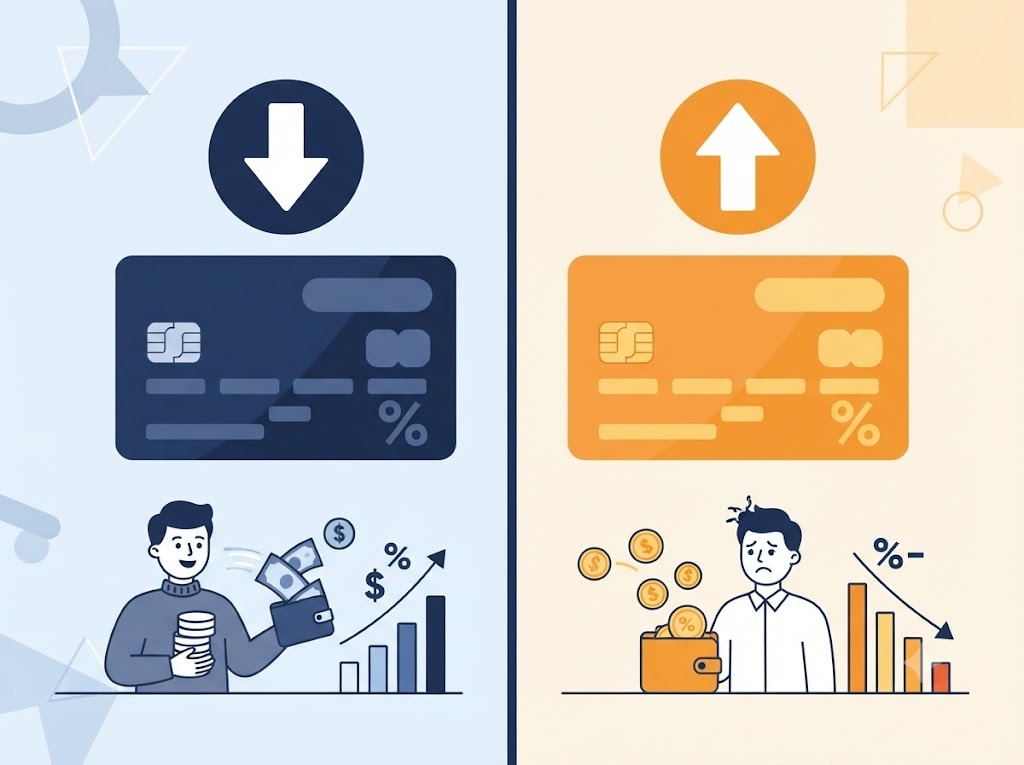
These benefits only hold if you clear the balance within the promotional window. What happens if you don't is worth knowing before you apply, not after.
Cons of Transferring Your Credit Card Balance
The processing fee, 1% to 3% of the transferred amount, is charged upfront, regardless of how much you eventually save. On a ₹2,00,000 transfer, a 2% fee is ₹4,000 gone from day one, money that needs to be weighed against the interest you expect to save, not treated as a rounding error.
The reduced rate is temporary. Whatever balance remains when it ends reverts to the card's standard 30% to 40% rate, often catching people off guard because the shift happens automatically, with no fresh warning beyond what was disclosed at signup.
Approval depends on your credit score and existing exposure, so someone already juggling multiple debts may not qualify for the best offers, or may not qualify at all. A full credit-card application may result in a hard inquiry. Depending on the scoring model and your overall credit profile, such an inquiry may affect your score.
It's easy to treat the freed-up limit on the old card as new spending room, turning one balance into two. This is arguably the single most common way a balance transfer ends up making someone's overall position worse rather than better.
A balance transfer only moves credit card debt to another credit card. It doesn't touch other unsecured loans sitting alongside it. For that, you need a different kind of consolidation.

Freed Expert Tip
Check the processing fee before the interest rate. A 1% to 3% fee on a large balance can erase most of what a low-rate window saves you.
Talk to FREED's TeamWhat Are Your Options Beyond a Balance Transfer
A balance transfer only works within credit cards. If you also have a personal loan, a BNPL balance, or a second card carrying its own rate, you need something that pulls all of it into one place, not just the single balance a transfer offer would cover.
A debt consolidation loan replaces multiple debts, across cards and loan types, with one new loan at one EMI. This is worth understanding at a general level before getting into how FREED's Debt Consolidation Program specifically approaches it. Here's how the two options actually compare side by side.
Feature | Balance Transfer Credit Card | FREED Debt Consolidation Program |
What it moves | One credit card's balance to another card | All eligible unsecured debt: cards, personal loans, BNPL, payday loans |
Interest rate | Low/0% for a short promotional window, then standard rate (30% to 40%) | Fixed rate from 11.99%* for the loan tenure |
Fees | Processing fee, 1% to 3% of transferred amount | Success-based fee, charged only on completion |
CIBIL impact | Improves if managed well, utilisation drops | Improves, does not drop |
Repayment structure | Still a revolving credit card | One fixed EMI, one lender, one due date |
*Rates and terms vary by lender and borrower profile. FREED matches you with a lending partner based on your financial profile.
The table makes the trade-off visible: a balance transfer is narrower in scope but faster to arrange, while consolidation covers more ground but involves a different kind of application. Here's how FREED specifically handles that part for you.
How FREED Helps
FREED's Loan Consolidation Plan, also called the Debt Consolidation Program or "Reduce My EMI," reviews your full debt picture, every card and loan, not just the ones a single balance-transfer offer would cover. This matters specifically for someone whose debt spans more than one type of account, since a transfer offer only ever sees the one card you apply with.
FREED matches you to a lending partner from its network based on your actual EMI-to-income math, not a generic advertised rate. That lending partner then disburses one new consolidated loan that pays off all your existing eligible debts instantly: credit cards, personal loans, BNPL, payday loans, all in a single move rather than one at a time.
The result is one loan, one EMI, one due date, at a lower EMI than what you were paying collectively across separate cards and loans. FREED charges a success-based fee, only when the consolidation is completed successfully, so there's no cost if it doesn't go through.
Consolidation is different from settlement, but taking a new loan can still affect your credit profile. The eventual impact depends on factors such as the credit inquiry, new account, repayment history, utilisation and how existing accounts are reported after repayment. It tends to improve as your utilisation drops and payments stay on time, since you go from several accounts with their own histories to one clean repayment record. FREED has counselled 20,00,000+ customers and manages ₹3,200 Cr+ in debt across its programs, with EMI reduced by up to 50%* and interest rates from 11.99%*.

Tips to Make a Balance Transfer Work in Your Favour
Calculate the processing fee against the interest saved before applying. A transfer only makes sense if the saving genuinely outweighs the fee, worked out in actual rupees, not just assumed because the rate looks lower on paper.
Set a repayment plan to clear the balance before the promotional window ends, not just "pay it off eventually." A tracker or payoff worksheet makes this easier to stick to than trying to remember a target in your head.
Avoid spending on the old card once it's paid off. Keep the limit if you want it for emergencies, but not the habit that built the original balance.
If your debt spans more than one card or loan type, compare a balance transfer against full consolidation before committing to either. The narrower tool isn't wrong for a narrower problem, but it's worth confirming that's actually the problem you have.
Sources
Claim | Source |
Card issuers must disclose fees and charges upfront under RBI's card conduct rules | Commonly required practice under RBI's Master Directions on Credit Card and Debit Card Issuance and Conduct; a directly loadable, page-specific source could not be confirmed during this research pass, and should be verified before publish |

FREED is India's trusted loan management platform. Founded in 2020 and headquartered in Gurugram, FREED has counselled 20 lakh+ people on personal loans, credit cards, and app loans. FREED charges fees only on successful settlement, not upfront. FREED does not handle secured loans (home loans, car loans, gold loans).
Media Mentions