Bill Consolidation Loan Without Collateral: Is It Possible?
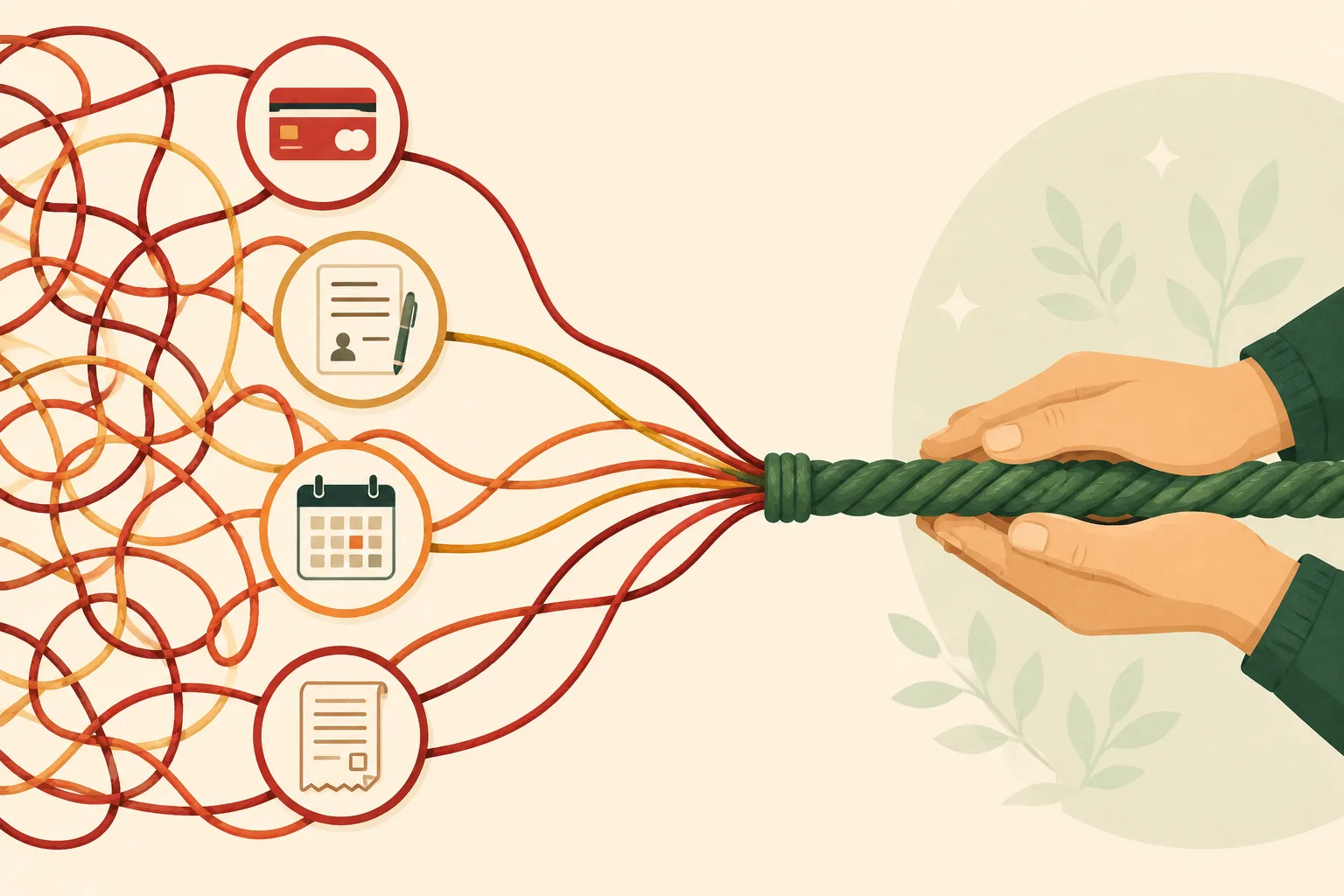
A bill consolidation loan without collateral is an unsecured loan that needs no property, gold or other asset as security. It may be used to repay eligible card balances and loans, leaving one repayment. It does not reduce what you owe.
Mohit Juneja
Reviewed by FREED India, Debt Resolution Specialists
 4.7/5
 ₹3,200Cr+
 20,000+
 20,00,000+4.7/5₹3,200Cr+20,000+20,00,000+
Key Summary

Yes. A bill consolidation loan with no collateral is possible in India.
“Bills” here means card bills, loan EMIs and similar dues. Not electricity or rent.
A secured loan can have a lower EMI. But it puts your property at risk.
Real lenders never ask you to send money to an agent’s account.
It suits people who can still repay, not people who have stopped paying.
Is a Bill Consolidation Loan Without Collateral Possible?
Yes, it is possible. In India, most consolidation loans for individuals need no collateral. The lender does not ask you to pledge your house, car or gold. Such a loan is called unsecured.
Here is how it works. You take one new loan. It pays off your card bills and loan EMIs (your fixed monthly payments). After that, you pay one EMI to one lender on one date.
Since there is nothing for the lender to hold, it looks closely at you. It checks your income. It checks your credit report. It checks how many EMIs you already pay. A later section explains this in detail.
The trade-off is simple. With no collateral, the lender takes more risk. So the rate is often higher than on a secured loan. In return, you do not risk your home if things go wrong.
Two things to remember. First, a consolidation loan is still a loan. It does not reduce what you owe. It changes how you pay. Second, it is meant for people who can still repay. You may be paying every bill on time, but it feels heavy. If that sounds like you, the option is open.
If you have missed several EMIs, a standard loan may be harder to get. We cover that later, and FREED’s team can look at your case too.
This guide is short and practical. It answers the question in the title, and then helps you avoid the most common traps, including fake offers that use “no collateral” as bait. For the full basics, see our pillar guide on what loan consolidation is.
For a wider look at the unsecured route, read our unsecured debt consolidation decision guide. We kept this page to the “no collateral” question and have not repeated the full list of pros and cons.

What Bills Can a Consolidation Loan Cover?
The word “bill” can confuse people. In loan talk, it mostly means money you owe on credit. It does not mean every bill at home.
Usually covered:
- Credit card bills. The outstanding balance on one or more cards.
- Personal loans. From banks and finance companies.
- Buy now, pay later (BNPL) dues. Pay-later balances on apps.
- Loan app and short-term loan dues. Small, short loans, often at a high rate.
- Card EMI conversions. Purchases you turned into EMIs.
Usually not covered:
- Electricity, water, gas and phone bills. These are not loans, so they are not part of a consolidation loan.
- Rent and school fees. These are regular costs.
- Medical bills. Unless they sit on a card or a loan, they are not included.
- Home loans and car loans. These are secured loans. An unsecured consolidation program does not cover them.
If you are struggling with household bills as well, a consolidation loan will not fix that on its own. It may reduce your monthly repayment burden, depending on the new loan's terms. However, it will not resolve underlying budget pressures on its own. Reviewing your income, essential expenses and repayment commitments can help you understand what is causing the shortfall.
Before you apply, list every card and loan. Write the balance, the rate and the EMI. This tells you which debts the new loan should pay off. Clear the costliest first. Cards and loan apps often charge the highest rates.
Our post on the types of debt consolidation explains the options side by side.
One more point. The new loan is meant to pay off your existing debts. It is not extra money to spend. Ask the lender how the payoff will be made, and get a payoff letter for each old account. A bill consolidation loan with no collateral still needs that paper trail.
How to Spot a Fake No-Collateral Loan Offer
Ads for “no collateral, no documents, instant loan” are everywhere. Some are real. Many are not. A few simple tests keep you safe.
Warning signs:
- They ask for money first. A real lender does not ask for a fee in advance.
- They say no documents are needed. Every real lender checks your identity (KYC) and income.
- They give you an account to pay your old lenders. This is how money gets lost.
- They pay the loan to someone else’s account. Your loan money should reach you, or your lender’s payoff should reach your old lender.
- They rush you. “Offer ends today” is a pressure trick.
- They contact you only on chat apps. Check that the lender has an official site and app.
- They cannot show a Key Facts Statement. A real lender gives one before you sign.
RBI's Digital Lending Directions, 2025 set out rules for digital lending by regulated entities within their scope. Loan disbursals must generally go directly to the borrower's bank account, with specified exceptions, including certain payments made directly to an end beneficiary. Repayments must generally be made directly to the regulated lender's bank account rather than through an account controlled by a lending service provider. The directions also restrict third-party control over fund flows. Check the applicable exceptions and requirements before describing a particular payment arrangement.
Fees owed to a service provider must be paid by the lender. They cannot be collected from you separately.
Use this as a simple test. Ask: “Which account receives the loan, and which account do I repay?” The loan should go to you, or, if the lender pays your old lender directly, it should say so in your written loan terms. Repayment should go to the lender. If a stranger’s account is in the picture, stop.
Under RBI's Digital Lending Directions, 2025, borrowers must be given a cooling-off period of at least one day for digital loans covered by the Directions. During this period, borrowers can exit by paying the principal and the proportionate APR, without a penalty. A disclosed one-time processing fee may be retained where permitted. Check the KFS and loan agreement for the applicable cooling-off period and exit conditions.
Ask for the lender’s registration details, and check them on RBI’s website. A lender you cannot find is a warning sign.
If you meet a scam, save the messages and report it to your bank and the cyber crime portal. Do not pay more to “recover” what you lost.

What the Law Says
Under RBI’s Digital Lending Directions, 2025, the lender must pay the loan into your bank account, and you repay directly into the lender’s account. No third party may control the flow of money.
Check My EMI ScoreIs an Unsecured or a Secured Consolidation Loan Better?
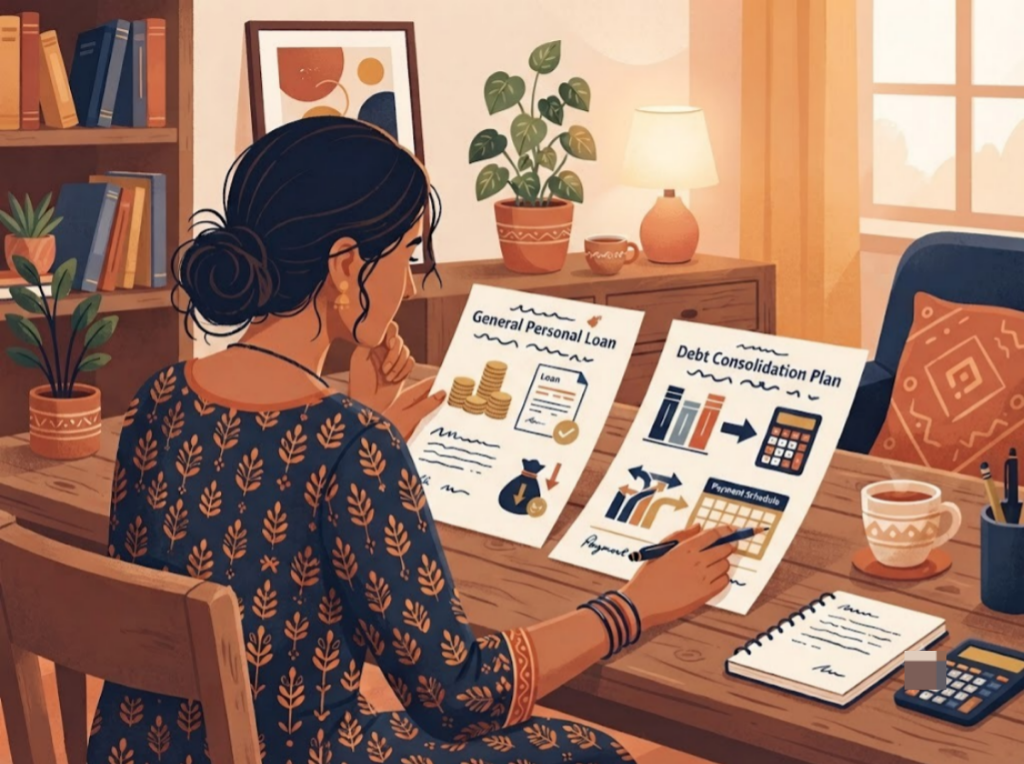
Neither is better for everyone. Here is a fair comparison.
A secured loan uses something you own as security. It could be your home (a loan against property) or gold. The lender can take that asset if you stop paying. Because the lender takes less risk, the rate is often lower, and the tenure can be longer.
An unsecured loan needs no security. The rate is often higher, but your home is not at risk.
Here is an illustration, not a real case. All rates are examples. You need ₹3,00,000 to pay off your bills and loans.
| Unsecured | Secured | |
|---|---|---|
| Rate | 16% | 11% |
| Tenure | 36 months | 60 months |
| EMI | ₹10,547 | ₹6,523 |
| Total repaid | about ₹3,79,696 | about ₹3,91,364 |
| What is at risk | Your credit record | Your property and your credit record |
Rates and ranges shown are indicative. Final terms decided by the lender. FREED is not a Loan Provider. No outcome is guaranteed. Please verify directly with your lender.
The secured loan has an EMI that is about ₹4,024 lower. That looks good. But because it runs for 60 months, you pay about ₹11,668 more in total. And your property is at risk the whole time.
The same secured loan over 36 months would total about ₹3,53,578. That is less than the unsecured loan, by about ₹26,118. But the EMI would be ₹9,822. So the lower cost comes from the shorter tenure and the lower rate, not from the security alone.
The lesson is plain. Look at the total, not only the EMI. And ask yourself whether a lower EMI is worth putting your home on the line.
Also think about what happens if your income falls. With an unsecured loan, a missed payment hurts your credit record, and you can talk to the lender. With a secured loan, a lender can also act on the property. That is a much heavier worry for a family.
Many careful borrowers choose unsecured for this reason. Our post on personal loan vs debt consolidation adds more.
Know your credit position before you apply
See your score and open accounts first.
Check My Credit InsightsWhat Does a Consolidation Loan Without Collateral Cost?
The EMI is not the only cost. Look at the full price.
- Interest rate. It is often higher without collateral, and it depends on your profile.
- Processing fee. Many lenders charge one. It may be taken out of the loan, so you receive less than the loan amount.
- Taxes. Tax can be added on the fee.
- Late payment charges. These apply if you miss a due date.
- Early payoff fees. Check whether the new loan, and your old loans, charge them.
- Tenure. A longer tenure lowers the EMI but raises the total cost.
Put all of these on one sheet. Then add them up.
The Key Facts Statement (KFS) is an important document to review before accepting a loan. For loans covered by RBI's KFS requirements, the regulated lender must provide it before the loan contract is executed. It includes the APR, applicable charges and repayment schedule. Review the KFS validity period and compare it with the loan agreement. Any charges not disclosed in the KFS must be handled in accordance with the applicable RBI requirements, including obtaining the borrower's explicit consent where required.
Compare the APR across lenders, not just the stated rate. The APR counts the fees too.
Here is one more check. Add up what you pay each month today. Add up what you would pay each month after the loan. Then compare the total you will repay in both cases. If the new total is higher, ask yourself why. It may be worth it for the lower EMI. But you should know the price.
Do not borrow more than you need. A bigger loan means more interest and a larger fee. If the lender takes its fee out of the loan, the money that reaches your old lenders can fall short, so ask how much will arrive after all fees.
To test numbers, see our debt consolidation calculator post.

FREED Expert Tip
Ask which account the lender will pay your old loans into, and who owns that account.
Plan My ConsolidationWhat Do Lenders Check Instead of Collateral?
With no collateral, the lender looks for other signs that you can repay. These are the main ones.
- Your income. Is it steady and enough for the new EMI?
- Your credit report. Do you pay on time? Are there errors?
- Your existing EMIs. How much of your income already goes to loans?
- Your job or business. How long have you been in it?
- Recent applications. Many applications in a short time can look like a rush for credit.
- Your papers. Do your name, address and income match?
We do not set a score or an income you must have. Each lender has its own view.
Here is a short self-check before you apply:
- Have I paid my EMIs and bills on time for the last several months?
- Do I have proof of steady income?
- Can I pay the new EMI even if my income dips a little?
- Have I avoided new loans and cards in the last few weeks?
- Is my credit report free of errors?
If most answers are yes, you are in a fair position.
This may suit you if you pay on time, have three or more debts and want one EMI. It may be better to wait if your income is unstable, or if you know you will use the cleared cards again.
If you have already missed one or more EMIs, avoid submitting multiple applications without first understanding your financial position. Review your credit report and repayment capacity, and consider discussing your options with a qualified financial counsellor.
Our guide on debt consolidation eligibility has more detail.
Not sure if you qualify?
See how a consolidation plan could fit your loans and income.
Check My EligibilityHow to Get a Bill Consolidation Loan Without Collateral
The process is short. Here are the steps.
- List your debts. Write the balance, the rate and the EMI of each card and loan.
- Check your credit report. Under RBI’s rules, each credit bureau gives you one free full report a year. Fix errors first.
- Decide how much you need. Add up the payoff amounts. Ask each old lender for the exact figure in writing.
- Compare a few offers. Look at the rate, the fees, the tenure and the total repaid. Ask for the Key Facts Statement.
- Apply once. Send one application to the lender you chose. Many forms at once can hurt.
- Check the payout. Ask how your old lenders will be paid, and get payoff letters.
- Set up auto-pay. Link the new EMI to your bank account.
Documents are usually the same as for any personal loan:
- A photo ID and an address proof.
- Your PAN card.
- Income proof, such as salary slips or tax returns.
- Recent bank statements.
- A statement for each debt you want to pay off.
Keep your papers in order. A mismatch in name or address is a common reason for delay.
After the money is paid, check your credit report a month or two later. Each old account should show as paid off. Keep the payoff letters.
If you apply through an app, read the permissions it asks for. Be careful with any app that asks for access it does not need to give you a loan, such as your contact list or photos.
For more on the steps, see our post on online debt consolidation loans.
See how much of your take-home pay your EMIs take
Before you apply for a bill consolidation loan with no collateral, see how heavy your EMIs really are. FREED’s EMI Score compares your EMIs with your take-home pay, so you can see where you stand against the 50% pointer, which is FREED’s rule of thumb and not an RBI rule. Results are indicative. Your lender statements are the final word.
See My EMI LoadWhat Helps Keep Your EMI Manageable After the Loan?
Getting the loan is only half the work. These habits help you stay on track.
- Set up auto-pay. Keep enough balance in the account on the due date.
- Keep cleared cards for emergencies only. Do not use them for new spending.
- Make a simple monthly budget. Write your income, your EMI and your must-pay costs.
- Build a small buffer. Even a small emergency fund helps you avoid a new card bill.
- Pay extra when you can. Ask first whether the lender charges a fee for part payment.
- Check your report now and then. See that the new loan and the paid-off accounts show correctly.
Your credit score tends to improve as you pay on time. Paying every EMI on or before the due date is the biggest help. Lower card balances help too. Do not expect a quick jump.
Also keep your papers in one folder. Keep the agreement, the Key Facts Statement, the payoff letters and the receipts.
If your income falls, speak to the lender early. A call before a missed payment is better than a call after it. Some lenders can offer more time or a new schedule, though the decision is theirs.
It also helps to look at why the bills grew. It may be a low income, a medical cost or a family need. A plan for that cause helps more than any loan. If you find it hard to see the full picture, a counsellor can help you.
Our post on the disadvantages of debt consolidation covers the risks to watch.
Not Sure Which Option Fits Your Loans?
Open the FREED app, add your loans and see which plan fits your situation.
See My Options on FREEDWhat If You Do Not Qualify Without Collateral?
A no from a lender is not the end. It tells you what to work on. Try these steps first.
- Ask for the reason. Request it in writing, if you can.
- Fix your report. Remove wrong entries, and clear small overdue amounts where you can.
- Lower your card balances. This helps your report and your chances.
- Ask for a smaller loan. Clearing only your costliest debts may be easier to get.
- Wait and rebuild. A few months of on-time payments can change the picture.
- Check your credit health. FREED’s Credit Insights shows your Experian credit report and gives step-by-step actions to improve it.
Be careful about one thing. After a rejection, a secured loan can look like an easy fix. A lender may say yes if you offer your property. But then your home is at risk. Think hard, and speak to someone you trust before you decide.
Also avoid apps and agents who promise a loan with no checks. These offers often hide high costs or turn out to be scams.
What if you have missed several EMIs, or repaying has become very hard? In that case, a standard consolidation may not be open to you. Talk to FREED’s team. They can look at your whole situation and explain the options that fit. You do not have to work it out alone.
Our post on the debt consolidation loan with no credit check explains why such offers need care.
How Does FREED Help With a Consolidation Loan Without Collateral?
FREED’s Loan Consolidation Plan (the Debt Consolidation Program, also called “Reduce My EMI”) is for people who can still repay but need a smarter way to manage their debt. FREED is India’s trusted loan management platform, and over 20 lakh people trust it. It helps you take control before your situation gets worse. Here is how it works:
- FREED assesses your profile. It looks at your loans, income and repayment record.
- FREED matches you to a lending partner from its network.
- The partner disburses one new loan. It pays off your existing eligible unsecured loans and card dues.
- You are left with one loan, one EMI and one due date.
- If one partner declines, FREED tries others that match your profile.
Your EMI amount is reduced. Your credit score is not hurt by consolidation, and it tends to improve as you pay on time. The whole process is 100% online, and FREED handles it end to end. The new loan is unsecured, so it needs no collateral. FREED charges a success-based fee, and the evaluation fee is non-refundable.
The program covers unsecured debt, such as personal loans, credit card dues, BNPL and app loans. It doesn’t cover home loans, car loans or other secured loans.
The checks in this guide still apply. Ask for the total amount you will repay, read the Key Facts Statement, and keep the payoff proof.
Not sure if you qualify? FREED’s team can look at your situation on a call and tell you which options fit. You can also read the Loan Consolidation Plan page for more.
Ready to Turn Many EMIs Into One?
See how the Loan Consolidation Plan could cover your cards and personal loans.
Get Started on FREED
Mohit Juneja
Mohit Juneja is FREED’s Content & Communication Lead with 12+ years of experience across content, media, advertising and digital communications. He holds a postgraduate diploma in Communications from Xavier Institute of Communications, Mumbai, and has worked with organisations including NDTV, The Indian Express, McCann Worldgroup and NABARD.
At FREED, he leads content and communication across loan management, debt resolution, debt consolidation and financial well-being. His work combines research, storytelling and consumer-focused communication to make complex financial topics easier to understand and act on. He has also scripted and produced 11 documentaries on rural development and agriculture for NABARD, with film's selected for the Mumbai International Film Festival.
mohit.juneja@freed.care

FREED is India's trusted loan management platform. We help India settle their loans, consolidate their EMIs, improve their credit score, and manage their loans better. Over 20 lakh people trust FREED. We have managed more than ₹3,500 crore in loans and saved our users over ₹450 crore.
Media Mentions