Types of EMI: Fixed vs Floating, Which Saves You More?
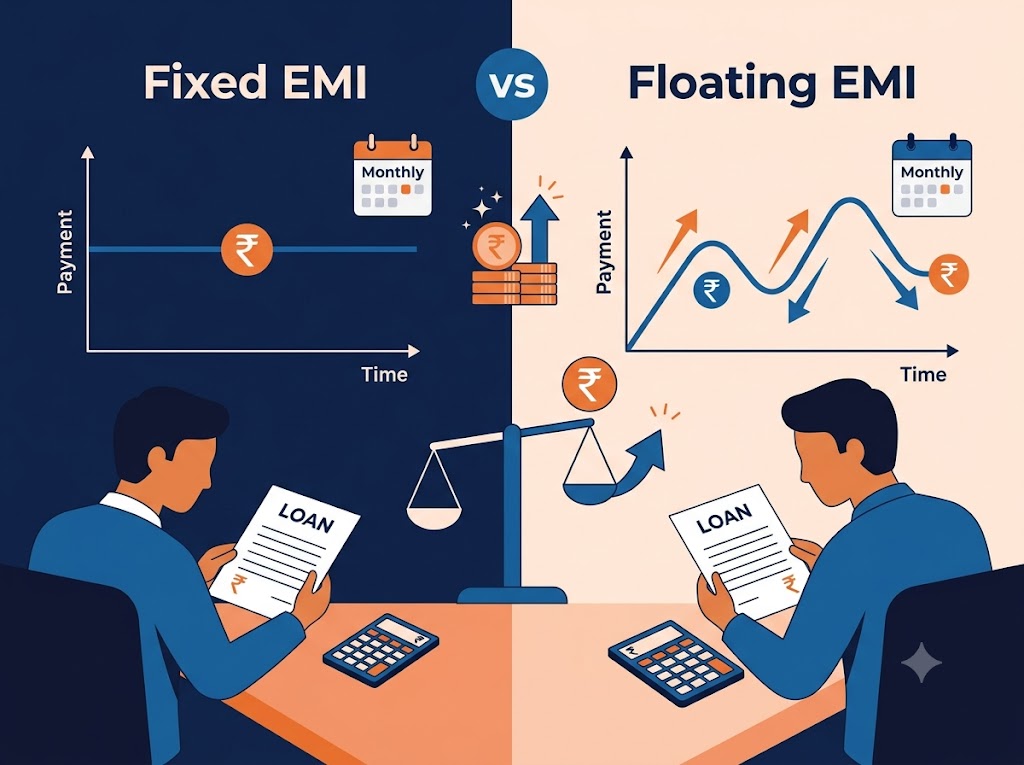
A fixed-rate loan keeps the interest rate unchanged for the agreed fixed-rate period. Where the EMI is structured as fixed, the scheduled EMI remains unchanged during that period.
Mohit Juneja
Reviewed by FREED India, Debt Resolution Specialists
 4.7/5
4.7/5 ₹3,200Cr+
 20,000+
 20,00,000+4.7/5₹3,200Cr+20,000+20,00,000+
KEY TAKEAWAYS

The main types of EMI are fixed rate, floating rate, and less common step-up or step-down structures.
A fixed EMI stays the same for the entire loan term, regardless of market rate changes.
A floating EMI moves with the market, it can go up or down, usually starting lower than fixed.
Floating rates can be cheaper than fixed rates when market rates remain favourable, but they can also become more expensive if rates rise. There is no guarantee which option will cost less over a future loan term.
Switching or consolidating multiple EMIs into one is possible even after a loan has started.
What Are the Different Types of EMI?
Almost every loan in India comes down to a handful of EMI structures, though two of them cover nearly everything you'll actually encounter.
- Fixed rate EMI. The rate and EMI amount stay constant for the entire loan term, no matter what happens to market rates later.
- Floating rate EMI. The rate is tied to a market benchmark, so the EMI or tenure can shift up or down over the life of the loan.
- Step-up EMI. Step-up structures increase scheduled payments over time and may be offered for specific borrower profiles or products.
- Step-down EMI. Step-down structures reduce scheduled payments over time and are less common; availability depends on the lender and product.
- Bullet or balloon EMI. Small regular payments through the term, followed by one large payment at the end, mostly seen in specific business or property loans.
Fixed and floating rates are the two main rate structures borrowers encounter across many personal, home and vehicle loans, although availability varies by lender and product. The other three are product-specific and considerably less common outside their particular use cases.
Since fixed and floating are what most borrowers actually end up choosing between, that comparison is really what the rest of this piece is about. Before getting into that, it helps to understand how EMI itself works as a concept and how the actual monthly figure gets calculated in the first place, both of which shape why fixed and floating behave so differently.
Why Fixed and Floating Rates Behave So Differently
The mechanics behind EMI (Equated Monthly Instalment, the fixed payment covering both principal and interest) explain why these two rate types end up feeling so different to live with.
A fixed rate loan locks in the rate for the entire term at the outset. Whatever happens to market rates over the next several years, your EMI stays exactly the same. That certainty comes at a cost, the starting rate on a fixed loan is usually a little higher than what a floating loan offers on day one, since the lender is pricing in the risk of rates moving against them later.
A floating rate loan works differently. A floating rate is linked to an external or lender-defined benchmark, depending on the loan and applicable rules. When the benchmark changes, the lender's applicable rate may change as well. Floating rates may start lower than comparable fixed-rate offers, but the actual rates depend on the lender, product, borrower profile and market conditions.
Here's roughly how that plays out over time. Say a floating loan started at a certain rate. If the benchmark rises over the next couple of years, the EMI or tenure adjusts upward to reflect that. If it falls instead, the borrower benefits without doing anything, the rate simply drops along with it. A fixed loan taken at the same starting point would have felt completely flat through both of those swings, neither the pain of the increase nor the benefit of the decrease.
None of this makes floating inherently risky or fixed inherently safe, it's a genuine trade-off between certainty and cost, not a right-or-wrong choice. Understanding that mechanism is what actually explains why the answer to "which one saves more" isn't the same for every borrower, which is covered directly a bit further down.

Freed Expert Tip
If you're on a floating rate loan, ask your lender for your current effective rate once a year. Most people never check after signing.
Compare your loan optionsSigns Your Current EMI Type Might Be Costing You More Than It Should
A quick self-check, not a cause for alarm, just five things worth confirming about your own loan rather than assuming everything's still priced the way it was on day one.
- You took a floating loan years ago and have never checked your current rate against recent benchmark changes. Rates move even when you're not paying attention, and the gap between what you're paying and what's current can quietly grow.
- You took a fixed loan when floating rates were lower, and never compared since. The premium you're paying for certainty might be larger than it needs to be if market conditions have shifted.
- You have multiple loans on different rate types and don't actually know your blended cost. Tracking what you're really paying across everything gets harder the more accounts are involved.
- Your EMI increased and you don't have a clear explanation from your lender. This deserves a direct question, not an assumption that it's automatically correct.
- You haven't compared your current rate to what new customers get for the same loan type. Compare your current rate with the lender's current offers for comparable borrowers and products; pricing can change over time.
If any of this sounds familiar, the next section on deciding between fixed and floating, or on switching, is worth reading closely.
How to Decide Between Fixed and Floating EMI, Step by Step
None of these steps require any specific product, this is the general decision process any borrower can work through on their own.
- Check Your Loan Tenure. Floating-rate risk becomes more relevant when the loan has a long remaining tenure. A fixed rate may appeal to borrowers who prioritise payment certainty, regardless of loan duration.
- Check Your Budget's Flexibility. If a rate increase would strain your monthly budget, a fixed EMI removes that uncertainty entirely.
- Compare Current Starting Rates. Ask your lender for both fixed and floating rates for your exact loan amount and tenure before deciding.
- Ask About Reset or Switch Options. Some lenders or loan products may allow a rate-type switch or reset, subject to the loan terms and applicable charges. If your current lender's switch terms aren't great, a balance transfer to a different lender is worth comparing as an alternative route to a better rate.
- Review the Choice Every Few Years. The better option can change as market rates move, don't assume the first decision is final.
Working through these in order matters more than picking randomly. Tenure and budget flexibility, the first two steps, largely determine which direction you should be leaning before you even look at actual rate numbers. Someone with a 20-year home loan and a comfortable buffer in their monthly budget is a very different case from someone with a 3-year personal loan and no room to absorb a rate increase, even if both are asking the exact same question.
Step three is where a lot of borrowers stop too early. It's tempting to assume the general pattern, floating usually starts lower, fixed offers certainty, applies automatically to your specific situation. But actual quoted rates vary by lender, by loan product, and by your own credit profile, so the only way to know for sure is asking for real numbers rather than working off a general rule of thumb.
The reset and review steps, four and five, are the ones people skip most often, mainly because they require revisiting a decision that felt finished at signing. But loan terms, especially long ones, span years during which market conditions genuinely change. A rate that made sense in year one can look quite different by year five. That's a more useful number to have in hand than a general sense that "floating is usually cheaper," since general patterns don't always hold for every individual loan.
Knowing how to decide is one thing. Seeing the actual money difference between the two paths is what the next section covers directly.

Fixed vs Floating EMI, Which Saves You More Money?
EMI Type | Rate Behavior | Predictability | Typically Best For |
Fixed | Stays the same for the full term | High, EMI never changes | Shorter tenures, tight fixed budgets |
Floating | Moves with the market benchmark | Lower, EMI can rise or fall | Longer tenures, some budget flexibility |
Hybrid | Fixed for an initial period, then floating | Medium, changes after the fixed period ends | Borrowers who want short-term certainty with long-term flexibility |
Rates and ranges shown are indicative. Final terms decided by the bank. FREED is not a Loan Provider. No outcome is guaranteed. Please verify directly with your bank.
Here's roughly how the money adds up over time. Even a one-percentage-point difference in the interest rate can materially change the total interest paid over a long loan tenure. This is exactly the kind of comparison worth running before assuming a balance transfer to the lowest available rate is automatically the right move, the transfer fee and paperwork need to be weighed against the actual savings too.
Neither type is objectively better in isolation, the right answer depends entirely on matching the structure to your own tenure and comfort with uncertainty, not on chasing whichever pattern sounds more appealing in the abstract.
The money difference is real, and it's worth taking seriously. But it's not the only factor in play. What happens if you're already sitting on the costlier side of this comparison, whether by circumstance or an earlier decision that no longer looks ideal, is exactly what the next section walks through.
What to Do If You're Stuck With a Costlier EMI Type
Two different situations call for two different responses here, and it matters which one actually describes you.
If the issue is that one loan is relatively expensive, compare a balance transfer after factoring in the new rate, fees, prepayment costs and remaining tenure. This moves your existing loan to another lender offering a better rate, and it's the more direct fix when the problem is really just "this one loan costs more than it should."
If instead you're juggling multiple loans, some fixed, some floating, spread across different lenders, and simply keeping track of due dates and rates has become genuinely difficult, that's a different problem with a different solution. Consolidation can combine eligible debts into a new loan, subject to lender approval and the programme's eligibility criteria.
These aren't interchangeable options, and it's worth being clear about that. A balance transfer solves a pricing problem on a single loan. Consolidation solves a complexity problem across several loans at once. Someone drowning in due dates across multiple accounts gets more value from consolidation than from transferring just one of several loans, since the underlying issue isn't really about any single rate, it's about the sheer number of things to track.
Neither path requires being behind on payments or in any kind of financial trouble, both are simply about getting a better structure for a situation that's still fully manageable, just more complicated than it needs to be.
This second case, multiple EMIs across different rate types getting hard to manage, is exactly where FREED's Debt Consolidation Program fits.
Are You in a Loan Trap? Quick Check
Move the slider to your total EMIs as a % of monthly salary. See your debt stress level instantly.
EMIs as % of Monthly Salary
How FREED Helps If Multiple EMIs at Different Rates Are Getting Hard to Track
FREED's Loan Consolidation Plan, also known as the Debt Consolidation Program, is built for people who can still repay comfortably but need a smarter way to manage several loans at once, not for anyone already behind on payments.
Here's how it actually works. FREED assesses your full financial profile, then matches you to a suitable lending partner from its network. Where approved, the lending partner provides a new loan that can be used to repay eligible existing debts, subject to the partner's process. The borrower may then have one new scheduled EMI instead of multiple eligible loan payments. What's left afterward is one loan, one EMI, one due date, replacing whatever combination of accounts you were juggling before.
A consolidation application may involve a new credit enquiry and account, so its credit-report impact can differ from simply continuing existing accounts. Consistent repayment is important after consolidation. Consolidation changes how your credit accounts are structured and reported. Consistent, on-time repayment on the new loan can support your credit profile over time.
Worth being direct about who this is actually for. If you've already defaulted on something, this program isn't the right fit, talking to FREED's team directly for an eligibility check makes more sense than assuming either way. For everyone else still current on payments but managing a genuinely complicated mix of loans, this is exactly the kind of situation it was built to simplify.
The fee only applies once consolidation is actually completed, nothing charged if it isn't. That structure matters, FREED only gets paid for actually solving the problem, not for the attempt, which keeps the incentive pointed in the right direction throughout.
For someone comparing fixed and floating loans across three or four different accounts, the honest answer is often that the rate type matters less at that point than simply reducing the number of moving pieces to track in the first place.
Tips for Managing Your EMI Type Wisely
A few habits keep an EMI type working in your favor long after the loan is signed, rather than just for the first year or two.
Revisit your loan's rate type every couple of years, don't assume whatever you signed up for stays optimal forever. Market conditions shift, and what made sense at signing might not still be the best fit years later.
Ask your lender directly for the current floating rate and compare it to what you're actually paying. This is the only reliable way to know if your effective rate still lines up with what's currently on offer.
Keep a small buffer in your budget if you're on a floating loan, so a rate increase doesn't turn into a missed payment. Even a modest cushion absorbs most ordinary rate movements without any real disruption.
Avoid taking a new loan just to "lock in" a rate without comparing the total cost first. A lower headline rate on a new loan can still cost more overall once fees and terms are factored in properly.
Check if a balance transfer or reducing your EMI through consolidation would genuinely save money before assuming your current loan is already the cheapest option available. It often isn't, simply because nobody's checked recently.
The right EMI type is the one that fits your actual budget and timeline, not the one that sounded better at signing.

Mohit Juneja
Mohit Juneja writes educational content at FREED on debt management, credit scores, loan repayment, and borrowing best practices. His content is shaped by expert insights and industry knowledge, helping readers better understand their financial options and make informed decisions.
mohit.juneja@freed.care

FREED is India's trusted loan management platform. Founded in 2020 and headquartered in Gurugram, FREED has counselled 20 lakh+ people on personal loans, credit cards, and app loans. FREED charges fees only on successful settlement, not upfront. FREED does not handle secured loans (home loans, car loans, gold loans).
Media Mentions