EMI Formula: The Exact Calculation Banks Use
A commonly used formula for fixed-rate, reducing-balance loans is EMI = [P × r × (1+r)^n] / [(1+r)^n − 1]. Since October 1, 2024, RBI requires regulated entities to provide a Key Fact Statement containing the APR computation and amortization schedule for new retail and MSME term loans before the borrower accepts the loan.

Mohit Juneja
Reviewed by FREED India, Debt Resolution Specialists
 4.7/5
4.7/5 ₹3,200Cr+
 20,000+
 20,00,000+4.7/5₹3,200Cr+20,000+20,00,000+
KEY TAKEAWAYS

The EMI formula banks use is a standard reducing balance calculation, EMI = [P × r × (1+r)^n] / [(1+r)^n − 1], applied to the outstanding balance each month.
Since October 1, 2024, RBI's Key Fact Statement (KFS) mandate requires every bank and NBFC to show the loan's APR computation and amortization schedule before you accept the loan.
APR includes the interest rate plus all fees and third-party charges. It's usually higher than the nominal interest rate advertised, sometimes noticeably so.
Any fee not disclosed in the KFS cannot be charged to you later without your express consent. This is a real, enforceable protection, not a courtesy.
If a lender won't show you a KFS before you accept a loan, that's a clear compliance red flag worth pausing over.
Why Loan Paperwork Makes It So Hard to Check Your Own EMI
Most people sign a loan agreement without ever really checking whether the EMI quoted actually matches the interest rate quoted. That's not carelessness. Loan agreements run several pages, use dense legal language, and bury the interest computation somewhere in a schedule most borrowers never open. Even someone comfortable with numbers can find it genuinely hard to tell whether a lender's ₹X per month figure is the correct output of the rate they advertised, or something quietly different.
This gap between what's advertised and what's actually calculated is exactly what RBI's Key Fact Statement mandate was built to close. It doesn't ask you to trust the lender's math. It requires the lender to hand you the computation itself, in a standard, simple format, before you agree to anything. That changes the question from "Do I trust this number?" to "Can I check this number?", and checking it is a lot more manageable than it sounds once you know what to look for.
The rest of this article covers exactly that: the formula itself, what the KFS is legally required to contain, how APR differs from the rate you see advertised, and a practical way to verify your own lender's numbers against it.

Verify Your Loan's Real Numbers
Free tool: check the EMI and total cost yourself.
Check your optionsWhat Is the Exact EMI Formula Banks Use?
A commonly used formula for a fixed-rate, reducing-balance loan is:
EMI = [P × r × (1+r)^n] / [(1+r)^n − 1]
Here, P is the principal, r is the monthly interest rate, and n is the number of monthly instalments. Actual calculations may vary depending on the loan’s interest structure, rate resets, repayment frequency, rounding, and other terms. RBI’s KFS rules require APR and amortization disclosures but do not prescribe one universal EMI formula for every loan.
This article isn't a full derivation of that formula. If you want to see it worked through variable by variable, with a complete amortization example, that lives on a separate page. What matters here is narrower and more practical: this exact calculation, along with every input that feeds it, is now something your lender is legally required to hand you in writing before you accept the loan. That requirement, the Key Fact Statement, is what the rest of this article is really about.
What Is the RBI's Key Fact Statement (KFS) Mandate?
Under a circular dated April 15, 2024 (RBI/2024-25/18, DOR.STR.REC.13/13.03.00/2024-25), the Reserve Bank of India made it mandatory for every regulated lender, commercial banks, small finance banks, local area banks, regional rural banks, urban and state co-operative banks, and NBFCs including housing finance companies, to hand borrowers a standardized Key Fact Statement before they accept any new retail or MSME term loan. The requirement became compulsory from October 1, 2024, and applies to all new loans sanctioned on or after that date, including fresh loans given to existing customers.
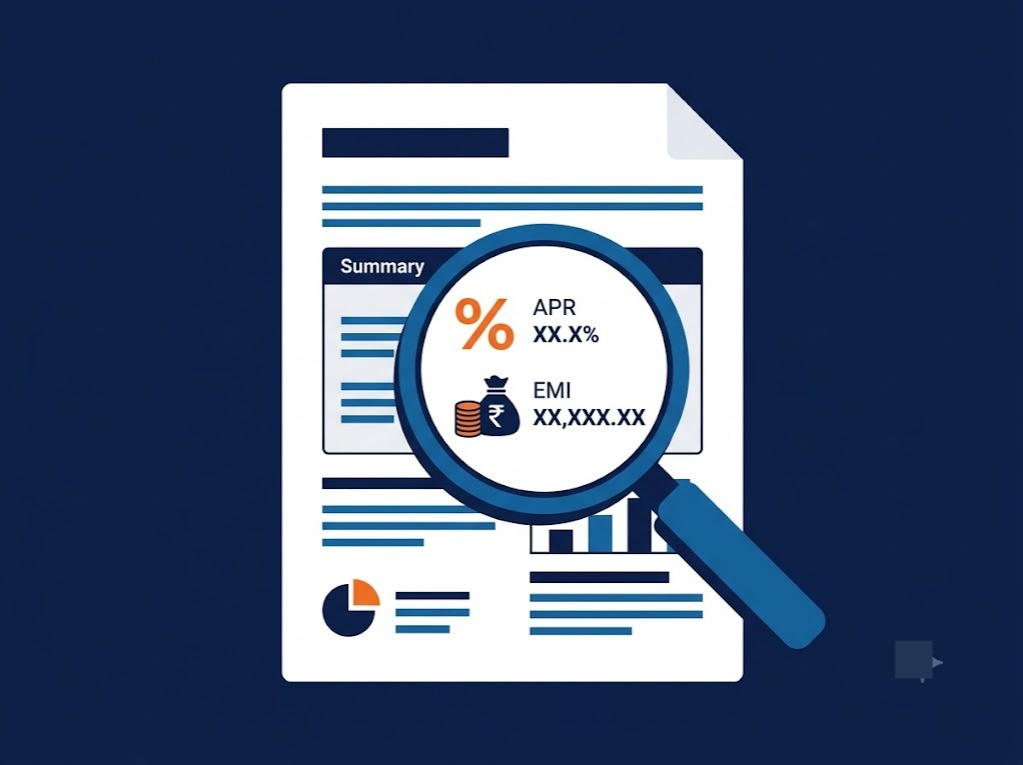
The KFS has to contain three things in a fixed, simple format that avoids legal jargon. First, a computation sheet showing exactly how the loan's Annual Percentage Rate (APR) was arrived at. Second, a full amortization schedule, the same month-by-month EMI, interest, and principal breakdown covered earlier on this site, showing how the loan plays out over its entire tenure. Third, every fee connected to the loan, including third-party charges like insurance premiums or legal and processing costs, is disclosed individually rather than buried inside one lump figure.
The protection that matters most for borrowers sits in one specific line of the circular: any fee or charge that isn't listed in the KFS cannot be charged to you later, at any point during the loan's term, without your explicit consent. That turns the KFS from a disclosure document into something with real teeth. If a cost shows up on your statement six months into a loan that was never mentioned in your KFS, the lender needs your explicit sign-off to charge it, not just a clause buried somewhere in the original agreement.
One notable exemption: credit card receivables are excluded from this specific KFS mandate. The requirement is built around term loans, personal loans, vehicle loans, and similar retail and MSME lending, not revolving credit card balances.

What the Law Says
Since October 1, 2024, RBI's Key Fact Statement circular (dated April 15, 2024) requires every bank, NBFC, and regulated lender to disclose APR, the amortization schedule, and all fees before a borrower accepts a retail or MSME term loan. Credit card receivables are exempted
Talk to FREED's TeamAPR vs the Advertised Interest Rate: What's the Real Difference?
The interest rate a lender advertises and the APR your loan actually carries are rarely the same number, and the gap between them is exactly what the KFS was designed to expose.
The advertised interest rate covers only the cost of borrowing the money itself, the base percentage applied to your principal. APR, the Annual Percentage Rate, folds that base rate together with every other mandatory cost of the loan, processing fees, documentation charges, and any third-party costs like insurance, into a single annualised figure. Two loans quoting the same interest rate can carry noticeably different APRs once you account for what each lender charges on top of it.
RBI's own illustration in the KFS circular makes the gap concrete: a loan advertised at a 15% per annum interest rate works out to an effective APR of 17.07% per annum once the associated charges are folded in, based on the hypothetical example RBI itself published to explain how lenders must calculate this figure. That's roughly a two-percentage-point difference on paper, and on a multi-lakh loan carried over several years, a gap that size adds up to a real, meaningful sum, not a rounding error.
This is the number that actually reflects what a loan costs you, not the headline rate in the advertisement. Once you know to look for it, checking a lender's own math becomes a genuinely practical exercise, not a matter of taking their word for it.
How to Verify Your Bank's EMI Calculation Is Correct
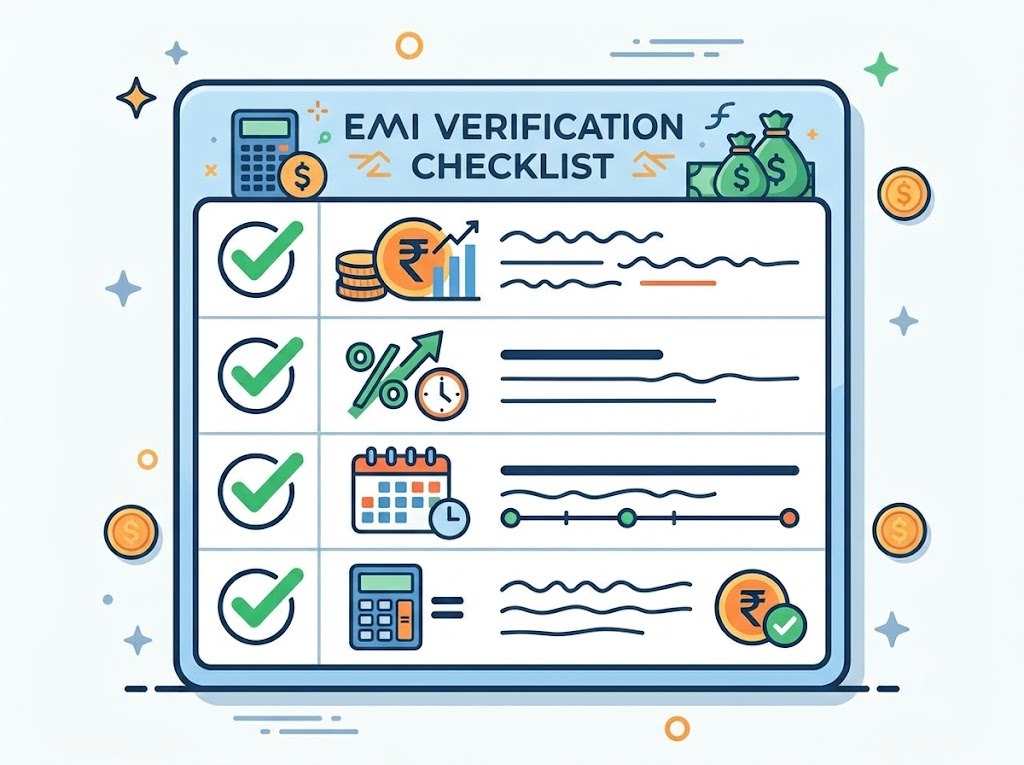
You don't need a finance background to check whether a lender's numbers add up. A few concrete steps cover most of it.
Ask for the KFS before you sign anything. This is your right under RBI's mandate, not a special request. A regulated lender is required to hand it over before you accept the loan, not after.
Check the amortization schedule against the reducing balance formula. The schedule in your KFS should show interest shrinking and principal growing month over month, the reducing balance pattern. If the numbers look flat, the same interest amount charged every month regardless of your falling balance, that's a sign the calculation may be running on a flat rate basis instead, which costs meaningfully more for the same quoted rate.
Confirm the APR figure includes every fee, not just the base interest rate. The computation sheet in the KFS should show how the APR was built up from the interest rate plus each individual charge. If the APR shown is identical to the advertised interest rate, ask why, since that would mean no fees were added at all, which is unusual.
Cross-check the quoted EMI yourself. Use the formula, or an EMI calculator, with the principal, rate, and tenure from your loan documents, and compare the result against what the lender has quoted. A small rounding difference is normal. A large gap is not.
If a lender can't or won't produce a KFS at all, that's reason enough to pause before proceeding, regardless of how good the rest of the offer looks.

FREED Expert Tip
Ask for the Key Fact Statement before you sign, not after. Once you accept the loan, undisclosed fees become much harder to contest.
Check My OptionsWhat If the Numbers Don't Add Up?
If you compare your quoted EMI against the formula and find a real gap, or if a lender never gave you a KFS at all, the first practical step is to raise it directly with the lender's grievance officer. Every regulated lender is required to have one, and a written query referencing the KFS mandate carries real weight, since it points to a specific, dated regulatory requirement rather than a general complaint.
The protection RBI built into this rule gives you actual standing here. Undisclosed charges cannot be enforced on you without your explicit consent, so if a fee shows up that was never in your KFS, that's not just unfair; it's not enforceable without your sign-off. Say it so clearly when you raise it.
This won't resolve every situation. Some disputes take longer, and some come down to a genuine misunderstanding rather than a compliance gap. But knowing the formula and knowing your KFS rights turns a vague feeling that "something's off" into a specific, checkable claim, and that's a real difference in a conversation with a lender's grievance desk.
Sometimes, though, the calculation is entirely correct, and the real issue is somewhere else. That's worth its own section.
When the Formula Is Correct but the EMI Still Doesn't Fit
Sometimes there's no error to find. The formula is correct, the KFS matches the amortization schedule, and the APR was disclosed properly. The real problem is simpler and harder to fix with a grievance letter: the EMI itself, calculated exactly right, is still more than your income can comfortably absorb once your other existing obligations are added in.
That's a different kind of problem, and it's a common one when EMIs across a personal loan, a credit card, and maybe a BNPL instalment are all running at once, each correctly calculated on its own, but adding up to more than your salary can carry.
In that situation, FREED may assess your financial profile and connect eligible borrowers with a lending partner that may consolidate eligible unsecured debts into one repayment, subject to the lender’s approval and final terms. FREED is not a lender, and approval or a lower EMI is not guaranteed.

Sources
Claim in Blog | Source |
KFS mandate for retail/MSME term loans, circular RBI/2024-25/18 dated April 15, 2024, compulsory from October 1, 2024 | RBI circular, Key Facts Statement (KFS) for Loans and Advances: https://rbidocs.rbi.org.in/rdocs/notification/PDFs/CIRCULARKFS1504242AE2500BAF494C2A82442B0B642705C1.PDF |
Fees/charges not mentioned in the KFS cannot be charged to the borrower at any stage without explicit consent | Same RBI circular as above |
Credit card receivables exempted from the KFS mandate | Same RBI circular as above |

Mohit Juneja
Mohit Juneja writes educational content at FREED on debt management, credit scores, loan repayment, and borrowing best practices. His content is shaped by expert insights and industry knowledge, helping readers better understand their financial options and make informed decisions.
mohit.juneja@freed.care

FREED is India's trusted loan management platform. Founded in 2020 and headquartered in Gurugram, FREED has counselled 20 lakh+ people on personal loans, credit cards, and app loans. FREED charges fees only on successful settlement, not upfront. FREED does not handle secured loans (home loans, car loans, gold loans).
Media Mentions