EMI Full Form: What It Stands For and How It Works
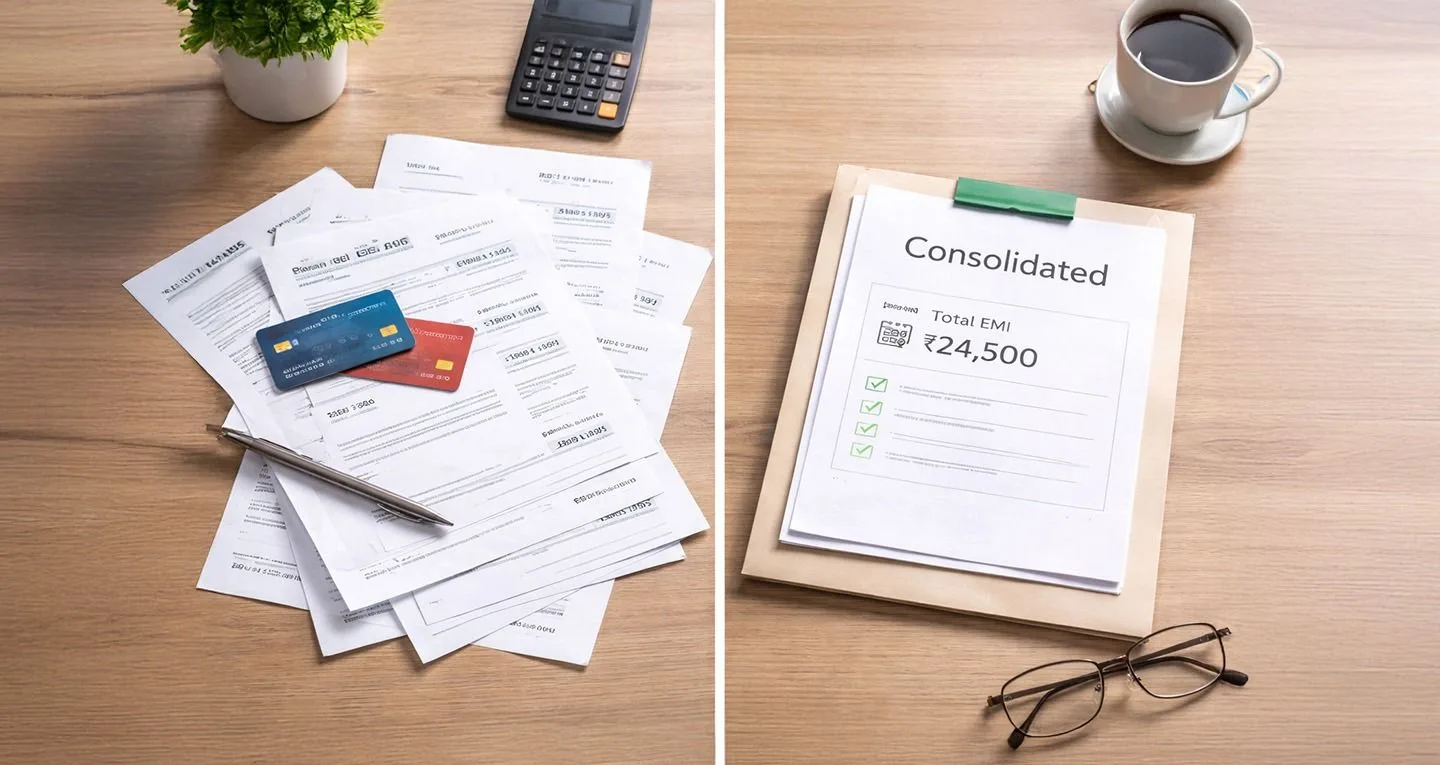
EMI full form is Equated Monthly Installment, a fixed monthly payment made to a lender that combines both principal (the amount borrowed) and interest (the cost of borrowing), repaid on a set date every month until the loan is fully paid off.
Mohit Juneja
Reviewed by FREED India, Debt Resolution Specialists
 4.7/5
4.7/5 ₹3,200Cr+
 20,000+
 20,00,000+4.7/5₹3,200Cr+20,000+20,00,000+
KEY TAKEAWAYS

EMI full form: Equated Monthly Installment, a fixed monthly repayment covering both principal and interest.
Each EMI has two parts: interest and principal. Early payments are interest-heavy; later ones lean principal-heavy.
The EMI amount stays fixed for the loan tenure unless the interest rate or loan terms change.
What Is the Full Form of EMI?
EMI stands for Equated Monthly Installment. Break the phrase down, and it explains itself. "Installment" is a payment made in parts rather than all at once. "Monthly" tells you how often that payment falls due. "Equated" is the word carrying the real meaning, and it's also the one people usually skip over without asking what it actually means.
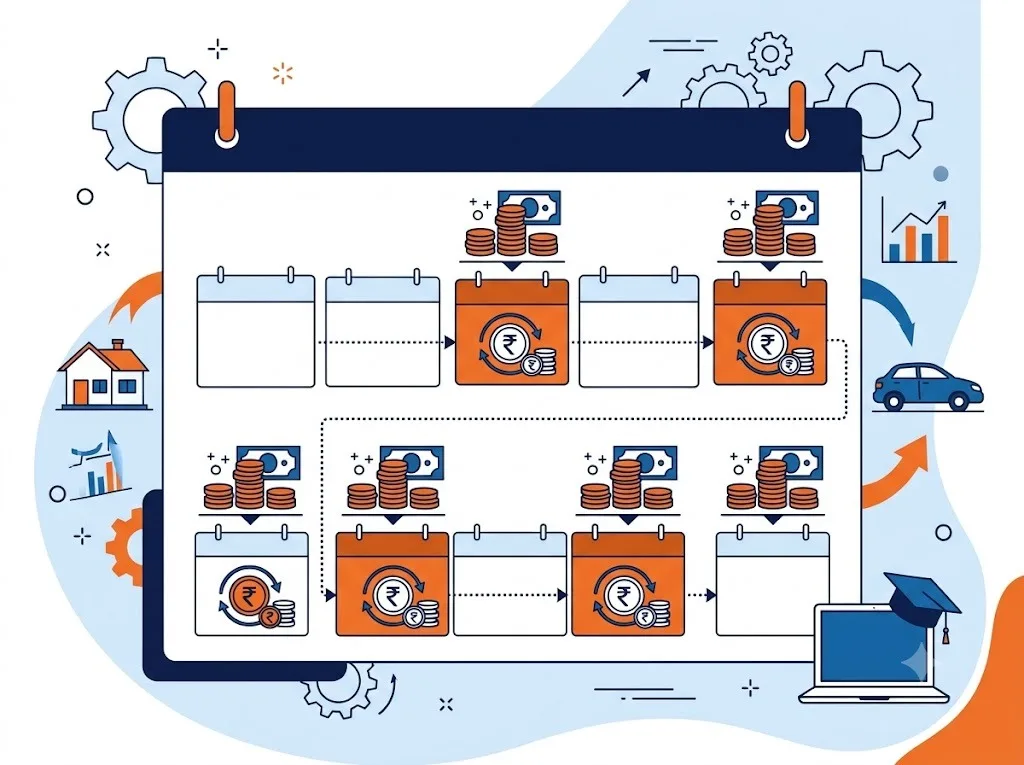
Equated means the payment amount is the same every single month, from your very first EMI to your very last one, for as long as the loan runs. That doesn't happen by accident. Banks calculate EMIs specifically so the number stays flat across the entire tenure, even though a loan's interest is technically charged on a shrinking balance every month. Without that calculation, your payment in month 1 would look nothing like your payment in month 30, since the outstanding amount you owe keeps dropping. The EMI formula exists precisely to smooth that out into one predictable number.
This predictability is the whole point of an EMI as a repayment structure. You know exactly what leaves your account and on what date, month after month, which makes budgeting around it far easier than a repayment plan where the amount shifts unpredictably. A ₹20,000 EMI due on the 5th of every month stays ₹20,000 whether it's your third payment or your thirtieth, as long as nothing about the loan itself changes.
But here's where it gets interesting, and where a lot of the confusion around EMIs actually starts. Even though the total payment amount stays frozen, what's happening inside that payment is anything but static. Every EMI is quietly made up of two different pieces, and the balance between those two pieces shifts constantly across the life of the loan. Understanding that split is the key to understanding how a loan actually gets paid off, not just how much you're handing over each month.

What Are the Components of an EMI?
Every EMI you pay is a mix of two things: principal and interest. The principal is straightforward: it's a slice of the actual amount you borrowed, being paid back bit by bit. Interest is the cost the lender charges for letting you borrow that money in the first place, calculated fresh each month on whatever balance you still owe, not on the original loan amount.
Here's the part that catches most people off guard. In the early months of a loan, the interest portion of your EMI is much bigger than the principal portion, even though your total EMI never changes. As you keep paying and the outstanding balance shrinks, the interest charged on that smaller balance shrinks too, which means more of each fixed EMI naturally flows toward principal instead. By the time you're near the end of the loan, almost the entire EMI is going toward principal, with only a sliver left for interest.
Walk through an actual example to see this properly. Say you take a ₹5,00,000 personal loan at 12% annual interest over 3 years, which comes out to an EMI of roughly ₹16,600 a month. In month 1, interest alone eats up close to ₹5,000 of that payment, since it's calculated on the full ₹5,00,000 you still owe. Only around ₹11,600 actually reduces your principal that month. Fast forward to month 30. Your outstanding balance has shrunk considerably by then, so the interest charged on it drops to somewhere around ₹700, while roughly ₹15,900 of the same ₹16,600 EMI now goes straight toward paying down principal.
This is exactly why closing a loan early saves more money in year one than it does in year three. Paying an extra lump sum against principal early in the loan wipes out a bigger chunk of future interest, because you're reducing the balance that interest gets calculated on for a much longer stretch of remaining months. The same extra payment made near the end of the loan barely moves the needle, since there's very little interest left to save at that point anyway.
How Is EMI Calculated?
A commonly used formula for fixed-rate, reducing-balance loans is:
EMI = [P × r × (1+r)^n] / [(1+r)^n − 1]
Here, P is the principal, r is the monthly interest rate, and n is the number of monthly instalments. Actual EMI calculations may vary depending on the loan’s interest structure, rate resets, repayment frequency, rounding, and other terms. Use the figures in your loan documents when checking the lender’s calculation.
Stretching the tenure is the lever most people reach for first when an EMI feels too high, and it does bring the monthly number down. But it comes at a real cost. Take that same ₹5,00,000 loan at 12% interest. Over 3 years, the EMI lands around ₹16,600, and you'd pay roughly ₹97,600 in total interest across the loan. Stretch the same loan to 5 years instead, and the EMI drops to about ₹11,100 a month, easier on the wallet each month, but the total interest paid climbs to nearly ₹1,66,000, almost ₹70,000 more than the shorter tenure would have cost you.
Neither choice is automatically wrong. A lower EMI over a longer tenure might be exactly what a tight monthly budget needs right now. A shorter tenure with a higher EMI might be worth it if you can comfortably absorb the bigger payment and want to walk away with less total interest. What matters is making that trade-off with your eyes open, rather than defaulting to the longest tenure just because it produces the smallest number on screen. And once you know what your EMI actually is, the more important question becomes what happens the month that number stops being manageable.
Are You in a Loan Trap? Quick Check
Move the slider to your total EMIs as a % of monthly salary. See your debt stress level instantly.
EMIs as % of Monthly Salary
What Happens If You Miss an EMI Payment?
A lender may report a missed EMI to credit bureaus. This may negatively affect your credit profile, although the exact impact depends on the lender’s reporting, the type of credit product, the bureau’s scoring model, and your overall credit history.
The sequence that typically follows a missed EMI is fairly consistent across banks and NBFCs, even if the exact timing varies slightly. A late payment fee usually gets added within a few days of the missed due date, sometimes automatically, sometimes after a short grace window. If the payment still hasn't come through after that, reminder calls and messages start, first from the bank's own collections team. If the gap stretches on longer, without any payment or communication from your side, the account can get escalated to a recovery team and, in some cases, handed over to a third-party recovery agency acting on the bank's behalf.
If none of this results in the account being brought current, the loan eventually gets classified as an NPA, a Non-Performing Asset, which is simply the formal term banks use for a loan marked as bad on their books. This isn't an arbitrary label a bank applies whenever it feels like it. RBI's prudential norms on income recognition and asset classification specifically require banks to treat a loan as non-performing once interest or principal payments have remained overdue for more than 90 days. That 90-day marker is the same across the industry, not something one bank decided on its own and another chose to skip.
None of this is meant to suggest that missing one EMI by a few days spells immediate disaster; most single late payments get resolved with a fee and a phone call. But the distance between "missed one payment" and "genuinely serious trouble" is smaller than most people assume, and it closes fast once non-payment becomes a pattern rather than a one-off. If your EMIs already feel uncomfortably tight even before you've missed a single one, that discomfort is worth taking seriously now, while you're still in a position to act on it rather than react to it.
How Much of Your Income Should Go Toward EMIs?
There's a rough benchmark that comes up often in personal finance conversations, and it's worth knowing even if it's not a law written anywhere. Once your combined EMIs, added across every loan and credit card you're servicing, cross 50% of your take-home salary, that's generally treated as a stress signal worth acting on, not a hard rule etched in stone, but a checkpoint that deserves your attention the moment you cross it.
This idea has a proper name in lending circles: FOIR, or Fixed Obligation to Income Ratio. All FOIR really measures is how much of your monthly salary is already spoken for by fixed EMI obligations before you've spent a single rupee on rent, groceries, electricity, school fees, or anything else that keeps a household running. If half your take-home pay disappears into EMIs the moment your salary lands, you're left trying to run your entire life on the other half, with almost no room to absorb a bad month, a medical expense, or even a delayed salary credit.
Walk through a concrete case. Someone earning ₹60,000 a month in take-home pay, with a home loan EMI of ₹18,000, a personal loan EMI of ₹9,000, and a credit card minimum due that regularly runs to ₹5,000, is already sitting at ₹32,000 in fixed obligations. That works out to just over 53% of take-home pay before a single other expense is accounted for, already past the caution line, and worth a serious look even though every EMI is still being paid on time.
This isn't about triggering panic or throwing around a scary number to alarm people who are managing perfectly fine. It's a practical checkpoint anyone can run for themselves in under a minute: add up every EMI you're paying, divide that total by your take-home salary, and see exactly where you land. If the number comes back at or above 50%, the smarter move is figuring out what to do about it while you're still current on every payment, rather than waiting until a missed EMI forces the question on someone else's timeline instead of yours.

Freed Expert Tip
If your combined EMIs are creeping past half your take-home salary, that's the moment to act, not the moment to add another loan.
Explore debt consolidation options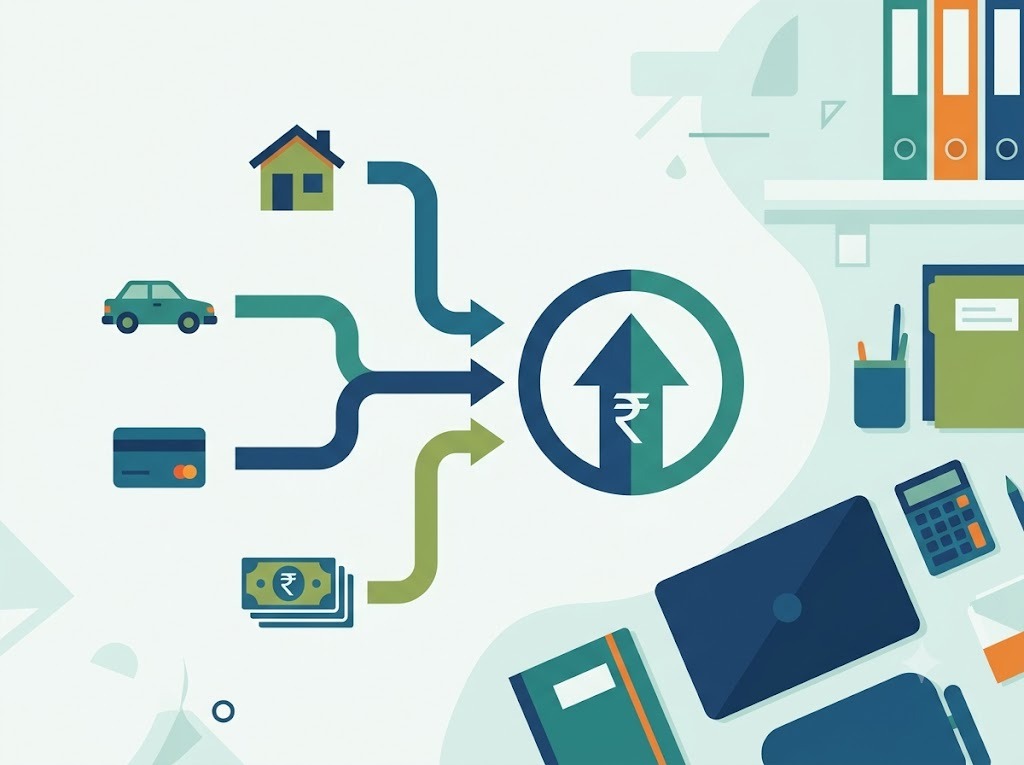
What If Your EMIs Have Become Genuinely Unmanageable?
Two very different situations get lumped together under "EMI trouble," and it's worth separating them clearly, because the right move depends entirely on which one actually describes you.
The first situation is where you are still making every payment on time, but managing several EMIs has become difficult. FREED may assess your profile and connect eligible borrowers with a lending partner that may consolidate eligible unsecured debts into one repayment, subject to the lender’s approval and final terms. FREED is not a lender, and approval, a lower EMI, or a particular credit-score outcome is not guaranteed.
The second situation is when your loans are unpaid or overdue, and repaying the full amount is no longer realistic. FREED helps eligible borrowers settle unpaid or overdue loans at up to 50%* less, subject to the lender’s approval and final settlement terms. The lender issues the settlement letter and reports the account as “Settled.” Settlement may negatively affect your credit profile and should be considered carefully.
Most people reading a page explaining what EMI even means fall into the first camp, still paying everything, just stretched thinner than they'd like. If that's you, consolidation is worth a proper look before things get harder than they need to. If you're further along and repayment has genuinely stopped being possible, that's a heavier conversation, and one worth having with a full picture of what it involves, rather than deciding on it in a single paragraph of a glossary article.
Sources
Claim | Source |
A loan is classified as an NPA once interest or principal remains overdue for more than 90 days | RBI Master Circular, Prudential Norms on Income Recognition, Asset Classification and Provisioning, Reserve Bank of India |

Mohit Juneja
Mohit Juneja writes educational content at FREED on debt management, credit scores, loan repayment, and borrowing best practices. His content is shaped by expert insights and industry knowledge, helping readers better understand their financial options and make informed decisions.
mohit.juneja@freed.care

FREED is India's trusted loan management platform. Founded in 2020 and headquartered in Gurugram, FREED has counselled 20 lakh+ people on personal loans, credit cards, and app loans. FREED charges fees only on successful settlement, not upfront. FREED does not handle secured loans (home loans, car loans, gold loans).
Media Mentions