Can a Bank Recover a Loan From Your Pension Account?
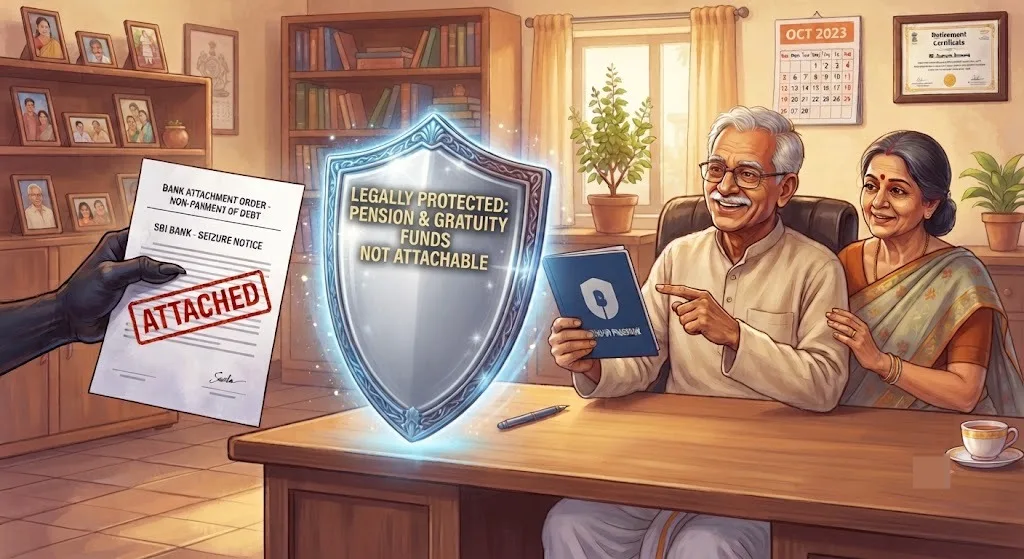
Loan recovery from a pension account means a bank takes overdue loan money from the account where your pension is paid. The law protects many pensions from court attachment. A bank also cannot normally debit your account without notice or a legal process.

Mohit Juneja
Reviewed by FREED India, Debt Resolution Specialists
 4.7/5
 ₹3,200Cr+
 20,000+
 20,00,000+4.7/5₹3,200Cr+20,000+20,00,000+
Key Summary

Many pensions are protected from attachment by law.
A bank cannot simply take money without notice or due process.
High Courts differ on whether protection continues after pension reaches your account.
Protection depends on the type of pension.
Can a Bank Do Loan Recovery From a Pension Account? The Short Answer
Your pension may be your only steady income. If you have a loan that you are struggling to repay, it is natural to fear that the bank can reach into your pension account. The short answer on loan recovery from pension account is this. A bank cannot simply take the money on its own, and many pensions are protected by law. But the answer has details, and courts do not all agree. This blog explains them gently and clearly. It is general information, not legal advice.
Here is the short answer in four lines.
- A bank may have contractual rights to adjust outstanding loan dues against funds held in a borrower's account. However, pension-related funds may receive additional legal protection, and the validity of such deductions depends on the pension type, applicable laws, account terms, and relevant court rulings.
- A court cannot attach a protected pension to pay a loan.
- But the law is not the same for every kind of pension.
- And High Courts in different states have not all agreed on what happens after the pension reaches your account.
So the safe answer is not "yes" and not "never". It depends on what kind of pension you get, what the bank did, and which court is involved.
Your loan does not disappear because your pension is protected. The bank can still ask you to repay. It must use lawful ways, and it must follow the rules RBI sets for recovery. To read about those rules, see RBI guidelines on recovery agents.
It helps to know how money can leave your pension account. There are four ways.
| How | Allowed? |
|---|---|
| Bank debits without notice | Courts have objected |
| Court attaches the account | Depends on the pension type and court |
| Auto-debit you agreed to | Yes, if you gave the mandate |
| You pay an agent voluntarily | Your choice, never compulsory |
Each way is explained below.

Want to See How Your Loans Show on Your Credit Report?
Credit Insights shows your score, what is affecting it, and the steps to improve it. Anyone can subscribe.
Check My Credit InsightsWhat Law Protects Your Pension From Loan Recovery?
Several laws protect pensions and similar money. Here are the main ones.
The Code of Civil Procedure. Section 60(1)(g) says that pensions paid by the government, by a local authority, or by certain other bodies cannot be attached to pay a court decree. Political pensions are covered too.
The Pensions Act, 1871. Section 11 says a government pension cannot be seized to pay a decree.
The Employees' Provident Fund Act. Section 10 protects provident fund money from attachment. The same section is often discussed for EPS pension from the EPFO, although how it applies to the pension is not fully settled.
The Payment of Gratuity Act. Section 13 protects gratuity from attachment.
Not all pensions get the same cover.
| Type of pension | Protected from court attachment? | Source |
|---|---|---|
| Government pension | Yes | CPC s.60(1)(g); Pensions Act s.11 |
| Pension of a local authority or notified body | Yes | CPC s.60(1)(g) |
| EPS pension (EPFO) | Generally yes | EPF Act s.10 |
| Political pension | Yes | CPC s.60(1)(g) |
| Private employer pension plan | Not clearly | Delhi High Court refused cover in one case |
If you are not sure which row fits you, check your pension payment order. It names who pays your pension and under which scheme.
These laws protect against a court decree. They do not, by themselves, say what a bank may do with a debit it makes on its own. That is the next question.
Can a Bank Debit Your Pension Account Without Telling You?
Banks sometimes say they can adjust a loan due against any account you hold with them. This is called set-off, or a lien. It means the bank holds back money in one account to cover dues in another.
Courts have pushed back when this is used on a pension account. In 2025, the Orissa High Court looked at a case where a bank took ₹5 lakh from an account that held pension, without notice. The court called it an "extreme step" and ordered the money put back.
The Kerala High Court has also said that a bank cannot use set-off on a pension account.
This does not cancel the loan. The bank can still try to recover through lawful means. It can send you notices, talk to you about a plan, or go to court.
What courts object to is the shortcut. A sudden debit without notice leaves you no chance to respond. It also may take money that the law protects.
If a bank tells you it has a right to debit your pension account, ask it to say which law or contract term gives that right. Ask in writing. A clear reply helps your advocate later. To learn what a legal notice is, read legal notice for loan recovery.
For a wider look at what banks can and cannot do, read bank loan recovery rules.
Got a Notice From the Bank About Your Account or Loan?
FREED’s in-house legal team can check whether it is real and help you draft a reply if one is needed. This support covers the stage before any court case is filed.
Get Legal Notice SupportDoes Pension Stay Protected Once It Reaches Your Bank Account?
This is the hardest question. High Courts have given different answers. The law is not settled.
What High Courts have said
| Court | Year | What it held |
|---|---|---|
| Orissa High Court | 2025 | Pension kept its protected character even after credit; bank’s debit without notice was illegal |
| J&K and Ladakh High Court | 2026 | Protection ceased once pension reached the account; recovery from a guarantor was valid |
| Kerala High Court | Earlier ruling | A bank cannot exercise set-off on a pension account |
What does this mean for you? It means that two borrowers in similar positions can get different results in different states. Do not rely on a single news report.
Courts look at the facts too. They ask what kind of pension it was, how the money moved, whether the bank gave notice, and what the borrower’s role was.
So please do not read "pension is always safe". The 2026 ruling went the other way. Do not read "a bank can always take it" either. The 2025 ruling protected the borrower.
Ask a practising advocate in your state. They know how your High Court has ruled and can tell you where you stand.

What the Law Says
Courts in different states have reached different views on credited pension. This page is general information, not legal advice. Ask a practising advocate about your case.
Know Your RightsWhat If Your Pension Account Also Receives Other Money?
Many people use one account for everything. Their pension, their salary from a small job, rent, and money from family all land in the same place. This can cause trouble.
Protection is about the source of the money. A pension is protected. Other income may not be. When the two mix in one account, it can be hard to show which money is which.
Here is a simple example. Mr. Rao gets a government pension. He also earns rent. Both go into one account. If a court attaches the account, he may have to prove which part is pension. That is harder when the credits are mixed.
You can make this easier. Keep your pension in an account used only for pension. Do not add other income to it. Let the account show a clean record of pension credits.
Also keep your pension payment order. It shows who pays you and what the payment is. It is a key paper if a debit happens.
If you already use one mixed account, do not panic. Do not move large sums around in a hurry either, as that can look like an attempt to hide money. Talk to an advocate before you change anything.

FREED Expert Tip
Keep your pension in an account used only for pension, and keep your pension payment order safe. If a debit happens, this makes it easier to show where the money came from.
Know Your RightsWhat If You Are a Guarantor or Hold a Joint Account?
Some of the hardest cases come from guarantees and joint accounts. A guarantor is a person who promised to pay if the borrower does not.
In the 2025 Orissa case, a wife took the loan, and her husband was the guarantor. The bank took ₹5 lakh from a joint account that held his pension. It did this without notice. The court held this was illegal and ordered the bank to reverse it.
In 2026, the J&K and Ladakh High Court went the other way. It allowed recovery from a guarantor’s pension after it was credited to the account.
Why do the outcomes differ? The facts differ, and so do the courts. In one case, there was no notice. The courts also hold different views on credited pension.
If you are a guarantor, you are fully responsible for the loan in many agreements. The bank may come to you first. Read the guarantee carefully. If you get a notice, take it to an advocate.
If you share an account, ask the bank how it treats joint accounts for recovery. A joint account holder who did not borrow may have a stronger case to protect the money, so take advice on your own position.
Never agree in a hurry to a debit or to sign new papers because of pressure on a call.
Struggling With EMIs on Several Loans?
FREED can look at your loans together and show whether a lower combined EMI is possible, so a guarantor or family member is not left exposed.
Reduce My EMIWhen Can Your Pension Be Used for Loan Dues?
There are a few clear cases.
When you have agreed. If you set up an auto-debit or a standing instruction from your pension account for an EMI, the bank can use it. You gave the mandate. To stop it, write to the bank and cancel it, but remember that stopping payment does not stop the loan.
When a court orders it, and the pension is not protected. Some private plans may not get covered. Here a court may allow attachment.
Rules for a bank’s own retired staff. A bank’s own retired staff may be bound by that bank’s pension rules, so check them before assuming protection applies.
When you pay on your own. You can choose to pay your dues from your pension. No one can force you to pay a recovery agent from your pension. If an agent presses you to hand over money in cash, say no and ask for the lender’s official account details.
Pay only to the lender’s account, and keep every receipt.
Facing Threats or Odd-Hour Calls?
If a recovery call turns abusive or threatening, or an agent visits without following the correct protocol, FREED Shield is open to everyone and can help you respond.
Get FREED Shield SupportWhat About Gratuity and Provident Fund?
Gratuity and provident fund are different from a pension. They are lump sums that you get when you retire or leave a job.
The Payment of Gratuity Act protects gratuity from attachment. The provident fund law protects EPF money too. A bank cannot attach them to recover a loan through a court order under these laws.
The same questions come up as with pension. What if the money is paid into your bank account? What if the bank adjusts it without telling you? Courts have looked at these questions in different ways.
This page does not go deeper, because there is a full guide. Read loan recovery from pension, gratuity and provident fund for the main protections.
One reminder. A protected lump sum is still your money, and you may choose to use it to clear a loan. That is your decision. No one can force you.
If you are near retirement and have a loan, plan ahead. Talk to your bank about the loan before your last day. A written plan is better than a surprise debit.
Planning Your EMIs Before You Retire?
Your EMI score shows how much of your income your loan payments take up, so you can plan before retirement.
Check My EMI ScoreWhat Happens to Pension Loan Dues After the Borrower Dies?
This is a painful question, and families ask it often. If the borrower dies, the loan does not simply vanish. But it does not pass to the family without limits either.
In general, a bank may claim dues from what the borrower left behind. This is called the estate. Relatives are not usually personally liable unless they signed as guarantors or co-borrowers.
A family pension, paid to a surviving spouse, is a separate matter. It may carry its own protection, so ask an advocate how it is treated in your case.
If a loan was insured, the insurance may cover the dues. Check the loan papers for coverage. Ask the bank for a statement and a copy of the policy.
If you are a family member in this position, do not pay anything under pressure. Ask for the papers in writing and take advice.
For more, read loan recovery after death. It explains the rules in detail.
Is Your Pension Account Safe? A Quick Check
Use this table to see where you stand. It is a rough guide only.
Is my pension account safe?
| What happened | Where you stand | Next step |
|---|---|---|
| Bank debited my pension account with no notice | Courts have objected | Ask for the legal basis in writing, and see an advocate |
| A court has attached my account | Depends on the pension type and court | See an advocate at once |
| I set up an auto-debit for my EMI | Allowed, as you gave the mandate | Cancel it in writing if you wish, and talk to the bank |
| An agent asks me to pay from my pension | Never compulsory | Pay only to the lender’s account |
| My account was frozen | Ask the bank why | Request a written reason and a reversal |
| I am a guarantor, and my account was debited | Courts differ | Take the papers to an advocate |
General information, not legal advice.
This table cannot cover every case. If your situation is not listed, or you are unsure, talk to an advocate.
You are not alone in this worry. Many retired people face it. A calm, written, step-by-step reply works better than panic.
What Should You Do If the Bank Debits or Freezes Your Pension Account?
Act in the first 24 hours. Move step by step. This is general information, not legal advice.
- Take a statement showing the debit. Print or save it.
- Write to the branch. Ask for the money to be put back and for the legal basis of the debit.
- Collect proof that the account holds pension. Keep your pension payment order and the pension credit entries.
- Ask for the grievance officer’s details. Complain to the bank in writing.
- Use RBI’s complaint scheme if needed. If it is not solved after 30 days, file within 90 days at cms.rbi.org.in, or call 14448. It is free.
For a court case, see a practising advocate. In some cases, people have filed a writ petition against an unlawful debit. Your advocate can tell you if this applies.
Keep a record of every call and every letter. If recovery agents are pressing you as well, read how to file a complaint against recovery agents. For your wider rights, see the pillar guide.
Worried About Your Unsecured Loans or Cards?
Talk to FREED’s team. They will look at your situation and tell you which options exist. FREED does not handle attachment disputes or court cases. FREED charges a success-based fee, and the evaluation fee is non-refundable.
Settle My Loans
Mohit Juneja
Mohit Juneja is FREED’s Content & Communication Lead with 12+ years of experience across content, media, advertising and digital communications. He holds a postgraduate diploma in Communications from Xavier Institute of Communications, Mumbai, and has worked with organisations including NDTV, The Indian Express, McCann Worldgroup and NABARD.
At FREED, he leads content and communication across loan management, debt resolution, debt consolidation and financial well-being. His work combines research, storytelling and consumer-focused communication to make complex financial topics easier to understand and act on. He has also scripted and produced 11 documentaries on rural development and agriculture for NABARD, with film's selected for the Mumbai International Film Festival.
mohit.juneja@freed.care

FREED is India's trusted loan management platform. Founded in 2020 and headquartered in Gurugram, FREED has counselled 20 lakh+ people on personal loans, credit cards, and app loans. FREED charges fees only on successful settlement, not upfront. FREED does not handle secured loans (home loans, car loans, gold loans).
Media Mentions