How to Check CIBIL Score in Kotak Mahindra Bank: Free Ways That Work
You can check your CIBIL score and report through CIBIL’s official website by following its current registration and identity-verification process. CIBIL provides one free score and report each calendar year, subject to its verification requirements. Checking your own score generally does not affect it.

Mohit Juneja
Reviewed by FREED India, Debt Resolution Specialists
 4.7/5
 ₹3,200Cr+
 20,000+
 20,00,000+4.7/5₹3,200Cr+20,000+20,00,000+
Key Summary

You can request your free annual CIBIL score and report through CIBIL’s official website.
CIBIL gives one free score and report a year.
A self-check does not lower your score.
Check your Kotak loan and card lines for errors.
What Does Checking Your CIBIL Score With Kotak Mahindra Bank Mean?
As a Kotak Mahindra Bank customer, you can check your CIBIL score and report through CIBIL’s official website. Kotak also has a page titled ‘Free Credit Score Checker’, which says the service is free, while a separate credit card page describes a paid CIBIL subscription. These appear to refer to different services, so check the current terms and destination of Kotak’s checker before using it. CIBIL provides one free score and report each calendar year, and checking your own score generally does not affect it.
It means you look at your own score and report, as someone who banks with Kotak, holds a Kotak card or has a Kotak loan. It doesn’t mean Kotak is checking you. When you check your own score, nobody is making a decision about you. You’re reading the record a lender would read when you apply for something new.
The score doesn’t belong to Kotak. It comes from a credit bureau, which keeps a record of every loan and card you’ve had, from every lender. So the same report holds your Kotak card, any Kotak loan, and anything you’ve borrowed elsewhere. That’s why the steps to check your CIBIL score in Kotak Mahindra Bank are mostly the steps for any bank. They run through the bureau.
People search this for three reasons. Some want a quick number before they apply for a card or loan. Some want to be sure their Kotak accounts show correctly. And some want to understand why an application was turned down. All three are covered here.
If you’re comparing banks, our pillar guide on a free CIBIL score check for bank customers explains the same idea for SBI. Next, here’s what shows on a report for each type of Kotak customer.

Not Sure Which Option Fits You?
Open the FREED app, add your details and see which plan fits your situation.
See My Options on FREEDWhat Shows on Your Report for Each Type of Kotak Customer?
It depends on what you have with Kotak. A credit report tracks credit, which means loans and cards. It doesn’t track your everyday banking.
Savings or current account only. A deposit account usually doesn’t appear on a credit report, because it isn’t credit. You won’t see a Kotak line, and that’s normal.
Credit card holder. Each card shows as a line, with your limit, balance and payment record.
Loan customer. A personal, home, car or other loan shows as a line, with the amount, balance and EMI record.
More than one. You’ll see a line for each card and loan, and you should check each one.
Many people look for a Kotak line, don’t find one, and worry. If you only have a savings account, that’s expected. If you have a card or loan and still see no Kotak line, that’s worth a closer look, and we cover it in the FAQ below.
Your report also shows lenders other than Kotak. That’s the point of a bureau record. It’s one view of everything you’ve borrowed.
Does Kotak Show Your Credit Score in Its Own Checker or App?
Kotak has a page called “Free Credit Score Checker”, and we couldn’t confirm how it works. The page’s FAQ says “You do not have to pay any fees to get your credit score from us”, and that free scores come from “reputable agencies (Credit information Bureau) approved by RBI”. It names no bureau for this tool. Its “Check Now” button leads to an external link, and the page lists no steps or fields. It doesn’t say whether non-customers can use it, and it doesn’t say whether the check is a soft enquiry.
Kotak’s credit card page on CIBIL scores describes something different. It says you can check “yourself on the CIBIL website”, and its steps are to choose a subscription, fill in a form and pay. It doesn’t mention CIBIL’s free yearly report. Kotak’s site menu also lists a “Check CIBIL Score” item under its loan tools, and its pages mention the Kotak Bank app and the 811 app only as downloads. We saw nothing that says either app shows a score.
So the honest answer is this. Kotak says its checker costs nothing, and its other page describes paying. Both can’t be your only option, and neither is the free report CIBIL and RBI promise you.
Here’s what to do while you check.
Open the Kotak Bank app and 811 yourself. Look for any credit score or “CIBIL” option.
Write down the exact path if you find one, and the date.
Check which bureau gives the score. It may not be CIBIL.
Note any site you’re sent to, and read the consent text before you tick anything.
If you find nothing clear, use the CIBIL website below.
Why Do Kotak’s Own Pages Seem to Disagree on Cost?
We can’t say for certain, and Kotak doesn’t explain it. But there are a few plausible reasons, and knowing them protects you from paying for something you don’t need.
Different products. A bank’s own checker and CIBIL’s paid plans are different services. One page may describe the first, and another the second.
Older text. A page may not have been updated when a free route started or stopped.
Different readers. A card page may be written for people comparing paid plans, not for someone who wants the free report.
Whatever the reason, you don’t need to pay to see your yearly report. CIBIL says it provides “one CIBIL Score and Report without any charge once a year”. RBI’s rule says the same for every bureau, once during January to December. If a page asks you to pay before you’ve tried CIBIL’s free option, stop and check CIBIL’s own page first.
How Do You Check Your CIBIL Score on the CIBIL Website for Free?
Go to CIBIL’s own website, and pick the free report, not a paid plan. Here are the steps.
If you’re new to CIBIL
Open the official CIBIL website. Type the address yourself.
Use the sign-up link for the free score and report. CIBIL’s FAQ points non-members to it.
Give your details. Expect your name, PAN and mobile number, and an OTP to confirm.
Choose the free option. Kotak’s card page lists a payment step because it describes a subscription, so skip the paid plans.
View your score and report.
If you already have a myCIBIL account
Log in to myCIBIL.
Open “My Account”.
Click “Get your Free Report”.
If CIBIL can’t verify you online, its FAQ says to call CIBIL customer support to finish. That can happen if your details don’t match, for example an old mobile number or a different spelling of your name. For more detail, read our guide to the official CIBIL score check website.
What Should You Have Ready Before You Check?
Have your PAN, your mobile number and a phone you can answer right now. CIBIL may use an OTP or other verification steps to confirm your identity. Follow the instructions displayed during registration, as the verification process may change. If the number on your bank account is old, use the one you have today, and be ready for a verification step.
Use the same name and date of birth as on your PAN card. Have these to hand, because you’ll compare them with the report.
Your Kotak card statement, with limit, balance and due date.
Your loan statement or EMI schedule, with amount, EMI and tenure.
Your last payment receipts, in case a payment shows as late.
Any no-dues or closure letter from Kotak for an account you’ve closed.
Save or screenshot the report on the day you check, and write down the date. Keep the file somewhere private, because it holds personal details.
Want Your Full Report, Not Just a Number?
See your Experian report with FREED Credit Insights.
Check My Credit Insights
What Other Free Ways Can Kotak Customers Use?
You can use any route that goes through a bureau, and none needs a Kotak account.
Route | Cost | Bureau | Score or full report | Needs a Kotak account? |
|---|---|---|---|---|
Kotak’s Free Credit Score Checker | Page says no fee; confirm [writer] | Not named for the tool | Not confirmed | Not stated |
CIBIL website | One free score and report a year, per CIBIL’s FAQ | TransUnion CIBIL | Score and full report | No |
Other free platforms | Many show a score at no charge | Varies by platform | Usually score only | No |
FREED Credit Insights | Check the page for current terms | Experian | Report and score, with an action plan | No |
Notice how little depends on your bank. Your Kotak card and loan will show on the report whichever route you pick, because the report comes from the bureau.
A few things help you choose.
If you want the CIBIL number lenders may see, use the CIBIL website.
If you want a quick look, Kotak’s checker or a free platform may do, though they may show only a score.
If you want the report explained, Credit Insights gives a second bureau’s view and points out what’s holding the score back.
If you want to compare, check two routes and write down the bureau and date on each.
Different routes can give different numbers. That’s not a mistake. It’s the bureau, the date and the data each one holds.
How Do You Stay Safe While You Check Your Score?
Score checks ask for your PAN and mobile number, which makes them a favourite bait for fraud. A few habits keep you safe.
Type the website address yourself. Don’t tap a link in a message, email or social post.
Check you’re on the real site. Look at the address, not just the page design.
Read where a bank button sends you. Kotak’s checker leads to an external link, so check who runs that site.
Never share your OTP with anyone, including a caller who says they’re from a bank.
Never enter a card PIN, CVV or net banking password. A genuine score check doesn’t ask for them.
Be wary of anyone who charges to “fix” or “boost” a score. Nobody can remove correct entries.
If something feels off, stop and close the page. If you think you’ve shared details with a fake site, tell your bank and check your report for accounts you don’t recognise.
Does Checking Your Own Score Lower It?
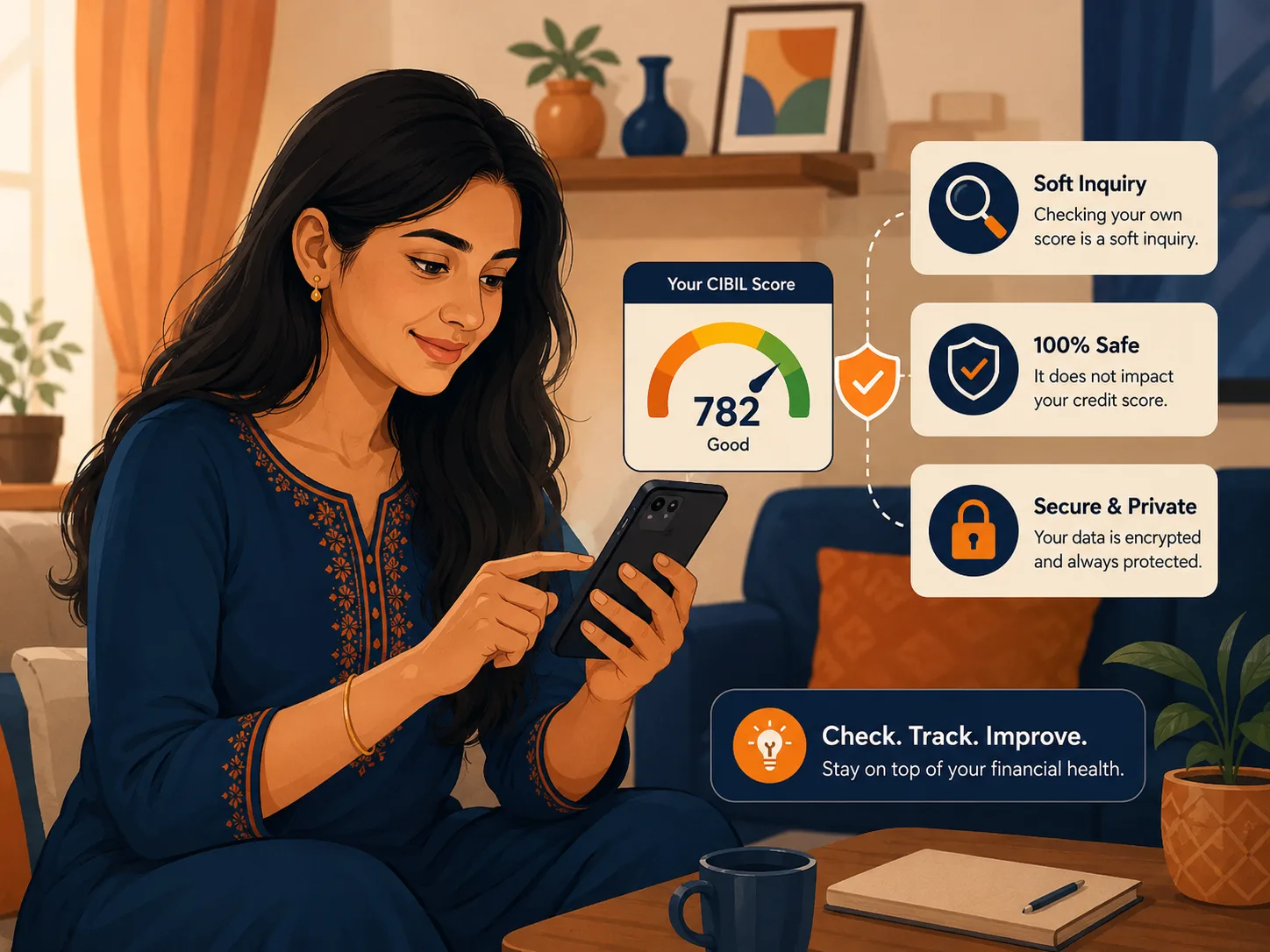
Checking your own credit report or score generally does not affect your credit score. CIBIL also states that checking your own score does not impact it. A lender's enquiry when you apply for credit is different and may affect your score. Kotak’s own credit card page says “a soft inquiry won’t affect or harm your CIBIL score”, and CIBIL’s free score page says “Checking your own credit score doesn’t impact it.”
A lender’s check when you apply for a card or loan is different. That’s a hard enquiry, and Kotak’s page notes that multiple hard enquiries at a given time can affect your credit score. One or two over a year isn’t a problem. Several in a few weeks can look like you’re short of money.
So look at your report as often as you like. Be careful about applying again and again, especially after a rejection. For the difference in detail, see Related below.

What the Law Says
Checking your own score does not lower it. Each credit bureau must give you one free full credit report with your score every calendar year. If a wrong entry isn't fixed within 30 days of your complaint, you may get ₹100 for each day of delay.
Check My EMI ScoreWhat Should You Check on Your Kotak Loan or Card Line?
Find each Kotak account on your report, and check the details against your papers.
Account type. A credit card, personal loan, home loan or other type, matching what you took.
Limit or sanctioned amount. The card limit, or the loan amount you were approved for.
Current balance. It should match your latest statement.
Days past due. If you paid on time, this should show zero.
Status. Look for Standard, Closed, Settled or Written Off, and check it matches the account.
Date reported. This tells you how recent the entry is.
Take one account at a time, and tick each item against your statement. The three things to flag are a wrong balance, a status that’s worse than your account, and an account you don’t recognise.
Check how many Kotak lines you see. If you hold one card and the report shows two, look closer. It could be a card you forgot, a replacement card, or an error. Match the limit and the start date to your papers.
Late payment charges on a card are a separate matter from what shows on your report. For how Kotak card late charges work, see our guide on Kotak credit card late payment charges. For a full guide to every section of the report, see how to read your CIBIL report.

FREED Expert Tip
Compare the date on each score you check. Scores from different services may differ because they can use different bureaus, scoring models and reporting dates. Always note the bureau and date when comparing results.
Check My EMI ScoreHow Do You Read the Payment History, Month by Month?
The payment history is the part lenders look at most closely. Each account shows a row of months, and each month is marked as paid on time, late, or not due.
A run of on-time months shows steady repayment. That’s what you want to see.
A late month shows a delay. Check whether it matches a payment you actually made late.
A gap or “not due” can mean the account was closed or not yet active.
A recent late mark matters more than an old one, as a general guide, so fix recent errors first.
Pick three months at random and check them against your bank statement. If a month shows late but your statement shows an on-time payment, write down the month and the date you paid. That’s the evidence you’ll need for a dispute.
A single late month is a record, not a verdict. Lenders look at the whole pattern. If you’ve paid on time since, the pattern keeps improving, month by month.
How Do You Fix a Wrong Kotak Entry?
Raise it with the bureau and with Kotak, in writing, and keep every reference number. Here are four steps.
Raise a dispute with the bureau online. Use the dispute option on your report. CIBIL’s FAQ says a dispute may take approximately 30 days to resolve, depending on the lender’s response.
Write to Kotak. Use its grievance channel, and keep a copy.
Keep every reference number. Note the date and what you reported.
Check again after the bureau replies. Look at the report once the dispute is closed.
In your message, be specific. Say which account, which month and what the entry should say. Attach your statement or receipt. A clear, short message with proof moves faster than a long complaint.
Here’s the timing from RBI. If a credit information complaint isn’t resolved within 30 days, the bureau pays ₹100 for each day of delay. The lender has 21 days to send the corrected details, and the bureau gets the remaining days. It doesn’t cover disputes about how a score is calculated.
Don’t count on compensation, and don’t expect a fix overnight. For the full process, read our guide on fixing wrong entries on your report.
Not Sure Which Option Fits You?
Open the FREED app, add your details and see which plan fits your situation.
See My Options on FREEDWhat Should You Do After You Pay Off or Close a Kotak Account?
Request written confirmation of the account closure or outstanding balance settlement and keep it safely. The credit report may not reflect the change immediately because the lender must report the updated status and the bureau must process it. Check your report after allowing time for the update.
Ask Kotak for a no-dues or closure letter in writing, and keep a copy.
Save your last payment receipt.
Wait a month or two for the update to reach the bureau.
Check your report. The account should show as closed, with a zero balance.
If it doesn’t, dispute it, using the steps above and your letter as proof.
For a card, make sure you’ve paid the full outstanding amount, including any charges, before you close it. A small unpaid balance can keep the account open on the report.
Don’t close an old card only to look tidier. Closing it cuts your total limit, so your balance on other cards can look larger against what’s left. If the card has a fee you don’t want to pay, ask Kotak about a no-fee option before you close.
What Score Does Kotak Look For?
Kotak sets its own cut-offs, and it also looks at income, existing EMIs and repayment history. Its own pages give different minimums in different places, so we don’t repeat any of them. A strong score alone doesn’t guarantee approval, and a lower one doesn’t always mean a refusal. For how scores connect to personal loans in general, see our guide on the CIBIL score for a personal loan.
How Often Should You Check Your Score?
Every few months is enough for most people, and always before you apply for a new card or loan. A self-check doesn’t lower your score, so the question is what’s useful. Once a quarter lets you catch errors and see whether your habits are working.
Check after you close or pay off a loan, once the lender has had time to report. Check if you get a message about an account you don’t recognise. And use each bureau’s free yearly report for a deeper look. Write down the date, the bureau and the score each time, so you can see the trend.
How Does FREED Help You Track Your Score?
FREED Credit Insights shows your credit report and score, and points to what’s holding the score back. It reads your Experian report, so the number can differ from your CIBIL score. Each bureau uses its own model, so a gap between two numbers is normal.
Over 30,000 borrowers trust Credit Insights, and over 20 lakh people trust FREED. FREED isn’t a loan provider. Credit Insights explains your report, and it doesn’t remove entries that are correct. If something on your report is wrong, you still raise the dispute with the bureau and the lender.
Use it next to a CIBIL check, not instead of one. The CIBIL report shows what lenders may see, and a second bureau shows whether the picture matches. If both show your Kotak accounts the same way, you can relax. If they differ, check the dates first. You can start on the Credit Insights page.
Track Your Score in One Place
Check your Experian report with FREED Credit Insights.
Check My Credit Insights
What If Your Score Is Too Low or Your EMIs Are Too High?
Match the fix to the cause. Here are three routes.
Errors on the report. Dispute them, using the steps above.
Still paying, but stretched. If most of your salary goes towards paying multiple EMIs, FREED’s Loan Consolidation Plan helps you combine multiple loans into a single monthly EMI. It’s only for people who haven’t missed payments. Read more about the Loan Consolidation Plan.
Cannot pay a Kotak loan. Settlement is not something a borrower chooses out of preference. If you are unable to repay your loans, you may explore whether a settlement arrangement is available. Any settlement is subject to the lender’s assessment, approval and agreed terms. The amount payable and outcome cannot be guaranteed. See how Kotak loan settlement works.
Rates and ranges shown are indicative. Final terms decided by the bank/lender. FREED is not a Loan Provider. No outcome is guaranteed. Please verify directly with your bank.
Outcomes vary by lender and borrower profile. Settlement terms are decided by the lender. No percentage is guaranteed.
Don’t take new loans or cards just to raise a score. Each application adds an enquiry, and new debt adds pressure. Your report shows whether you have missed payments, and that decides which option is open to you. Before you act, add up your EMIs and compare them with your monthly take-home pay.
Not Sure Which Option Fits You?
Open the FREED app, add your details and see which plan fits your situation.
See My Options on FREED
Mohit Juneja
Mohit Juneja is FREED’s Content & Communication Lead with 12+ years of experience across content, media, advertising and digital communications. He holds a postgraduate diploma in Communications from Xavier Institute of Communications, Mumbai, and has worked with organisations including NDTV, The Indian Express, McCann Worldgroup and NABARD.
At FREED, he leads content and communication across loan management, debt resolution, debt consolidation and financial well-being. His work combines research, storytelling and consumer-focused communication to make complex financial topics easier to understand and act on. He has also scripted and produced 11 documentaries on rural development and agriculture for NABARD, with film's selected for the Mumbai International Film Festival.
mohit.juneja@freed.care

FREED is India's trusted loan management platform. We help India settle their loans, consolidate their EMIs, improve their credit score, and manage their loans better. Over 20 lakh people trust FREED. We have managed more than ₹3,500 crore in loans and saved our users over ₹450 crore.
Media Mentions