CIBIL Full Form and Meaning: The Basics Explained
CIBIL's full form is Credit Information Bureau (India) Limited, now operating as TransUnion CIBIL, one of India's licensed credit bureaus. It collects loan and repayment data from banks and NBFCs, then compiles it into the credit report and score that lenders check whenever you apply for credit.
Mohit Juneja
Reviewed by FREED India, Debt Resolution Specialists

 4.7/5
4.7/5 ₹3,200Cr+
 20,000+
 20,00,000+4.7/5₹3,200Cr+20,000+20,00,000+
KEY TAKEAWAYS

CIBIL stands for Credit Information Bureau (India) Limited, now branded TransUnion CIBIL.
It's a private company licensed by the RBI, not a government body or a lender itself.
CIBIL collects data from banks and NBFCs and compiles it into your credit report and score.
CIBIL doesn't approve or reject loans; lenders make that decision using CIBIL's data as one input.
Confusing "CIBIL the company" with "your CIBIL score" is common and worth clearing up early.
What Does CIBIL Stand For?
CIBIL stands for Credit Information Bureau (India) Limited. The company now operates under the TransUnion CIBIL name, following TransUnion's acquisition of a 92.1% stake in 2016, though "CIBIL" as a term is still used colloquially for both the company itself and the credit score it produces, which is exactly the confusion this piece exists to clear up.
The company was founded in Mumbai in August 2000 and became India's first credit information company, laying the groundwork for the credit bureau system the country now relies on. Individual consumers gained direct access to their own CIBIL Score starting in 2011, a relatively recent development compared to how long the company had already been compiling data on lenders' behalf.
That full name rarely gets written out anywhere; most people only ever encounter the abbreviation, which is part of why the underlying structure behind it stays unclear even for experienced borrowers.
The score and the company aren't the same thing, even though people use "CIBIL" for both interchangeably in everyday conversation. One is a private company, the other is a number that the company produces about you specifically.
Knowing the name is step one. Understanding why the company exists, how it's structured, and what it actually does day-to-day is what actually matters for a borrower trying to make sense of their own credit file, and that's exactly where the next section goes.
Why the Name and Structure Matter
CIBIL is a private company, not a government department, though it operates under RBI's regulatory oversight through the Credit Information Companies (Regulation) Act, 2005 (CICRA, the law establishing how credit bureaus are licensed and regulated in India). Being licensed by RBI is different from being run by RBI, and that distinction matters more than it might seem.
Just as important: CIBIL does not lend money, approve loans, or reject applications itself. It compiles and reports data; lenders make their own decisions using that data as one input among several. A CIBIL file has no authority to say yes or no to anyone; it simply describes a repayment history as accurately as the reporting lenders provide.
On ownership, TransUnion acquired a 92.1% stake in the company in 2016, which is when it began operating under the TransUnion CIBIL name rather than its original standalone branding. Indian financial institutions retain a smaller stake alongside TransUnion's majority holding.
The broader regulatory framework covers every licensed bureau in India, not just CIBIL, all operating under the same basic set of rules regardless of which one a specific lender happens to check.
Understanding that CIBIL isn't a lender, and never was, clears up a genuinely common misconception. It's worth checking whether that confusion has been shaping how you've thought about your own credit history up to this point.

Freed Expert Tip
CIBIL doesn't reject your loan, your lender does, using CIBIL's data as one input. If you're rejected, ask the lender directly what factor mattered most.
Understand your own reportSigns You're Confusing CIBIL the Company With Your CIBIL Score
A quick, clarifying self-check, not a quiz, just a few common mix-ups worth noticing since they show up constantly in everyday conversations about credit.
- You say "checking your CIBIL" when you actually mean checking your score. This is extremely common shorthand, and it's harmless in casual conversation, but worth knowing the distinction exists.
- You've assumed CIBIL itself decided to reject a loan application, rather than the lender. The rejection decision always sits with the lender; CIBIL only supplies data.
- You've wondered why "CIBIL" and "TransUnion CIBIL" both show up in different places. They're the same company, just referenced under two names depending on how recently the source material was written.
- You didn't know that other credit bureaus besides CIBIL exist in India. CIBIL is simply the most historically referenced one, not the only licensed option.
- You've never actually seen the full company name written out before now. Most people only ever encounter the abbreviation, which is part of why the underlying structure stays unclear even for experienced borrowers.
Understanding this distinction makes how CIBIL actually operates much easier to follow, and that's exactly what the next section walks through.
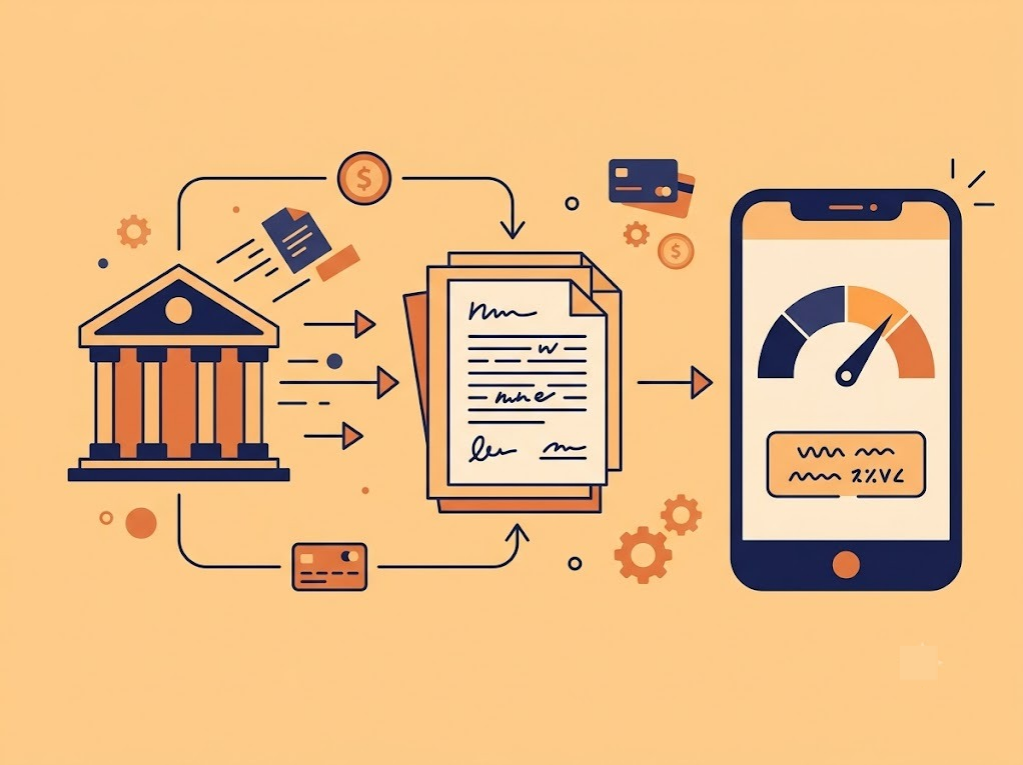
How CIBIL Actually Works, Step by Step
Banks and NBFCs Report Your Data. Lenders report your credit information to CIBIL regularly. Since January 1, 2025, RBI requires credit information to be updated at least fortnightly.
CIBIL Compiles It Into a File. All the reported data across every lender gets combined into a single record tied to your PAN.
A Score and Report Get Generated. CIBIL's model processes the file into a numeric score (300 to 900) and a detailed report.
Lenders Pull Your Data When You Apply. With your consent, a lender checks your CIBIL file as one input in their own approval decision.
The Cycle Repeats Every Reporting Period. Your file updates as new repayment data comes in, with credit information now required to be updated at least fortnightly.
That's the full mechanism: five steps that repeat continuously as long as you're actively borrowing or using credit anywhere. The process is not instantaneous or real time. Updates follow the reporting cycle prescribed for lenders and credit bureaus.
The consent step in step four deserves a bit more attention than it usually gets. A lender can't simply look up anyone's CIBIL file at will; they need your explicit consent to pull it, typically built into the application form you sign when applying for credit. This is also why checking your own file counts as a soft enquiry rather than a hard one: you're the one authorizing the pull, and it isn't tied to an actual credit application from a lender's side.
It's worth noting how mechanical this whole system actually is once you see it laid out. There's no judgment call happening inside CIBIL itself about whether you're a "good" or "bad" borrower; the company processes whatever data comes in and produces a score reflecting that data, nothing more subjective than that. The judgment, if there is one, happens entirely on the lender's side once they see the output. It's also worth knowing that this cycle doesn't pause just because you're not actively applying for anything. Every EMI you pay, every card bill you clear, quietly feeds into this same reporting loop in the background, building the file whether or not you're paying attention to it at any given moment.
Understanding the process explains what CIBIL actually does for a borrower day-to-day, beyond just producing a single number, and that's exactly what the next section covers.

What CIBIL Actually Does for Borrowers
Stripped down to the practical functions, CIBIL does four things that actually matter to a borrower directly.
It generates the score and full report you can check yourself, giving you visibility into exactly what lenders see when they pull your file. It provides the underlying data lenders use for loan and card decisions, the raw material behind every approval or rejection a lender issues. It offers a dispute process for fixing genuinely wrong entries when something on the report doesn't match reality. And it maintains the ongoing account history that builds or accurately reflects a person's credit reputation over time, rather than resetting with each new application.
Tying this back to the earlier point, worth repeating clearly: CIBIL provides the data and the process, but every actual lending decision belongs to the lender, not CIBIL. Two different lenders can look at the exact same CIBIL file and reach two different conclusions because each applies its own policy, risk appetite, and additional factors on top of what CIBIL supplies.
None of these four functions require anything beyond what's already been covered; the score, the report, the dispute channel, and the ongoing history, together, are essentially the entire scope of what this company does. There's no hidden fifth function or special access tier that most people don't know about.
Since CIBIL isn't the only bureau performing this role in India, it's worth knowing where it actually fits among the others, particularly if a specific lender or application happens to reference a different one entirely.
Credit bureaus in India, including CIBIL, operate under a licensing and regulatory framework set by the RBI, commonly referenced as the Credit Information Companies (Regulation) Act, 2005. Current amendments and specific provisions are worth confirming directly with the RBI if precision matters for a particular purpose.

CIBIL vs Other Credit Bureaus in India
Bureau | Full Name | Common Use in India |
CIBIL | TransUnion CIBIL Limited | Most commonly referenced by borrowers and lenders historically |
Experian | Experian Credit Information Company of India | Used by several banks and card issuers for specific products |
Equifax | Equifax Credit Information Services | Used across various lending categories |
CRIF High Mark | CRIF High Mark Credit Information Services | Widely used for MSME and rural/microfinance lending |
All four are equally licensed and legitimate; this is not a ranking.
All four operate under the same basic regulatory framework, and none is officially "the" default bureau a lender must use, though CIBIL's historical head start as India's first credit information company explains why it remains the most commonly referenced name among the four. What actually counts as a good score holds roughly true regardless of which bureau produced it; the underlying principles, consistent payments, low utilization, and an established file matter the same way across all four.
It's worth resisting the instinct to treat CIBIL as somehow more official than the other three simply because it's the name most people already know; familiarity and regulatory standing are two entirely different things here.
Whichever bureau a specific lender happens to check for a given application, understanding your own report clearly is what actually matters day to day, which is exactly where FREED's Credit Insights fits into this picture.
How FREED Helps You Make Sense of Your CIBIL Data
Now that the mechanics are clear, what CIBIL is, how it works, and what it actually does, Credit Insights is a practical next step for turning that understanding into something you can act on.
To be precise here, since this entire piece has been specifically about CIBIL, Credit Insights pulls your credit report from Experian, not from CIBIL itself. Given the amount of clarity this blog has tried to establish about which company does what, it would be careless to blur that same distinction in this section. If you want your CIBIL-specific score checked, that's a separate process, covered elsewhere on this site, from what Credit Insights provides.
What Credit Insights does offer is the Experian equivalent of that same clarity: your score, a breakdown of what's currently helping or hurting it, and step-by-step recommendations based on your actual file rather than generic advice.
It's open to everyone, no enrollment in any FREED program required, and no minimum income or score threshold to subscribe. The subscription costs ₹249 for three months.
For someone who's just spent this entire piece learning what CIBIL actually is, understanding the mechanics is the foundation; seeing your own file clearly, on whichever bureau, is the natural next move once the foundational knowledge actually clicks. That progression, from understanding the system to actually looking at your own data within it, is really the whole point of a piece like this one. Knowing what CIBIL is matters less if it never translates into actually checking where you personally stand.
Are You in a Loan Trap? Quick Check
Move the slider to your total EMIs as a % of monthly salary. See your debt stress level instantly.
EMIs as % of Monthly Salary
Tips Every Borrower Should Know About CIBIL
A handful of foundational habits make everything else in this piece more useful going forward.
Check your report at least once a year, even if nothing seems wrong. Errors happen more often than people expect, and the only way to catch one is by actually looking.
Remember, lenders make the final decision, not CIBIL itself. If you're rejected somewhere, asking the lender directly what factor mattered most is more useful than assuming CIBIL alone determined the outcome.
Know that other bureaus exist beyond CIBIL. A rejection based on one bureau's data doesn't necessarily mean every bureau shows the same picture, which is worth keeping in mind before assuming a single number defines your entire credit standing.
Keep your PAN and personal details updated with every lender you work with. Mismatches between what different lenders have on file can cause reporting errors that are entirely avoidable with accurate, consistent information.
Treat "CIBIL" as shorthand, not a mysterious authority. Building genuinely stronger credit habits gets easier once you stop thinking of it as an opaque gatekeeper and start seeing it for what it actually is: a company compiling data other people report about you.
Understanding what CIBIL actually is makes every other credit decision easier to navigate.

Mohit Juneja
Mohit Juneja writes educational content at FREED on debt management, credit scores, loan repayment, and borrowing best practices. His content is shaped by expert insights and industry knowledge, helping readers better understand their financial options and make informed decisions.
mohit.juneja@freed.care

FREED is India's trusted loan management platform. Founded in 2020 and headquartered in Gurugram, FREED has counselled 20 lakh+ people on personal loans, credit cards, and app loans. FREED charges fees only on successful settlement, not upfront. FREED does not handle secured loans (home loans, car loans, gold loans).
Media Mentions