Axis Bank Loan
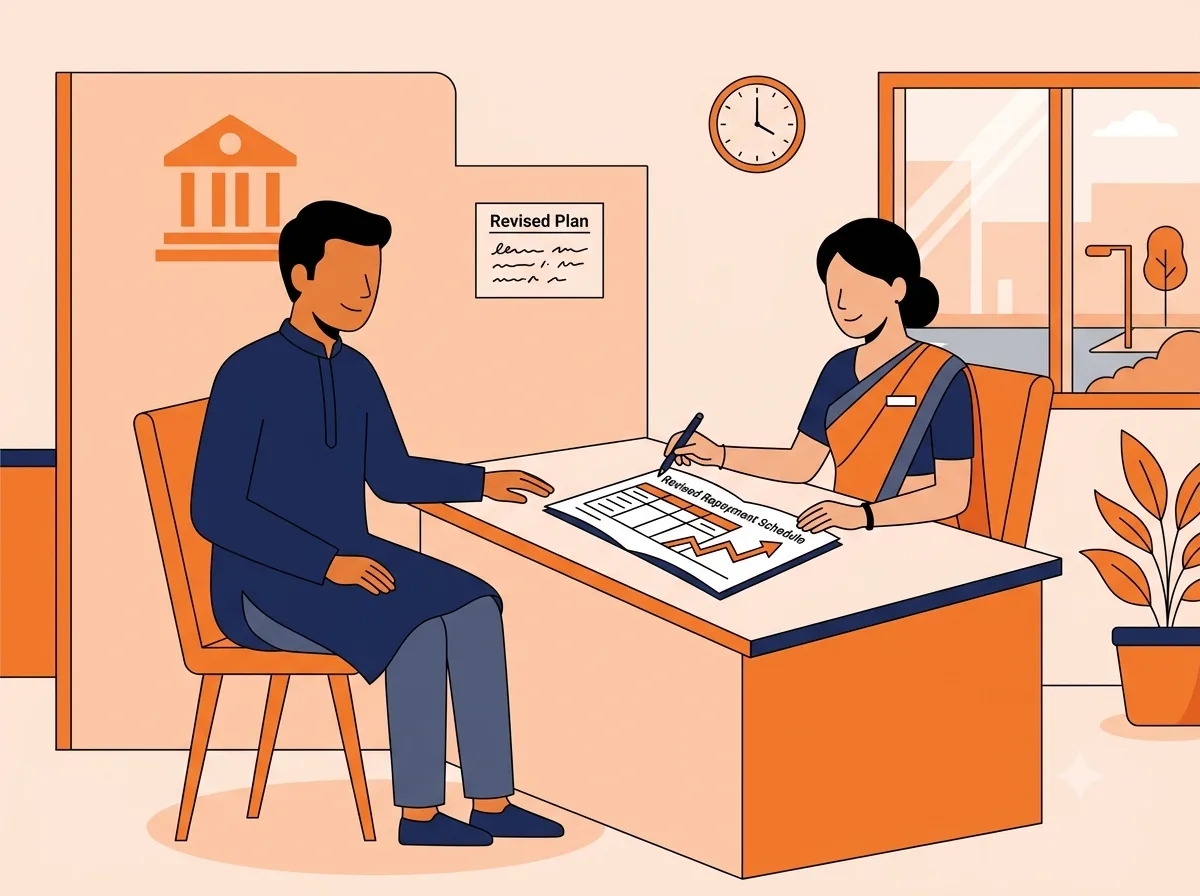
Axis Bank loan restructuring means the bank changes the terms of your loan because you are in financial difficulty. That can mean a longer tenure, a lower EMI or a short break. The bank decides each case. The change can show on your credit report.

Mohit Juneja
Reviewed by FREED India, Debt Resolution Specialists
 4.7/5
4.7/5 ₹3,200Cr+
 20,000+
 20,00,000+4.7/5₹3,200Cr+20,000+20,00,000+
Key Summary

Axis Bank loan restructuring apply online: restructuring is the bank's decision, and you must ask the bank first.
At last check, Axis Bank's online loan services listed EMI date changes, not a restructuring form.
Under RBI rules, a restructured loan is first classified as non-performing, then upgraded after steady payments.
A longer tenure lowers the EMI (monthly instalment) but usually raises total interest.
Restructuring suits borrowers who want to keep the loan. Several dues may need another route.
What Does Axis Bank Loan Restructuring Mean?
Axis Bank loan restructuring apply online is a common search, and the answer starts with what restructuring means. It means changing the loan plan, because your income fell or your costs rose.
The bank may do 1 or more of these:
Stretch the tenure so the EMI falls. The same amount is repaid over more months.
Give a short payment break. This is called a moratorium (a temporary pause).
Change the payment schedule. The dates or the split of payments can move.
Restructuring generally changes the terms of repayment because of financial difficulty. Depending on the approved resolution plan, this can affect the repayment period, instalment amount, interest rate or other terms. It is not automatically a waiver of the debt.
It is meant for borrowers in genuine financial difficulty who want to keep the loan. The bank decides each case under its own board-approved policy, so no one can promise you an outcome.
This page does not quote any Axis Bank rate, fee or tenure. Those depend on your loan type and your case, and only the bank can confirm them.
For the wider picture, read about loan restructuring and how it works. Next, why borrowers ask for it.

FREED Expert Tip
Contact the bank before you miss an EMI, not after. RBI expects banks to start resolution even before default.
Check My OptionsWhy Do Borrowers Ask Axis Bank for Loan Restructuring?
Your income has fallen, or your expenses have risen. The EMI that once fit now takes too much of the month.
How does it get here? A job loss. A pay cut. A medical bill. A business slowdown. A family emergency. None of these comes with a warning, and none is a failure on your part.
Asking for help early is a sensible step. Contacting the bank early can give you more time to discuss available options before the account becomes more seriously overdue. RBI's framework also expects lenders to recognise signs of financial stress early and initiate resolution where appropriate.
A single missed EMI does not automatically determine your long-term credit profile, but even one overdue payment can have consequences. If you expect difficulty making an EMI, contact the lender as early as possible and understand how the overdue will be reported. If you have already missed a payment, read about when a loan becomes overdue so you know what to expect.
You may also wonder whether asking will count against you. A request for relief is a normal conversation between a borrower and a bank. What matters is that you ask clearly, with your numbers ready.
So the useful question is not "how do I avoid the bank?" It is "what can I ask for, and how do I ask?" The next sections cover both.
Who Can Ask for Axis Bank Loan Restructuring?
Banks decide each request on its own facts. Here is how to tell whether yours fits.
Banks tend to consider a request when:
You are in genuine financial difficulty that you can explain. A clear, honest account of what changed helps the bank understand your case.
You can show a realistic plan to pay the revised EMI. A bank wants to see that the new terms can actually be met.
Your record before the difficulty was steady. A history of on-time payments supports your request.
You ask early, before the account slips far. There is more room to work with when the account is still current.
A different route may fit better when:
Your difficulty is only a date problem. An EMI date change may be enough, with no need for restructuring.
Your dues are spread across several loans and cards. Changing 1 loan will not ease the rest.
Repayment has become genuinely impossible. That calls for a different conversation.
Here is how RBI tags overdue accounts. SMA means special mention account. SMA-0 is up to 30 days overdue, SMA-1 is 31 to 60 days, and SMA-2 is 61 to 90 days. A loan moves to NPA (marked as a bad loan, usually after 90 days of missed EMI). This explains why timing matters. It is not a tip. Read more about SMA on your report.
It is the bank's discretion, not a right. No eligibility threshold is quoted here. You can check how heavy your load is with EMI Score. If EMIs take more than 50% of your take-home salary, relief deserves a conversation.
How to Apply for Axis Bank Loan Restructuring Online, Step by Step
Restructuring is requested from the bank. The route can differ by loan type.
A note on "online". At last check, Axis Bank's online loan services listed requests for an EMI date change and a repayment account change. They also listed overdue EMI payment and statements. They did not list a restructuring request. So ask Axis Bank which channel it accepts for your loan, and confirm before you rely on any website or form.
Write Down Why You Need Relief
Note what changed and when. Banks look at genuine difficulty.Collect Your Papers
Keep income proof, recent bank statements, a list of all loans and any proof of your difficulty. A complete file avoids delays.Ask Axis Bank Which Channel to Use
Check the customer care number, branch or digital channel listed on Axis Bank's own website for your loan type. Do not rely on third-party pages.Send a Written Request
Explain your difficulty and give a realistic payment plan. A written request creates a record.Keep Paying What You Can
Do not stop payments while you wait. A missed EMI can still be recorded.Get the Decision in Writing
Ask for the revised terms, the new EMI and the date it starts. Do not act on a verbal offer.Read How It Will Show on Your Report
Ask how the account will be reported after the change. Plan for that.
For the difference between the 2 terms people mix up, see rescheduling and restructuring. The rules behind them are in RBI's restructuring rules.
Every change has a cost and a credit effect. The next section shows both.

What the Law Says
Under RBI rules, a loan that is restructured is first classified as non-performing, then upgraded only after a period of on-time payments.
Talk Through My Loan TermsWhat Does Restructuring Do to Your Credit Record and Cost?
2 effects are easy to miss. The loan can be recorded as restructured. And a lower EMI usually means more interest overall.
Here is the RBI rule in plain words. A restructured loan that was "standard" is first marked non-performing. It can return to standard only after steady on-time payments. A default after that triggers a fresh review.
A lender can report a restructured status to a credit bureau, and that information may be visible to future lenders reviewing your credit report. Ask the bank how the account will be reported before accepting revised terms.
Here is a worked example. It is hypothetical and illustrative. The 16% is an example, not an Axis Bank rate.
₹3,00,000 outstanding at 16% | Remaining 24 months | Stretched to 48 months |
EMI | about ₹14,690 | about ₹8,500 |
Total interest | about ₹52,500 | about ₹1,08,100 |
In practice, the EMI falls by about ₹6,190 a month. The interest rises by about ₹55,600. Both are true at once, so decide which matters more to you.
Here is the rule of thumb. Ask what the total repayment will be, not only the new EMI.
You can read how restructured loans show on your report, and the wider credit impact of restructuring.
Rates and ranges shown are indicative. Final terms decided by the bank. FREED is not a Loan Provider. No outcome is guaranteed. Please verify directly with your bank.

What Are Your Options Besides Restructuring?
The order matters. Small fixes come first, then restructuring, then other routes. They are never equal choices for the same person.
The table puts 4 routes side by side. Read the "Effect on your credit record" column first, since that is where the real difference shows.
Four Routes, From Softer to Last
Route | Who it is for | Effect on your credit record | What to check | Who arranges it |
Small fixes (EMI date, repayment account) | Borrowers whose due date clashes with salary | Usually little effect if payments stay on time | Any broken-period interest, and whether overdues must be cleared first | You, through the bank's channels |
Restructuring with the bank | Borrowers in genuine difficulty who want to keep the loan | The loan can be recorded as restructured, and is first classified as non-performing under RBI rules | Total repayment, the new EMI and the start date | You ask. The bank decides |
People who can still repay but are stretched across several dues | Credit score starts to improve | Eligibility and final terms depend on the lending partner's assessment | FREED matches you to a lending partner, who disburses the loan | |
Settlement is not something a borrower chooses out of preference. It is only for people genuinely unable to repay in full | A "Settled" mark can stay on your report for up to 7 years [LEGAL FLAG: no RBI source for the 7-year figure. Send to legal review.] | The bank decides the terms | FREED negotiates with the bank on your behalf |
Rates and ranges shown are indicative. Final terms decided by the bank. FREED is not a Loan Provider. No outcome is guaranteed. Please verify directly with your bank.
In practice, start at the top and move down only if the earlier rows do not fit.
3 points help here. First, an EMI date change or a repayment account change is listed on Axis Bank's online loan services. So a due date that clashes with your salary may be fixed without restructuring. Confirm the steps with the bank.
Second, if your area has a declared calamity, RBI's calamity framework (effective 1 July 2026) lets banks offer relief to eligible borrowers. Their accounts must be standard and not more than 30 days overdue. Banks must invoke it within 45 days of the declaration. This may not apply to you.
How FREED Helps If Your EMIs Are Hard to Manage Across Several Loans
For people who can still repay but need a smarter way to manage their debt.
Restructuring is something only the bank can do. FREED does not restructure a loan. If your dues sit on several cards and loans, FREED's Debt Consolidation Program is built for that. FREED has counselled 20,00,000+ customers.
Here is what FREED does for you:
FREED assesses your profile and matches you to a lending partner from its network.
The partner disburses 1 new loan. It pays off your eligible dues instantly, including card dues, personal loans, BNPL (buy now pay later) and similar unsecured credit.
You are left with 1 loan, 1 lower EMI and 1 due date.
FREED handles the process from assessment to payout. You do not have to chase each bank on your own.
Your credit score does not drop with consolidation. It starts to improve as old dues are cleared and you pay 1 loan on time.
FREED's fee is success-based. It is charged only when the consolidation is completed.
Maybe you have missed a payment or two, or you are not sure where you stand. If you are unsure whether you qualify, FREED's team can assess your situation in a free call and let you know what options are available.
Eligibility and final terms depend on the lending partner's assessment. FREED is not a Loan Provider.
If you want the comparison in detail, read how consolidation and restructuring differ.
What Helps While You Wait for the Bank's Decision?
The wait can be long, and a few habits keep you steady. These 6 tips take little time.
Keep paying whatever you can, on time. A part-payment shows intent, and it limits how far the account slips.
Keep every email, letter and call note from the bank. A record protects you if a question comes up later. If a call turns abusive or threatening, FREED Shield helps you understand your rights and report it through the right channels.
Get the decision and the revised terms in writing. A verbal promise is hard to prove, and a written one is not.
Do not take a new loan just to cover EMIs without comparing the cost. A new loan can add to the weight, so compare the total before you sign.
Check how the change will be reported before you accept. Ask what the account will show on your credit report.
Check your credit report a month after the change. It shows whether the account is reported as you were told. You can check your credit report in a few minutes.
It also helps to know what happens when an EMI bounces, so a missed date does not surprise you.
If the numbers still feel tight after all this, the options section covers another route.

FREED is India's trusted loan management platform. Founded in 2020 and headquartered in Gurugram, FREED has counselled 20 lakh+ people on personal loans, credit cards, and app loans. FREED charges fees only on successful settlement, not upfront. FREED does not handle secured loans (home loans, car loans, gold loans).
Media Mentions