Restructured Loans: What They Mean and How to Read One on Your Report
A restructured loan is a loan whose original terms, tenure, EMI, or interest rate, were formally changed by the lender, usually due to genuine repayment difficulty. This guide focuses specifically on how that shows up on your credit report, the exact field values to look for, not just the general concept.

Mohit Juneja
Reviewed by Mohit Juneja, Debt Resolution Specialists
 4.7/5
4.7/5 ₹3,200Cr+
 20,000+
 20,00,000+4.7/5₹3,200Cr+20,000+20,00,000+
KEY TAKEAWAYS

A restructured account may be identified through the Account Status, remarks and other account-level fields reported by the lender. The exact wording can vary by bureau and reporting format.
Use the Account Status, restructuring-related remarks and other reported fields together. A Written Off Amount of zero does not by itself confirm that an account is restructured.
For payments made after restructuring, an account that is paid on time may show 000 DPD for those reporting periods. Earlier DPD history is not erased simply because the account was restructured.
Some older reports may still show legacy status codes like "Restructured due to COVID-19", these mean the same underlying thing under an older label.
Quick Recap: What "Restructured" Means
A restructured loan is one where the lender formally changed the original terms, tenure, EMI, or interest rate, usually because of genuine repayment difficulty on the borrower's side.
FREED's fuller explainer on restructured loans covers what causes this and its broader credit impact in depth. This guide explains the types of account-level fields and indicators you may encounter when a lender reports a restructured account.

Freed Expert Tip
Pull your actual credit report before reading further, this guide is most useful with your own report open alongside it. Want to Check Yours Now?
Check My Credit ScoreThe Exact Fields That Change on Your Report
Here's exactly what changes, field by field, once a loan is restructured.
- Account Status. Before restructuring, this typically reads "Active" or shows a specific number of overdue days. After restructuring, it shows "Restructured" while the loan remains active, or "Restructured and Closed" once it's fully repaid under the new terms.
- Remarks. Often carries a specific note, "Restructured Account" or "Rescheduled Account" are both common phrasings.
- Current Balance generally reflects the amount still outstanding on the account. The reported balance and other fields should be read together with the account status and lender reporting.
- Written Off Amount. Stays at zero for a straightforward restructuring. This is one of the clearest ways to distinguish it from settlement, covered next.
- Date Closed. Stays blank while the restructured loan remains active, and only gets filled in once it's eventually paid off in full under the new terms.
How This Differs From "Settled" and "Written Off" on the Same Report
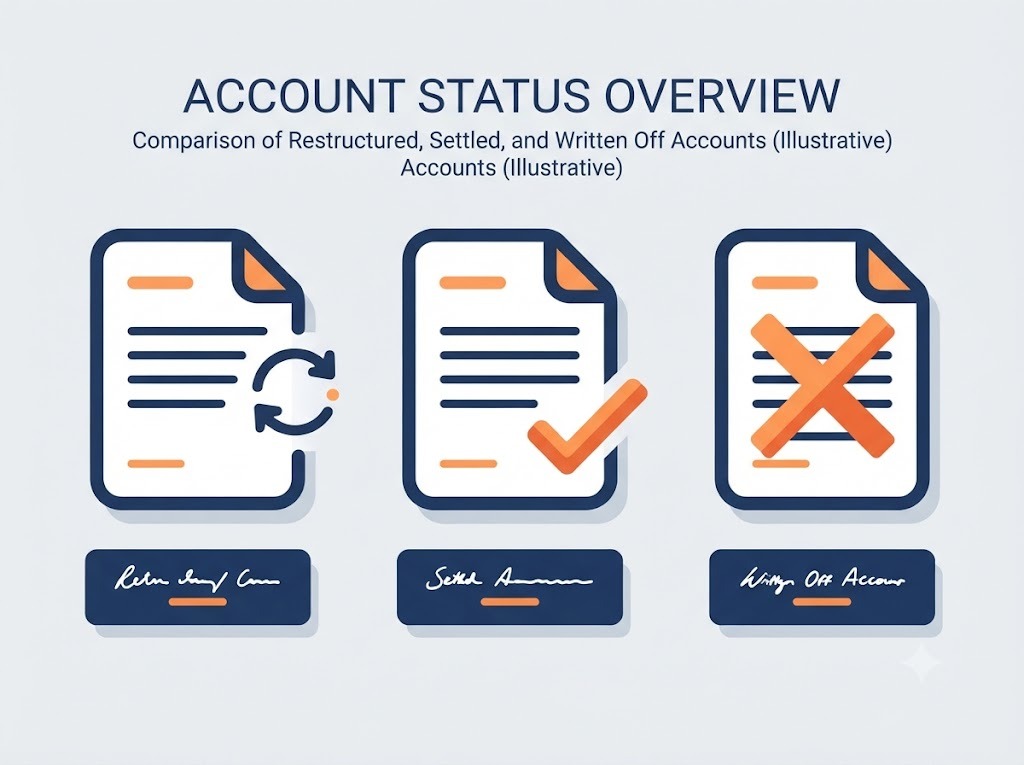
These three statuses get confused constantly, so it's worth laying them side by side directly.
Restructured. Written Off Amount = 0, Current Balance = the actual outstanding amount, account usually stays open and active. Settled. Written Off Amount = the waived amount, Current Balance = 0, account shows closed at a reduced payoff figure. Written Off. Similar to settled in that the lender has given up recovering the full amount, but without a negotiated settlement agreement in place, often the more severe of the two in how future lenders read it.
The practical distinction, if you're staring at a report and unsure which of these three applies: the Written Off Amount field is the fastest way to tell them apart. Zero means restructured, non-zero means either settled or written off.
What Happens to Your DPD History After Restructuring
Once new terms take effect, on-time payments made under the restructured plan show DPD as "000" each month, exactly the same as any well-managed account going forward.
Critically, this doesn't erase the DPD entries from before the restructuring. Earlier DPD entries may remain visible in the account's payment history after restructuring, depending on the bureau's reporting format and applicable retention rules. The practical effect is a report that can show a genuine mix, older months carrying DPD entries reflecting the original difficulty, followed by a run of "000" entries once the new terms began, both visible at once on the same account. The full DPD mechanics are covered in depth elsewhere, worth reading if this specific field still feels unclear.
This is exactly why consistent on-time payment under the new terms matters so much, it's the only thing actively building a better-looking recent record alongside the restructuring flag itself.
Freed Expert Tip
Track the number of consecutive on-time payment periods since restructuring, as recent repayment behaviour may be relevant to future lender assessment. Want to Know Where You Stand?
Check My Credit ScoreOlder Status Codes You Might Still See
Some reports, especially for loans restructured a few years ago, may still show older, more specific status codes rather than a generic "Restructured," You may encounter legacy labels such as ‘Restructured due to COVID-19’ on older accounts. These indicate that the account was reported under a specific restructuring framework applicable at that time.
Worth stating plainly: these mean the same underlying thing, a formally restructured account, just labelled with the name of whichever relief scheme was active at the time. They carry no different or additional meaning today.
How to Actually Find This on Your Own Report
Access your credit report through the relevant bureau's official portal or another authorised channel. Navigate to the account-level detail for the specific loan, not just the summary score page at the top.
Look for the Account Status and Remarks fields specifically, using the exact field names covered above. CIBIL, Experian and Equifax may use different wording or display different account-level fields. When interpreting an entry, consider the status, remarks and other reported details together. If in doubt, the presence of a zero Written Off Amount alongside an active balance is the more reliable signal than the exact wording used by any one bureau.
How FREED Helps If You Also Have Other Debt to Sort Out
Worth stating plainly: FREED doesn't perform loan restructuring itself, and doesn't edit what appears on your credit report either. That's between you and your lender, and the bureau's own reporting process.
What FREED does help with is a separate piece entirely. Depending on your circumstances and eligibility, FREED's Debt Consolidation Program or Debt Resolution Program may help address that separate unsecured debt.

Sorting Out More Than This One Account?
See if consolidation could help with the rest.
Check My Consolidation OptionsTips for Reading Your Report Accurately
Freed Expert Tip
Screenshot or save your report right after any status change, having a dated record makes disputing a later error far easier. Ready to Look at the Bigger Picture?
Start My Free Assessment
Mohit Juneja
Mohit Juneja writes educational content at FREED on debt management, credit scores, loan repayment, and borrowing best practices. His content is shaped by expert insights and industry knowledge, helping readers better understand their financial options and make informed decisions.
mohit.juneja@freed.care

FREED is India's trusted loan management platform. Founded in 2020 and headquartered in Gurugram, FREED has counselled 20 lakh+ people on personal loans, credit cards, and app loans. FREED charges fees only on successful settlement, not upfront. FREED does not handle secured loans (home loans, car loans, gold loans).
Media Mentions