SBI Card Balance Transfer: Eligibility, Charges and Process
SBI Card balance transfer, officially called BT on EMI, lets you move outstanding dues from another bank's credit card onto your SBI Card, then repay it as a fixed EMI over 3 or 6 months. BT on EMI is available only to eligible primary SBI Cardholders. The interest rate isn't fixed for everyone. It's cardholder-specific, linked to the bureau-score methodology SBI Card applies at the time the offer is made.

Mohit Juneja
Reviewed by FREED India, Debt Resolution Specialists
 4.7/5
4.7/5 ₹3,200Cr+
 20,000+
 20,00,000+4.7/5₹3,200Cr+20,000+20,00,000+
KEY TAKEAWAYS

SBI Card balance transfer, officially BT on EMI, moves dues from another bank's card onto SBI Card.
Only primary SBI cardholders qualify, add-on cardholders are excluded.
Minimum transfer is ₹5,000, up to 75% of your SBI Card's available credit limit.
Cancelling the facility is only possible on the same day it's booked, not afterward.
What Is SBI Card Balance Transfer?
SBI Card's official name for this facility is BT on EMI, short for Balance Transfer on Easy Monthly Instalment. That's the exact term you'll see if you check SBI Card's own site.
Here's the mechanism. You request the transfer, and the amount moves via NEFT to your other bank's card within 3 to 4 working days. Once it lands, that amount becomes a fixed monthly EMI on your SBI Card, running over a tenure of either 3 or 6 months.
This is only open to primary SBI cardholders. Add-on cardholders are excluded entirely, per SBI Card's own terms, regardless of their individual repayment record. One more gate worth knowing upfront: the request won't be processed if your SBI Card account is currently overdue or when the credit limit has been exceeded, since the transferred amount effectively adds to your outstanding balance the same way a fresh purchase would.
Once you clear that basic eligibility, the next question is pricing, and this is where SBI Card does something most competitor banks don't spell out clearly: the rate isn't a single number for every applicant.

What the Law Says
The interest rate for BT on EMI is tied to the cardholder's bureau score at the time the offer is made. A lower score generally means a higher rate within the published range. If you're unsure where you stand or want a clearer read on your options, FREED's team can walk through it with you.
Talk to FREED About Your OptionsWhy the Interest Rate Isn't the Same for Everyone
Bureau Score | Interest Rate Range (p.a.) |
700 or below (or no score available) | 11.50% – 15.25% |
701 to 780 | 11.00% – 14.00% |
Above 780 | 10.00% – 12.25% |
Rates effective 9th December 2024 per SBI Card's own terms, subject to change. A processing fee of 1% of the booking amount applies across all bands.
One important detail: this rate is set using your bureau score at the time the specific offer was made, not your score today. If your score has moved since then, up or down, it may not match the band your current offer is priced on.
Understanding which band you fall into matters, but so does knowing whether you're eligible to book this at all, which the next section covers.

Freed Expert Tip
The rate on your original offer was set using your bureau score at that time. If your score has changed since an earlier offer, a future offer may carry different pricing.
Check your debt Consolidation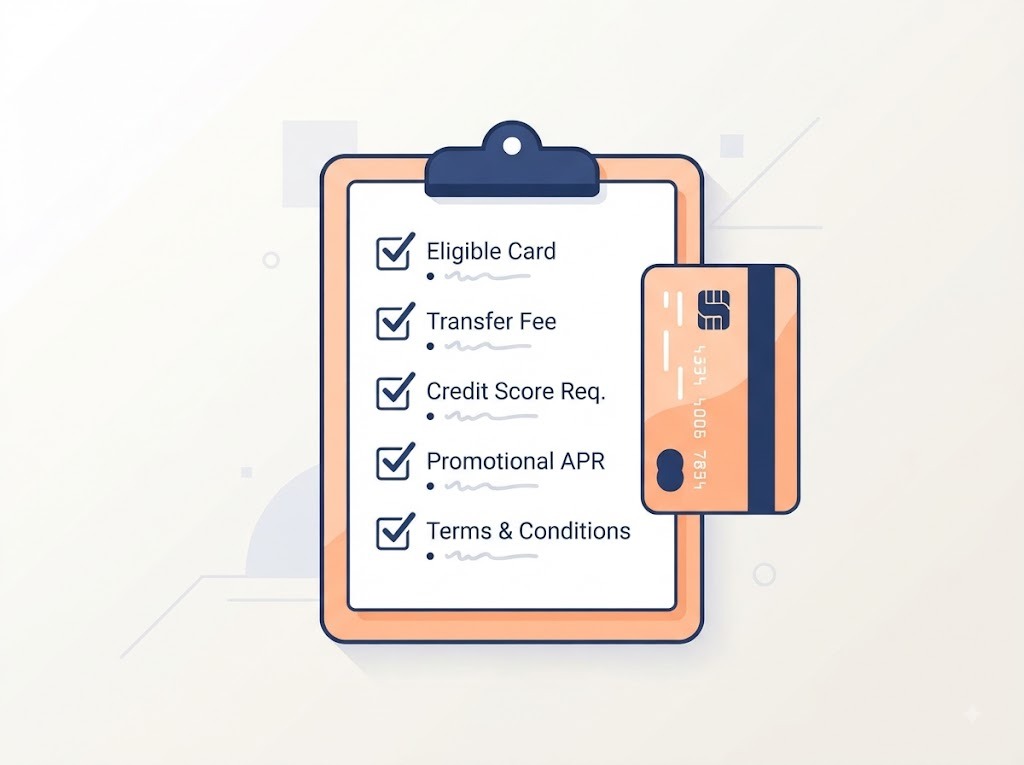
Signs You're Eligible for SBI Card Balance Transfer
Run through this list before you book:
- You hold a primary SBI Card, not an add-on card. This facility is closed to add-on cardholders entirely.
- Your SBI Card account isn't currently overdue or over its credit limit. Either one blocks the request outright.
- The amount you want to transfer is at least ₹5,000. SBI Card won't process anything below this minimum.
- The amount fits within roughly 75% of your SBI Card's available credit limit. The exact figure is confirmed at the time of your request.
- You have an eligible BT on EMI offer communicated by SBI Card. This typically isn't something every cardholder can request without an active offer already in place.
If most of these describe your situation, applying is straightforward, and here's exactly how.
How to Apply for SBI Card Balance Transfer
SBI Card offers a few application channels, so pick whichever's easiest.
Log into net banking and look for the Balance Transfer option under the Benefits section. You can also apply through the SBI Card app or by calling the SBI Card helpline.
Once your request is confirmed, funds move via NEFT to your other bank's card, typically within 3 to 4 working days.
- 1
Step 1 - Check for an Active Offer
BT on EMI typically requires a specific offer communicated by SBI Card, check net banking or the SBI Card app for one.
- 2
Step 2 - Choose Your Application Channel
Apply via net banking's Benefits section, SMS with the designated keyword, or SBI Card's ILA chatbot.
- 3
Step 3 - Confirm the Transfer Details
Provide the other bank's card details and the exact amount, within the ₹5,000 minimum and 75%-of-limit maximum.
- 4
Step 4 - Pick Your Tenure
Choose between the 3-month or 6-month tenure, your rate depends on your bureau score band at the time.
- 5
Step 5 -Track the NEFT Transfer
Funds move to the other bank's card via NEFT, typically within 3 to 4 working days (excluding bank holidays) confirm the other card reflects the payment.

What Happens If You Want to Cancel or Pay Off Early
This is the detail most competitor content gets wrong, so it's worth being precise.
Cancellation and foreclosure are two different things, not interchangeable, and mixing them up costs you options.
Per SBI Card's own terms, cancelling a BT on EMI request is only possible on the same day the booking request is made, by calling the helpline. Once that day passes, cancellation is no longer available to you.
Foreclosure is different: paying off the facility before the tenure ends, at any point after the same-day cancellation window has closed. This carries a foreclosure fee of 3% of the outstanding principal, plus applicable taxes. Interest adjustments may also apply depending on the foreclosure date. Depending on exactly when you request it, additional interest adjustments may also apply.
Most guides online blur these two together, or quote an incorrect cancellation window. The distinction matters because it changes what's actually available to you and when. If you want to cancel, the cancellation request must be raised on the same day. Miss that window, and foreclosure process and applicable charges are worth weighing against how much you'd otherwise pay if the balance simply reverted to SBI's standard revolving rate instead.
What Are Your Options Beyond a Single Card Transfer
Think of this as a two-tier ladder.
Tier one is a single-card balance transfer, like BT on EMI. This works well when the real issue is genuinely just one high-interest card, and you have a clear plan to pay it off within the tenure. It's worth comparing SBI Card's terms against other banks too, HDFC's balance transfer facility works on similar logic but different numbers, and a broader look at balance transfer options across Indian banks can help you see where SBI Card actually sits.
Tier two is for a different situation. If you're actually juggling multiple loans and cards across different lenders, not just this one SBI Card balance, moving one balance to SBI Card only relocates part of the problem. The rest of your monthly obligations stay exactly as complicated as before.
If tier two sounds closer to your situation, here's what that actually looks like.
How FREED Helps If SBI Card's Facility Doesn't Cover Your Full Situation
FREED's Debt Consolidation Program (DCP), also known as 'Reduce My EMI,' is the natural next step... The effect on your credit profile depends on how the new account and repayment behaviour get reported to the bureau. Consistent, timely repayments can support a healthier credit profile over time
Here's the mechanism: FREED assesses your full financial profile, everything you're currently paying across banks and NBFCs. Based on that, FREED matches you to a suitable lending partner from its network. The lending partner may consolidate eligible existing loans and card balances into a new repayment arrangement, subject to eligibility, lender approval and final terms.
Your CIBIL score doesn't drop from this. It typically improves, since older accounts get cleared properly and you move to one consistent, on-time repayment record, the same underlying logic behind reducing your EMIs through consolidation more broadly.
FREED charges a success-based fee only once a consolidation is completed a flag for the team to confirm this against currently approved commercial terms before publishing. Existing eligible accounts may be repaid as part of the consolidation arrangement, subject to lender terms. It's generally positioned for borrowers who are still making payments but are finding multiple EMIs difficult to manage. .
One Card Fixed, What About the Rest?
See if consolidation works for your full picture, not just one card.
See If Consolidation Works for YouCompare Your Balance Transfer Options Across Banks
SBI Card's BT on EMI is one option among several. Before committing, it helps to see how its tenure, rate structure, and eligibility style compare to other banks.
Bank/Lender Comparison Matrix
- Inputs: loan/card type, CIBIL range, interest rate expectation
- Output: filterable table across ICICI, HDFC, IndusInd, SBI, Kotak, Axis, RBL.
- Filter by: bank, product type, CIBIL threshold, settlement availability
- Label: "Compare Balance Transfer Options by Bank"
This is a comparison aid, not a verdict on which bank is "best." The right fit depends on your specific bureau score band and how quickly you can realistically repay.
Not Sure If This Actually Saves You Money?
Talk to FREED's team, free, no pressure.
Book My Free CallTips to Get the Most Out of SBI Card Balance Transfer
Sources
# | Claim in Copy | Source |
|---|---|---|
1 | Official name "BT on EMI"; NEFT transfer, 3–4 working days | SBI Card official website BT on EMI product page |
2 | Tenure options: 3 or 6 months | SBI Card BT on EMI T&C |
3 | Restricted to primary cardholders; add-ons excluded | SBI Card BT on EMI T&C |
4 | Request blocked if account overdue / over limit | SBI Card BT on EMI T&C |
5 | Interest rate tied to bureau score band at time of offer | SBI Card BT on EMI T&C pricing clause |
6 | Rate table (11.50–15.25% / 11.00–14.00% / 10.00–12.25%), effective 9 Dec 2024 | SBI Card BT on EMI T&C, rate schedule |
7 | Processing fee: 1% of booking amount | SBI Card BT on EMI T&C |
8 | Min transfer ₹5,000; max ~75% of available limit | SBI Card BT on EMI T&C |
9 | Application channels: net banking, app, helpline, SMS keyword | SBI Card official site / app |
10 | Cancellation only same-day via helpline | SBI Card BT on EMI T&C |
11 | Foreclosure fee: 3% of outstanding principal + taxes; possible interest adjustment | SBI Card BT on EMI T&C |
12 | Facility closes + full amount payable if MAD unpaid 3 consecutive months | SBI Card BT on EMI T&C / cardholder agreement |
13 | FREED DCP mechanism, fee structure, credit impact framing | Internal FREED product fact |

Mohit Juneja
Mohit Juneja writes educational content at FREED on debt management, credit scores, loan repayment, and borrowing best practices. His content is shaped by expert insights and industry knowledge, helping readers better understand their financial options and make informed decisions.
mohit.juneja@freed.care

FREED is India's trusted loan management platform. Founded in 2020 and headquartered in Gurugram, FREED has counselled 20 lakh+ people on personal loans, credit cards, and app loans. FREED charges fees only on successful settlement, not upfront. FREED does not handle secured loans (home loans, car loans, gold loans).
Media Mentions