SARFAESI Section 13 Explained: What It Means for Borrowers
When a borrower defaults on a secured debt and the account is classified as a non-performing asset, the secured creditor may initiate the process under Section 13(2), subject to applicable legal requirements. It's the core enforcement mechanism of the Act, covering the 60-day demand notice (13(2)), your right to raise objections (13(3A)), and what the bank can do if dues remain unpaid (13(4)). Together, these provisions explain important stages of the SARFAESI enforcement process, from the demand notice and borrower representation to the enforcement measures that may follow.

Mohit Juneja
Reviewed by FREED India, Debt Resolution Specialists
 4.7/5
4.7/5 ₹3,200Cr+
 20,000+
 20,00,000+4.7/5₹3,200Cr+20,000+20,00,000+
KEY TAKEAWAYS

SARFAESI Section 13 covers three connected steps: the demand notice (13(2)), your right to object (13(3A)), and enforcement action if dues remain unpaid (13(4)).
The demand notice gives you 60 days to clear dues before the bank can take further action.
Under 13(3A), you can raise objections to the notice, and the bank must respond in writing within 15 days, though it isn't required to accept your objection.
Section 13(4) allows more than just possession, banks can also appoint a manager, take over the business, or sell the secured asset.
What Is Section 13 of the SARFAESI Act?
Section 13 is one of the central provisions of the SARFAESI Act because it outlines the demand notice process and the enforcement measures available to a secured creditor. The first formal notice, the possession, the eventual sale, all of it flows from Section 13, the rest of the Act mostly exists to support what happens here.
Three sub-provisions matter, in the order they actually fire: Section 13(2), the demand notice that starts the clock, Section 13(3A), your chance to push back on it, and Section 13(4), the enforcement measures unlocked once the notice period runs out. Following the SARFAESI Act as a whole is useful background, but this specific section is where your actual timeline and options live. The Section 13(2) demand notice is an important starting point for understanding the borrower’s statutory timeline and the possible enforcement measures that may follow.

Want to check where your own situation actually stands?
Talk to FREED about your broader financial picture.
Talk to FREED's TeamSection 13(2): The Demand Notice
A secured creditor may issue a notice under Section 13(2) when the borrower defaults on a secured debt and the relevant account is classified as a non-performing asset, subject to applicable statutory requirements. Before a Section 13(2) notice is generally issued, the relevant secured loan account must meet the applicable requirements for classification as a non-performing asset. NPA classification is governed by the relevant regulatory framework and is not determined solely by the number of missed EMIs. The classification sequence leading up to this point is worth understanding, since it shows exactly how far a loan has to drift before Section 13(2) even becomes available to the lender.
The notice under Section 13(2) must provide details of the amount payable by the borrower and the secured assets intended to be enforced if the secured debt remains unpaid. From there, a defined window opens, commonly 60 days, for the borrower to clear the dues before anything further can happen. That window is often the single most useful stretch of time in the whole process. What a borrower can actually do with it is worth covering directly.
Section 13(3A): Your Right to Raise Objections
Receive the 13(2) notice, and a specific right kicks in: you can submit a written representation or objection to it. Section 13(3A) provides borrowers with a statutory opportunity to submit a representation or objection against a Section 13(2) notice. The secured creditor must consider the submission and communicate reasons for non-acceptance within the prescribed period where applicable.
If the borrower submits a representation or objection, the secured creditor must consider it. If the creditor concludes that the representation or objection is not acceptable or tenable, it must communicate the reasons for non-acceptance within 15 days of receiving it. Worth being honest about the limits here: a response isn't agreement. The bank engaging with your objection doesn't mean the bank accepting it, this is a procedural right, not a promise of a favourable outcome. Courts have held, though, that a lazy, one-line rejection with no real reasoning behind it can itself be challenged later, so the requirement isn't purely symbolic either. What happens once the 60 days actually run out is worth walking through next.

Freed Expert Tip
a verbal objection is generally harder to rely on later, since there's no record showing it was actually raised. Written communication, with proof of submission, is what creates something you can point back to if the matter is disputed.
Check your optionsSection 13(4): What the Bank Can Do Next
If the borrower fails to discharge the liability in full within the period specified in Section 13(2), the secured creditor may take one or more measures permitted under Section 13(4), subject to applicable legal and procedural requirements.
Those options include taking possession of the secured asset, taking over management of the borrower's business where a substantial part of it is held as security, appointing a manager to run assets already in the bank's possession, and selling, leasing, or assigning the asset outright to recover what's owed. Here's the correction worth sitting with: this section was never just about auction. Possession is one tool among several, and the bank has to actually choose which measure fits the case in front of it rather than reaching automatically for the most severe option available. How 13(2), 13(3A), and 13(4) actually string together in a real timeline is worth seeing laid out in full.

What the Law Says
Section 13(4) of the SARFAESI Act gives banks more than one enforcement option once the notice period lapses, including possession, taking over the business within specific limits, appointing a manager, or selling or leasing the secured asset.
Book My Free CallHow 13(2), 13(3A), and 13(4) Fit Together
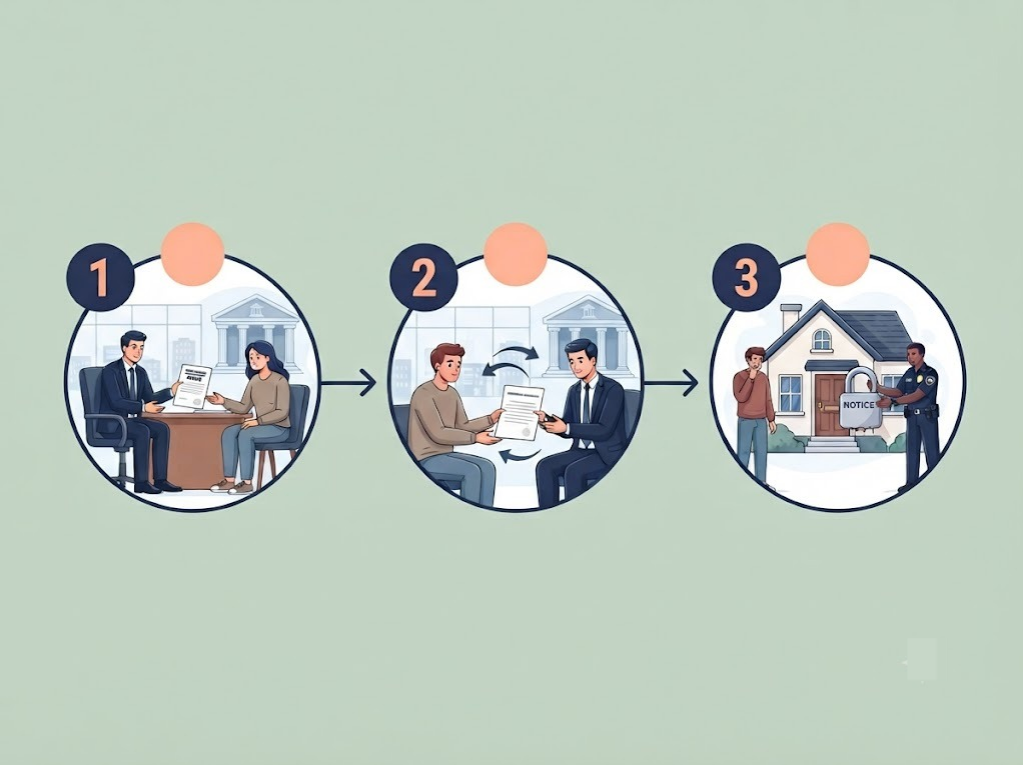
Here's the full sequence, start to finish, in the order it actually unfolds.
- Account Classified as NPA. The loan goes into default long enough to be internally classified as non-performing, this is the precondition for any Section 13 action at all.
- Demand Notice Issued (13(2)). The bank formally demands repayment in writing, starting a defined notice period, commonly 60 days.
- Borrower May Object (13(3A)). You can submit a written objection during this window, and the bank must respond in writing within 15 days if it rejects the objection.
- Notice Period Lapses. Dues remain unpaid, any objection has been addressed, and the window closes.
- Enforcement Action (13(4)). The bank can now take possession, appoint a manager, take over the business, or sell or lease the secured asset, whichever it actually pursues.
The timing of enforcement can vary depending on the borrower’s response, payments, representations, the secured creditor’s actions, and applicable procedural requirements. The 60-day period under Section 13(2) should not be treated as a guarantee of a fixed overall enforcement timeline.
What Rights Do You Have at Each Stage?
Stage | What Happens | Your Right |
13(2) | Demand notice issued | Pay within the window, or prepare a formal objection |
13(3A) | Objection window | Submit written objection, bank must respond in writing |
13(4) | Enforcement action available | Pay, negotiate, or approach DRT under Section 17 |
This is general information, not a substitute for legal counsel on your specific situation.
What Are Your Options at Each Stage?
At 13(2), the choice is simple: pay what's demanded, negotiate directly with the bank, or build a written objection if you genuinely have grounds worth raising.
At 13(3A), that objection has to be on paper. A frustrated phone call to a branch officer carries zero procedural weight, however justified the frustration. By 13(4), the room to manoeuvre has narrowed, but it hasn't vanished, paying the outstanding dues, negotiating even at this late stage, or approaching the DRT under Section 17 all remain genuinely open. This isn't the point where every door slams shut. What happens to a borrower's other debt while all this plays out deserves an honest answer too.
Want to understand exactly where your own situation stands?
Get a free, honest read on your full picture.
Get a Free AssessmentWhat About Your Other Loans During This Process?
Section 13 action only touches the secured loan and whatever asset was pledged against it. A credit card bill doesn't care that a Section 13(2) notice just arrived, personal loans and credit cards keep running on their own schedule regardless, and they can quietly pile pressure on top of an already stressful situation.
Unsecured debt sitting alongside a secured loan doesn't pause for any of this, and treating it as something to sort out "later" usually just means it's grown harder to manage by the time the Section 13 process actually wraps up.
How FREED Helps With the Unsecured Side of This
FREED stays out of Section 13 enforcement and the secured loan itself entirely, that runs directly between you and your bank, or the DRT if it gets that far.
Where FREED actually fits is the separate unsecured debt running alongside it, personal loans, credit cards. Consolidating that debt into one lower payment through FREED's Debt Consolidation Program suits someone still able to pay. For genuine, sustained inability to repay, FREED's Loan Settlement Plan is the separate, structured last resort instead.
Juggling Other Debt While Dealing With This?
FREED can help with your personal loans and credit cards separately.
Start My Free AssessmentA Few Things Worth Knowing
Note your exact notice date the day it arrives. The 60-day clock starts there, not whenever you finally sit down and read it properly.
Put any objection in writing, formally. A conversation with a branch officer isn't a record, only paper is.
Don't assume 13(4) automatically means auction. Ask the bank directly what it's actually planning, the answer might surprise you.
Get legal advice early if your objection has real substance behind it, not once the response deadline is already breathing down your neck.
Sources
Claim | Source |
Demand notice under Section 13(2) requires the account to be classified as NPA, with a 60-day repayment window | SARFAESI Act, 2002, Section 13(2), India Code (Government of India) |
Section 13(3A) requires the secured creditor to communicate reasons for rejecting a borrower's representation within 15 days, introduced by the 2004 amendment | SARFAESI Act, 2002, Section 13(3A), India Code; Enforcement of Security Interest and Recovery of Debts Laws (Amendment) Act, 2004 |
Section 13(4)(a)-(d) provides four distinct enforcement measures: possession, business takeover (within limits), manager appointment, and third-party payment redirection | SARFAESI Act, 2002, Section 13(4), India Code (Government of India) |
Disclaimer
Rates, fees, tenures, and other loan-related information shown are indicative in nature and based on publicly available information and market inputs available at the time of publishing. The actual applicable interest rates, processing fees, eligibility criteria, loan amounts, repayment terms, and approval decisions are solely determined by the respective bank, NBFC, or financial institution based on the applicant’s individual profile, credit assessment, and prevailing internal policies.
FREED does not act as the lender and does not guarantee loan approval, final sanction terms, or accuracy of lender-specific policies that may be revised without prior notice. Financial institutions may modify their products, rates, and eligibility criteria from time to time at their sole discretion.
Users are advised to independently verify all applicable terms and conditions directly with the respective lender before making any financial decision or submitting an application. FREED shall not be held responsible for any discrepancy, rejection, revision, or decision taken by the lender in this regard.

Mohit Juneja
Mohit Juneja writes educational content at FREED on debt management, credit scores, loan repayment, and borrowing best practices. His content is shaped by expert insights and industry knowledge, helping readers better understand their financial options and make informed decisions.
mohit.juneja@freed.care

FREED is India's trusted loan management platform. Founded in 2020 and headquartered in Gurugram, FREED has counselled 20 lakh+ people on personal loans, credit cards, and app loans. FREED charges fees only on successful settlement, not upfront. FREED does not handle secured loans (home loans, car loans, gold loans).
Media Mentions