Sale Certificate Under SARFAESI: What It Means for Borrowers
A sale certificate under SARFAESI is the document a bank issues to confirm the sale of a secured property once the auction is complete and the winning bidder has paid in full. For the borrower, this generally marks the final, formal transfer of ownership away from them.

Mohit Juneja
Reviewed by FREED India, Debt Resolution Specialists
 4.7/5
4.7/5 ₹3,200Cr+
 20,000+
 20,00,000+4.7/5₹3,200Cr+20,000+20,00,000+
KEY TAKEAWAYS

A sale certificate under SARFAESI is issued once the auction winner pays the full bid amount, confirming the property has been transferred.
Unlike a private sale deed, the Supreme Court has confirmed a SARFAESI sale certificate doesn't require compulsory registration; filing a copy with the Sub-Registrar is enough.
If the sale proceeds fall short of what you owed, the bank can still pursue you for the remaining balance through the DRT or a competent court.
If the sale proceeds exceed what you owed, the surplus is legally owed back to you, and courts have ordered banks to pay it with interest when they didn't.
What Is a Sale Certificate Under SARFAESI?
This is the final procedural document in the SARFAESI enforcement sequence, issued only after everything else, the demand notice, possession, valuation, and the auction itself, has already happened. It's issued by the authorised officer to the winning bidder, not to the original borrower.
Worth understanding why this still matters to you even though it's addressed to someone else: it marks a specific, legally significant point in the timeline, the point where the property genuinely stops being yours to influence in any practical sense. The full SARFAESI process leading up to this final document is worth understanding in context if any earlier stage still feels unfamiliar. Exactly when this document actually gets issued is worth knowing precisely.

Want to understand exactly where your situation stands? Talk to FREED about your full picture.
Talk to FREED about your full picture.
Talk to FREED's TeamWhen Is a Sale Certificate Actually Issued?
Only after the auction concludes and the winning bidder has paid the full bid amount; partial payment doesn't trigger this document at all. There's typically a short window, commonly cited as 15 days, for the buyer to pay the remaining balance after winning the bid, and the certificate follows once that full payment is actually confirmed.
Worth connecting this directly to a question many borrowers arrive at this page already worried about: By the time the sale certificate is issued, the borrower’s right of redemption will generally already have ended. The exact cutoff can depend on the facts and applicable law. The exact legal cutoff for that right has genuine nuance worth confirming with a lawyer for your own specific timeline; that's a separate, detailed question in its own right. What this document technically is, and isn't, compared to a normal property sale, is worth understanding next.
Sale Certificate vs Sale Deed: Does It Need to Be Registered?
A sale certificate is genuinely different from a standard private sale deed. It's issued by an authorised officer under a statutory process, not negotiated and executed between two private parties the way an ordinary property sale normally works.
This exact question, whether a SARFAESI sale certificate requires registration under the Registration Act the same way a private sale deed does, was genuinely contested for years, with different High Courts reaching opposite conclusions. The Supreme Court has since settled it, most authoritatively in Esjaypee Impex Pvt. Ltd. v. Canara Bank, and reaffirmed again in Inspector General of Registration v. G. Madhurambal (2022): a sale certificate issued by an authorised officer under SARFAESI is not compulsorily registrable. Filing a copy with the Sub-Registrar under Section 89(4) of the Registration Act, a step the authorised officer handles, is sufficient to satisfy the law. Worth noting for context that in practice, buyers sometimes still choose to present the original for registration anyway, for their own record-keeping comfort, though doing so voluntarily can attract stamp duty in a way the mandatory filing step doesn't. What this actually means for your position as the borrower is worth spelling out directly.

What the Law Says
A sale certificate issued by an authorised officer under SARFAESI does not require compulsory registration under Section 17(2)(xii) of the Registration Act; filing a copy with the Sub-Registrar under Section 89(4) is sufficient. This was genuinely contested across High Courts before the Supreme Court settled it.
Check your optionsWhat Does This Mean for You as the Borrower?
Once the sale certificate is issued, ownership has formally transferred. This is generally treated as the end point of the enforcement process on the property itself; there's no further step in this specific chain that brings it back.
Your relationship to that specific asset is over at this point; whatever comes next concerns the money, not the property itself. At this stage, the focus generally shifts from the property itself to any remaining financial or legal issues. The practical question from here, the one that genuinely still matters, is what happens to the outstanding dues, and that answer runs in two very different directions depending on the numbers.
What Happens to the Money: Shortfall and Surplus
If the auction sale proceeds don't cover the full outstanding dues, including principal, interest, and costs, the bank can pursue you for the remaining shortfall through other legal means, typically an application to the DRT or a competent court under Section 13(10). The sale doesn't automatically close out the debt if there's a genuine gap between what it fetched and what you owed.
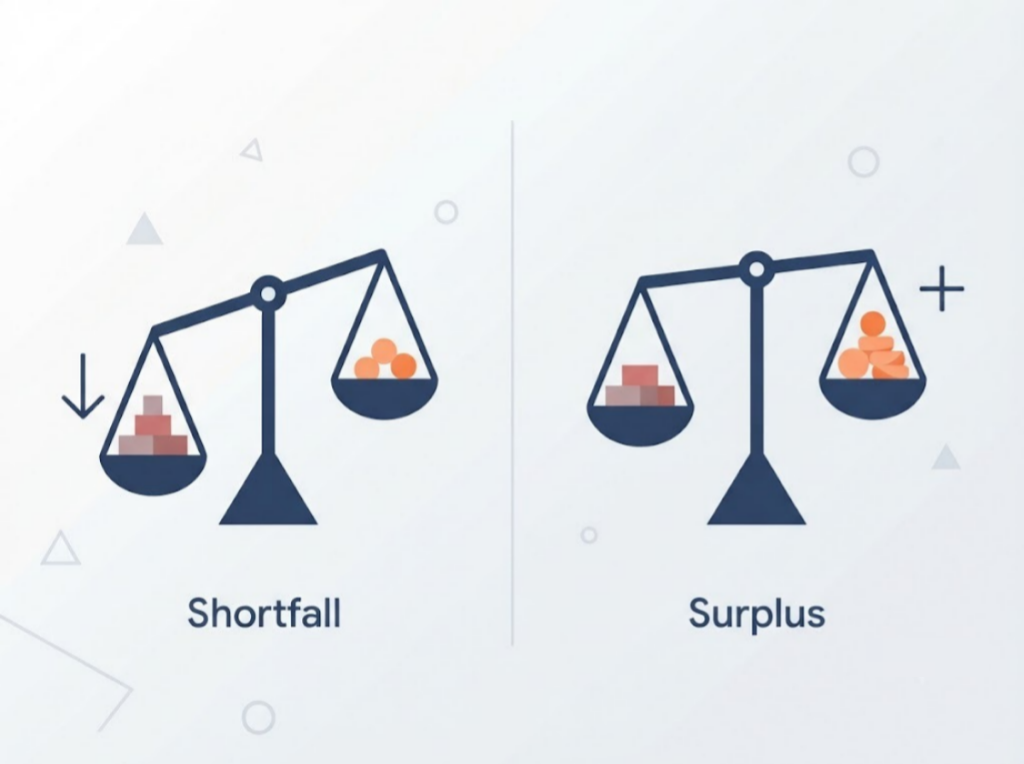
If the sale proceeds exceed what you owed, the surplus amount legally belongs to you. Section 13(7) treats money received from the sale as held in trust, and the bank is required to return anything left over after dues and costs; this is a real, enforceable right, not a courtesy extended at the bank's discretion. Courts have taken this seriously too; in a recent Supreme Court ruling, a bank was directed to refund ₹1.33 crore in surplus proceeds along with 7% interest, after failing to keep the money in an interest-bearing account as it should have. The one practical, plain instruction worth taking from all this: ask for a clear, itemised accounting of the sale proceeds and how they were applied; don't assume either a shortfall or a surplus without actually seeing the numbers yourself. Your broader rights as a borrower throughout this process extend well beyond just this specific moment.

Freed Expert Tip
Ask the bank for a clear, itemised accounting of the auction sale proceeds; don't assume there's a shortfall or a surplus owed to you without seeing the actual numbers.
Get a Clear AccountingCan You Challenge a Sale Certificate After It's Issued?
Yes, in principle, if there was a genuine procedural flaw in how the auction or sale was conducted, under-valuation, notice defects, or something else that genuinely undermined the process. This isn't automatic just because the outcome feels unfair.
The route for this is generally the Debt Recovery Tribunal, the same forum that handles other SARFAESI challenges under Section 17. Worth being honest that challenging a completed sale is genuinely harder than challenging an earlier stage in the process; courts are naturally protective of a sale that's already gone through to a third-party buyer, and this needs a lawyer's real assessment of whether there's genuine legal ground, not just dissatisfaction with how things turned out. A related but entirely separate applicability question, worth addressing on its own terms, comes up often enough to deserve its own section.
Does SARFAESI Apply to an Under-Construction Flat?
SARFAESI applicability to an under-construction property depends on the security created, the loan arrangement, and the underlying documents. Because these cases may also involve RERA and property-law issues, borrowers should seek advice based on their specific documentation. Whether the loan in question is the developer's own construction finance, or an individual buyer's home loan, matters significantly here; these are genuinely different scenarios with very different implications for other buyers in the same project who have nothing to do with the specific default in question. RERA, the Real Estate Regulation Act, protections can intersect with this in ways that have seen genuine, ongoing judicial debate; this is not a settled, one-line answer the way the registration question above turned out to be. If you're in this exact situation, an under-construction unit tangled up in a SARFAESI action, this genuinely needs individual legal assessment against your specific documents, allotment letter, builder-buyer agreement, whatever security was actually created and when. General principles only go so far here, and anyone offering a confident yes or no without seeing your paperwork is oversimplifying a genuinely complicated area.
Not sure if you have grounds to challenge?
A quick call can help clarify your options.
Book My Free CallWhat About Your Other Loans During All This?
This entire process concerns only the secured loan and the specific property involved. Separate unsecured debt, personal loans, credit cards, keeps running entirely independently, and often compounds pressure at exactly this late, already stressful stage.
Settling that separate unsecured debt is a genuinely different conversation from anything covered in this piece, worth addressing on its own terms rather than letting it drift while all the attention understandably goes to the secured matter.
How FREED Helps With the Unsecured Side of This
FREED doesn't handle sale certificates, auctions, or the secured loan itself in any capacity; that process runs entirely between you, your bank, and the DRT if a genuine dispute exists.
What FREED does help with is unsecured debt sitting alongside this, personal loans and credit cards running on their own track. FREED's Loan Settlement Plan addresses that directly, and consolidating that debt into one lower payment is worth exploring for those still able to pay. If a shortfall claim from the bank adds new pressure on top of everything else, that's exactly the kind of additional debt FREED can help address separately too.
Facing a Shortfall or Other Debt Pressure?
FREED can help with your personal loans and credit cards separately
Get a Free AssessmentA Few Things Worth Knowing
Get a clear, written accounting of the sale proceeds. Don't assume a shortfall or a surplus either way without actually seeing the numbers laid out in front of you.
If you're owed a surplus, follow up on it directly. It isn't always sent automatically, and the recent case law above shows banks don't always get this right on their own.
If you're facing an under-construction flat situation, get legal advice specific to your own documentation. General answers genuinely won't cover your exact facts here.
Keep every document from this entire process, the notices, the valuation, the sale certificate itself; you may need it for a shortfall dispute or a surplus claim later on.
Sources
Claim | Source |
A SARFAESI sale certificate does not require compulsory registration; filing a copy under Section 89(4) of the Registration Act is sufficient | Esjaypee Impex Pvt. Ltd. v. Canara Bank; Inspector General of Registration v. G. Madhurambal, Supreme Court of India (2022) |
Where sale proceeds don't fully satisfy the secured debt, the creditor may apply to the DRT or a competent court for the balance | SARFAESI Act, 2002, Section 13(10) |
Sale proceeds are held in trust, and surplus after dues and costs must be returned to the borrower | SARFAESI Act, 2002, Section 13(7) |
A bank was directed to refund ₹1.33 crore in surplus sale proceeds with 7% interest for failing to hold it in an interest-bearing account | Lakshmi Mohan (Dead) Through LRs & Anr. v. M/s Airtech Projects & Engineers Pvt. Ltd. & Anr., Supreme Court of India (2026) |
Applicability of SARFAESI to under-construction property is fact-specific and intersects with RERA in ways that remain judicially debated | General principle only, no single settled rule; individual legal assessment required |

Mohit Juneja
Mohit Juneja writes educational content at FREED on debt management, credit scores, loan repayment, and borrowing best practices. His content is shaped by expert insights and industry knowledge, helping readers better understand their financial options and make informed decisions.
mohit.juneja@freed.care

FREED is India's trusted loan management platform. Founded in 2020 and headquartered in Gurugram, FREED has counselled 20 lakh+ people on personal loans, credit cards, and app loans. FREED charges fees only on successful settlement, not upfront. FREED does not handle secured loans (home loans, car loans, gold loans).
Media Mentions