Personal Loan for Self-Employed With Low CIBIL Score
A personal loan for self-employed with low CIBIL score is a loan approved despite a weak credit history, based on business income proof like bank statements and ITRs instead of a salary slip. Approval isn't guaranteed. NBFCs and digital lenders look at cash flow and existing EMI load as much as the score itself.

Mohit Juneja
Reviewed by FREED India, Debt Resolution Specialists
 4.7/5
4.7/5 ₹3,200Cr+
 20,000+
 20,00,000+4.7/5₹3,200Cr+20,000+20,00,000+
KEY TAKEAWAYS

A personal loan for someone self-employed with low CIBIL score is harder to get from banks, but not impossible through NBFCs.
Many banks generally prefer applicants with stronger credit profiles, although eligibility criteria vary by lender.
Lenders weigh income stability and existing EMI load (FOIR) alongside the score, not the score alone.
If existing loans are the real reason for a low score, adding a new loan rarely fixes the problem.
FREED's Debt Consolidation Program merges eligible unsecured loans into one lower EMI, without a "Settled" tag.
What Is a Personal Loan for Self-Employed With Low CIBIL Score
CIBIL scores in India run on a scale of 300 to 900. Most banks look for 700 and above before considering an unsecured personal loan, though the exact cut-off varies from one bank to another. Below that, a bank application becomes harder, but it isn't the end of the road.
For a self-employed applicant, the loan itself works differently from the start. There's no salary slip to hand over, so lenders lean on business income proof instead: income tax returns (ITRs), GST returns, and several months of bank statements that show the business actually earns what it claims to. A low score narrows which lenders will look at you, but it doesn't close every door. NBFCs and digital lenders in particular are often built to weigh this kind of documentation more heavily than the score in isolation.
This is a different situation from a "no CIBIL" case, someone with no credit history at all. Here, there's a track record, it just isn't a strong one. That distinction matters, because it means the fix usually lies in improving what that history shows, not in starting from scratch.
Why Do Self-Employed Applicants With Low CIBIL Get Rejected
The rejection isn't about being self-employed itself. It comes down to how bank systems are built to read income, and self-employed income often doesn't fit that mould cleanly.
A salaried applicant has one predictable number landing in their account every month. A self-employed applicant's income moves with the business, strong one month, thinner the next, and that irregularity makes repayment capacity harder for a bank to verify at a glance.
On top of that, existing loans add up quickly. If your EMIs already eat up more than 50% of your take-home income, your FOIR (how much of your salary goes to EMIs) signals real strain to any lender reviewing the file, regardless of your business's actual health.
A cash-heavy business without a clean bank trail compounds this further. If a large share of revenue never shows up as a traceable bank credit, there's simply less for a lender to verify.
Each formal loan application creates a hard enquiry that future lenders may consider during credit assessments. Applying to several banks in a short window, hoping one says yes, tends to lower the score a little further each time, making the next attempt even harder.
None of this reflects poorly on the borrower. It's a structural mismatch between how self-employed income actually looks and how most lending systems were built to assess it.
Signs You Need a Different Approach, Not Just Another Loan
A few situations suggest the real fix isn't a new loan at all:
- You're already juggling 2 or more unsecured loans or credit cards, and keeping track of due dates has become its own job.
- A new loan would mostly go toward covering EMIs on older ones, rather than funding anything new for the business or household.
- You've been rejected by more than one bank in the last few months, and each rejection is making the next application harder.
- Your monthly EMI outgo already crosses half of your take-home income, the point where most lenders start reading your file as stretched.
If two or more of these describe your situation, a new loan isn't the fix. What actually helps at this stage is changing how your existing debt is paid, not adding one more EMI to the pile.
How to Apply for a Personal Loan as a Self-Employed Borrower With Low CIBIL
Following these steps may strengthen your application, depending on the lender's assessment.
Start by checking your credit report for errors. A wrongly reported due or a duplicate or incorrect entries may affect how future lenders assess your credit profile without your knowledge, and it's worth fixing before you apply anywhere. Next, gather your business income proof properly: ITRs for the last 2 to 3 years, GST returns if applicable, and at least 6 months of clean bank statements that show your business income clearly.
Rather than asking for the maximum amount a lender might offer, work out a realistic figure based on what you actually need and can comfortably repay. A smaller ask is easier to get approved and easier to live with afterward.
From there, apply selectively. NBFCs and digital lenders often look at your income pattern and cash flow more closely than a bank would, so it's worth including them alongside any bank applications rather than approaching banks first and NBFCs only as a fallback. If your first attempt doesn't succeed, adding a co-applicant with a stronger credit score, a spouse, sibling, or business partner, can shift a lender's decision meaningfully.

FREED Expert Tip
Apply to 1 to 2 lenders at a time. Each formal loan application creates a hard enquiry that future lenders may consider during credit assessments.
Get a Free EMI AssessmentWhat Do Lenders Check Beyond the CIBIL Score
The score is only the starting point. What lenders actually read closely is what your bank statements show underneath it.
Many NBFCs and several digital lenders look for consistent monthly inflows that look like genuine business revenue, not one-off deposits that could be anything. They also check for an absence of frequent bounces, since a pattern of failed payments or insufficient balance says more about real repayment risk than the score alone ever could. And they compare the amount you're requesting against your actual income. A loan ask that's disproportionate to what your bank statements show is one of the fastest ways to get flagged, regardless of your score.
In practice, this means your bank statements often do more work in a lender's decision than the CIBIL number does by itself. A borderline score paired with clean, consistent statements can move a lender toward approval in a way the score alone wouldn't suggest. The reverse is also true: a decent score paired with messy, inconsistent statements can still result in a decline.

What the Law Says
Under RBI's fair practices code, banks and NBFCs must convey the main reason for rejecting a loan application in writing, for loans up to ₹2 lakh.
See How Debt Consolidation WorksWhat Are Your Options If a New Loan Isn't the Right Move
Think of this as a ladder, worth trying in order rather than skipping straight to the end.
If you have just one loan running at a higher rate and your score is still reasonably healthy, a balance transfer to a lower-rate bank can work. This route is likely not the right fit if you're already carrying multiple loans or your score has slipped below what most banks want to see, but it's worth ruling out first.
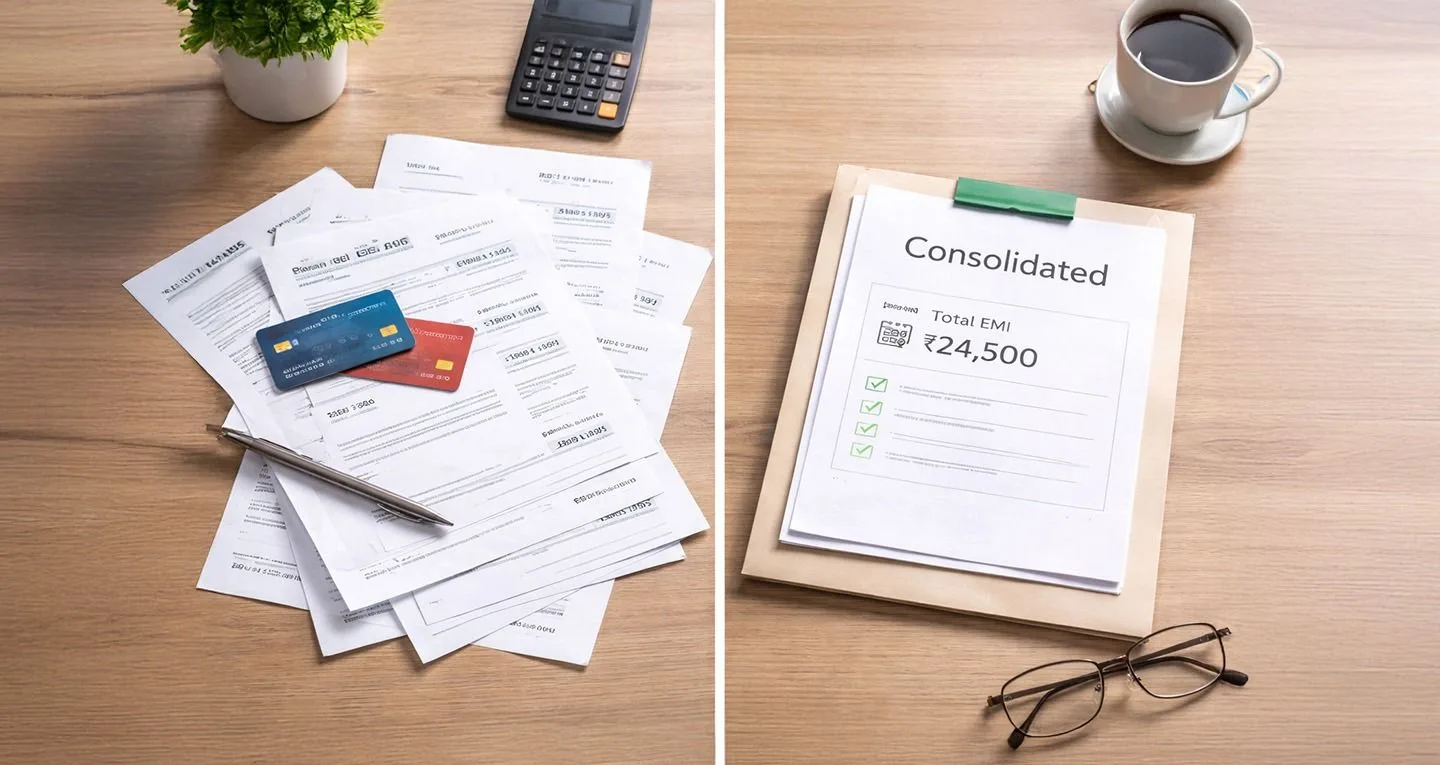
For most self-employed borrowers stretched across 2 or more unsecured loans and cards, FREED's Debt Consolidation Program is the next step. FREED's Debt Consolidation Program may combine eligible unsecured debts into a single repayment, depending on the approved loan amount, tenure, and lender terms. This isn't a fresh loan for new spending, it's a way of merging what you already owe into something more manageable.
Settlement sits further down this ladder, and it's reserved for genuine, ongoing inability to repay, not for someone who is still managing, even if it's difficult. If consolidation fits your situation, it's the step worth exploring first.

One Loan, One Lower EMI, No New Debt Anxiety
See if consolidation fits your situation better than a fresh loan.
Start My Debt AssessmentHow FREED Helps If You're Self-Employed and Stretched Across Multiple Loans
FREED looks at your full financial profile, not just the score sitting on your report. This includes your existing loans, your income pattern, and how much of it is already going toward EMIs. For a self-employed borrower, this matters more than it does for a salaried one, since the score alone often tells an incomplete story about what's actually happening month to month.
Where FREED's Loan Consolidation Plan fits, FREED matches you to a suitable lending partner from its network, specifically for consolidating what you already owe, not for a fresh personal loan meant for other spending. That lending partner disburses one new loan that pays off your existing eligible debt instantly. You're left with one loan, one EMI, one due date, and a lower monthly amount than what you were juggling across multiple loans before.
Unlike taking on new debt, this route is generally viewed as responsible repayment management, since your utilisation improves and your payment history consolidates onto a single, regular track. FREED charges you no fee for this service; any processing or foreclosure fee is set directly by the lending partner, not by FREED.
FREED has worked through 20,000+ accounts settled and ₹3,200 Cr+ in debt managed across its programs, handling the process end to end rather than leaving you to manage the back-and-forth with a lending partner

Compare Your Options by Bank Before You Apply
Applying blind to several banks at once means taking a hard inquiry hit on each one, even the applications that get rejected. Before doing that, it's worth seeing which banks and NBFCs typically consider self-employed applicants and at what CIBIL range, so you can apply to the ones actually likely to say yes
Are You in a Loan Trap? Quick Check
Move the slider to your total EMIs as a % of monthly salary. See your debt stress level instantly.
EMIs as % of Monthly Salary
What Helps During the Application Process
A handful of habits genuinely improve your odds before you submit anything.
Pull your free credit report first, so you know exactly what a lender will see before they see it. Each formal loan application creates a hard enquiry that future lenders may consider during credit assessments. Keep your bank statements clean for 3 to 6 months before applying, consistent inflows and no bounces during this window carry real weight. And be upfront about your actual business income rather than overstating it, an inflated figure that doesn't match your bank statements is one of the fastest ways to get flagged during verification.
Steps: Applying for a Personal Loan as a Self-Employed Borrower With Low CIBIL
- 1
Pull your credit report first.
Check your CIBIL report for errors before applying anywhere. Correcting inaccurate information ensures lenders assess accurate credit information.
- 2
Gather business income proof.
Keep ITRs, GST returns, and 6 months of bank statements ready. This substitutes for a salary slip and is what most lenders will actually verify your repayment capacity against.
- 3
Calculate what you actually need.
Ask for a realistic amount, not the maximum offered. Smaller asks get approved faster and are easier to manage once the EMI starts.
- 4
Check NBFCs and digital lenders, not just banks.
Banks often set the highest score cut-offs. NBFCs weigh income and cash flow more heavily, which can work in your favour at a lower score.
- 5
Consider a co-applicant.
A co-applicant or guarantor with a stronger score can shift the lender's decision meaningfully, especially when your own file is borderline.
Comparison Table: Bank vs NBFC, Personal Loan for Self-Employed With Low CIBIL
Lender Type | Typical CIBIL Expectation | Self-Employed Friendliness | Documentation Focus |
Public/Private Banks | Usually 700+ | Lower, stricter income proof norms | ITR, audited financials |
NBFCs | Often more flexible | Higher, income-pattern focused | Bank statements, GST returns |
Digital Lending Apps | Varies widely by platform | High, fast digital checks | Bank statement analysis, OTP-based KYC |
Rates and approval criteria vary by lender and change over time. FREED is not a Loan Provider. Please verify directly with the bank or NBFC.
Sources
Claim | Source |
Banks and NBFCs must convey the main reason for rejecting a loan application in writing, for loans up to ₹2 lakh | RBI Guidelines on Fair Practices Code for Lenders, DBOD.Leg.No.BC.104/09.07.007/2002-03, May 5, 2003, rbidocs.rbi.org.in/rdocs/notification/PDFs/36102.PDF |

Mohit Juneja
Mohit Juneja writes educational content at FREED on debt management, credit scores, loan repayment, and borrowing best practices. His content is shaped by expert insights and industry knowledge, helping readers better understand their financial options and make informed decisions.
mohit.juneja@freed.care

FREED is India's trusted loan management platform. Founded in 2020 and headquartered in Gurugram, FREED has counselled 20 lakh+ people on personal loans, credit cards, and app loans. FREED charges fees only on successful settlement, not upfront. FREED does not handle secured loans (home loans, car loans, gold loans).
Media Mentions