Personal CIBIL vs Corporate CIBIL: Key Differences
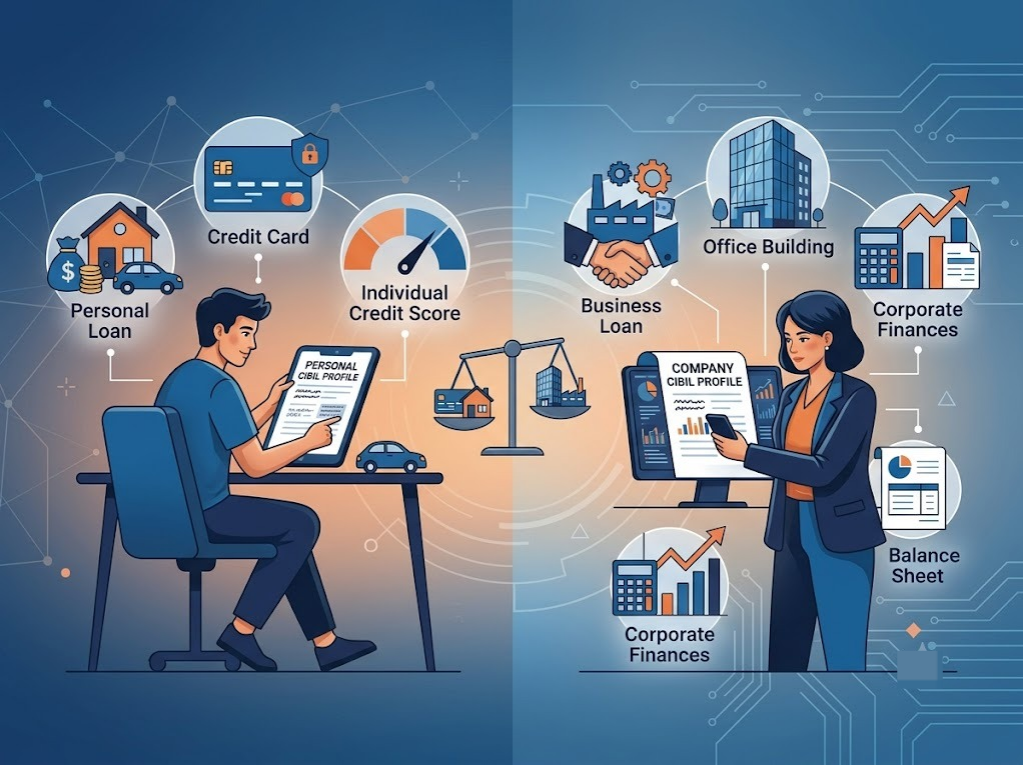
Personal CIBIL is the individual credit score, ranging from 300 to 900, that reflects how you've repaid your own loans and credit cards. For businesses, TransUnion CIBIL provides commercial credit information and products such as CIBIL Rank. This is different from an individual's personal CIBIL Score. For most salaried borrowers, only the personal score matters.
Mohit Juneja
Reviewed by FREED India, Debt Resolution Specialists
 4.7/5
4.7/5 ₹3,200Cr+
 20,000+
 20,00,000+4.7/5₹3,200Cr+20,000+20,00,000+
KEY TAKEAWAYS

Personal CIBIL is your individual credit score, ranging from 300 to 900, based on your own repayment history.
Corporate CIBIL evaluates a company's or business entity's credit behavior, not an individual's.
For a personal loan or credit card application made by an individual in their own name, the lender will generally assess the individual's personal credit profile. A business credit profile becomes relevant when borrowing is being undertaken by a business or commercial entity.
Business owners and company directors may need to think about both scores in some situations.
Confusing the two, or being asked for the wrong one, is a common and fixable mix-up.
What Is Personal CIBIL?
Personal CIBIL is an individual's credit score from TransUnion CIBIL, ranging from 300 to 900, built entirely from that person's own loan and credit card repayment history. This is the score checked whenever you, salaried or not, apply for a personal loan, a credit card, a home loan, or a car loan in your own name.
Worth clarifying one naming point here. CIBIL is actually a specific bureau's brand name, TransUnion CIBIL, while "credit score" is the broader term that also covers scores from India's other three bureaus. People use the terms interchangeably in everyday conversation, which is fine, but it helps to know the distinction exists.
What personal CIBIL does not cover is just as important. It has nothing to do with a company's finances or a business's credit behavior, even if the person in question owns or runs a business on the side. The two stay completely separate, no matter how closely connected the individual and the business might otherwise be.
Since a business can carry its own entirely separate score, that's worth understanding next, especially for anyone self-employed or running a company of their own.

What Is Corporate CIBIL and How Is It Different?
Corporate CIBIL is a separate score used to evaluate a company's or business entity's credit behavior, not an individual's. In commercial credit contexts, this is often referred to by the product name CIBIL Rank.
It comes into play when a lender is assessing a business's own loan applications, things like business loans, working capital financing, or trade credit, rather than when assessing an individual's personal loan or credit card. The two systems exist to answer different questions for a lender: one is asking "will this person repay what they borrow personally," the other is asking "will this business repay what it borrows."
The scoring approach itself is structured differently from the familiar 300 to 900 personal scale, though exact current methodology is worth confirming directly with the bureau rather than assuming it hasn't changed, these things do get updated over time.
Here's where it gets genuinely confusing for a lot of people. A sole proprietor (someone running an unregistered business under their own name) doesn't always have a clean separation between personal and business finances the way a registered company does. Depending on how a lender structures its evaluation, personal and business factors can sometimes overlap in ways that aren't immediately obvious. This overlap is exactly the kind of confusion this blog exists to clear up.
The practical differences between the two systems are laid out clearly in the comparison table further down, which makes the distinction much easier to hold onto than trying to keep it all in your head from a paragraph of explanation.
Signs You Might Be Confusing Personal and Corporate CIBIL
A quick self-check, five situations where this mix-up commonly shows up.
- A lender or form asked for "company CIBIL," and you weren't sure if that meant your own score. This exact confusion is common enough that it's worth a direct question back to whoever's asking, rather than guessing.
- You're self-employed or run a small business and have never checked whether it has its own separate credit file. Self-employed borrowers often assume only one score exists simply because they've never had a reason to check otherwise.
- You assumed a business loan rejection was tied to your personal score when it may have been evaluated separately. The actual reason behind a rejection can sit entirely on the business side, not yours personally.
- You're salaried but got asked about a business credit report because of a side business or freelance income. Even a small side income stream can occasionally trigger this kind of question from a lender.
- You've never actually checked which score applies to you before applying for credit. Most people default to assuming there's just "one score," which is usually true for salaried employees but not always for everyone else.
For most salaried readers, the answer really is simpler than it sounds, personal CIBIL is what to check, and that's covered next.


FREED Expert Tip
If you're salaried, you only need to track your personal CIBIL.Business credit information generally relates to the business entity or commercial borrowing, while a person's CIBIL Score relates to their individual credit history. Which records a lender considers can depend on the business structure and type of credit being requested.
Check My OptionsHow to Check Your Personal CIBIL Score, Step by Step
None of these steps require any specific product, this is the general process for checking the one score that actually matters for a salaried borrower.
- Go to the Official Bureau Site or a Trusted App. Use the official CIBIL website or a well-known platform, not a link from an unsolicited message.
- Enter Your PAN and Basic Details. Your PAN and other identifying details are used to help match you to your individual credit records.
- Verify Your Identity. Most platforms confirm identity through an OTP sent to your registered mobile number.
- View Your Score and Report. You'll see your score out of 900, along with a summary or full report depending on the platform. Checking through PAN verification works the same way across most legitimate free options, so the process should feel familiar regardless of which one you use.
- Check the Report for Errors. Review account details for anything that looks wrong or unfamiliar before assuming the score itself is accurate.
That's genuinely the whole process for a salaried borrower, five steps, none of which touch anything business-related. No separate business registration to look up, no company PAN to track down, nothing beyond your own individual identity documents.
A word of caution worth including here, since it comes up often enough. Be wary of any message or email claiming you need to "verify your corporate CIBIL" as a salaried employee, this is a common phishing angle precisely because most people aren't entirely sure what corporate CIBIL even is. If something is asking you for business-related credit verification and you're salaried, that's a signal to pause and confirm through official channels rather than clicking through.
It's also worth building this into a habit rather than a one-time check. A score checked once at loan application time tells you very little about the trend that got you there, checking every few months gives a much clearer read on which direction things are actually moving.
Now that it's clear this is the one score to actually track, the direct comparison between personal and corporate CIBIL in the next section makes the full picture obvious rather than something you have to keep half-remembering.

Not Sure Which Score Applies to You?
Get a free assessment of your credit profile.
Book My Free CallPersonal vs Corporate CIBIL: Key Differences
Personal CIBIL | Corporate CIBIL | |
Who it's for | An individual | A company or business entity |
Based on | The individual's own loan and card repayment history | The business's own credit and repayment behavior |
Identifier used | PAN card | Business PAN or company registration details |
Typical range | 300 to 900 | A different scoring structure |
Checked for | Personal loans, credit cards, home loans, car loans | Business loans, working capital, trade credit |
Looking at the table, the practical takeaway is straightforward: match the identifier to the applicant. If it's your own PAN and your own name on the application, personal CIBIL is what's being checked, full stop. What actually counts as a strong personal score is a completely separate question from anything happening on the corporate side.
For most readers of this blog, salaried employees without a registered business of their own, this table settles the confusion entirely. There simply isn't a second score to worry about. Where it gets more complicated is for business owners: a business loan involving a personal guarantee, or personal borrowing used to fund the business, can create real personal credit implications depending on how it's structured and reported. The clean separation above holds when there's no personal guarantee or personal borrowing in the mix, not as a universal rule for every business owner.

What This Means If You're Salaried vs Self-Employed or a Business Owner
How this actually applies depends on which category you fall into.
If you're salaried, only personal CIBIL applies. There's no separate business score to track unless you've separately registered a business in your own name, which most salaried employees simply haven't done. Salaried borrowers dealing with a lower score are working entirely within the personal system, corporate CIBIL never enters the equation for them.
If you're a sole proprietor, the distinction is less straightforward than it is for a company. Because the proprietor and proprietorship are not separate legal persons in the same way a company and its owner are, lenders may consider the proprietor's personal credit profile alongside business financial information when evaluating borrowing.
If you're a business owner or company director, the business itself may carry its own separate corporate CIBIL, tracked entirely independently of your personal score. Exactly how to check or manage that corporate score is beyond what this blog covers, but knowing it exists as a separate thing to look into is the useful starting point.
None of these categories are fixed forever either. Someone salaried today who starts a small side business next year moves from the first bucket into the second without necessarily realizing the credit picture has changed underneath them. The categories exist to help you locate yourself in this picture quickly, not to box you in permanently, revisit which one actually describes you if your own situation shifts.
Whichever category actually describes you, checking and understanding your own personal score remains the practical first step, and that's covered directly next.
Are You in a Loan Trap? Quick Check
Move the slider to your total EMIs as a % of monthly salary. See your debt stress level instantly.
EMIs as % of Monthly Salary
How FREED Helps You Track and Improve Your Personal CIBIL Score
FREED's Credit Insight tool pulls your Experian credit report and shows your personal score alongside exactly what's currently helping or hurting it, plus step-by-step recommendations for improving it further.
To be clear about scope here, this is a personal credit product, built for individuals, not a corporate or business credit service. FREED doesn't offer anything on the corporate CIBIL side, and nothing here should be read as implying otherwise.
It's open to everyone, no enrollment in any FREED program required, and no minimum income or score threshold to subscribe. The subscription runs ₹249 for three months, giving you a fuller view of your personal file than a bare score number provides on its own.
Given everything covered in this piece, the practical value here is straightforward. Once you've confirmed personal CIBIL is the one score that actually applies to you, day-to-day tracking of that score is where the real, ongoing value sits, not a one-time check before a single loan application.
Whether you're salaried with a single score to watch, or self-employed and juggling the awareness that a second system exists somewhere in the background, your personal file is the one thing that directly shapes every loan and card decision made about you as an individual. Checking it every few months, rather than only right before a big application, gives enough lead time to fix a problem if one shows up, an error, an unexpected dip, anything worth catching early rather than discovering during an actual application. For a salaried borrower specifically, this is genuinely the only score worth this level of attention.
Know What's Really Behind Your Score
Get the full picture of your personal credit health.
Check My Credit InsightsTips for Salaried Borrowers to Keep Their Personal CIBIL Healthy
A handful of habits keep the one score that actually matters working in your favor.
Pay every EMI and card bill on time. This is the single biggest factor in the score, more than anything else on this list combined.
Keep credit utilization under 30% across all cards. Lower usage relative to your limit reads as financial comfort rather than financial pressure, even when every bill gets paid.
Avoid applying for multiple loans or cards in a short window, especially around a salary hike or a big purchase. Each application triggers a hard enquiry, and a cluster of them close together can work against you rather than for you.
Keep older accounts open rather than closing them right after a loan is paid off. Account age adds stability to your file, something a freshly closed account can't replicate.
Check your personal CIBIL report every few months, especially before a big loan application like a home loan. Smart financial habits for salaried professionals generally include this kind of periodic review as a matter of course, not just as loan-application prep.
For a salaried borrower, one score does the work, and it rewards consistency more than anything else.

Mohit Juneja
Mohit Juneja writes educational content at FREED on debt management, credit scores, loan repayment, and borrowing best practices. His content is shaped by expert insights and industry knowledge, helping readers better understand their financial options and make informed decisions.
mohit.juneja@freed.care

FREED is India's trusted loan management platform. Founded in 2020 and headquartered in Gurugram, FREED has counselled 20 lakh+ people on personal loans, credit cards, and app loans. FREED charges fees only on successful settlement, not upfront. FREED does not handle secured loans (home loans, car loans, gold loans).
Media Mentions