What Is the Lowest Credit Score?
For CIBIL, the lowest numerical score is 300. CIBIL's consumer score ranges from 300 to 900. Other credit bureaus may use their own scoring models and ranges, so don't assume 300 is the universal floor for every bureau, not simply a lack of credit history. That distinction matters, because no history at all shows up differently, as NA or NH, not as 300.
Mohit Juneja
Reviewed by FREED India, Debt Resolution Specialists
 4.7/5
4.7/5 ₹3,200Cr+
 20,000+
 20,00,000+4.7/5₹3,200Cr+20,000+20,00,000+
KEY TAKEAWAYS

Lowest credit score in India is 300, the floor of the 300-900 scale used by all 4 bureaus.
A 300 score reflects a poor track record, not just a lack of one.
No credit history at all shows up as NA or NH, a different code from an actual low score.
A score this low usually builds up over time, from missed payments or high utilisation, not a single event.
What Is the Lowest Credit Score?
For CIBIL, 300 is the bottom of its 300–900 scoring range.
Landing at or near 300 is not the same as having no score at all. The system has data on you, and that data reads as high risk, a pattern of missed payments, heavy credit usage, or a default sitting on the file. It's not an absence of information, it's the opposite, a full picture that happens to look bad.
That raises an obvious question worth answering before anything else: if 300 represents actual risk data, why does the scale start there instead of at zero?

What the Law Says
All 4 of India's credit bureaus operate under the same RBI-mandated 300 to 900 scoring scale, standardised under RBI's directions issued under the Credit Information Companies (Regulation) Act, 2005.
Talk to FREED About Your ScoreWhy Does the Scale Start at 300, Not Zero?
The CIBIL Score is designed as a 300–900 numerical range. A score of 300 is therefore the bottom of the published range, not a code for having no credit information.
That's the key contrast worth holding onto: a genuinely empty file, someone who's never taken a loan or card, doesn't get scored at all, it gets flagged differently, covered fully further down. What actually pushes someone toward this floor is a separate question, and it's rarely one single thing.

Freed Expert Tip
A score near 300 almost always traces back to something specific and fixable, a settled account, a run of missed payments, high utilisation, find the exact cause before assuming nothing can change.
Check My Credit Now
Signs You Might Be Near the Lowest Band
A handful of patterns tend to show up together when a score sits this low.
- Multiple missed EMIs or credit card payments over recent months. Not a single slip, a repeated pattern across several billing cycles.
- An account marked "Settled" or "Written Off" sitting on the report. Either status signals a debt that wasn't repaid in full, and both can negatively affect your credit profile. If you're not sure which one applies to an account of yours, our explainer on what a written-off status actually means breaks down the difference.
- Credit utilisation consistently near or at the full limit across active cards. Maxed-out cards, even paid on time, still signal financial strain to the scoring model.
- Several loan or credit card applications in a short window. Multiple credit applications in a short period can result in additional enquiries and may negatively affect your score.
- An account still showing as overdue that was actually resolved. This one's an error rather than a real problem, but it still drags the score down until it's corrected.
Individually, none of these guarantee a score at the floor. Together, sustained over time, they usually do.
How a Score Actually Drops This Low
A score near 300 generally reflects the broader credit history rather than a single isolated event. It's almost always an accumulation, sustained missed payments, a settled or written-off account, high utilisation held for months, or some combination of all three.
Here's how that typically plays out. Someone misses a handful of EMIs during a genuinely rough patch, a job loss, a medical bill, something real. While catching up, their credit card usage climbs, since cash is tight and the card becomes the buffer. For example, a borrower may have repeated missed payments, high utilisation and an account reported as settled. None of these three things happened in isolation, each one made the next slightly more likely, and together they compound into a score sitting near the floor.
This isn't the story of one bad decision. It's a pattern, built over months, usually during a period that was already difficult for other reasons. Worth understanding clearly before moving to the piece of this topic most people get wrong entirely: the difference between an actual low score and simply having no score yet.
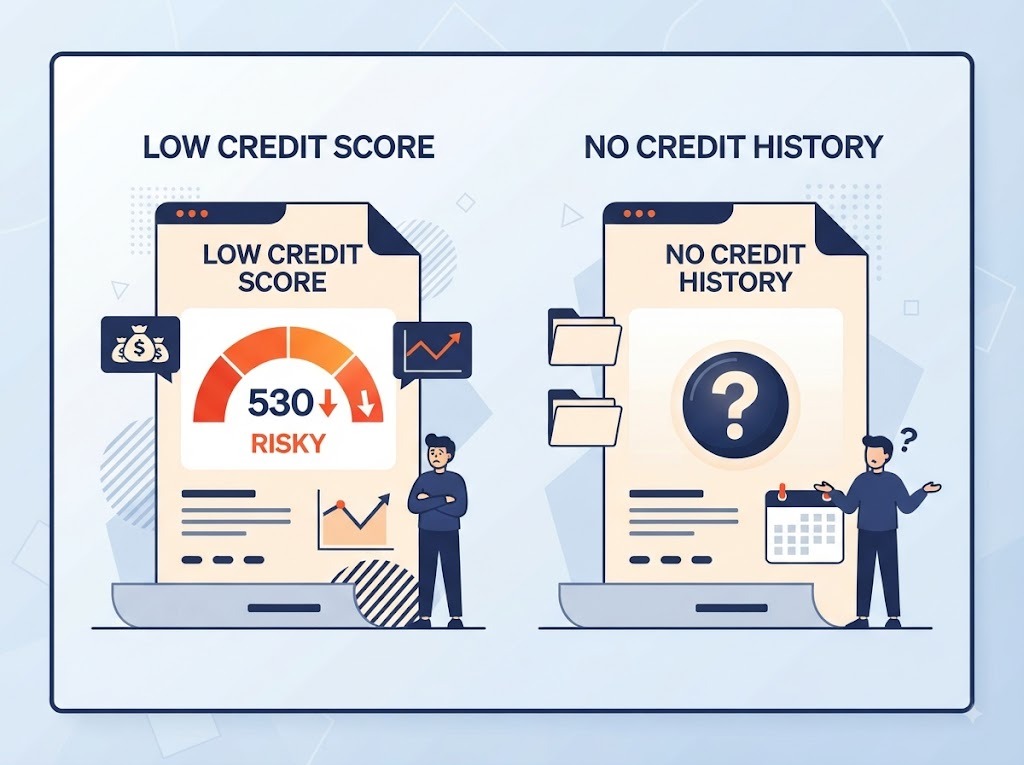
Is 300 the Same as Having No Credit Score at All?
No, and this is where a lot of content on this topic gets muddled.
Someone with no credit history at all, never taken a loan or card, doesn't show up as 300. They show up as NA (Not Applicable) or NH (No History) instead, a completely different code. Per TransUnion CIBIL's own consumer guidance, this appears when there isn't enough recent credit activity to generate a score, commonly cited as under six months, though the exact threshold can shift and isn't a fixed universal rule.
The distinction matters practically, not just technically. NA/NH means "we don't have enough data yet." 300 means "we have data, and it shows a poor track record." These are not the same conversation, and treating them as equivalent leads to the wrong next step.
NA/NH is not itself a bad thing, whatever it might feel like at first glance. Banks may ask for extra documentation or lean more heavily on income and employment stability when a score isn't available, but this is a fundamentally different situation from an actual 300. One means "start building." The other means "something specific needs fixing." What someone in either situation should actually do next is covered right below.
What Are Your Options at the Lowest End
The right first move depends entirely on which of the two situations actually applies to you.
Path 1, if you have an actual low score reflecting real credit history: understanding exactly what's driving it comes before anything else. Which specific account, which pattern, a settled debt, sustained high utilisation, a string of missed payments, guessing at the cause wastes time you could spend fixing the actual thing.
Path 2, if you have NA or NH rather than an actual low number: Depending on eligibility, options such as a secured credit card or another suitable starter credit product may help establish a credit history. There's nothing to repair here, only a track record to start.
If you're specifically looking for loan options available at this end of the score range, our dedicated piece on 300 credit score loans and what's realistically available covers that ground directly rather than repeating it here.
How FREED Helps
The honest starting point for most readers here isn't a fix, it's finding out which situation actually applies. FREED's Credit Insights, consumer label "Check My Credit," is built for exactly that, telling you whether you're looking at a real low score with a specific, identifiable cause, or simply NA/NH needing time and deliberate credit-building, rather than guessing from a number alone.
It's open to everyone, no minimum income and no CIBIL floor apply, which matters directly for this particular audience, since this is exactly the group that might assume they don't qualify for anything, including a basic diagnostic check. Credit Insights pulls your report from Experian and gives you three things: your score, a clear breakdown of what's specifically affecting it, and step-by-step recommendations for what to work on first. It's available as a short-term subscription; check the live product page for current pricing.
One honest caveat worth stating plainly: no single check fixes a pattern that took months or years to build, and no timeline gets promised here. What Credit Insights does is replace guessing with an actual, specific answer, which is the necessary first step regardless of how long the rest of the process takes.
Find Out What's Actually Behind Your Number
Your score, what's affecting it, and what to do next.
Check My Credit NowTips If You're Starting From the Lowest End
Sources
# | Claim in Copy | Source | Note |
|---|---|---|---|
1 | 300–900 scale, all 4 bureaus, RBI-mandated | RBI Master Direction Credit Information Reporting Directions, 2025 | Under Credit Information Companies (Regulation) Act, 2005 |
2 | 300 = poor track record, not zero history | TransUnion CIBIL consumer education pages | Standard bureau explainer, no single URL cited |
3 | NA/NH shown when no/insufficient credit activity | TransUnion CIBIL consumer guidance | "Commonly cited as under 6 months" bureau doesn't fix exact threshold publicly |
4 | Settled/Written-off hurts score | RBI CIC Directions + CIBIL scoring factors (general bureau disclosure) | No single doc number industry-standard factor |
5 | Multiple applications → more hard enquiries → score dip | CIBIL/Experian public FAQ on hard enquiries | General bureau disclosure, not one document |
6 | High utilisation drags score even if paid on time | CIBIL scoring factor disclosures | Same general bureau education content |
7 | Self-check doesn't lower score (soft vs hard pull) | RBI CIC Directions, 2025 + bureau FAQs | Distinguishes self-enquiry (soft) from lender enquiry (hard) |
8 | Secured card as NA/NH starter option | General lending practice no regulator mandate | Framed as "may help," not guaranteed |

Mohit Juneja
Mohit Juneja writes educational content at FREED on debt management, credit scores, loan repayment, and borrowing best practices. His content is shaped by expert insights and industry knowledge, helping readers better understand their financial options and make informed decisions.
mohit.juneja@freed.care

FREED is India's trusted loan management platform. Founded in 2020 and headquartered in Gurugram, FREED has counselled 20 lakh+ people on personal loans, credit cards, and app loans. FREED charges fees only on successful settlement, not upfront. FREED does not handle secured loans (home loans, car loans, gold loans).
Media Mentions