Loan Recovery Rules: Call Timings, Home Visits, Rights
A bank or NBFC can ask you to repay. It cannot threaten you. This guide explains call hours, home visits, what agents must carry, what is reported for 2027, and how to complain.

Mohit Juneja
Reviewed by FREED India, Debt Resolution Specialists
 4.7/5
 ₹3,200Cr+
 20,000+
 20,00,000+4.7/5₹3,200Cr+20,000+20,00,000+
Key Summary

A bank or NBFC may ask you to repay. It may not threaten, shame, or abuse you, and it answers for what its agents do.
RBI’s 2022 circular makes banks and NBFCs responsible for their recovery agents. Reports say calls are limited to 8 AM to 7 PM.
New recovery-agent requirements have been reported for 2027. However, their effective date, applicability, and specific conditions must be verified against the official RBI notification before being presented as regulatory requirements. Until then, treat them as reported, not as today’s rule.
First, submit a written complaint to your bank or NBFC. If your complaint is rejected, the response is unsatisfactory, or no response is received within 30 days, you may approach the RBI Ombudsman. Check the applicable filing deadline under the current RBI Integrated Ombudsman Scheme. Filing is free.

Calls and visits piling up?
Check where your credit stands before you decide anything.
Check My CreditWhat a Bank or NBFC Is Allowed to Do When You Miss an EMI
Missing an EMI has a cost. The bank or NBFC can charge late fees and report the delay to the credit bureaus. It can call, message, and write to you. It can send a notice. All of this is allowed.
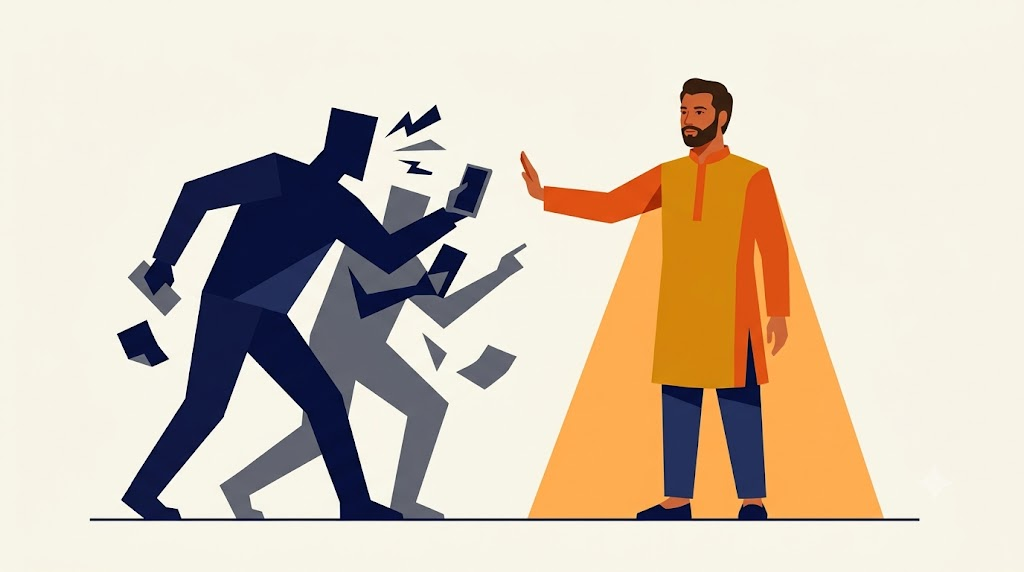
What it cannot do is treat you as a criminal. Asking for money you owe is recovery. Frightening you into paying is harassment. The line between the two is the whole subject of this guide.
Here is what normal recovery looks like.
A reminder call or SMS a few days after the due date.
A letter or email stating the overdue amount and charges.
A call from the collections team asking when you can pay.
A legal notice if the account stays unpaid for a long time.
Now the other side. These are not recovery.
Shouting, abusing, or using filthy language.
Calling at midnight or at dawn.
Calling your boss, neighbours, or relatives to shame you.
Threatening jail for a plain loan default.
Sending photos or messages that name you as a “fraud” in a group chat.
One more point matters here. Missing EMIs does not take away your rights. You are still a customer. You still have a right to be spoken to with basic respect. You also have a right to know the exact amount due and how it was calculated.
Many borrowers also ask who is actually calling. Collections can be done by the bank’s own staff or by an outside agency. In both cases, the bank or NBFC stays answerable. It cannot say “that was the agency, not us.” RBI’s 2022 circular says this clearly, and the next section covers it.
What the RBI Circular Says About Agents and Harassment
On 12 Aug 2022, RBI issued circular RBI/2022-23/108. Its subject is outsourcing of financial services and the conduct of recovery agents. The core message is simple. A bank or NBFC that hands recovery to an agent is still responsible for that agent.
In plain words, the circular says this.
The bank or NBFC must make sure its agents do not intimidate or harass you.
Agents must not use threats, abuse, or any method that violates your dignity.
Calls and visits must follow the bank’s own code of conduct.
Customer complaints about agents must be handled by the bank or NBFC.
This matters because many borrowers think the agent is a stranger with no link to the bank. That is wrong. The agent works for the bank or NBFC. If the agent crosses the line, the bank or NBFC owes you an answer.
Call timings. News reports of RBI’s rules say recovery calls should be made only between 8 AM and 7 PM. Treat this as the usual standard that banks have followed in their fair practice codes. If a call comes at 9 PM or 6 AM, note the time. That note will help you later.
Repeated calls. There is no published number of calls per day in the material we checked. So we do not quote one. If calls feel constant, count them for a week and save the log. A pattern of daily, repeated calls can itself be harassment.
Calling other people. A bank or NBFC may try to reach you through the contact numbers you gave. It should not use your family or colleagues as a pressure tool. Sharing your debt with them breaks your privacy and your dignity.
Home Visits: Rules, Timings and What the Agent Must Show
Banks and NBFCs can send someone to your home. This is legal. But a visit is not a free pass to shout at the door or camp outside.
Today’s position. Visits are expected to follow the same standard of conduct as calls. Reports mention the 8 AM to 7 PM window here too. The agent should be polite and should not enter your home without your permission. The agent should not threaten you or embarrass you in front of neighbours.
What is reported for 2027. RBI’s revised recovery directions are reported as issued on 6 Aug 2026 and effective from 1 Jan 2027. These details come from news and secondary sources, not from RBI’s own text, which we could not open. According to those reports:
Visits stay within 8 AM to 7 PM.
The bank or NBFC gives at least 1 day’s notice before a visit.
The agent carries an ID card, an authorisation letter, and the notice.
Agents must hold IIBF certification, with a one-year window for existing agents.
Please read this carefully. These points are reported, not confirmed, from RBI’s own paragraphs. Business Standard also says some entities and activities may be excluded, and the details are not clear yet. Until 1 Jan 2027, do not tell an agent “the 2027 rule says you cannot come.” Instead, ask them who they are and who sent them.
What to do when someone arrives.
Stay calm and stay at the door.
Ask for the agent’s name, ID, and the name of the bank or NBFC.
Ask for a written authorisation. If they have none, you can say you will talk only in writing.
Do not sign anything you have not read.
Write down the time, the name, and what was said.
If you feel unsafe, call the police helpline at 112.
You do not have to let anyone into your home. Speaking at the door is enough. If the agent refuses to leave or becomes abusive, that is a clear case for a complaint.
A visit to your office is a sensitive case. An agent who tells your colleagues about your loan has gone past recovery. Note it and add it to your complaint.
FREED Shield. If a recovery call turns abusive, or a visit does not follow the proper protocol, FREED Shield is there for you. It is open to everyone, even if you are not a FREED customer. FREED Shield is not legal representation. It helps you understand your rights, record what happened, and file your complaint through the right channels. The complaint itself is filed by you.

What the Law Says
RBI circular RBI/2022-23/108 (12 Aug 2022) makes banks and NBFCs responsible for the conduct of their recovery agents. Agents must not intimidate or harass you. Reports say the usual calling window is 8 AM to 7 PM. Criminal intimidation is also an offence under Section 351 of the Bharatiya Nyaya Sanhita (BNS), and a plain loan default is a civil matter.
Recovery agent rules, in plain wordsWhat Counts as Harassment and What Does Not
Many people feel every call is harassment. That feeling is real, but the law looks at conduct, not feelings. Here is a way to sort calls and visits into three groups.
Normal recovery
A polite call between 8 AM and 7 PM asking about payment.
A written reminder or legal notice.
A visit by an identified agent at a sensible hour.
Poor conduct; complain to the bank
Calls at odd hours.
Many calls in a day after you have already given a payment date.
A rude or sarcastic tone.
Refusing to give the agent’s name.
Harassment or worse; escalate quickly
Abuse, slurs, or threats to you or your family.
Calls to your boss, relatives, or neighbours to shame you.
Messages that call you a thief or fraud.
Threats of jail for a plain loan default.
Blocking your gate or staying outside for hours.
Taking your phone, ID, or belongings.
Any threat to harm you.
On threats of jail: a missed loan EMI is a civil matter. A bounced cheque is different. A bounced cheque EMI can trigger Section 138 of the NI Act, which allows a criminal complaint, up to 2 years' jail or a fine up to 2x the cheque amount. NACH/ECS bounces take a different legal path, but banks can still act. So an agent who says “jail” may be wrong, or may be pointing to a real cheque bounce. Ask which document they mean, and ask for it in writing.
Here is a simple test. Ask yourself whether the person would say the same thing to you if a camera were on. Honest recovery survives a camera. Harassment does not.
How to Keep Proof: Call Logs, Recordings and Notes
A complaint with proof moves fast. A complaint without proof gets a standard reply. You do not need fancy tools. You need a habit.
Build a simple file.
A screenshot of your call log showing numbers, dates, and times.
Saved SMS, WhatsApp, and email messages from the bank or NBFC.
A notebook entry for each call or visit: date, time, name, what was said.
The agent’s name, ID number, and agency, if they gave it.
Names of anyone who saw or heard the visit.
Recording calls. Many phones can record calls. Tell the person on the call that the call is being recorded, if you can. A recording of abuse is strong proof. Keep the original file safe and do not edit it.
Do not reply in anger. Even if you are furious, stay short and plain. A rude reply from you gives the agent something to quote. Say: “Please send this in writing to my email.”
Write one summary a week. At the end of the week, write three lines. How many calls came, which were out of hours, and which were abusive. This takes five minutes. It turns scattered anger into an organised case.
Ask for the right documents. You have the right to ask for the loan statement, the break-up of charges, and a copy of the loan agreement. Ask in writing, and keep the reply.
For people with several loans, one tidy folder per bank or NBFC avoids mix-ups. If you are managing many EMIs and the calls keep coming, FREED’s team can look at your full situation. Settlement is a last resort. If you are still paying every month and only struggling, the Debt Consolidation Program may suit you better. It merges eligible unsecured loans into one EMI and charges a success-based fee only when it is done.
How to Handle a Call or Visit Step by Step
Having a plan stops panic. Use these steps the next time the phone rings or the doorbell goes.
On a call
Ask: “May I know your name and which bank or NBFC you are calling from?”
Ask for the loan account and the exact amount due.
Stay polite. Say what you can do and by when.
If the tone turns abusive, say: “I will talk only in writing.” Then end the call.
Note the number, time, and words used.
At your door
Do not let the person in. Speak at the door.
Ask for ID and written authorisation.
Do not sign blank or unread papers.
Ask for the bank or NBFC’s reference for the visit.
If it becomes unsafe, call 112.
After either one
Write your notes within the hour.
Save screenshots and recordings.
If conduct was wrong, email the bank or NBFC’s grievance team the same day.
What not to do
Do not give out your OTP, PIN, or card details to a caller who says he is from the bank.
Do not take a fresh loan to repay a recovery call in panic.
Do not give family contacts as pressure points.
Do not ignore a legal notice. Read it and get it checked.
A legal notice is not a court order. It is a warning that action may follow. It needs a calm read and often a reply. FREED Shield’s in-house legal team can check whether a notice is genuine and tell you whether it needs a reply. This is pre-litigation support only. FREED cannot represent you once a case is filed in court.

FREED Expert Tip
Send every complaint by email, not just by phone. An email gives you a date, a time and a record. Put the bank’s reference number in the subject line, and ask for a written reply. Then use a recovery-agent complaint template to keep it short and factual.
Recovery agent complaint formatHow to Complain: Bank First, Then the RBI Ombudsman
Complaints work in order. You cannot jump straight to the RBI. The steps below follow the Reserve Bank – Integrated Ombudsman Scheme, 2026 (RB-IOS 2026), effective 1 Jul 2026.
Step 1: Write to the bank or NBFC. Use its grievance email or app. Describe what happened, with dates and proof. Ask for a written reply and keep the reference number.
Step 2: Wait 30 days. The bank or NBFC gets 30 days to reply. If it rejects your complaint or does not reply, you can go ahead.
Step 3: Go to the RBI Ombudsman. File within 90 days of the bank’s reply. Use the portal cms.rbi.org.in. Filing is free.
Step 4: Know the helpline. The helpline number printed in bank documents is 14448.
What you can get. Under RBI-IOS 2026, the Ombudsman can award compensation up to ₹30 lakh in a proper case. Most complaints about agent conduct will not reach that, but the limit shows the process has teeth.
What to attach.
Your call log and screenshots
Your notes and recordings
The bank or NBFC’s reply, or proof it did not reply
Your loan account number
Credit report errors. Recovery trouble often comes with credit report errors. Under the credit information direction (id=12764), you get one free full credit report each year. Bureaus have set windows of 21 and 30 days to fix errors, and compensation of ₹100 a day applies when they miss the time. If your report has a wrong default entry, raise it too.
A note on what FREED does. FREED does not file complaints for you. You file them. FREED Shield helps you understand your rights, document the events and prepare the complaint. Use it if calls become abusive or a visit breaks the rules.
Rights of a Borrower After a Missed EMI: What Stays and What Changes
After a default, a few things really do change. It helps to know them so nothing surprises you.
What changes
Late fees and extra interest can apply.
The bureau shows the delay, which lowers your score.
After 90 days of missed EMIs, the loan can be marked as bad by the bank (NPA).
The bank or NBFC can send a legal notice.
Credit cards and new loans become harder to get.
What does not change
You have the right to be treated with dignity.
You have the right to know the exact amount due.
You have the right to a written reply to your complaint.
You have the right to complain to the RBI Ombudsman.
You are not a criminal for a plain loan default.
Talk before you fall behind. If you can see trouble coming, talk to the bank or NBFC early. Ask about a change in the loan plan or a short pause (moratorium). Put the request in writing.
If you are still paying but stretched. Debt consolidation may combine eligible unsecured debts into a single loan with one monthly EMI. However, approval, repayment terms, and EMI reductions depend on the lender's assessment. A new loan application may temporarily affect your credit score, while timely repayments may help improve your credit profile over time. Talk to FREED’s team to see if you qualify. See the Debt Consolidation Program.
If you truly cannot repay. Settlement is not something a borrower chooses out of preference. It is for people whose repayment has become genuinely impossible. In cases of genuine repayment difficulty, a lender may consider a negotiated settlement for less than the total outstanding amount. Any reduction depends on the lender's approval and the borrower's circumstances. A settled account may be reported to credit bureaus and negatively affect future borrowing eligibility. The duration and impact of this reporting depend on applicable credit-information rules and bureau practices. FREED negotiates with banks, and no outcome is guaranteed. Talk to FREED’s team to see if this fits. See the Debt Resolution Program.
Rates and ranges shown are indicative. Final terms decided by the bank. FREED is not a Loan Provider. No outcome is guaranteed. Please verify directly with your bank.
Check your credit first. Before any step, see what your report shows. Credit Insights pulls your Experian report and gives a score, what hurts it, and clear steps to improve it. It is open to anyone.
Check Your Credit First
See your score, what is pulling it down, and what to fix first.
Check My CreditSourcing Table
Claim | Source |
|---|---|
Banks and NBFCs answer for their agents | RBI press release |
Circular RBI/2022-23/108 (12 Aug 2022) | RBI notification |
Revised recovery directions (reported, 2027) | RBI draft-directions press release |
RB-IOS 2026 steps, timelines, ₹30 lakh | RB-IOS 2026 PDF; portal cms.rbi.org.in |
Credit reporting rules, id=12764 | RBI direction |

Mohit Juneja
Mohit Juneja writes educational content at FREED on debt management, credit scores, loan repayment, and borrowing best practices. His content is shaped by expert insights and industry knowledge, helping readers better understand their financial options and make informed decisions.
mohit.juneja@freed.care

FREED is India's trusted loan management platform. Founded in 2020 and headquartered in Gurugram, FREED has counselled 20 lakh+ people on personal loans, credit cards, and app loans. FREED charges fees only on successful settlement, not upfront. FREED does not handle secured loans (home loans, car loans, gold loans).
Media Mentions