Debt Consolidation Loan ICICI, Explained in Plain Language
A debt consolidation loan from ICICI, in plain terms, is a personal loan you use to pay off several smaller debts (credit cards, personal loans, or both) so you're left with one EMI instead of several. ICICI does not sell a product literally called a "consolidation loan." You apply for a regular personal loan and use it that way yourself.
Mohit Juneja
Reviewed by FREED India, Debt Resolution Specialists
 4.7/5
 ₹3,200Cr+
 20,000+
 20,00,000+4.7/5₹3,200Cr+20,000+20,00,000+
KEY TAKEAWAYS

ICICI has no product literally called a "debt consolidation loan." What people mean is using an ICICI personal loan to pay off multiple existing debts at once.
Getting one typically requires a healthy credit score and a steady, verifiable income. ICICI checks both closely before approving a large personal loan.
It simplifies your payments into one EMI, but it does not shrink how much you owe. The total debt is the same; only the structure changes.
If ICICI turns you down or the numbers don't work in your favour, other paths exist, including working with a platform that matches you to a lender or, in genuine hardship cases, loan settlement.
What This Actually Means, in One Simple Example
Say you're paying three things every month: a credit card bill of ₹8,000, a personal loan EMI of ₹6,500, and another small loan EMI of ₹4,000. That's ₹18,500 going out every month, on three different dates, to three different lenders. Miss one due date because your salary got credited a day late, and you're already looking at a late fee plus a ding on your credit report.
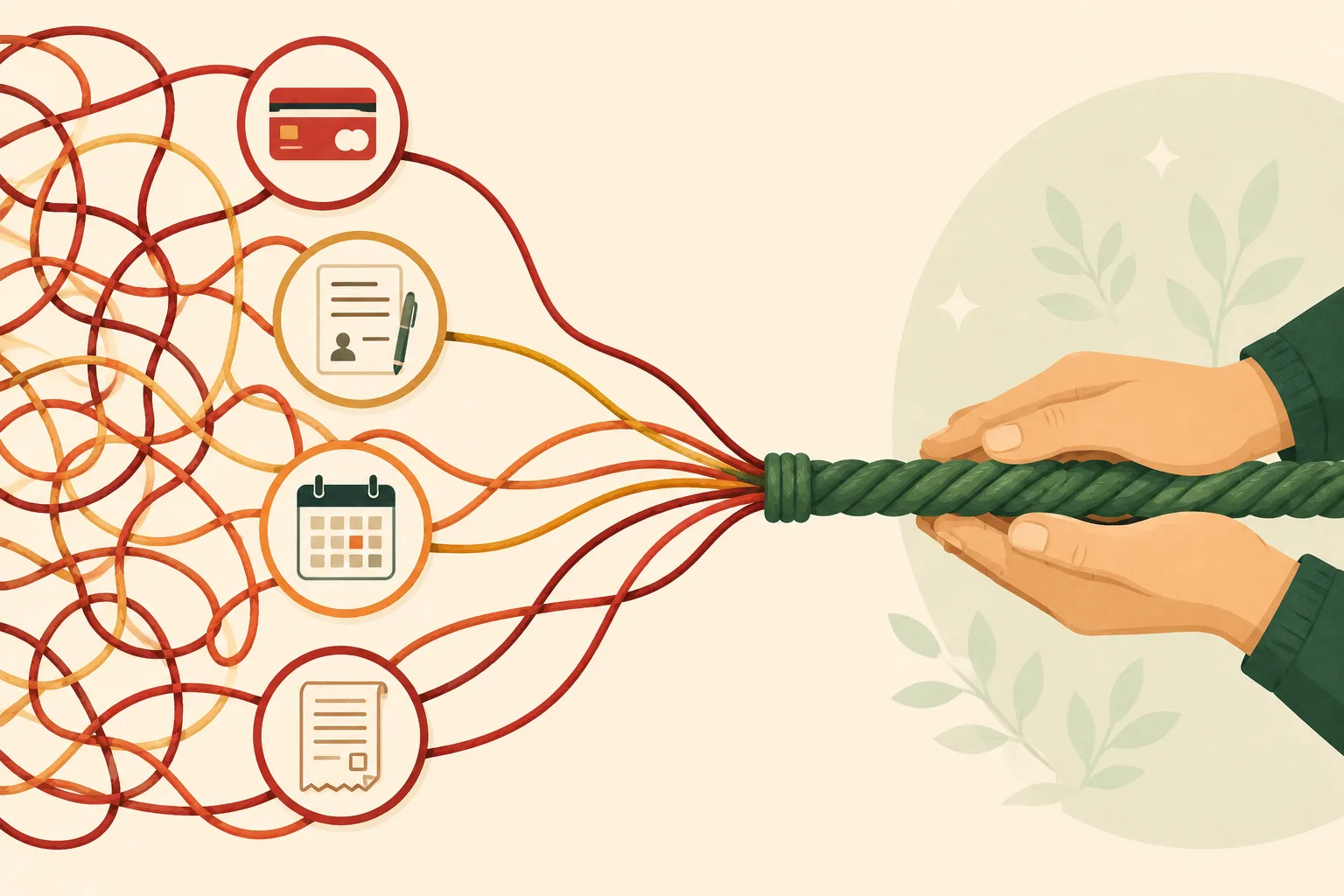
A debt consolidation loan replaces all three with one new loan. You borrow enough to pay off the credit card and both existing loans in full, immediately. From that point on, you owe only ICICI (or whichever bank approved the new loan), on one EMI, on one date each month. If the new loan comes with a longer tenure or a better rate than what you were paying combined, your monthly EMI can come out lower than the ₹18,500 you were juggling before.
What doesn't change is the ₹18,500-ish worth of debt itself. You're not getting a discount on what you owe. You're restructuring how you pay it back, into one predictable line item instead of three.

Freed Expert Tip
Before applying anywhere, add up every EMI and card minimum due you're currently paying each month. If your existing EMIs and card obligations already take up a large share of your take-home income, review your repayment capacity carefully before taking on a new loan.
Get a Free AssessmentWhy It's Not Actually Called "Consolidation Loan" at ICICI
This trips a lot of people up. You search "ICICI debt consolidation loan" expecting a dedicated product page, and instead you land on ICICI's regular personal loan page. That's not a mistake on your end. ICICI appears to offer consolidation through its regular personal-loan framework rather than as a separately named debt-consolidation product. Borrowers should confirm the current product structure directly with the bank before applying.
Here's why. A personal loan is already flexible by design. The bank doesn't ask what you'll do with the money once it's disbursed to your account, whether that's a wedding expense, a medical bill, or paying off your existing credit card and loan balances. So instead of building and marketing a separate "consolidation loan" product, ICICI (and most other banks) let the existing personal loan do that job. The consolidation happens on your end, after disbursement, when you use the funds to close out your other debts.
This matters practically in two ways. First, when you apply, you'll fill out ICICI's standard personal loan form, not a special consolidation application. Second, ICICI will evaluate you the same way it evaluates any personal loan applicant, on your income, your credit score, and your existing obligations, not on any consolidation-specific criteria. If a website or agent tells you ICICI has a distinct "consolidation loan scheme" with separate eligibility rules, that's worth double-checking directly with the bank before you proceed.
Some readers manage this themselves once they understand the mechanics involved. Others prefer having someone assess their full loan list first and confirm which existing debts even qualify to be paid off this way, since credit card dues, personal loans, and BNPL balances usually qualify, while secured loans like a car loan or home loan don't.
Who Typically Qualifies, in Plain Terms
Because ICICI is evaluating you through its standard personal loan process, the checks are the same ones any personal loan applicant goes through. In plain terms, three things carry the most weight.
Your credit score. ICICI wants to see a track record of on-time repayment. A history of missed payments or existing defaults makes approval harder, since the bank is essentially being asked to take on more exposure to help you consolidate what you already owe.
Your income and its stability. A salaried applicant with a consistent monthly credit and a clear salary slip has an easier time than someone with irregular or undocumented income. ICICI will also look at how much of that income is already committed to existing EMIs, since a large new loan on top of a stretched budget doesn't make sense for either side.
Your existing debt load relative to income. Even with a good score, if your current EMIs already eat up a large share of your salary, the bank may offer a smaller loan amount than you need, or decline outright. This is the exact scenario a consolidation loan is meant to fix, which creates a real catch: you often need to look financially comfortable to qualify for the loan that would make you more comfortable.
If you want the fuller mechanics, including documentation requirements and how the approval timeline usually plays out, FREED's detailed breakdown of how ICICI's debt consolidation route works walks through the process step by step.
Factor | What ICICI Typically Looks For | Why It Matters |
Credit score | Consistent on-time repayment history | Signals lower repayment risk |
Income | Stable, verifiable, salaried or documented self-employed | Confirms repayment capacity |
Existing EMI load | Room left in your monthly budget after current obligations | Prevents over-lending on top of existing strain |
A reader with a strong score but a high existing EMI load is a common, frustrating middle ground. If that's your situation, it's worth getting an outside assessment before applying anywhere, so you're not spending a hard credit inquiry on a loan you're unlikely to get approved for at the amount you actually need.
What This Doesn't Fix, in Plain Terms
It's worth being direct about this, because a lot of what gets written about consolidation online skips it. A consolidation loan does not reduce your total debt. If you owed ₹18.5 lakh across three accounts, you'll owe roughly the same amount (plus whatever processing fee ICICI charges) to one account after consolidating. The number on your ledger doesn't shrink just because it's now in one place.
What it fixes is structure, not size. You go from multiple due dates to one, from multiple lenders to one point of contact, and often from a higher blended interest rate to a single, potentially lower rate depending on your profile. For someone who's currently managing their debt fine but finds the juggling stressful and error-prone, that's a genuinely useful fix.
It also doesn't fix a spending pattern. If the reason you're carrying three debts is that expenses have consistently outpaced income, consolidating without addressing that gap usually just means you're back to multiple debts again in a year or two, except now with a consolidation loan added to the pile. This isn't said to be discouraging. It's said because the people who get the most out of consolidation are the ones who use the breathing room it creates to actually stay ahead of new EMIs, not to take on new spending.
And it doesn't help if you're already behind on payments. ICICI's consolidation route, like any personal loan, is built for people who are current on their obligations, not for people who have already missed several EMIs or received a notice. If that's closer to your situation, a different path applies, covered next.

See If You Qualify for a Lower EMI
Get a free assessment of your loans and find out if consolidation could bring your monthly outgo down.
Check My EligibilityWhat to Do If This Specific Option Doesn't Work Out
If ICICI doesn't approve the loan, or the amount offered doesn't cover what you actually need, you still have real options. The first is straightforward: apply through a different bank or a platform that can match you against multiple lenders at once, since eligibility criteria and the amount offered vary from one institution to another. FREED's Debt Consolidation Program does this by assessing your full financial profile and matching you to a lending partner suited to it, rather than you applying individually, bank by bank, and collecting rejections along the way.
But there's a second, harder scenario worth naming honestly. If your EMIs are already stretched past what your income can realistically support, consolidation, at ICICI or anywhere else, may not be the right fix at all, because it's still a loan you have to repay in full. Settlement is not something a borrower chooses out of preference. Banks and financial companies only consider it when you are in genuine financial difficulty and are truly unable to repay the full amount.
If that describes your situation more than "I want simpler payments," loan settlement works differently. Instead of taking on a new loan, you save toward a lump sum over time, and FREED negotiates with your existing lenders to accept a reduced amount as full and final payment, typically bringing down what you owe by up to 50%. Settlement can be reported as ‘Settled’ on your credit report and may affect future borrowing. The duration and impact depend on the credit bureau’s reporting practices and your subsequent credit history. Consolidation and settlement are not two versions of the same solution. One is for people still able to repay on a smarter structure. The other is for people who genuinely can't.
*Rates and ranges shown are indicative. Final terms decided by the bank. FREED is not a Loan Provider. No outcome is guaranteed. Please verify directly with your bank.
How FREED Helps if Your ICICI Application Doesn't Work Out or You're Not Sure Where You Stand
If you're unsure whether you'd qualify with ICICI, or you've applied and the numbers didn't work, FREED starts by looking at your complete financial picture: every loan, every card, your income, and what's actually left over each month. From there, FREED matches you to a lending partner from its own network suited to your specific profile, rather than leaving you to apply bank by bank and hope one comes through.
If a new loan turns out to be the wrong fit given how stretched your repayment capacity already is, FREED can also walk you through what loan settlement would look like instead, including what it does to your credit report and what it doesn't. There's no pressure either way. The point of the conversation is figuring out which option, if any, actually matches where you are right now.
This works the same way whether you've never applied for a consolidation loan yet or you've already been turned down once. A rejection from one bank doesn't mean you're out of options; it usually just means that specific product, at that specific bank, wasn't the right match for your file.
Not Sure If Consolidation Is Right for You?
Talk to FREED's team for a free, no-obligation assessment of your loans and options.
Book My Free CallSimple Tips Before You Decide
A few practical checks before you sign anything, whether with ICICI or any other lender.
Compare the total cost, not just the EMI. A lower monthly EMI can come from a longer tenure, which sometimes means paying more total interest over the life of the loan. Ask for the total repayment amount, not just the monthly figure, before deciding.
Confirm which debts are actually being paid off. Get written confirmation from ICICI (or whichever bank) on exactly which existing loans and cards the disbursed amount will close, and get closure confirmation from your old lenders once it happens. Don't assume it's automatic.
Check the processing fee and any prepayment charges. These get overlooked when someone's focused on the EMI reduction. A processing fee is usually deducted upfront from your disbursed amount, so the money that actually reaches your old lenders is slightly less than the loan amount you agreed to.
Don't close the gap and then reopen it. Once your cards and old loans are paid off, resist using the freed-up credit limit to spend again. This is the single most common way consolidation stops working within a year.

What the Law Says
Under RBI's Key Fact Statement (KFS) rules for retail and personal loans, banks and lenders must disclose the annual percentage rate, all fees, and the total repayment amount in a standard format before you sign. Ask ICICI for this document before agreeing to anything; it's your right to see it.
Learn About Your Borrower RightsSources
Claim in Blog | Source |
Banks must disclose APR, fees, and total repayment via a Key Fact Statement (KFS) before loan sign-off | RBI Master Direction / Digital Lending Guidelines requiring KFS disclosure |
"Settled" status remains on a CIBIL report for up to 7 years | Standard credit bureau reporting convention widely referenced in Indian financial media |

Mohit Juneja
Mohit Juneja writes educational content at FREED on debt management, credit scores, loan repayment, and borrowing best practices. His content is shaped by expert insights and industry knowledge, helping readers better understand their financial options and make informed decisions.
mohit.juneja@freed.care

FREED is India's trusted loan management platform. Founded in 2020 and headquartered in Gurugram, FREED has counselled 20 lakh+ people on personal loans, credit cards, and app loans. FREED charges fees only on successful settlement, not upfront. FREED does not handle secured loans (home loans, car loans, gold loans).
Media Mentions