How to Apply for Debt Consolidation: A Step-by-Step Guide
Loan-based debt consolidation generally involves applying for a new loan intended to repay eligible existing debts. The application may be submitted directly to a bank or NBFC or through a program that connects eligible applicants with a lending partner. This guide covers that application step itself: what it asks for, what to have ready, and what happens after you submit.

Mohit Juneja
Reviewed by FREED India, Debt Resolution Specialists
 4.7/5
4.7/5 ₹3,200Cr+
 20,000+
 20,00,000+4.7/5₹3,200Cr+20,000+20,00,000+
KEY TAKEAWAYS

A loan-based consolidation application often requires documents such as income proof, KYC documents, bank statements, and details of existing debts. The exact requirements vary by lender and applicant profile.
Most lenders or programs run a soft eligibility check first, which doesn't affect your credit score, before you submit the full application, which does trigger a hard inquiry.
Having your existing debt list ready before you start, lender, balance, account number, saves the most time during the actual application.
If an application is declined, that's specific, useful information, not a dead end. The next section covers exactly what to do with it.
What a Debt Consolidation Application Actually Is
Applying for consolidation means applying for a new personal loan, sized and intended specifically to pay off your existing unsecured debts. The application mechanics are the same as any personal loan application. What's different is the purpose and the list of debts you'll need to provide.
This can take one of two paths. You can apply directly with a bank or NBFC yourself. Or you can apply through a consolidation program that matches you to a partner lender based on your profile, so you're not approaching each bank one at a time.
This piece covers the application step itself: filling out forms, gathering documents, tracking status. The fuller end-to-end journey, eligibility criteria in depth, disbursement, closing old accounts, is covered separately in our complete guide to consolidating your loans.

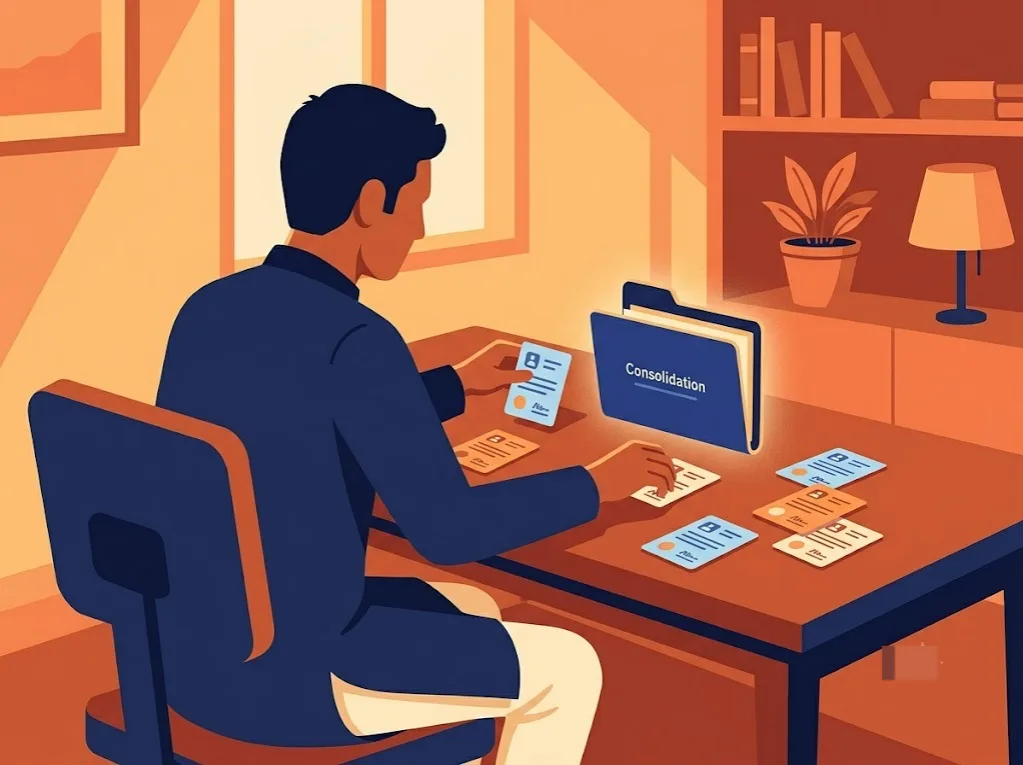
Before you open any application form, have your existing debt list ready.
This is the single biggest time-saver at this specific step.
Talk to FREED's TeamBefore You Start: What to Have Ready
Having every item on this list ready before you open the form is what actually decides whether the application takes ten minutes or several days of back and forth.
Your existing debt list. Every unsecured debt you want consolidated: lender name, account number, current outstanding balance, and interest rate.
Income proof. Depending on your employment status and the lender's requirements, you may need recent salary slips, income-tax returns, bank statements, Form 16, or business and income records.
KYC documents. PAN and Aadhaar, or another accepted identity and address proof.
Bank statements. Usually the last 3 to 6 months, showing your actual income and your existing EMI debits.
Employment or business details. Your current employer and how long you've worked there, or your business registration details if you're self-employed.
Pull all five together before you start the form. If you want a quick read on how stretched your EMIs actually are before you apply, FREED's EMI Score gives you that in a couple of minutes, free. Missing or incomplete documents can cause delays and may lead to additional follow-up requests.
The Soft Check vs the Full Application
Most lenders and programs actually run this in two stages, and knowing the difference saves you a real headache.
Stage one is a soft eligibility check. You give basic details, an income range, your total existing debt, and see an indicative offer. Where the provider uses a soft inquiry, it generally does not affect the credit score in the same way as a hard inquiry. Confirm the type of inquiry and the provider's disclosure before proceeding.
Stage two is the real application. Once you decide to move ahead based on that indicative offer, the full application, with complete documentation, triggers an actual hard credit inquiry. A hard inquiry may affect your credit score, depending on the scoring model and your overall credit profile. Multiple applications within a short period may also affect your credit profile. If you want to understand exactly how that kind of inquiry shows up on your report, see what happens when you're reported to a credit bureau.
Use the soft check stage to compare more than one option before you commit to a full application anywhere. Comparing available options before submitting multiple full applications may help you avoid unnecessary credit inquiries. Check each provider's inquiry process before giving consent.

Filling Out the Application, Step by Step
Enter your personal and employment details. Match these exactly to your documents. Small mismatches here (a slightly different employer name, a different spelling) are a common reason for delay.
Enter your existing debt list. This is where having it prepared in advance pays off directly. You're just transcribing what you already gathered.
Upload your documents in the format requested. Usually PDF or a clear photo scan. Blurry or partial uploads are the most common reason for a follow-up request.
Review the requested loan amount against your actual combined outstanding debt. A mismatch here can mean the disbursed amount doesn't fully cover what you intended to consolidate.
Submit, and note your application reference number. Keep it somewhere you can find it quickly.
What to Expect After You Submit
Initial responses may be provided within a few business days by some lenders, but timelines vary. Verification requirements, incomplete documents, and additional checks may extend the process. Don't assume same-day approval is standard, even if you've heard of it happening for someone else.
You may get contacted for additional documents or clarification. Respond promptly. This is normal and doesn't mean anything is wrong with your application.

Track your status using the reference number you were given, rather than assuming silence means either approval or rejection. Once approved, disbursement and the old-debt payoff process begins.
What to Do If Your Application Is Declined
A decline is specific, useful information, not a dead end. Ask directly for the reason. Ask whether the lender can provide a reason or general category for the decline. Possible factors may include income, existing debt obligations, credit history, eligibility criteria, or internal underwriting requirements.
If it was a credit profile issue, check your report for an error before assuming the decline was accurate. Mistakes on credit reports happen more often than people expect. FREED's Credit Insights pulls your Experian report along with what's actually affecting your score, so you can see for yourself before you reapply anywhere.
If it was genuinely about your current debt-to-income ratio, that's worth addressing before reapplying elsewhere, rather than trying a different lender immediately with the same numbers. The math that got you declined once will likely get you declined again.
Space out reapplications rather than applying to several lenders in quick succession after a decline. Each one is a fresh hard inquiry, and several close together can pull your score down further.
What Are Your Options
If a direct application with a bank or NBFC was declined, a consolidation program that matches you to a partner lender based on your specific profile may have different eligibility criteria worth trying. This isn't the same lender saying no twice.
For genuine, sustained inability to repay even a consolidated amount, settlement is the separate, structured last resort. Settlement is not something a borrower chooses out of preference. Banks only consider it when someone is in genuine financial difficulty and is truly unable to repay in full. Our guide to the settlement letter format covers what that process actually involves.
How FREED Helps With the Application Itself
FREED's Debt Consolidation Program handles the matching and application process directly. Reviewing documents and debt details before submission may help reduce avoidable errors and additional document requests.
No specific approval odds or timeline can be guaranteed. But a second set of eyes checking your document set before it goes anywhere catches the small mismatches, an employer name, a rounding error on a balance, that otherwise turn into follow-up requests days later.
Tips for a Smooth Application
Prepare your full document set before starting, not after being asked for each item one at a time. It's the single biggest difference between a fast application and a slow one.
Double-check every figure against your actual statements before submitting. A typo in an outstanding balance is an easy, avoidable delay.
Use the soft-check stage to compare options before committing to a full, hard-inquiry application anywhere. It costs you nothing to look first.
If declined, ask for the specific reason before reapplying anywhere else. That one piece of information tells you what to fix before you try again.

Mohit Juneja
Mohit Juneja writes educational content at FREED on debt management, credit scores, loan repayment, and borrowing best practices. His content is shaped by expert insights and industry knowledge, helping readers better understand their financial options and make informed decisions.
mohit.juneja@freed.care

FREED is India's trusted loan management platform. Founded in 2020 and headquartered in Gurugram, FREED has counselled 20 lakh+ people on personal loans, credit cards, and app loans. FREED charges fees only on successful settlement, not upfront. FREED does not handle secured loans (home loans, car loans, gold loans).
Media Mentions