Floating Interest Rate Calculation: Formula & Example
Floating interest rate calculation means your loan's interest rate is recalculated whenever your lender's benchmark rate, usually the RBI repo rate, changes. The formula is simple: your rate = benchmark rate + spread (a fixed margin your bank adds and keeps constant).

Mohit Juneja
Reviewed by FREED India, Debt Resolution Specialists
 4.7/5
4.7/5 ₹3,200Cr+
 20,000+
 20,00,000+4.7/5₹3,200Cr+20,000+20,00,000+
KEY TAKEAWAYS

Floating interest rate calculation ties your loan's rate to an external benchmark, usually the repo rate, plus a fixed spread set by your bank.
Banks must reset externally linked floating rates at least once every three months for most retail loans.
A 0.5% rate hike on a ₹30 lakh, 20-year home loan adds roughly ₹950 to ₹1,000 to the monthly EMI if the tenure stays fixed.
The same hike instead extends the tenure by roughly 27 months if your bank keeps the EMI unchanged, which is the more common default.
What Is Floating Interest Rate Calculation?
A floating rate has two parts. The first is the benchmark rate, which moves with the market and RBI policy. The second is the spread, a margin your bank sets at loan sanction.
For most retail loans today, the benchmark used is the repo rate, the rate at which the RBI lends to banks. Since RBI moved lenders to external benchmarking, the repo rate has become the default reference point for home loans, auto loans, and several other retail products.
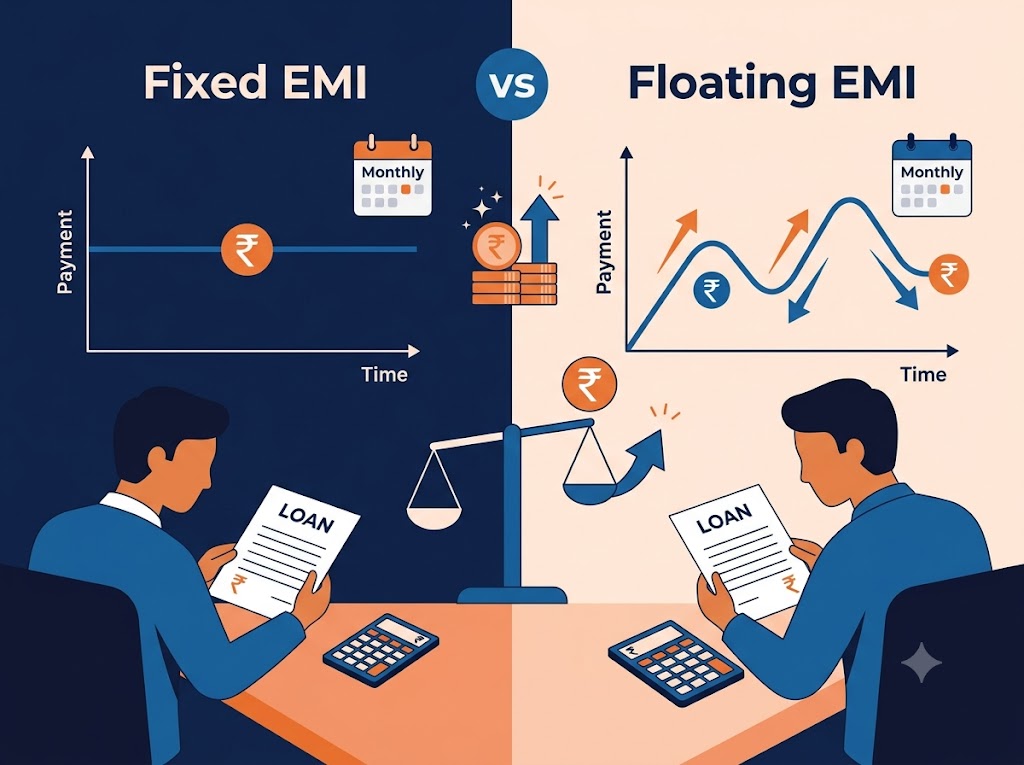
This is different from a fixed-rate loan, where the rate you sign up for never moves regardless of what happens in the market afterward. With a floating loan, only the benchmark portion moves. Your bank's spread stays put.
That raises an obvious question. If your bank doesn't control the benchmark, what actually makes your rate move, and who decides when?

Not Sure How Your Loan's Rate Works?
Talk to a FREED counsellor for a free, no-obligation walkthrough of your loan terms.
Start My Free AssessmentWhy Does Your Floating Rate Change in the First Place?
The benchmark rate, usually the repo rate, is set by the RBI's Monetary Policy Committee based on inflation and growth conditions. Your bank has no say in this number. It simply receives it.
When the RBI changes the repo rate, banks with externally benchmarked loans are required to pass that change through. They can't absorb it quietly or delay it indefinitely. RBI made external benchmarking mandatory for new floating-rate retail and MSME loans, including housing and auto loans, from October 2019, specifically so this pass-through would be consistent across lenders.
The part your bank does control is the spread. That portion is fixed at the sanction and typically stays the same for as long as the loan runs. Only the benchmark component moves after that.
None of this is something you did. It's a market mechanism working exactly as designed, tied to how your loan's interest rate is structured from the start. The next question is simply how you'd know when it has actually happened to your loan.
How Do You Know Your Floating Rate Has Changed?
A few checks tell you where your loan actually stands right now.
- Check your latest loan statement. Compare the current applicable rate against what you started with at sanction. The gap tells you how much the benchmark has moved since then.
- Read the SMS or email your bank sends at reset. Most banks notify you when the recalculation happens. Don't ignore these messages even if they look routine.
- Check your bank's published benchmark rate page. This is public information, updated whenever the RBI moves the repo rate, and it's the fastest way to confirm what your bank is currently referencing.
- Know your reset date. It's specified in your loan agreement and tells you exactly when the next recalculation is due, so you're not caught off guard.
- Watch your EMI itself. If it has stayed the same for a while despite a known repo rate change, your tenure likely absorbed the difference instead. Worth confirming directly with your bank.

The Floating Interest Rate Formula, With a Worked Example
The formula itself is simple:
Applicable Rate = Benchmark Rate + Spread
Once you have that rate, your EMI uses the same standard formula every loan uses: EMI = P × r × (1+r)^n / ((1+r)^n - 1), where P is your loan amount, r is the monthly interest rate, and n is the number of months. If you want that formula broken down from scratch, how banks calculate your EMI covers it in full. Here, it's just the tool we're plugging numbers into.
Worked example
Loan amount: ₹30,00,000. Original rate: 8.5% per year. Tenure: 240 months (20 years).
Starting EMI: approximately ₹26,035 per month.
Rate rises by 0.5%, to 9.0%, tenure held fixed:
New EMI: approximately ₹26,992 per month, an increase of about ₹957.
Same rate rise, EMI held fixed instead at ₹26,035:
Tenure extends to approximately 267 months, about 22.3 years, an increase of roughly 27 months.
This is one illustrative scenario. Actual figures on your loan will vary by amount, tenure, and lender. But the mechanics scale the same way regardless of loan size. So, what actually happens next does your bank raises the EMI or stretches the tenure.
Floating vs Fixed: How the Calculation Actually Differs
Feature | Floating Rate | Fixed Rate |
Rate changes over tenure | Yes, tied to benchmark + spread | No, locked at sanction |
Starting rate | Usually lower | Usually higher |
Prepayment penalty | Typically, none for individual borrowers | Often applies |
Recalculation trigger | Benchmark rate change, e.g., repo rate | None, the rate is fixed |
What changes on reset | EMI, tenure, or both, depending on the applicable loan terms | Nothing |
The figures above are general market patterns. Actual terms vary by lender and loan agreement.
Neither is inherently better. Floating usually starts cheaper but carries rate risk. Fixed costs more upfront in exchange for predictability. For the fuller category comparison, the fixed EMI stays the same for the entire tenure, walking through when each type actually makes sense.

Freed Expert Tip
Recalculate your EMI yourself the moment the RBI changes the repo rate. Don't wait for your bank's notice; it can take a few weeks to arrive.
Estimate Your New EMIWhat Are Your Options When a Rate Hike Pushes Your EMI Up?
A rate hike doesn't leave you without options. Three real levers are usually available.
- Ask your bank to extend the tenure instead of raising your EMI. If your loan agreement allows it and you'd rather keep your monthly outgoings stable, this is the first thing to raise with your lender.
- Make a lump-sum prepayment to offset the increase. Most floating-rate loans allow this without a heavy penalty, unlike fixed-rate loans, which makes it a genuinely usable option when you have some spare cash.
- Check whether a balance transfer makes sense. If your current spread is no longer competitive against what other lenders are offering, a balance transfer to a lower-spread lender can bring your rate back down.
These three levers work well when the hike is hitting one loan. They work less well for one specific reader: someone whose EMI increase on this loan is now colliding with several other EMIs they're already juggling. That's a different problem, and it needs a different answer.

If the Rate Hike Broke Your Budget Across Multiple Loans
A single rate hike on one loan is manageable for most people. The real problem shows up when it lands on top of several other EMIs that were already stretching your income thin.
This is where FREED's Loan Consolidation Plan (LCP) fits, also known as the Debt Consolidation Program (DCP), or "Reduce My EMI" in the FREED app. FREED assesses your existing loans and matches you to a lending partner from its network for one new consolidated loan that pays off the others. What you're left with may be one lower EMI instead of several, depending on the new loan terms.
The EMI amount comes down, and your CIBIL score doesn't take a hit the way it would with settlement; it tends to improve instead. This program is built for borrowers who are still current on their payments but stretched thin, not for those who've already defaulted.
If your EMIs are the actual pressure point, it's worth understanding what it takes to reduce your EMIs this way, separate from any one loan's rate reset.
Are You in a Loan Trap? Quick Check
Move the slider to your total EMIs as a % of monthly salary. See your debt stress level instantly.
EMIs as % of Monthly Salary
What to Do the Next Time Your Rate Resets
A few habits keep the next reset from catching you off guard.
- Mark your reset date on a calendar. Don't let your bank's notice be the only signal you're relying on.
- Recalculate your own EMI whenever the repo rate moves. Use the formula from the worked example above so you already know roughly what's coming before your bank confirms it.
- Decide your preference in advance. Tenure extension or EMI increase, whichever you'd rather have, and tell your bank that preference if your agreement gives you a choice.
- Get ahead of it if you're already juggling multiple loans. Don't wait for the hike to hit before you start thinking about consolidation.
Staying on top of resets is easier once you understand RBI's rules for lenders around disclosure and timing. None of this requires guesswork once you know what to watch for.

Mohit Juneja
Mohit Juneja writes educational content at FREED on debt management, credit scores, loan repayment, and borrowing best practices. His content is shaped by expert insights and industry knowledge, helping readers better understand their financial options and make informed decisions.
mohit.juneja@freed.care

FREED is India's trusted loan management platform. Founded in 2020 and headquartered in Gurugram, FREED has counselled 20 lakh+ people on personal loans, credit cards, and app loans. FREED charges fees only on successful settlement, not upfront. FREED does not handle secured loans (home loans, car loans, gold loans).
Media Mentions