Debt Management Services: What They Do (and Don't)
Debt management services help borrowers organise and repay existing debts through a structured plan. Depending on the provider and arrangement, this may involve negotiating repayment terms, managing multiple accounts or consolidating payments into a simpler repayment structure. They organise and reduce the cost of repayment, they don't erase your principal or guarantee an improved credit score overnight.

Mohit Juneja
Reviewed by FREED India, Debt Resolution Specialists
 4.7/5
4.7/5 ₹3,200Cr+
 20,000+
 20,00,000+4.7/5₹3,200Cr+20,000+20,00,000+
KEY TAKEAWAYS

Some debt management arrangements may consolidate or simplify multiple repayments and may involve negotiating repayment terms with lenders. They don't reduce what you owe.
The timeline depends on the total debt, repayment capacity, interest rates and terms agreed with lenders. A debt management arrangement may run for several years.
FREED's debt management services don't cover secured loans like home, car, or gold loans.
If repayment in full genuinely isn't possible, that's a settlement conversation, not a debt management one.
A settled account can remain visible on your credit report and may affect future credit assessments
What Are Debt Management Services?
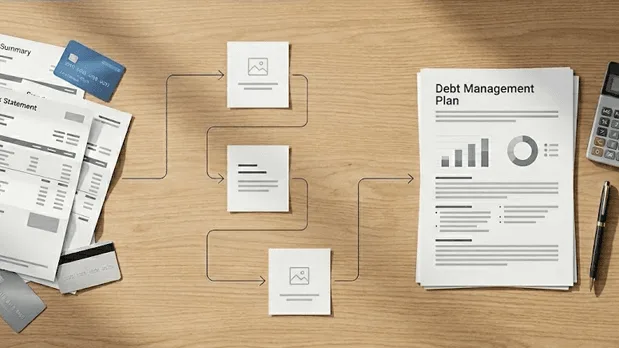
A debt management service reviews everything you owe across multiple loans and cards, then builds a structured repayment plan around it, typically consolidating several EMIs into one, and negotiating lower interest rates directly with your lenders on your behalf.
A debt-management service is not necessarily a new loan. However, some debt-consolidation products work by taking a new loan to repay existing debts, so borrowers should understand exactly which structure a provider is offering. It's a restructuring of what already exists, aimed at making repayment more manageable, not adding to it.
FREED already has a full, dedicated explainer on what debt management actually is, covering the complete mechanics in depth, worth reading if you want the full walkthrough. This piece stays deliberately narrower, focused on a different, more practical question: given what these services genuinely do, what do they actually deliver, and just as importantly, where do their limits sit?

What Do Debt Management Services Actually Do?
- Review the full picture, every loan, card, and EMI, alongside your income and expenses. This isn't a partial audit focused on whichever debt feels most urgent right now, it's a complete inventory, since a plan built on incomplete information tends to fall apart within a few months.
- Negotiate with lenders where possible for more manageable repayment terms, which may include interest-rate or fee adjustments depending on the lender. This is one of the genuinely valuable things a structured service can do that's hard to replicate on your own, banks are often more willing to adjust terms for an organised, professionally presented case than for an individual call.
- Consolidate multiple monthly payments into one fixed amount. A consolidation arrangement may combine multiple repayments into a single scheduled payment, depending on the structure of the program.
- Build a realistic, time-bound repayment schedule, typically running 3 to 5 years. This isn't an open-ended arrangement, it has a defined endpoint you're working toward, calculated against your actual income rather than an arbitrary target.
- Provide ongoing budgeting guidance so the plan stays on track. A plan that looks good on paper in month one needs active management to actually survive month twenty-four, especially if income or expenses shift along the way.
Each of these is a real, concrete service, worth understanding clearly before assuming a debt management plan does more, or less, than it actually does.
What Debt Management Services Don't Do
Just as important as what these services deliver is what they explicitly don't, since a few persistent misconceptions cause real confusion here.
- They don't reduce the principal you owe. A debt management plan repays the full amount, just on better, more manageable terms. Reducing what's actually owed is a different service entirely, settlement, with its own process, its own terms, and its own consequences.
- They don't cover secured loans. Home loans, car loans, and gold loans follow a separate, collateral-based process, since the lender has different recovery options available to it when an asset backs the loan.
- They don't lend money or act as a new credit line. Nothing about this service adds to your borrowing, it restructures what already exists.
- They don't guarantee loan approval elsewhere, or an instant CIBIL score jump. Following a repayment plan consistently can help you avoid further missed payments, but the effect on your credit profile depends on how the underlying accounts are reported and repaid.
- They don't replace legal advice if legal action has already started. Once a matter has moved into a formal legal process, that's a different track requiring its own specific expertise.
FREED is upfront about every one of these limits before ever recommending its own Debt Consolidation Program, since a service that overstates what it can do sets a borrower up for disappointment down the line, not genuine help.


FREED Expert Tip
If a "debt management" service offers to cut your principal, ask them to put that in writing. What they're actually describing is settlement, a different service with different terms.
Reduce My EMIDebt Management vs Debt Settlement vs Debt Consolidation, Which Is Which?
Comparison Table: Debt Management vs Settlement vs Consolidation
Purpose | Debt Management (DMP) | Debt Settlement | Debt Consolidation |
What it does | Repays debt in full on restructured terms | Closes debt for less than owed | Merges multiple loans into one lower EMI |
Reduces what you owe? | No | Yes | No |
Best for | Still able to repay in full with better terms | Genuinely unable to repay in full | Still paying, but managing multiple loans |
None of these three is universally "better" than the others, that framing genuinely misses the point. Fit depends entirely on your actual situation, specifically whether full repayment is realistically achievable given better terms, or genuinely isn't, regardless of how the terms improve. FREED's own comparison of debt settlement and debt management walks through this same distinction from a different angle, worth cross-referencing if you want a second pass at the same question.
FREED's Debt Consolidation Program corresponds to the debt-consolidation approach described in the third column, while its Debt Resolution Program is designed for borrowers considering the settlement route.
Rates and ranges shown are indicative. Final terms decided by the bank. FREED is not a Loan Provider. No outcome is guaranteed. Please verify directly with your bank.

What the Law Says
RBI's framework requires regulated entities to have a Board-approved policy governing compromise settlements. Any settlement arrangement with a regulated lender should therefore be understood in the context of the lender's applicable policy and regulatory requirements.
Settle My LoansHow Do You Know If a Debt Management Service Is Right for You?
One question actually decides this, worth asking directly rather than working through an extended checklist: can the full amount realistically be repaid, given a restructured schedule and lower interest rates?
If the answer is yes, and multiple loans are simply making that hard to track and manage on your own, debt management or consolidation is the right fit. The debt itself isn't the fundamental problem, the number of moving pieces is, and that's exactly what a structured plan is built to solve.
If the answer is genuinely no, if income can't stretch to cover full repayment even once terms improve, settlement is the more relevant conversation instead, not debt management stretched past what the actual numbers support. Pushing a debt management plan onto a situation where full repayment isn't realistic just delays an honest conversation, it doesn't resolve anything.
This section deliberately doesn't repeat the general checklist of red flags to watch for when choosing a provider, that ground is already covered properly in FREED's dedicated guide on choosing a loan settlement company in India. What matters here is fit, not vetting, those are two separate questions worth keeping distinct.

FREED Expert Tip
A free assessment answers the fit question directly, still repayable with better terms, or genuinely not repayable in full, before committing to either path.
Talk to a FREED CounsellorHow FREED Approaches Debt Management
FREED's Debt Consolidation Program reviews your full debt and income picture first, every loan, every card, every EMI, before recommending anything, rather than jumping straight to a solution based on a partial view of the situation.
The program is designed to support full repayment of eligible debt. The effect on your credit profile depends on the individual accounts, lender reporting and subsequent repayment behaviour.
Where the honest answer, after that full review, is that full repayment genuinely isn't realistic, FREED is upfront about that rather than stretching a debt management plan past what the actual numbers can support. In that case, the conversation moves to FREED's Debt Resolution Program instead, a genuinely different path built for a genuinely different situation, not a rebranded version of the same plan.
FREED has managed ₹3,200 Cr+ and 20,000+ accounts confirmed against the brand file, which matches exactly. "Never charged upfront" is consistent with everything checked in this thread too, but she's flagging it correctly as an absolute promise; that phrasing needs current internal sign-off specifically because it's an unconditional claim, not because it looks wrong.
What Helps You Get the Most Out of a Debt Management Service
- Bring a complete list of every loan and card, not just the most stressful one. A plan built around only the loudest problem often misses something that turns out to matter just as much once the full picture is on the table.
- Ask directly whether the plan reduces interest only, or is being described as reducing the principal too, and get that distinction in writing. As covered above, this single question separates a legitimate debt management conversation from one quietly describing settlement without using the word.
- Stick to the agreed monthly payment consistently. Missed payments can undo negotiated terms entirely, since they were extended on the basis that the new schedule would actually be honoured.
- Revisit the plan if income changes significantly, rather than quietly falling behind. A plan built around your income six months ago may no longer fit if your circumstances have genuinely shifted since then, and flagging that early keeps options open that silence tends to close.
None of this requires walking in with everything perfectly organised from day one. FREED's assessment call is built around getting this full picture together from the start, so bringing what you have is enough to begin.
Sources
Claim | Source |
Any principal reduction on a loan must go through a bank's own Board-approved compromise settlement policy, not an informal arrangement | RBI/2023-24/40, DOR.STR.REC.20/21.04.048/2023-24, Framework for Compromise Settlements and Technical Write-offs, June 8, 2023 |

Mohit Juneja
Mohit Juneja writes educational content at FREED on debt management, credit scores, loan repayment, and borrowing best practices. His content is shaped by expert insights and industry knowledge, helping readers better understand their financial options and make informed decisions.
mohit.juneja@freed.care

FREED is India's trusted loan management platform. Founded in 2020 and headquartered in Gurugram, FREED has counselled 20 lakh+ people on personal loans, credit cards, and app loans. FREED charges fees only on successful settlement, not upfront. FREED does not handle secured loans (home loans, car loans, gold loans).
Media Mentions