Debt Management Counseling: What to Expect and How to Find Trusted Help
Debt management counseling is guidance from a trained counselor to help you understand your loans, build a realistic budget, and decide the right way to repay. A genuine session looks at your full financial picture before recommending anything. It should never start with a payment request.
Mohit Juneja
Reviewed by FREED India, Debt Resolution Specialists

 4.7/5
4.7/5 ₹3,200Cr+
 20,000+
 20,00,000+4.7/5₹3,200Cr+20,000+20,00,000+
KEY TAKEAWAYS

Debt management counseling reviews your income, debts, and spending before suggesting any repayment path.
A first session usually runs 30 to 45 minutes and is free at RBI-backed centres.
Genuine counselors disclose fees, if any, before you commit to a paid plan.
RBI does not issue a general 'RBI-approved debt counseling' licence to private debt counseling companies. Be cautious of providers using that wording as an endorsement.
A high share of income going toward EMIs can be a sign that your debt burden needs closer attention.
What Is Debt Management Counseling?
Debt management counseling is a conversation with a trained counselor who looks at what you owe, what you earn, and what you spend, then helps you make sense of it. The counselor asks for your total income, every loan and credit card balance, and your monthly essential expenses. From there, they work out how much room you actually have and what your realistic options look like.
In India, this takes two forms. The first is advice-only counseling. The counselor helps you build a budget, understand your loans, and see your options clearly but doesn't contact your bank on your own behalf. The second form goes further. Some providers may also offer support in communicating or negotiating with lenders, depending on the service. If you want the full picture of how both forms actually work across the country, debt counselling in India breaks that down in more depth.
The session itself doesn't fix anything. It gives you a clearer picture and a recommendation. Acting on that recommendation is still on you. A first session typically runs 30 to 45 minutes. Basic counselling at Financial Literacy and Credit Counselling Centres, set up under RBI's guidelines and run by banks, can be provided free of charge, and credit counseling in India is worth reading if you want to know exactly which centres qualify. Private providers may charge for a structured plan or ongoing support, and fees vary by provider, so ask directly rather than assume.

Not Sure Which Path Fits Your Debt?
Get a free, confidential assessment of your options.
Start My Debt Assessment
Why Do People Look for Debt Management Counseling?
The trigger is usually concrete. A few EMIs have slipped over the last few months. A credit card balance keeps rolling instead of clearing. Recovery calls have started. Or the math on paper simply doesn't add up anymore. Nobody searches for debt counseling out of curiosity. Something specific pushed them to look.
Take Priya. She's still paying every EMI on time, but it's tight. Between a personal loan, a credit card, and a BNPL balance she took for a home repair, more than half her salary is committed before the month even starts. She isn't behind. She's stretched, and she wants to know if there's a smarter way to manage what she already has.
Ramesh is further along. Two EMIs have already been missed. A recovery call came in last week, and the numbers on his notepad don't leave much room. He isn't confused about whether he's in trouble. He's unsure what to do next, and whether restructuring, consolidation, or settlement actually fits his situation.
Both are looking for the same first step, even though what happens after it looks different for each of them. If your EMIs already eat up more than 50% of your take-home salary, that's the point where counseling should move from general advice to naming a specific next step.
See Where You Stand
A short assessment helps you understand how much of your income is going toward debt repayments.
Check My Debt LoadWhat Happens in a Debt Counseling Session?
A first debt counseling session follows a fairly consistent shape, whether you're speaking to a bank-run centre or a private provider. The counselor starts by asking about your total income, every loan and card balance you're carrying, and your monthly essential expenses, rent, groceries, transport, and anything else that isn't optional. This is the foundation. Without accurate numbers, no recommendation that follows means much.
If you bring a credit report, the counselor reviews it with you next. This shows what's already on record, which accounts are active, which are overdue, and how your current score reflects your repayment history so far. Not everyone brings a report to the first call, and a genuine counselor will still work with what you have.
From there, the conversation moves into your realistic options. This is where a good session earns its name. Instead of a preset product pitch, the counselor should walk through what actually fits your numbers, whether that's a longer loan tenure, consolidating multiple loans into one, or, in genuine cases of inability to repay, settlement. This is also where you can tell a lot about who you're talking to. A trustworthy provider clearly explains any consultation or program fees before asking you to pay, does not push one specific paid program before understanding your situation, and does not guarantee a waiver percentage, because no counselor, however experienced, can control what a bank ultimately agrees to. A fuller checklist on how to score a provider on exactly this behaviour is covered in how to evaluate a debt counseling service.
How a First Session Flows
- 1
Share Your Full Financial Picture
Total income, every loan, every card balance, and monthly essential expenses, laid out honestly.
- 2
Review Your Credit Report Together
The counselor checks what's already showing on your report and what it means for your options.
- 3
Discuss Realistic Paths Forward
Restructuring, consolidation, or settlement, explained against your actual numbers, not a generic pitch.
- 4
Get a Plan You Can Act On
A clear next step, in writing, with any fees stated upfront before you commit to anything.

Expert Tip: Check Your Full Debt Picture
Before your first counseling call, write down every loan and card balance in one place. A counselor can only give you a realistic plan if your numbers are complete.
Check your full debt picture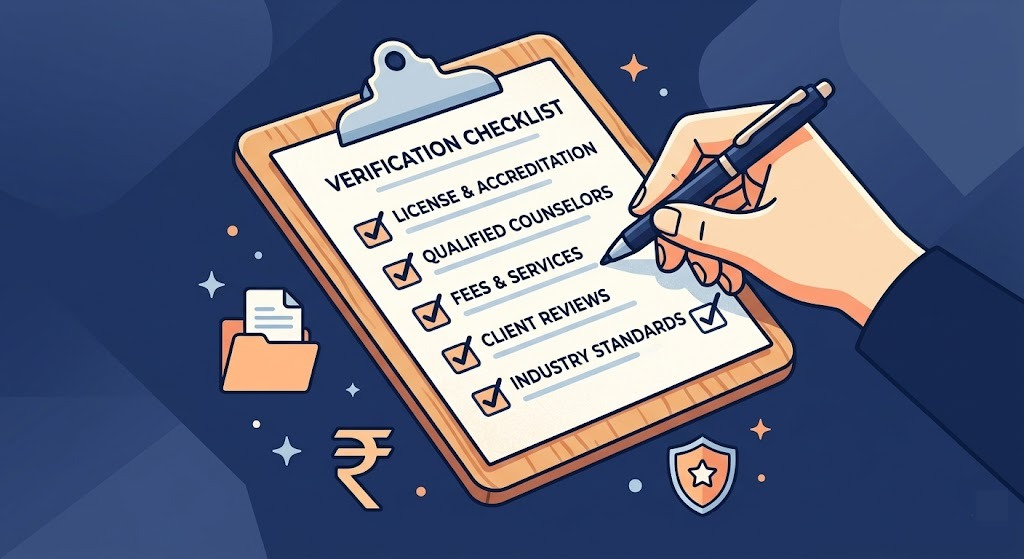
How to Find a Trusted Debt Counselor
Once you know what a genuine session should cover, checking a provider against it becomes fairly simple. Look for these signals before you agree to anything.
- They ask detailed questions about your finances before recommending anything. A counselor who recommends a specific program before understanding your income, loans and expenses may be making a recommendation without enough information.
- They tell you upfront if you don't need a paid service at all. Sometimes the honest answer is that a call to your own bank, asking for a longer tenure or a revised EMI, solves the problem. A trustworthy counselor says so, even when it means no fee for them.
- Fees are disclosed before you sign, and success-based structures are stated plainly. If a program charges only when it's completed, that should be said clearly, not buried in fine print you find out about later.
- They never claim an "RBI-approved" counseling license. This license does not exist for private debt counseling companies in India. RBI regulates lenders and sets guidelines for bank-run centres, it does not certify private counseling providers.
- They explain both the benefits and the downsides of any path they suggest. If settlement comes up, that conversation has to include the CIBIL impact, not just the debt relief.
Before looking at paid providers, it helps to know that free counseling exists first. Financial Literacy and Credit Counselling Centres, set up under RBI's guidelines, run by banks as non-profit trusts, operate at arm's length from the sponsoring bank and can offer a basic consultation free of charge. A scored comparison across several providers against these exact criteria is covered in best debt counselling services in India, and if location is part of your decision, debt counseling near me explains why it matters less than most people assume.

What the Law Says: Free Counselling Centres Exist
RBI directs banks to run free debt counselling centres in most districts. These centres operate at arm's length from the bank and charge nothing.
Talk to a FREED counsellorDebt Management Counseling vs Debt Consolidation vs Loan Settlement
What It Is | Who It's For | CIBIL Impact | Cost |
Debt Management Counseling | Guidance session to understand your options | Anyone unsure where to start | No direct impact |
Debt Consolidation | One new loan pays off all existing loans | Still paying, but over-leveraged | Can improve with consistent repayment |
Loan Settlement | Bank accepts a reduced lump sum as final payment | Genuinely unable to repay in full | Score drops, "Settled" mark for up to 7 years |
Rates and ranges shown are indicative. Final terms decided by the bank. FREED is not a Loan Provider. No outcome is guaranteed. Please verify directly with your bank.
Where you go after counseling depends on what your numbers actually show. If you're still paying but stretched, like Priya, consolidation may be considered when the borrower can still repay but needs a different repayment structure, and how debt consolidation actually reduces your EMI is worth reading before assuming it applies to you. If full repayment is no longer realistically sustainable, settlement may be considered, subject to eligibility and lender agreement, and the CIBIL impact of loan settlement is worth reading in full before going down that road. If the session shows your income and expenses just need re-balancing, no program may be needed at all.
Compare Your Real Options
See what consolidation or settlement would actually look like for your numbers.
Start My Debt Assessment
What Are Your Options After Counseling?
If a counseling session shows you can still manage repayment, the first thing worth asking your bank about is a longer tenure or a change to your loan plan. A longer tenure may reduce the monthly repayment amount, depending on the lender's revised terms. If repayments remain current, that can help you avoid additional late-payment entries.
FREED's Loan Consolidation Plan may replace multiple eligible repayments with a new loan from a lending partner, subject to approval and final terms. FREED assesses your financial profile and matches you to a lending partner from its network. If approved, the lending partner may disburse a new loan that is used to repay eligible existing debts, subject to the lender's process and terms. If the consolidation is approved and the eligible debts are repaid through the new loan, you may be left with one new loan, lender and repayment schedule.
If repayment has genuinely become impossible, FREED's Loan Settlement Plan is built for that situation. It works through a structured monthly savings plan that builds toward a settlement fund, and FREED negotiates with your bank once that fund is sufficient. Waivers can bring your total debt down by up to 50%*, though the exact figure ultimately depends on your bank. This path affects your CIBIL score, and the "Settled" mark stays on your report for up to 7 years, so it's a route for genuine hardship, not a shortcut. Since fees and honesty are the real test of whether a provider deserves your trust at this stage, it's worth cross-checking against financial counseling services and what to look for before signing up with anyone.
Talk Through Your Next Step
A counsellor can confirm which of these three actually fits, before you commit to anything.
Book My Free CallHow FREED Helps If Counseling Points You Toward a Program
If a session shows you still have room to repay but need one manageable payment instead of several, FREED's Loan Consolidation Plan takes over from there. FREED looks at your income, your existing loans, and your overall profile, then matches you to a suitable lending partner. That partner's new loan clears your existing eligible debt in one go, so you're left with a single EMI, on one date, to one lender. The impact on your credit profile depends on how the new loan and existing accounts are reported and how consistently you repay. FREED charges a success-based fee, only once the consolidation actually goes through.
If your session points the other way, toward genuine inability to repay, FREED's Loan Settlement Plan follows a different structure. FREED first builds a personalised plan around your income and expenses, then guides you through a structured monthly savings routine. That money goes into a Special Purpose Account (SPA), a dedicated savings pool held by an independent trusteeship firm, not by FREED. Once the SPA builds enough corpus, FREED negotiates with each of your lenders, and nothing is paid out without your authorisation first. FREED has settled over 20,000 accounts, counselled over 20,00,000 customers, and managed more than ₹3,200 Cr in debt through this process. If a bank refuses to settle, no service fee is charged, and the evaluation fee is refunded.
See If You Qualify for Consolidation
Check whether you may qualify for a single structured repayment.
Reduce My EMITips for Getting the Most Out of Debt Counseling
A session is only as useful as the information you bring into it. Here's what actually helps.
Bring your real numbers, not estimates. Loan statements, your latest salary slip, and a rough monthly expense list turn a vague conversation into a specific one. A counselor working off a rough guess can only give you a rough answer back.
Ask what happens if you do nothing. A genuine counselor should have a straight answer to this, whether that means EMIs continuing to slip, continued missed payments or other adverse information being reported.
Get any fee structure in writing before your second session. A verbal mention of "some charges apply" isn't enough. Ask for the number, or the percentage, and the conditions under which it applies.
Ask specifically how the counselor earns their income. Some run on commission from a lender, some on a flat consultation fee, some purely on success-based fees once a settlement or consolidation completes. This shapes what they're likely to recommend, and credit counseling vs debt settlement is a useful read for understanding how that recommendation can shift depending on who's earning what.
Are You in a Loan Trap? Quick Check
Move the slider to your total EMIs as a % of monthly salary. See your debt stress level instantly.
EMIs as % of Monthly Salary
Sources
Claim in Blog | Source |
|---|---|
RBI directs banks to set up and run Financial Literacy Centres/FLCCs offering free counselling, operating at arm's length from the sponsoring bank | RBI/2015-16/286, FIDD.FLC.BC.No.18/12.01.018/2015-16, "Financial Literacy Centres (FLCs) – Revised Guidelines," Jan 14, 2016 rbi.org.in link |

Mohit Juneja
Mohit Juneja writes educational content at FREED on debt management, credit scores, loan repayment, and borrowing best practices. His content is shaped by expert insights and industry knowledge, helping readers better understand their financial options and make informed decisions.
mohit.juneja@freed.care

FREED is India's trusted loan management platform. Founded in 2020 and headquartered in Gurugram, FREED has counselled 20 lakh+ people on personal loans, credit cards, and app loans. FREED charges fees only on successful settlement, not upfront. FREED does not handle secured loans (home loans, car loans, gold loans).
Media Mentions