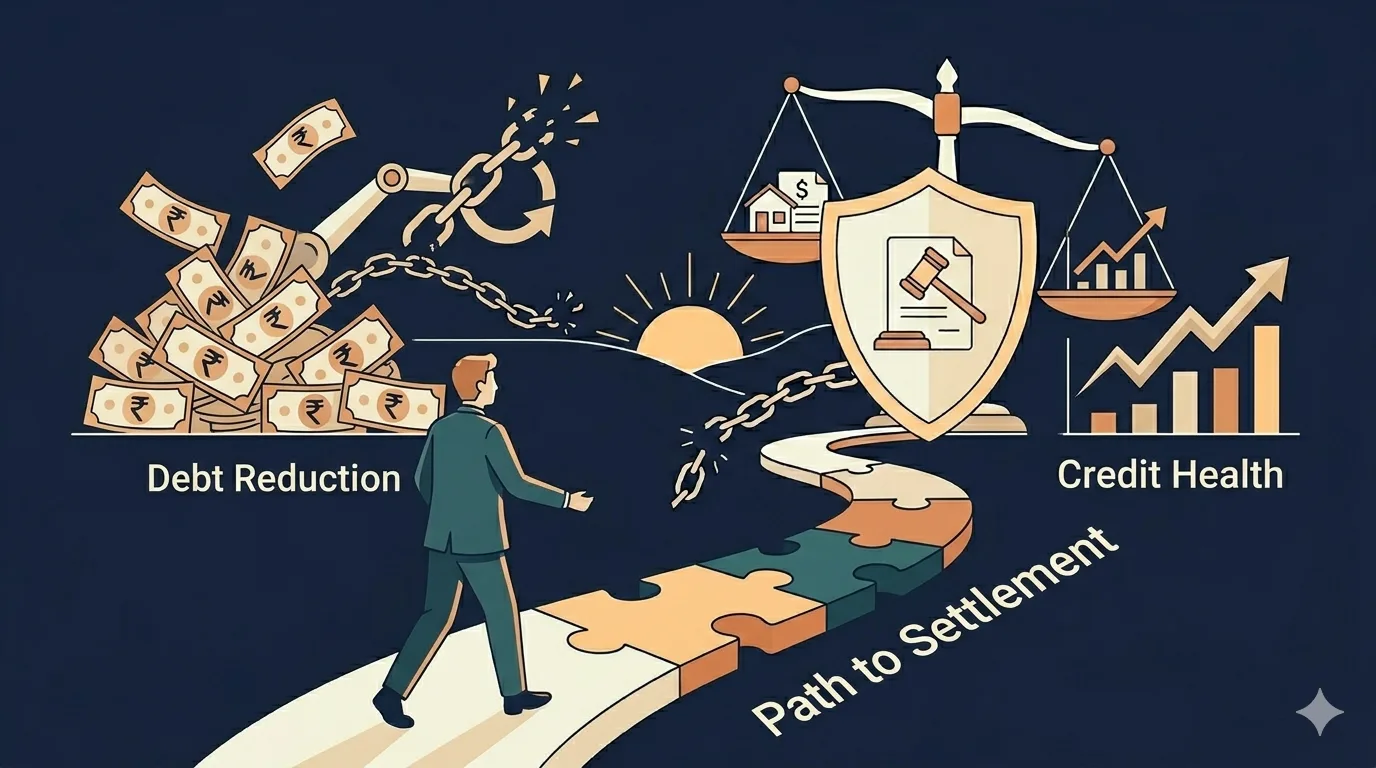
What Is Loan Settlement? Meaning, Process, and CIBIL Impact
If your EMIs have piled up and someone has mentioned "settlement," you probably have a lot of questions. What does it actually mean? Will it hurt your CIBIL? Is it the same as closing the loan? In this guide, we'll explain loan settlement in plain words, the meaning, the process, the costs, and what you need to know before deciding.

Mohit Juneja
Reviewed by FREED India, Debt Resolution Specialists
 4.7/5
4.7/5 ₹3,200Cr+
 20,000+
 20,00,000+4.7/5₹3,200Cr+20,000+20,00,000+
Key Takeaways

Loan settlement is when your Bank or NBFC agrees to wrap up the loan for less than what you owe, usually after you've missed EMIs and are in genuine financial distress.
Settlement is not the same as loan closure. Closure means you paid in full. Settlement means you paid less and the Bank accepted it as final.
A "Settled" status stays on your CIBIL report for up to 7 years and may drop your score noticeably.
Settlement should be a last resort, only after restructuring (changing your loan plan), EMI revision, consolidation (merging all loans into one), and moratorium (a temporary pause on payments) have been explored. Doing settlement yourself can be challenging, especially when it comes to documentation and negotiation. Doing settlement yourself is risky. Banks may reject low offers, agents may make verbal promises that fall through, and one wrong step can leave you with a default status that's worse than where you started.
FREED helps you check whether settlement is really the right step for your situation, and if it is, we handle the talks with your Bank or NBFC, get the paperwork right, and support you during recovery-related communication and escalation situations.
What Is Loan Settlement?
Settlement is not something a borrower chooses out of preference. Banks and financial companies only consider it when you are in genuine financial difficulty and are truly unable to repay the full amount. It is a last resort, not a shortcut.
Here's a plain example. Say someone has a personal loan with ₹4,00,000 still outstanding. They've missed EMIs for 7 months. A job loss or medical emergency made it impossible to keep paying. At some point, the Bank may agree to wrap it up for a reduced lumpsum, maybe a smaller amount the borrower can actually manage, often from savings, family, or selling an asset. The exact amount the Bank agrees to is decided by them, based on the case. (Figures above are indicative only.)
Settlement (closing a loan for less than what you owe, with the Bank's written agreement) is the Bank agreeing to accept a reduced amount based on the borrower's circumstances and its internal policies. the Bank saying: we'd rather take something now than chase the full amount for years. For the borrower, it ends the active dues. But it comes with costs, and the biggest one shows up on your CIBIL report.
Settlement is one of several debt-resolution paths. It's not always the best one, but for some borrowers, it might be the only realistic one left.
Loan Settlement vs Loan Closure vs Loan Write-Off
Factor | Loan Closure | Loan Settlement | Loan Write-Off |
What it means | You repaid the full amount as per schedule | You paid a reduced amount, Bank accepted as final | Bank removed loan from its active books, you may still legally owe |
When it happens | Normal repayment journey | After several missed EMIs and a negotiation | Internal accounting action by Bank |
CIBIL status shown | "Closed" | "Settled" | "Written Off" |
Effect on CIBIL score | Positive | Negative, drops noticeably | Most damaging, stays visible for years |
Are you debt-free? | Yes | Yes, after final payment + NOC | No, Bank can still pursue you |
Duration on report | Shows positive history | Up to 7 years | Up to 7 years |
Closure is always the goal. Settlement is a recovery path. Write-off is something to actively avoid, not aim for.
When Does Loan Settlement Usually Happen?
Banks and NBFCs don't entertain settlement requests on healthy accounts. They typically consider it only after a loan has been overdue for a significant period, usually once the account is classified as NPA (loan gone bad, i.e., overdue for 90+ days). At that point, the Bank does a calculation: is it better to recover some amount now, or keep chasing the full dues for years?
Common reasons on the borrower's side include job loss, a medical emergency, business failure, irregular income, or a family crisis. These are not choices. They are circumstances.
Signs you might be eligible for settlement:
- Your account has been overdue for 90+ days
- You've genuinely exhausted other repayment options
- You can arrange a one-time lumpsum, often from savings, family support, or selling an asset
The Bank has escalated beyond routine recovery
How Does the Loan Settlement Process Work?
- Step 01: Honest Self-Assessment You map every loan, every due, every missed EMI, and what you can realistically arrange as a one-time amount.
- Step 02: Reach Out to the Bank or NBFC A formal hardship letter goes in, with supporting documents showing why you've been unable to pay.
- Step 03: Negotiation Begins The Bank or NBFC reviews your case and proposes a reduced lumpsum, usually a percentage of the outstanding dues.
- Step 04: Counter-Offer and Final Agreement Borrowers often review and discuss the initial offer before reaching a final agreement. Most first offers aren't the best. A counter-proposal goes back. Both sides go back and forth until an amount is agreed upon.
- Step 05: Written Settlement Letter Issued Everything in writing, the agreed amount, the deadline, the payment terms, and a commitment to issue a NOC (clearance letter from the Bank).
- Step 06: Make the Final Payment You pay the agreed lumpsum within the deadline stated in the letter. Not before the letter. Not after the deadline.
- Step 07: Collect the NOC (Clearance Letter) This is your proof. Keep it safely. The NOC confirms the loan has been wrapped up.
- Step 08: Check Your CIBIL Update Credit bureau updates are commonly reflected within a few weeks, though timelines may vary. Within 30 to 60 days, your CIBIL should reflect "Settled" status. If it doesn't, file a dispute with CIBIL and the Bank.
This list looks straightforward on paper. In reality, each step has its own pitfalls, wrong wording in your hardship letter, accepting the first offer too early, missing the payment deadline, or never receiving the NOC. That's why most borrowers benefit from expert support.

What the Law Says
Under RBI guidelines, Banks and NBFCs are required to update your loan status with the credit bureau within 30 days of settlement. If your CIBIL still shows the loan as "active" or "overdue" after settlement, you have the legal right to file a dispute with CIBIL and the Bank. Settlement done before a SARFAESI (a law that lets Banks take property on secured defaults) auction or legal notice may also stop further recovery proceedings.
Talk to a FREED ExpertHow Does Loan Settlement Affect Your CIBIL Score?
This is the part most readers are most afraid of. So let's be direct, no sugarcoating, no panic.
The "Settled" status is a negative mark on your CIBIL report. It tells future Banks and NBFCs that you did not repay in full. Your score will drop noticeably after settlement. The exact drop varies by case, it depends on your existing score, how many loans you have, your overall payment history, and how the Bank reports it. We won't quote a specific number range here because it genuinely differs from person to person.
The "Settled" status stays on your CIBIL report for up to 7 years.
But here's the honest context. Settlement is still usually better for your CIBIL than continuing to default month after month. Each missed EMI is a fresh negative mark. And a "Written Off" status, which is what happens if you keep defaulting without resolving anything, is the most damaging of all. Settlement at least closes the chapter.
CIBIL recovery is real and possible. With on-time payments on small secured products (like a secured credit card or a fixed deposit-linked card), and disciplined credit behaviour, positive repayment behaviour can help improve your credit profile over time. Full recovery to a healthy score takes longer, but it moves.
Two myths worth clearing up:
Myth: "Settlement permanently destroys my CIBIL." Truth: Its impact reduces over time when supported by healthy repayment behaviour. The "Settled" mark stays for up to 7 years, but the score itself can improve well before that with the right steps.
Myth: "Settled status is the same as Closed." Truth: No. They look very different to future Banks. "Closed" is positive. Future lenders may view a Settled status less favourably than a Closed account. "Settled" is a red flag. Future Banks will ask about it.
Pros and Cons of Loan Settlement
Settlement is not free relief. It's a trade.
What works in your favour
- Wraps up the loan for less than the full outstanding
- Helps resolve the debt and reduce further escalation.
- Gives mental and financial breathing room
- Better than continuing to default month after month
- Provides a structured resolution path. , you can start rebuilding
What it costs you
- "Settled" status on CIBIL for up to 7 years
- CIBIL score drops noticeably
- New loan approvals may be harder for some years
- Higher interest rates on future loans, even when approved
- May limit credit card eligibility for a while
You exchange a part of your CIBIL future for present peace. For some borrowers, that trade is worth it. For others, restructuring (changing the loan plan) or consolidation (merging all loans into one lower EMI) is the smarter call. The right answer depends on the full picture.
Why Doing Loan Settlement Alone Can Backfire
Banks negotiate differently with individuals than with experienced negotiators. The first offer is rarely the best one, and without knowing what's reasonable, it's easy to accept an amount that was never the floor.
Verbal promises from collection agents are not binding. Many borrowers pay the agreed amount and then never receive the NOC (clearance letter). That leaves the loan still showing as active on CIBIL, which defeats the entire purpose.
The settlement letter wording matters more than most people realise. One ambiguous line about "future dues" or "interest waiver" can be reinterpreted later by the Bank. The paperwork has to be exact.
Recovery calls can also escalate during the negotiation if the borrower isn't aware of the RBI's rules on recovery agent conduct. And one wrong move, a missed deadline, a misworded letter, a settlement accepted on only part of the dues, can leave the account with a "Written Off" status that's harder to recover from than where the borrower started.
FREED handles this for thousands of Indians every year, we manage the back-and-forth with the Bank, get the settlement letter worded correctly, and make sure the NOC lands in your hands.
How FREED Helps You Settle the Right Way
- 1
Step 01: We Listen, You Breathe
One free call. We understand your full situation. No pressure to commit.
- 2
Step 02: We Map the Full Picture
Every loan, every due, every penalty, clearly listed together so you can see where you actually stand.
- 3
Step 03: We Pick the Right Path
Settlement, restructuring (changing the loan plan), consolidation (merging all loans into one), or moratorium (a temporary pause), based on what genuinely helps you most.
- 4
Step 04: We Talk to the Bank or NBFC
FREED supports borrowers during communication and negotiation with lenders. We handle the back-and-forth, negotiate the waiver, and get everything in writing.
- 5
Step 05: We Secure the NOC (Clearance Letter)
You get a clean paper trail proving the loan is wrapped up. No loose ends.
- 6
Step 06: We Track Your CIBIL Update
We help borrowers review reporting and raise disputes if needed. We make sure the "Settled" status reflects correctly within the RBI's 30-day reporting window. If it doesn't, we help you raise a dispute.
- 7
Step 07: We Guide the Rebuild
Guidance on rebuilding healthy credit habits. , secured cards, on-time payments, healthy credit usage.

Get expert help for loan settlement
Settlement done right protects your future. Settlement done wrong makes it worse. FREED has handled it for over 60,000 Indians.
Talk to an ExpertWhen Should You Avoid Loan Settlement?
Settlement is the right call only when other paths are genuinely closed. Not before.
- If you can afford to pay the full amount over a slightly extended timeline, choose restructuring (changing your loan plan) instead
- If your loan is still less than 90 days overdue, try EMI revision or moratorium (a temporary pause) first
- If you have only 1 loan and a steady income, consolidation (merging all loans into one) or balance transfer may help
- If you plan to apply for a home loan, car loan, or major credit in the near future. , settlement may hurt eligibility
- If your loan is a secured loan (home loan, car loan), settlement is rare for these and SARFAESI (law that lets Banks take property on secured defaults) risks apply; explore other paths first
Settlement is the right call only when other paths are genuinely closed. Not before.
About FREED
FREED is India's first debt relief company, founded in 2020 and headquartered in Gurugram. We help people dealing with unsecured debt, credit cards, personal loans, BNPL (buy now, pay later), and app loans, find the right path forward. Whether that's settlement, restructuring, or a managed repayment plan, we work with you to resolve the debt in a way that protects your future. We've worked with over 60,000 customers across India. Our fees are charged only when we successfully resolve your debt, no upfront charges. FREED does not handle secured loans like home loans or car loans.

Mohit Juneja
Mohit Juneja writes educational content at FREED on debt management, credit scores, loan repayment, and borrowing best practices. His content is shaped by expert insights and industry knowledge, helping readers better understand their financial options and make informed decisions.
mohit.juneja@freed.care

FREED is India's trusted loan management platform. Founded in 2020 and headquartered in Gurugram, FREED has counselled 20 lakh+ people on personal loans, credit cards, and app loans. FREED charges fees only on successful settlement, not upfront. FREED does not handle secured loans (home loans, car loans, gold loans).
Media Mentions