Credit Counseling vs Debt Settlement: Which One Is Right for You?
Credit counseling gives you advice and a budget without changing what you owe. Debt settlement is a formal negotiation where the lender may agree to accept a reduced amount as full and final settlement, depending on the borrower's circumstances. One is a starting point for almost anyone carrying debt stress. The other is a last resort for a genuine inability to repay.
Mohit Juneja
Reviewed by FREED India, Debt Resolution Specialists

 4.7/5
4.7/5 ₹3,200Cr+
 20,000+
 20,00,000+4.7/5₹3,200Cr+20,000+20,00,000+
KEY TAKEAWAYS

Credit counseling vs debt settlement really comes down to one question: do you need a plan, or do you need the debt itself reduced?
Counseling suits people who can still repay but need structure and clarity.
Settlement suits people facing genuine hardship, where full repayment has become impossible.
Credit counseling itself does not create a credit enquiry or change your repayment status. Settlement adds a "Settled" tag for up to 7 years.
The Core Difference Between Credit Counseling and Debt Settlement
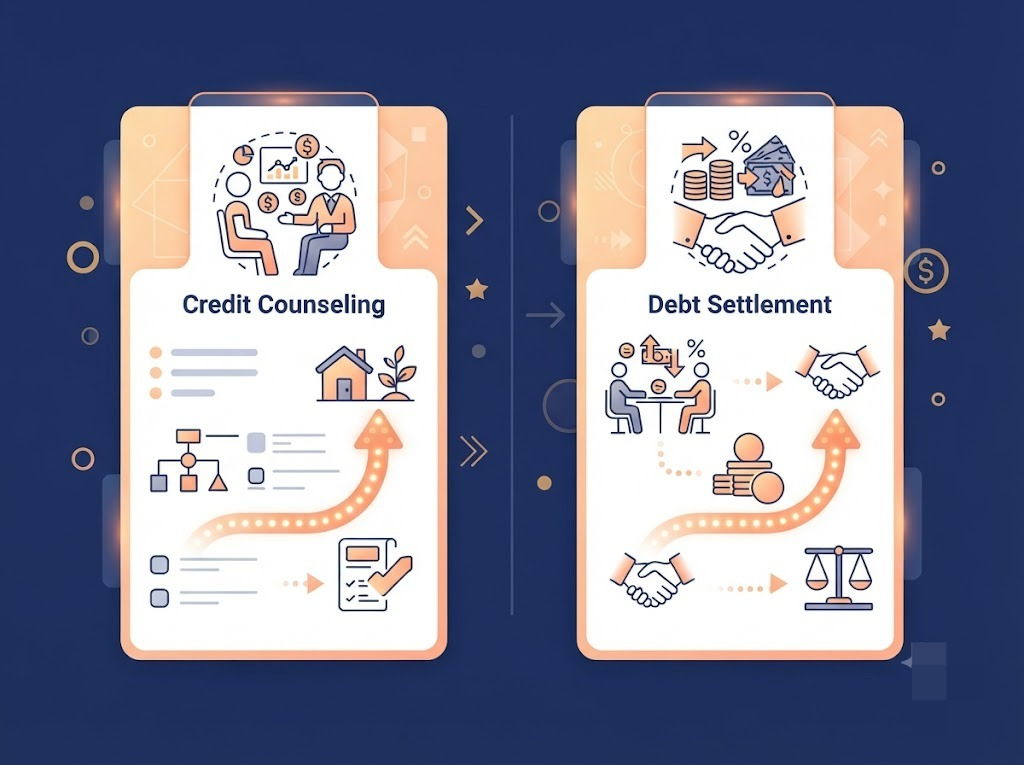
Strip away the jargon and it's actually a simple split. Credit counseling is advice. A counsellor looks at your income, your expenses, your loans, and helps you build a budget you can actually follow. Nothing about what you owe changes. You still pay back every rupee, just with a clearer plan for doing it.
Debt settlement is different in kind, not just degree. It's a formal negotiation where your bank agrees to accept less than the full amount as final payment. The loan gets marked "Settled" once that's done. This isn't a budgeting exercise, it's a reduction in the actual debt.
That distinction is the whole decision, really. If your problem is disorganization or a squeeze on cash flow, counseling addresses that directly. If your problem is that full repayment genuinely isn't possible anymore, no amount of budgeting fixes that, and settlement becomes the relevant conversation.
When Credit Counseling Is the Right Fit
Counseling fits a specific, fairly common situation: you're still managing your EMIs, but it takes real effort, and you don't have a clear picture of where all your money is actually going each month.
Maybe you've got two or three loans running at once, plus a credit card balance that never quite clears. Nothing's in default. Nothing's urgent. But it's stressful, and a nagging sense that things could slip if one thing goes wrong is a pretty common trigger for people who search this topic.
This is exactly the situation counseling is built for. FREED's Debt Consolidation Program may combine eligible unsecured debts into a single repayment, depending on the approved loan amount, tenure, and lender terms. There's no genuine hardship here yet, just a need for a clearer plan before things get harder.

Freed Expert Tip
If you can still make payments with some breathing room, counseling and a tighter budget may solve the problem before settlement is ever needed.
Talk to a counsellor about tightening your budgetWhen Debt Settlement Is the Right Fit
Settlement fits a different, harder situation. Something has genuinely gone wrong, a job loss, a medical emergency, a sharp drop in income, and full repayment has stopped being realistic, not just uncomfortable.
The signs tend to stack up together: several EMIs missed over recent months, recovery calls that have already started, no path back to paying everything in full even with a tighter budget or a longer tenure. This is genuine hardship, not a preference or a shortcut.
Worth repeating, because it matters: settlement is never something a borrower chooses out of convenience. Banks only consider it once it's clear repayment in full is no longer possible. If you're reading this and still managing, even with some strain, this probably isn't your situation yet, counseling and restructuring likely have more to offer first.

What the Law Says
RBI requires banks to have a board-approved, transparent policy for compromise settlements, meaning settlement approval is at the bank's discretion, not an automatic right. This follows RBI's Framework for Compromise Settlements and Technical Write-offs (circular dated June 8, 2023).
Ask your bank about its settlement policy before assuming eligibilityComparing the Two Side by Side
Aspect | Credit Counseling | Debt Settlement |
What it does | Advises and budgets | Negotiates a reduced payoff amount |
Changes total debt owed? | No | Yes |
Best suited for | Still repaying, needs structure | Genuine inability to repay |
Credit report impact | Minimal to none | "Settled" tag for up to 7 years |
Typical duration | One session to a few months of guidance | Several months to a few years of negotiation |
Cost | Often free or low-cost | Service fee, usually on successful settlement |
This is a general guide. Individual circumstances vary, and a professional assessment gives the most accurate direction.
Can You Do Both? Counseling First, Settlement Later
This is actually the most common real-world path, and it's worth naming clearly: plenty of people start with a counseling conversation, and only move toward settlement later, once the numbers make it obvious that full repayment genuinely isn't happening.
That's not a failure of the first step. A counsellor doing an honest assessment sometimes discovers that budgeting alone won't close the gap, the income just isn't there, or the debt load is too large relative to what's coming in. When that's the case, settlement becomes the more realistic conversation, and it's a natural next step rather than a sign counseling didn't work.
The two don't usually run in parallel, though. Counseling comes first to get a clear picture. Settlement, if it turns out to be the right fit, follows from that assessment rather than happening alongside it. Thinking of it as a sequence, rather than two competing options you have to pick blind, tends to make the decision a lot less stressful.

Genuinely Can't Repay in Full?
See if settlement is the right path for your situation.
Check My OptionsWhat This Means for Your Credit Score
The score impact is where these two paths really pull apart. Credit counseling, on its own, has little to no direct effect on your credit report. You're still repaying everything, just with a clearer plan, so there's nothing for the bureau to flag differently.
Settlement is different. Once a loan is settled for less than the full amount, it gets marked "Settled" on your credit report, and that tag stays for up to 7 years. It's a real, lasting mark, not something to gloss over.
That said, it's worth weighing against the alternative. If you're already missing EMIs and heading toward default anyway, that path affects your credit reporting too, just through a different route: missed payments, mounting arrears, an eventual NPA classification. Settlement changes your repayment status to a defined, known mark instead, which future lenders will factor into their assessment. Neither path is painless. One of them is at least predictable.
How FREED Helps You Figure Out Which One You Need
If you're genuinely unsure which side of this you're on, that's a completely normal place to be, and it's exactly what a free consultation is for.
A FREED counsellor looks at your actual numbers, income, expenses, what you're carrying across loans and cards, and gives you an honest read on where you stand. Sometimes that means counseling-level guidance is enough: a tighter budget, maybe a revised EMI. FREED's Debt Consolidation Program may combine eligible unsecured debts into a single repayment, depending on the approved loan amount, tenure, and lender terms. And sometimes, if repayment in full genuinely isn't realistic, it means talking through the Loan Settlement Plan.
None of these gets pushed by default. The point of the call is to match you to what actually fits, not to steer you toward one particular outcome regardless of your situation. That's the honest version of this decision, and it's a lot easier to make with someone who's actually looked at your numbers than to guess at it alone.
Not Sure Which One Fits Your Situation?
One free, honest call tells you exactly where you stand
Book My Free Call
Sources
Claim | Source |
RBI requires banks/NBFCs to have board-approved policies for compromise settlements, at the discretion of a higher sanctioning authority | RBI Circular, "Framework for Compromise Settlements and Technical Write-offs," June 8, 2023 — https://www.rbi.org.in/commonman/english/Scripts/FAQs.aspx?Id=3459 |
A settled loan carries a "Settled" status on the credit report for up to 7 years | Standard credit bureau retention convention; no single codified RBI rule sets this exact duration, so it's stated as a general, well-established industry norm rather than tied to one circular |

Mohit Juneja
Mohit Juneja writes educational content at FREED on debt management, credit scores, loan repayment, and borrowing best practices. His content is shaped by expert insights and industry knowledge, helping readers better understand their financial options and make informed decisions.
mohit.juneja@freed.care

FREED is India's trusted loan management platform. Founded in 2020 and headquartered in Gurugram, FREED has counselled 20 lakh+ people on personal loans, credit cards, and app loans. FREED charges fees only on successful settlement, not upfront. FREED does not handle secured loans (home loans, car loans, gold loans).
Media Mentions