Highest Spending Limit on Debit & Prepaid Cards
A card's spending limit is the maximum amount you can transact within a set period, daily, monthly, or as a running balance cap. RBI sets regulatory ceilings for different PPI categories, while individual issuers may apply lower limits based on their product terms.
Mohit Juneja
Reviewed by Mohit Juneja, Debt Resolution Specialists
 4.7/5
4.7/5 ₹3,200Cr+
 20,000+
 20,00,000+4.7/5₹3,200Cr+20,000+20,00,000+
KEY TAKEAWAYS

Debit card spending limits are set by your bank based on card tier (classic, gold, platinum) and are not fixed by RBI as a specific rupee figure.
Prepaid card (PPI) limits, by contrast, are directly capped by RBI: ₹10,000 for minimum-KYC ("Small") PPIs, up to ₹2,00,000 for full-KYC PPIs.
RBI requires banks to let debit card holders set and adjust their own usage limits and toggle channels (online, international, contactless) on or off.
A card's spending limit says nothing about whether spending that much is actually affordable, those are two completely separate questions.
What "Spending Limit" Actually Means Here
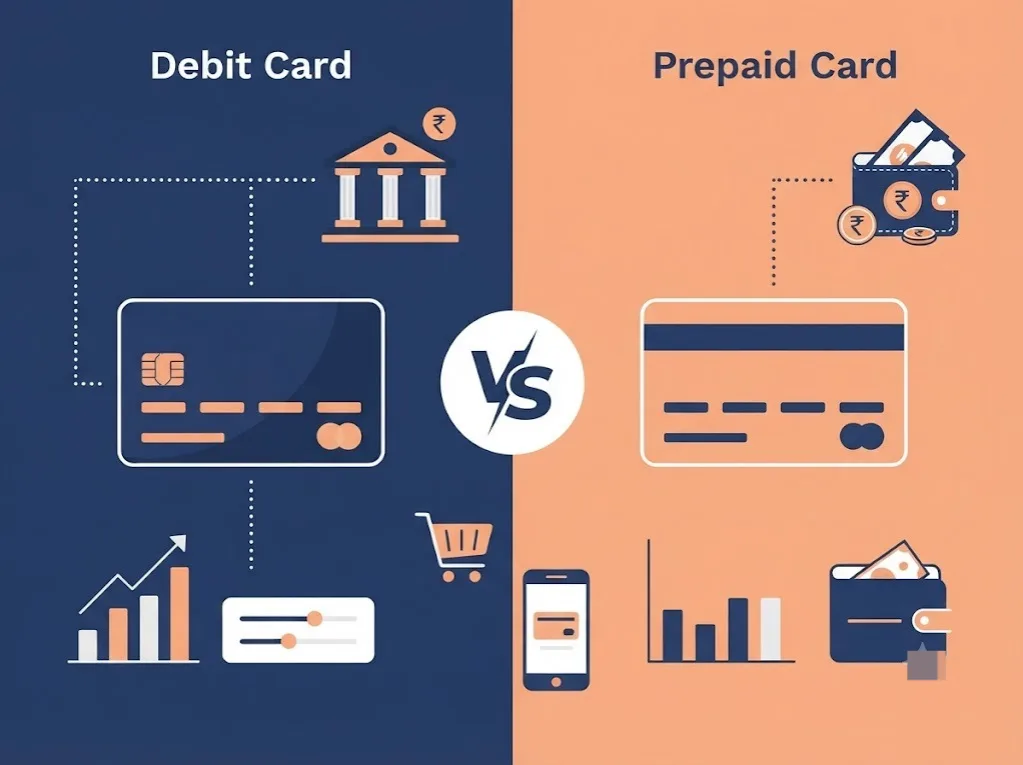
Debit card limits govern spending from money already sitting in your bank account. Prepaid card limits govern spending from money pre-loaded onto the card itself. Neither one involves borrowed money at any point, that distinction matters for everything that follows.
A few specific limit types apply here. Debit cards typically carry a daily ATM withdrawal limit, a daily or monthly POS (point of sale) limit, and a separate online transaction limit. PPI rules can set limits on the maximum outstanding balance and, depending on the PPI category, transaction or debit activity.
The two follow genuinely different rules for a clear reason. Debit cards draw against a regulated bank account that's already subject to its own set of controls. Prepaid cards are a distinct RBI-regulated instrument entirely, a PPI (Prepaid Payment Instrument), with its own dedicated framework built specifically around how much identity verification has actually been completed. Card transactions generally generate transaction alerts or records through channels provided by the issuer.
Debit card limits first, since they work differently from what most people expect going in.
How Debit Card Spending Limits Actually Work
Individual banks can set their own maximums and channel-specific limits. Each issuing bank sets its own limits by card variant, a classic card typically carries lower default limits than a platinum or premium variant from the same bank.
Limits are usually split by channel too, ATM withdrawal, POS or in-store spending, online or e-commerce transactions, and international usage, each can carry its own distinct cap. RBI does regulate one important thing here directly: since 2020, banks are required to let customers set and adjust their own limits within the issuer's overall maximum, and to switch entire channels on or off. RBI requires banks to provide customers with controls to switch certain transaction channels on or off and modify transaction limits. The exact default settings can depend on the card and issuer.
The practical takeaway: if a transaction gets declined for exceeding a limit, checking and adjusting your own settings through net banking or the bank's app is usually the fastest fix, not calling customer care first. Prepaid cards work on a completely different, RBI-fixed system.

Freed Expert Tip
Check your own debit card limit settings once, most people have never actually looked, and many banks default to conservative settings that don't match how the card is actually used. Want to Check Your Credit Picture Too?
Check My Credit ScoreHow Prepaid Card (PPI) Limits Are Set by RBI, by KYC Tier
Here are the actual, currently applicable RBI-fixed limits, by tier.
- Minimum-KYC ("Small") PPI. Small/minimum-detail PPIs are subject to a ₹10,000 maximum outstanding balance and applicable transaction/loading restrictions. They are subject to time and usage conditions under the RBI framework; check the issuer's current terms for what happens when those conditions are reached.
- Full-KYC PPI. Maximum outstanding balance and monthly debit limit up to ₹2,00,000, requiring completion of the applicable full-KYC requirements under RBI/KYC rules.
- Gift PPI: non-reloadable PPI with a maximum value of ₹10,000, subject to the applicable RBI conditions.
- Transit/Mass Transit System PPI. Capped at ₹3,000, restricted to transport use only, not general spending.
Worth a note on timing: RBI has released a 2026 draft proposing changes to certain PPI parameters, tighter peer-to-peer transfer caps and reduced cash-loading limits specifically, but these core outstanding-balance and monthly-debit figures above are already the current, in-force rules, not part of that unfinalized draft.
BNPL-Style Prepaid Products Follow the Same PPI Rules
Some products marketed as prepaid or wallet-based spending products may be structured as PPIs, while BNPL products can also be structured as credit facilities. Check the product's actual regulatory structure rather than assuming that every BNPL-style card follows PPI limits.
That means their maximum limits follow the same KYC-tier structure covered above, a minimum-KYC version capped at ₹10,000, a full-KYC version potentially up to ₹2,00,000. The practical implication worth knowing: a card marketed with a higher advertised limit almost always requires full KYC completion to actually reach it. That's regulatory, not a marketing choice made by any specific provider.
FREED Expert Tip
If a prepaid or BNPL-style card advertises a limit higher than ₹10,000, check whether that figure assumes full KYC completion, the advertised maximum and your actual current limit can be very different. Want to Check Your Credit Picture?
Check My Credit ScoreHow to Increase Your Spending Limit
For debit cards, log in to net banking or your bank's app and adjust channel-wise limits within the issuer's own ceiling, or request a card tier upgrade if the current variant's maximum itself feels genuinely restrictive.
For prepaid cards, completing full KYC on a currently minimum-KYC or Small PPI is the single biggest lever available, moving from a ₹10,000 cap to a potential ₹2,00,000 one. Worth being plain about one thing though: neither of these increases your actual money. A higher limit on a prepaid card doesn't add funds to it, and a higher debit card limit doesn't add money to your bank account, both simply raise the ceiling on what you're allowed to spend from what's actually already there.
A Spending Limit Isn't the Same as What You Can Actually Afford
A card's maximum limit is a regulatory or issuer-set ceiling. It says nothing about whether spending up to that ceiling is actually a good idea for your own finances.This distinction gets genuinely confusing with BNPL-style prepaid products specifically, since a genuine prepaid product uses stored/pre-loaded value, while BNPL products may involve credit. Check the product structure before assuming which rules apply. Worth naming honestly where a real connection to debt does exist: If someone is using several prepaid products or BNPL/credit facilities to work around individual spending limits, that may be worth examining as part of their overall spending pattern. What BNPL actually is and how it works is worth reading if this pattern feels familiar.
Freed Expert Tip
If you're tracking spending across several prepaid or BNPL-style cards just to stay under individual limits, that's worth naming as a pattern in its own right, separate from the limits themselves. Juggling Several of These?
Book My CallHow FREED Helps If This Signals Something Bigger
Worth stating plainly: If multiple prepaid products, BNPL facilities or other unsecured debt have become difficult to manage, FREED's Debt Consolidation Program or Debt Resolution Program may help address that separate debt, depending on eligibility. That's entirely between the cardholder, the issuer, and RBI's regulatory framework.
If juggling several prepaid or BNPL products has become a sign of broader unsecured debt strain, personal loans, credit cards, other BNPL, FREED's Debt Consolidation Program or Debt Resolution Program address that separate, underlying debt, not the card limits themselves.

Tips for Managing Card Limits Sensibly
Sources
Claim | Source |
RBI caps Small (minimum-KYC) PPIs at ₹10,000 outstanding balance and ₹10,000 monthly debit | RBI Master Directions on Prepaid Payment Instruments (MD-PPIs), 2021, as amended |
Full-KYC PPI balance and monthly debit limit raised to ₹2,00,000 | RBI notification, "Prepaid Payment Instruments (PPIs) Mandating Interoperability; Increasing the Limit to ₹2 lakh for Full-KYC PPIs," May 19, 2021 |
Transit/Mass Transit System PPI capped at ₹3,000 | RBI amendment to MD-PPIs, 2021, effective February 23, 2024 |
Banks must allow customers to set/adjust their own debit card usage limits and toggle channels | RBI circular on enhancing security of card transactions, 2020 |

Mohit Juneja
Mohit Juneja writes educational content at FREED on debt management, credit scores, loan repayment, and borrowing best practices. His content is shaped by expert insights and industry knowledge, helping readers better understand their financial options and make informed decisions.
mohit.juneja@freed.care

FREED is India's trusted loan management platform. Founded in 2020 and headquartered in Gurugram, FREED has counselled 20 lakh+ people on personal loans, credit cards, and app loans. FREED charges fees only on successful settlement, not upfront. FREED does not handle secured loans (home loans, car loans, gold loans).
Media Mentions