Debt Service Meaning: What It Is and Why Lenders Track It
Debt service is the total amount you pay in a given period, principal plus interest, toward all your debts, EMIs, credit card minimum dues, and any other loan repayments. It's an amount, not a ratio, that's what DSR, FOIR, and DTI are calculated from.

Mohit Juneja
Reviewed by FREED India, Debt Resolution Specialists
 4.7/5
4.7/5 ₹3,200Cr+
 20,000+
 20,00,000+4.7/5₹3,200Cr+20,000+20,00,000+
KEY TAKEAWAYS

Debt service is the total amount you pay in a given period, principal plus interest, toward all your debts, EMIs, credit card minimum dues, and any other loan repayments.
Lenders track your debt service because it's the clearest signal of whether you can safely take on more credit.
Debt service is an amount, not a ratio. Debt Service Ratio (DSR), FOIR, and DTI are the ratios built on top of it, and they aren't all calculated the same way.
For low-income households covered by RBI's microfinance framework, total monthly loan repayment obligations cannot exceed 50% of monthly household income.
What Is Debt Service?
Debt service is the periodic, usually monthly, cash outflow required to cover both principal and interest across every debt obligation you hold. That includes EMIs on personal loans, home loans, and car loans, plus the minimum due on your credit cards.
The distinction worth establishing right away is that debt service is a rupee amount, not a percentage or a ratio. The ratio comes later, once that amount gets compared against your income. Debt service on its own is just the number itself, what actually leaves your account each month toward what you owe.
Here's a quick way to ground that. Say a household is paying ₹12,000 toward a personal loan EMI, ₹8,000 toward a car loan EMI, and a ₹3,000 minimum due on a credit card. Their monthly debt service is ₹23,000, full stop. That figure doesn't change based on what their income is, whether ₹23,000 is comfortable or crushing depends entirely on income, and that's a separate calculation covered further down this piece.
This number matters enormously to lenders specifically, not just for your own household budgeting, and the reason why is worth understanding in full.

Freed Expert Tip
Add up your debt service once, in writing, across every loan and card you hold. Most people can name their EMIs individually but have never seen the combined monthly total in one place.
Want Your Full Number?Why Lenders Track It
A lender extending new credit needs one core answer before approving anything: can this borrower absorb another monthly obligation without becoming overextended? Debt service is the single number that answers that most directly, more directly than income alone, and more directly than credit score alone.
Here's the mechanism behind it. Your existing loans and credit facilities are reported to credit bureaus. When you apply for new credit, lenders assess your existing repayment obligations along with your income and other information before deciding whether to approve the loan.. This is exactly why an existing high debt service can get an otherwise creditworthy applicant rejected, or offered a smaller loan than they actually applied for, even with a strong credit score sitting right there on the file.
This isn't just internal lender caution dressed up as policy. For microfinance loans specifically, the RBI has made this a hard, enforceable rule rather than a mere guideline. Under the Master Direction on microfinance loans, a household's total monthly loan repayment obligations, principal and interest, across every loan it holds, cannot exceed 50% of monthly household income. Lenders are not permitted to approve a new loan that would push a household past that ceiling.
This income-comparison step is exactly where DSR, FOIR, and DTI enter the picture, three closely related terms worth untangling properly.

What the Law Says
For microfinance loans specifically, RBI caps a household's total monthly debt service (principal plus interest across all loans) at 50% of monthly household income; lenders cannot approve a new loan that would push a household past this limit.
Talk to FREED's TeamHow Lenders Calculate Your Debt Service Ratio
Once the debt service amount is established, lenders divide it by your income to arrive at a ratio. That ratio, not the raw rupee figure on its own, is what actually gets compared against a lender's approval threshold.
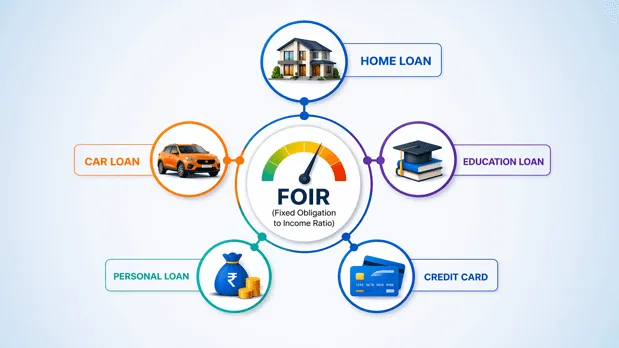
Most Indian lenders don't use a standalone "DSR" as their working term. They use FOIR, Fixed Obligation to Income Ratio, which folds debt service together with a small number of other fixed monthly obligations before comparing the total against your income. The typical range lenders look for is a FOIR of 40% to 55%, depending on your income bracket and the type of loan you're applying for. Higher earners are often allowed a somewhat higher ceiling.
Rather than re-deriving the full FOIR calculation here, FREED's dedicated guide on FOIR walks through the exact formula and a full worked example, worth reading if you want the calculation itself rather than just the concept.
FOIR itself, though, gets confused with two other closely related terms often enough that it's worth clearing up directly.
Freed Expert Tip
Ask your lender directly which ratio they use, FOIR, DTI, or something else internal, before assuming your own back-of-the-envelope math matches theirs.
Book My Free CallDebt Service vs FOIR vs DSCR: What's the Difference

Term | What It Actually Is |
Debt Service | The actual rupee amount paid periodically toward principal and interest. Not a ratio at all. |
FOIR / DSR / DTI | Debt service, and sometimes other fixed obligations like rent, is expressed as a percentage of income. The retail lending version is used for personal loans, home loans, and credit cards. |
DSCR (Debt Service Coverage Ratio) | The business and income-property version. Flips the fraction, income divided by debt service, rather than debt service divided by income. Used for business loans and rental-property financing. Most Indian banks want DSCR at 1.25x to 1.50x or higher. |
The practical guidance here is straightforward. An individual retail borrower will encounter FOIR or DTI when applying for a personal or home loan. A small business owner applying for a business loan will encounter DSCR instead. Knowing which one applies to your situation saves you from comparing the wrong number against the wrong benchmark.

Not Sure Where Your Ratio Stands?
Get a free, honest read on your full debt picture.
Get a Free AssessmentWhat Counts as Debt Service (and What Doesn't)
This is exactly where people trip up, so it's worth keeping the two lists cleanly separated.
Counts toward debt service:
- EMIs on personal loans, home loans, car loans, and education loans
- Minimum due on credit cards
- BNPL instalments, where reported to a credit bureau
Does not count toward debt service itself (though some of this counts toward the broader FOIR calculation):
- Rent
- Utility bills
- Insurance premiums
- SIP or investment contributions
- Everyday living expenses
The practical implication of this split is exactly why FOIR, which folds in some of these extra obligations, can differ meaningfully from a simple debt-service-to-income calculation. Two people with identical debt service can end up with quite different FOIR figures if one pays substantial rent and the other doesn't, since rent factors into FOIR for many lenders but was never part of debt service to begin with.
Signs Your Debt Service Is Too High
A handful of concrete, checkable signs suggest your combined debt service has crossed into territory that will start working against you.
- Your combined EMIs and minimum dues cross roughly 40 to 50% of your take-home income. The exact ceiling varies by lender, but this range is where most start getting cautious.
- You were recently rejected for a new loan or offered a smaller amount than you applied for, with no change in your credit score. A high existing debt service is a common, under-communicated reason behind this.
- You're relying on one credit source to make payments on another. This is one of the clearest signals that the underlying number has already tipped too far.
- A new EMI would require cutting into essential monthly expenses, not discretionary ones.
- You genuinely don't know your own combined monthly debt service off the top of your head. That's worth fixing regardless of what the number turns out to be.
Juggling Several EMIs and Card Payments?
See if one lower EMI could replace all of them.
Check My Consolidation OptionsWhat Are Your Options If Your Debt Service Is Too High?
A few paths are worth working through in order, depending on how much room you actually have left.
Start by talking to your existing lender about restructuring; it costs nothing to ask, and some lenders will genuinely work with you on a revised schedule. For multiple unsecured EMIs pushing your ratio up specifically, consolidation, combining them into one new loan with a single, lower monthly debt service, directly lowers the number a future lender would actually look at. Loan consolidation is worth reading in full if this is the direction that fits your situation. Settlement sits at the far end of this list, and it's only for genuine, sustained inability to repay, not a first option. It's worth being direct that settlement affects your CIBIL score, and the "Settled" status can stay on your report for up to 7 years.
How FREED Helps Bring Your Debt Service Down
For readers whose combined debt service is genuinely straining their income, but who are still current on every payment, there's a direct way to bring that number down rather than just tracking it more closely.

FREED's Debt Consolidation Program, "Reduce My EMI," combines existing unsecured EMIs, personal loans, credit cards, and BNPL into one new loan through a partner lender, at one lower monthly payment. That directly reduces the debt service figure a future lender would see on your credit report, not just your own sense of how manageable things feel. impact on your CIBIL score can vary depending on your credit profile, the new loan application, repayment behaviour, and how the existing debts are reported and closed. Worth being plain that this covers unsecured debt only. For genuine, sustained inability to repay, FREED's Debt Resolution Program is the separate, later-stage path, distinct from consolidation.
See What Consolidation Could Do to Your Ratio
A free assessment shows your real numbers.
Get a Free AssessmentTips for Managing Your Debt Service
A few habits keep this number working for you rather than quietly against you.
- Know your combined monthly debt service as one number, not scattered across separate EMI reminders on your phone.
- Before taking any new loan, calculate what it would push your ratio to, not just whether the new EMI alone feels affordable in isolation.
- Prioritise paying down your highest-interest debt first if lowering debt service is the actual goal; it moves the number fastest per rupee paid.
- Avoid taking a new loan specifically to cover an existing EMI. That raises your debt service further; it doesn't lower it.
- Revisit your combined number after any income change. A raise or a job change shifts what's actually sustainable in either direction.
Freed Expert Tip
Recalculate your combined debt service every time you take on or pay off a loan, not just once a year. It changes more often than most people track.
Ready to See Where You Stand?Sources
Claim | Source |
RBI caps household monthly loan repayment obligations (principal plus interest, across all loans) at 50% of monthly household income for microfinance loans | RBI Master Direction (Regulatory Framework for Microfinance Loans) Directions, 2022 |

Mohit Juneja
Mohit Juneja writes educational content at FREED on debt management, credit scores, loan repayment, and borrowing best practices. His content is shaped by expert insights and industry knowledge, helping readers better understand their financial options and make informed decisions.
mohit.juneja@freed.care

FREED is India's trusted loan management platform. Founded in 2020 and headquartered in Gurugram, FREED has counselled 20 lakh+ people on personal loans, credit cards, and app loans. FREED charges fees only on successful settlement, not upfront. FREED does not handle secured loans (home loans, car loans, gold loans).
Media Mentions