Credit Card Payoff Calculator India
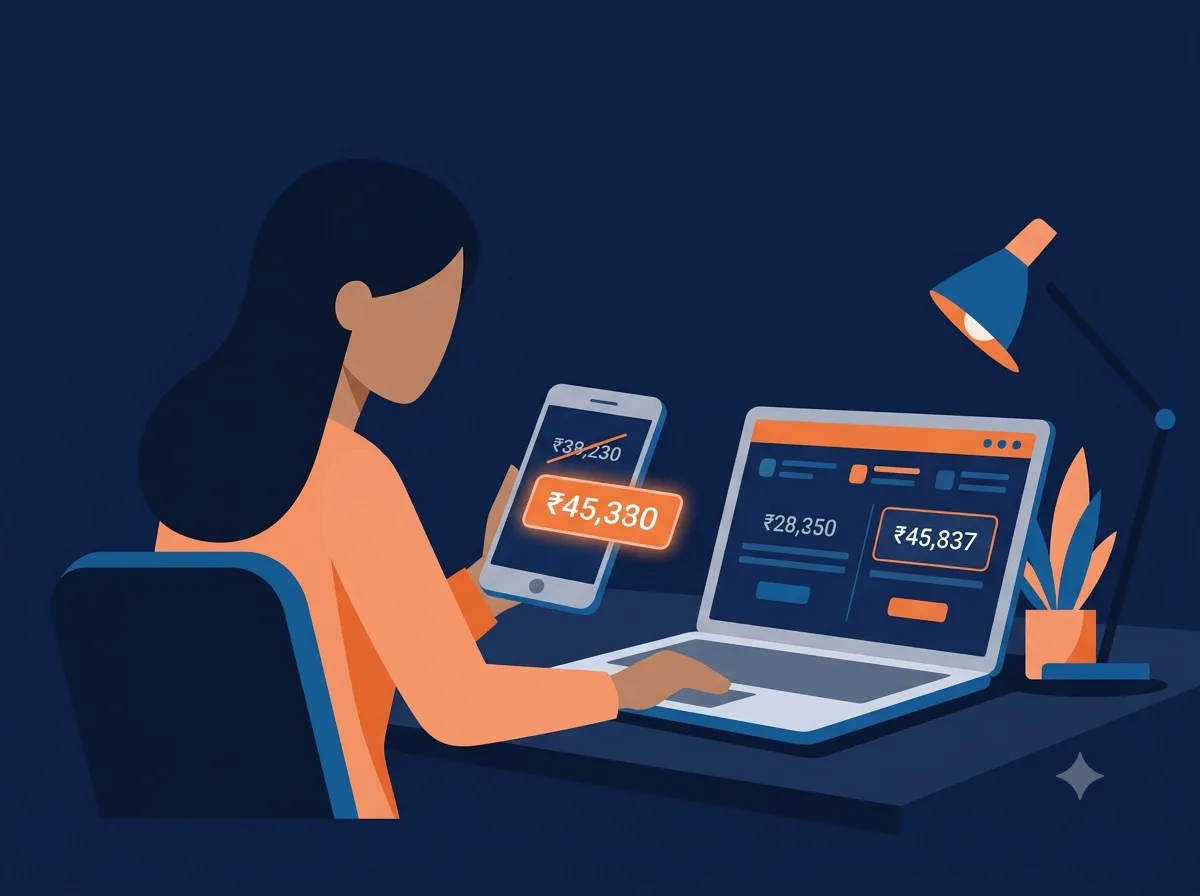
A credit card payoff calculator in India works out how many months it takes to clear a card balance when you pay a fixed amount each month, and how much interest you pay on the way. You need three numbers: your outstanding balance, your monthly interest rate and what you can pay each month.
Mohit Juneja
Reviewed by FREED India, Debt Resolution Specialists
 4.7/5
 ₹3,200Cr+
 20,000+
 20,00,000+4.7/5₹3,200Cr+20,000+20,00,000+
Key Summary

A payoff calculator needs three inputs: balance, monthly interest rate and monthly payment.
If your payment is no more than one month's interest, the balance never falls.
On an illustrative ₹50,000 at 3.5% a month, paying ₹2,000 a month takes 61 months and ₹70,901 in interest. Paying ₹5,000 takes 13 months and ₹12,633.
The 3.5% is an assumption for the examples, not any bank's rate. Use the rate on your own statement.
You can build the calculator yourself in a spreadsheet with one formula, shown below.
The order you clear several cards in matters less than how much you pay each month.
What Is a Credit Card Payoff Calculator?
It's a way to answer one question: if I pay this much each month, when will the card be clear? A good credit card payoff calculator in India also tells you the total interest you'll pay, so you can see what a smaller payment costs.
The calculation estimates how your outstanding balance changes each month. Interest is added to the balance, and your payment reduces the amount owed. The remaining balance carries forward to the next month until it is cleared.
This guide explains how a credit card payoff calculator works, including the formula, a worked example and instructions for creating your own calculator in a spreadsheet.
What Numbers Do You Need Before You Start?
Pull three figures from your latest card statement.
- Outstanding balance: the total you owe now. Axis Bank's explainer defines it as the total amount you owe the issuer at a given time.
- Interest rate: the monthly or annual rate on your statement. Divide an annual rate by 12 for the monthly one.
- Monthly payment: what you can pay every month, on top of new spending you've stopped.
Check the statement for fees, GST and cash-advance charges too. They change the balance. For the pieces of a bill, read our guide on credit card minimum due.

Want Help Reading Your Statement?
See which options fit your situation on FREED.
See My Options on FREEDHow Does the Payoff Maths Work?
Two formulas cover everything.
Months to pay off (when payment is bigger than one month's interest):
n = −ln(1 − r × B ÷ P) ÷ ln(1 + r)
where B is the balance, r is the monthly rate and P is the monthly payment.
Payment needed to clear in n months:
P = B × r ÷ (1 − (1 + r)^−n)
You don't need to do this by hand. Both exist as spreadsheet functions, and we show them below. The key calculation is the first month's interest, B × r. If your payment is exactly equal to that interest, the balance remains unchanged. If your payment is lower, the balance increases. To reduce the balance, your payment must be greater than the interest charged for the month.
What Happens on a ₹50,000 Balance? A Worked Example
Let's assume ₹50,000 owed and a monthly interest rate of 3.5%, which is 42% a year when you multiply by 12. That rate is for the example only. Your card's rate is on your statement.
First month's interest: ₹50,000 × 3.5% = ₹1,750.
| Monthly payment | Months to clear | Total interest paid |
|---|---|---|
| ₹2,000 | 61 | ₹70,901 |
| ₹3,000 | 26 | ₹26,359 |
| ₹5,000 | 13 | ₹12,633 |
| ₹10,000 | 6 | ₹5,961 |
Look at the first and last rows of this credit card payoff calculator India example. Paying five times as much cuts the time from over five years to six months, and the interest from more than the original balance to a small fraction of it.
What Is the Smallest Payment That Makes Progress?
Under this simplified calculation, your payment must exceed the first month's interest to reduce the outstanding balance. On a ₹50,000 balance at 3.5% monthly interest, the first month's interest is ₹1,750. Paying exactly ₹1,750 leaves the balance unchanged, while paying ₹2,000 reduces the principal by ₹250 in the first month. As interest is recalculated on the remaining balance each month, the repayment pattern changes over time.
The same logic is behind RBI's rule on minimum due. RBI's credit card directions say the minimum amount due must be set so it doesn't cause negative amortisation, which is when the balance grows even though you pay. Banks must also print a warning that paying only the minimum stretches repayment over months or years. For what happens when you pay only the minimum, see our guide on what happens if you only pay the minimum due.
How Much Do You Need to Pay to Clear the Card in a Fixed Time?
Use the second formula. On the same ₹50,000 at 3.5% a month:
| Clear it in | Payment each month | Total interest |
|---|---|---|
| 6 months | ₹9,383 | ₹6,300 |
| 12 months | ₹5,174 | ₹12,090 |
| 24 months | ₹3,114 | ₹24,727 |
The table answers the question most people ask a credit card payoff calculator in India: what do I need to pay to be done by a certain date? Pick the row that fits your pay, and make that your fixed monthly payment.

Check Your Report Before You Plan a Payoff
See your credit report before you plan a payoff.
Check My Credit InsightsHow Do You Build the Calculator in a Spreadsheet?
You don't need an app. Put these in a sheet and you've got your own credit card payoff calculator for India.
| Cell | What to enter |
|---|---|
| A1 | Outstanding balance (for example 50000) |
| A2 | Annual interest rate (for example 42%) |
| A3 | Monthly rate: =A2/12 |
| A4 | Monthly payment you plan (for example 5000) |
| A5 | Months to clear: =NPER(A3,-A4,A1) |
| A6 | Total interest: =A5*A4-A1 |
Check it against our table. With a balance of 50,000, a rate of 42% a year and a payment of 5,000, NPER gives about 12.5 months, so the card clears in month 13 with a smaller last payment. The spreadsheet's total interest will be a touch off from our table because it treats every payment as full size. Our table uses a smaller final payment.
To find the payment for a target, use =PMT(A3,12,-A1) and change 12 to the number of months you want. On our example it returns about ₹5,174.
If your payment turns out to be at or below one month's interest, NPER returns an error. That's the sheet telling you the balance isn't falling.
Which Card Should You Pay First?
If you hold more than one card, pick an order. There are two common ones.
- Highest rate first (avalanche): you put the extra money on the card with the biggest interest rate. It costs the least in interest.
- Smallest balance first (snowball): you clear the smallest card to cut the number of bills you carry. It costs a bit more but feels faster.
Here's a worked case. You've got three cards: ₹20,000 at 3.6% a month, ₹8,000 at 3.4% and ₹30,000 at 3.2%. You can pay ₹9,000 in total each month. These rates are assumed for the example.
| Order | Months to clear | Total interest |
|---|---|---|
| Smallest balance first | 8 | ₹8,306 |
| Highest rate first | 8 | ₹8,259 |
The estimated difference in interest is just ₹47 in this example. However, the result depends on the assumptions used for minimum payments, interest calculations and payment allocation. The amount you can consistently repay each month is important, but the repayment order can also affect the total interest. Pick the order you'll stick with. For a template to track it, see our guide on a credit card payoff plan template and our note on accelerated payoff strategies.
What Happens If You Pay a Little Extra Each Month?
You save more than you'd expect. On the ₹50,000 example, moving from ₹5,000 to ₹10,000 a month cuts the time from 13 months to 6 and the interest from ₹12,633 to ₹5,961. You pay twice as much each month and save more than half the interest.
The lesson holds on any balance you put into a credit card payoff calculator in India. Interest is charged on what's left, so every rupee you pay early cuts the base for next month's interest. An extra payment in month one does more work than an extra payment in month ten.
Your Rights if a Card Charge or Entry Is Wrong
- You're entitled to one Free Full Credit Report, including your score, once during January to December from each credit information company.
- If a complaint about your credit information isn't resolved within 30 days, the company pays ₹100 a day. The lender has 21 days to send corrected details.
- Disputes about how a score is calculated are excluded.
Sources: RBI/DOR/2025-26/378 and cibil.com/freecibilscore
Should You Convert the Balance to an EMI Instead?
Sometimes. Banks offer to turn a card balance into fixed monthly instalments. The benefit is a structured repayment schedule with fixed instalments over an agreed tenure. However, the bank may charge interest, a processing fee and applicable taxes. The terms, interest rate and eligibility conditions vary by issuer. We don't quote a rate, because it changes and each bank sets its own. Compare the total you'd pay against the payoff table above before you say yes. For a bank-specific view, see our guide on converting an HDFC credit card bill to EMI.
What About a Balance Transfer?
A balance transfer moves what you owe to another card or loan, usually at a different rate. It can help if the new cost is lower and you stop spending on the old card. It can hurt if fees, a short offer window and a new application cancel the saving. Read our guide on balance transfer credit cards in India and use our balance transfer calculator to compare.
What Mistakes Make a Payoff Take Longer?
- Using the card while paying it off. New spending adds to the balance faster than your payment shrinks it.
- Paying only the minimum due. It keeps the account current, but the balance can sit for years.
- Ignoring fees and GST. They sit inside the balance and earn interest too, so put them into a credit card payoff calculator in India as well.
- Not checking the rate. Your statement has the real one. Don't use ours.
- Missing a payment. A late fee adds to the balance, and CIBIL says a failed payment can lower your score.

FREED Expert Tip
Pick the monthly payment from the 12-month or 24-month row, then set it up as an auto-debit for the day after your salary. A payoff plan you don't have to remember is the one that finishes.
Check My Credit InsightsDoes Paying Off a Card Help Your Credit Score?
It can, through utilisation. CIBIL says a high credit utilisation limit indicates a rising debt burden over time and may negatively impact your score. Paying down your outstanding balance can reduce your credit utilisation ratio once the lender reports the updated balance to the credit bureau. Lower utilisation may support your credit profile, although the effect on your score depends on other information in your report and the bureau's scoring model.
On-time payments help too. CIBIL says late payments hurt, so a payoff plan that never misses a due date does double work. Use our credit card payoff calculator in India method to pick a payment you can keep up, then keep it up.
Should You Close the Card After Paying It Off?
Not automatically. CIBIL's guide on closing a card lists utilisation, the length of your history and your credit mix as the things to think about. Closing a card removes its limit, which can push the share used on your other cards up.
If you want to close it anyway, make sure the balance is zero and there are no fees pending. RBI's card directions say the issuer must close the card within seven working days once there's nothing outstanding, with compensation of ₹500 a day for delay. Then check your report to see that it shows closed.
What If a Charge on Your Statement Looks Wrong?
Don't include it in your payoff plan until you've checked it. Compare it with your transaction alerts. If it's not yours, tell the bank in writing at once and ask for a reference number.
If a wrong status ends up on your report, CIBIL's FAQ says you can raise a dispute online, and that it may take approximately 30 days to resolve. For the steps, see our guide on fixing wrong entries.
How Do You Use a Credit Card Payoff Calculator in India Without Getting Misled?
A few cautions apply to any credit card payoff calculator in India, including ours.
- Use your own rate. Online calculators often pre-fill a rate. Overwrite it with the one on your statement.
- Check what the tool leaves out. Some ignore GST, fees and cash-advance charges.
- Stop new spending in the model, and in life. The maths assumes the balance only falls.
- Don't treat the result as a promise. Rates and charges can change, so re-run it every few months.
- Be wary of tools that ask for card details. A calculator needs numbers, not your card number, PIN or OTP.
How Does FREED Help With Card Payoff?
FREED Credit Insights shows your credit report and score and points to what's holding the score back, which helps you see how your cards look to a lender before and after a payoff. It reads your Experian report, so the number can differ from your CIBIL score.
Over 30,000 borrowers have used Credit Insights, and over 20 lakh people trust FREED. FREED isn't a loan provider. Credit Insights explains your report. It doesn't change what's reported, and it isn't a payoff tool.
You can start on the Credit Insights page.
What If the Payoff Payment Is More Than You Can Afford?
Then the plan needs a different shape. Match the fix to your situation.
- Still paying, but stretched. If most of your salary goes towards paying multiple EMIs, FREED's Loan Consolidation Plan helps you combine multiple loans into a single monthly EMI. This can reduce your monthly EMI burden by up to 50%.* It's only for people who are still paying. Read more about the Loan Consolidation Plan.
- Cannot repay. Settlement is not something a borrower chooses out of preference. If you genuinely cannot repay your loans, FREED negotiates with your lenders to settle them for less than 50%* of your outstanding dues. Read more about the settlement programme.
Rates and ranges shown are indicative. Final terms decided by the bank/lender. FREED is not a Loan Provider. No outcome is guaranteed. Please verify directly with your bank.
Outcomes vary by lender and borrower profile. Settlement terms are decided by the lender. No percentage is guaranteed.
Settlement leaves a settled status on your report, which CIBIL says will affect your access to credit in the future. Weigh that before you choose it.


Mohit Juneja
Mohit Juneja is FREED’s Content & Communication Lead with 12+ years of experience across content, media, advertising and digital communications. He holds a postgraduate diploma in Communications from Xavier Institute of Communications, Mumbai, and has worked with organisations including NDTV, The Indian Express, McCann Worldgroup and NABARD.
At FREED, he leads content and communication across loan management, debt resolution, debt consolidation and financial well-being. His work combines research, storytelling and consumer-focused communication to make complex financial topics easier to understand and act on. He has also scripted and produced 11 documentaries on rural development and agriculture for NABARD, with film's selected for the Mumbai International Film Festival.
mohit.juneja@freed.care

FREED is India's trusted loan management platform. We help India settle their loans, consolidate their EMIs, improve their credit score, and manage their loans better. Over 20 lakh people trust FREED. We have managed more than ₹3,500 crore in loans and saved our users over ₹450 crore.
Media Mentions