The Origin of Debt: From Ancient Promises to Today's Financial World
Debt is as old as human civilisation. Long before banks, credit cards, or EMIs existed, people were making promises to repay. Understanding where debt came from changes how we think about where it has led.
Mohit Juneja
Reviewed by FREED India, Debt Resolution Specialists
 4.7/5
4.7/5 ₹3,200Cr+
 20,000+
 20,00,000+4.7/5₹3,200Cr+20,000+20,00,000+
Key Takeaways

Debt predates money. The earliest debts were promises, of grain, livestock, or labour, recorded on clay tablets in Mesopotamia around 3000 BCE, centuries before coins existed.
In ancient India, the concept of rina (debt or obligation) was embedded in Vedic texts and carried social, ethical, and spiritual dimensions alongside financial ones. Debt was not merely a transaction. It was a relationship.
The invention of interest transformed debt from a social arrangement into an economic engine, enabling trade, empire, and eventually the modern financial system
The same human need that drove ancient Mesopotamian farmers to borrow grain against a future harvest drives Indians today to take personal loans and credit cards for emergencies, education, and aspiration. The instrument has changed. The fundamental dynamic has not.
FREED exists because this ancient dynamic has, in the modern form, outpaced the protections that were built into its historical versions.
Debt Before Money: The First Promises
The common assumption is that debt follows money. A currency is created, a borrowing and lending system develops, and debt emerges as a consequence. History suggests the opposite.
The earliest recorded economic transactions were not purchases or sales. They were debts. In ancient Mesopotamia, around 3000 BCE, farmers borrowed grain from temples and wealthy landowners before the harvest, promising to repay with interest once the crops came in. These promises were recorded on clay tablets with precise terms: the amount borrowed, the interest rate, the due date, and the consequences of default.
This predates coinage by more than a thousand years. Debt, in this sense, was not a financial instrument that emerged from an existing monetary system. It was the original economic relationship from which monetary systems later developed.
The reason debt came first is simple: agricultural societies lived with seasonal cycles of abundance and scarcity. A farmer with grain surplus in autumn and grain shortage in spring could not wait for money to be invented to solve that problem. A promise of future repayment, enforced by social norms and community reputation, was a practical and immediate solution.
The social fabric of debt, the way that giving and receiving creates obligation and relationship, preceded formal finance by millennia.
Debt in Ancient India: The Vedic Conception
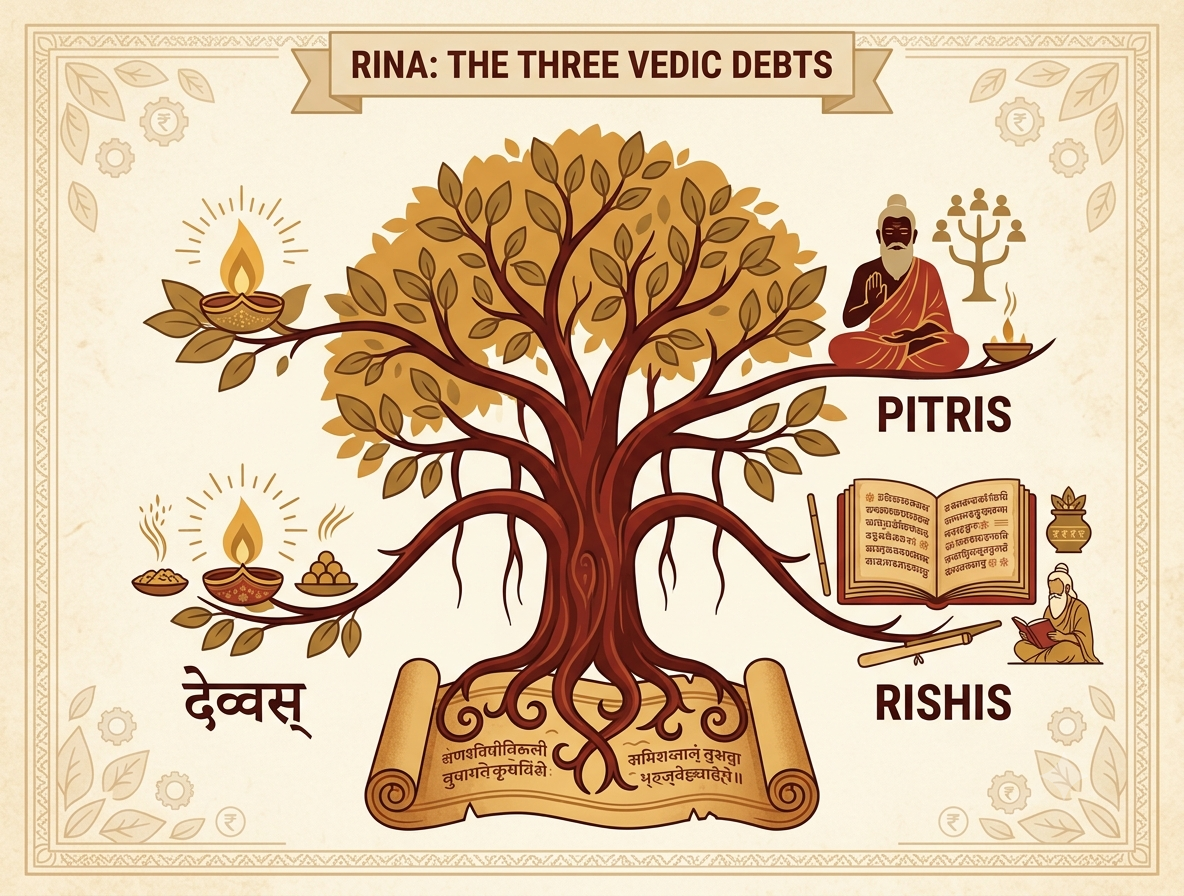
In India, the idea of debt has roots in the earliest texts of the civilisation. The Rig Veda, composed roughly 1500 BCE, contains the word rina, which translates broadly as debt or obligation. Rina carried dimensions that modern personal finance terminology does not: it included financial obligation, but also social obligation, spiritual obligation, and ethical duty.
The Vedic framework described three kinds of rina that every person was born carrying: debt to the gods (devaruna), to be repaid through ritual and devotion, debt to the ancestors (pitruruna), to be repaid through continuing the family lineage, and debt to teachers and sages (rishiruna), to be repaid through learning and passing on knowledge.
In this conception, debt was not a failure or a burden. It was the condition of being embedded in a web of relationships and obligations that defined a fully human life. The person without debt, in this framework, was not free. They were isolated, outside the network of reciprocal obligation that constituted society.
The Arthashastra of Kautilya, written around 300 BCE, contains detailed provisions governing interest rates, debt contracts, and the rights of borrowers and lenders, including protections against excessive interest and provisions for debt forgiveness in cases of genuine hardship. The idea that a lender had some obligation toward a borrower in distress, that debt had ethical as well as transactional dimensions, was embedded in Indian legal thought from very early on.
This is not a history lesson without contemporary relevance. The cultural complexity India carries about debt, the shame, the silence, the social weight, has roots in a very long tradition of debt as a moral as well as financial category.
The Invention of Interest
Interest is the mechanism that transformed debt from a social arrangement between individuals into an economic engine. Its history is almost as old as debt itself.
The earliest known interest rates appear on those same Mesopotamian clay tablets from around 3000 BCE. Grain loans carried interest rates of approximately 33% annually. Silver loans carried rates of around 20%. These were not arbitrary numbers. They reflected the risk of agricultural lending (crops could fail) and the time value of resources (grain consumed now was more valuable than grain promised for future repayment).
Interest made large-scale lending economically rational. A lender willing to risk their surplus could expect a return. This made lending more common, which made larger projects possible, which enabled the growth of trade, cities, and eventually empires.
The Greeks and Romans built sophisticated credit systems. Rome had a professional banking class (the argentarii) who took deposits, extended credit, and facilitated long-distance trade through letters of credit. Roman law developed extensive provisions governing debt contracts, enforcement, and default, many of which influenced the legal systems of medieval Europe and, through them, modern commercial law.
The moral status of interest was contested throughout this history. Both Aristotle and, much later, medieval Islamic and Christian scholars argued that charging interest on money was unnatural and exploitative. The Quran specifically addresses debt: if a debtor is in difficulty, grant him time till it is easy for him to repay. The Jewish concept of the jubilee year, appearing in Leviticus, mandated the cancellation of all debts every fifty years. Ancient Mesopotamian kings periodically declared debt jubilees for political reasons, cancelling agricultural debts to prevent social collapse.
The history of interest is, in other words, also a history of the recognition that unchecked debt accumulation produces social crisis, and of the various mechanisms societies have developed to contain it.
How Debt Shaped Empires and Economies
Debt at the scale of states and empires has shaped history in ways that individual debt management does not, but the underlying dynamics are the same.
The Spanish empire financed its expansion in the Americas through Genoese and later Flemish banking houses. The British East India Company, which conquered much of the Indian subcontinent, was a debt-financed venture. The American Civil War was financed on both sides by bond issuance. The World Wars required sovereign debt on a scale that restructured global finance.
The modern financial system, characterised by fractional reserve banking, sovereign debt markets, and global credit flows, is the product of centuries of evolution in these lending relationships. Central banks were created largely to manage the crisis tendency of debt systems: the Bank of England was established in 1694 specifically to help the British government finance a war.
The 2008 global financial crisis, the COVID-19 sovereign debt surge, and the current challenges facing emerging market economies are all, in different forms, expressions of the same fundamental dynamic that ancient Mesopotamian farmers navigated: the tension between debt as an enabling tool and debt as a compounding burden.
The Modern Debt System and How It Reached India
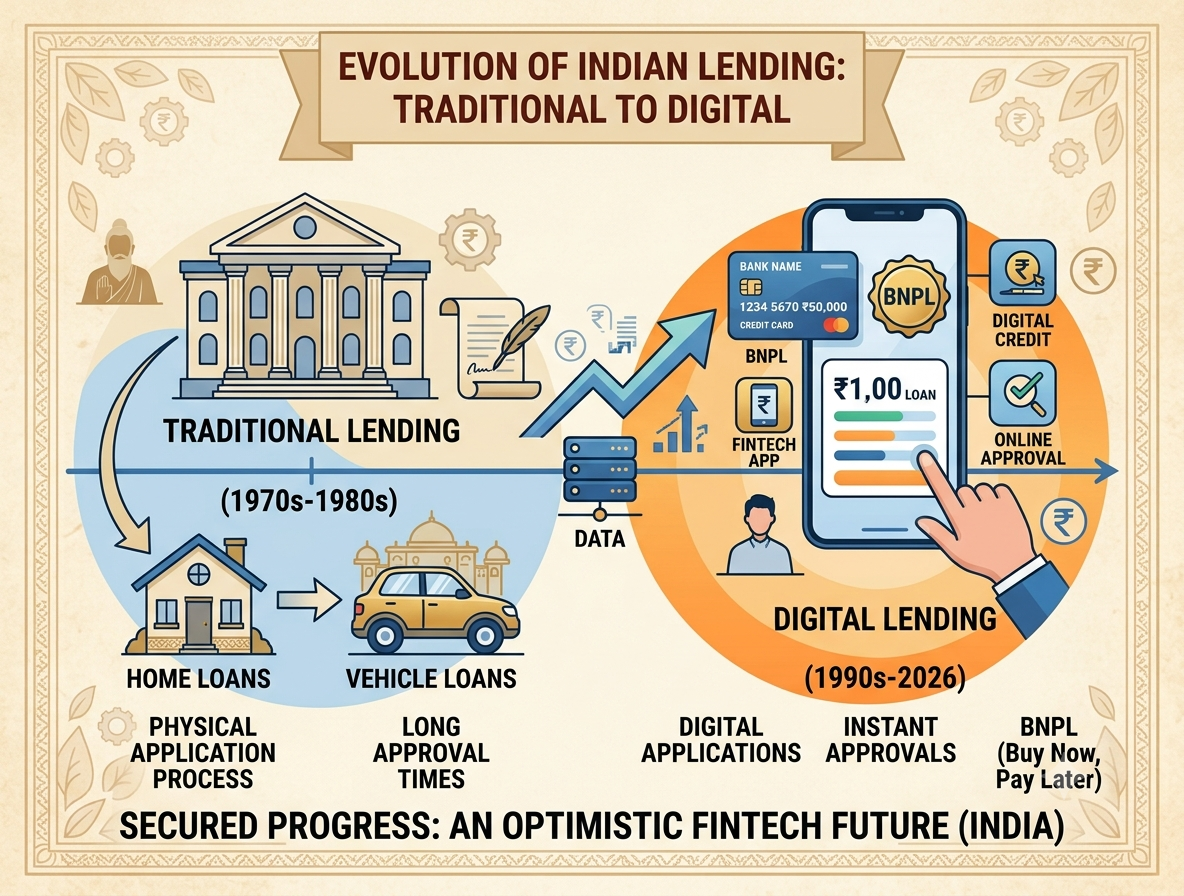
Modern consumer credit in India arrived in two waves.
The first was the expansion of public sector banking in the 1970s and 1980s, which extended formal credit access to the middle class through home loans, vehicle loans, and eventually personal loans. This was credit for productive purposes: home ownership, asset building, business development.
The second, beginning in the 1990s and accelerating through the 2000s, was the expansion of consumer credit: credit cards, personal loans for lifestyle purposes, and from 2015 onward, digital lending apps, BNPL platforms, and fintech credit products that extended formal credit access to Tier 2 and Tier 3 cities and to income groups that had never previously had formal credit.
The speed of this second expansion outpaced the financial literacy infrastructure needed to support responsible use. Products charging 36% to 42% annual interest were extended to millions of people who had no framework for assessing what that rate meant in practice, and no experience of managing revolving credit with a compounding interest trap embedded in the minimum payment structure.
The result is the unsecured retail debt crisis that FREED was built to address: millions of ordinary, responsible Indians in debt that has grown beyond what their income can manage, not because of recklessness, but because the system extended credit faster than it extended the understanding needed to use it safely
What History Teaches Us About Debt Today
The history of debt is not a detour from the practical question of how to manage it. It is context that changes the moral dimension of the experience.
Debt has always been both enabling and potentially crushing. Every society that has engaged seriously with the problem, from the Mesopotamian debt jubilee to the Vedic rina framework to the Qur'anic instruction to grant relief to the struggling debtor, has recognised that unchecked debt accumulation produces human suffering and social crisis, and has attempted to build correction mechanisms.
The modern Indian regulatory framework, through RBI guidelines on responsible lending, Fair Practices Code, the Banking Ombudsman, and the right to hardship restructuring, is the contemporary version of these correction mechanisms. FREED is an institution built specifically to help individuals navigate these mechanisms effectively.
The person carrying unmanageable debt in India in 2026 is not in a new or unusual situation. They are in a situation as old as settled human civilisation. What is available now, in the form of professional debt resolution support and regulatory protection, is considerably better than what was available to the Mesopotamian farmer who could not repay the temple grain loan. But the need for it, the debt that has grown beyond what the borrower can manage, is ancient.
Understanding this history does not solve the debt. But it does remove the shame that is one of the largest barriers to addressing it. Debt is part of the human condition. The response to it is what defines the path forward.
Are You in a Loan Trap? Quick Check
Move the slider to your total EMIs as a % of monthly salary. See your debt stress level instantly.
EMIs as % of Monthly Salary

Mohit Juneja
Mohit Juneja writes educational content at FREED on debt management, credit scores, loan repayment, and borrowing best practices. His content is shaped by expert insights and industry knowledge, helping readers better understand their financial options and make informed decisions.
mohit.juneja@freed.care

FREED is India's trusted loan management platform. Founded in 2020 and headquartered in Gurugram, FREED has counselled 20 lakh+ people on personal loans, credit cards, and app loans. FREED charges fees only on successful settlement, not upfront. FREED does not handle secured loans (home loans, car loans, gold loans).
Media Mentions