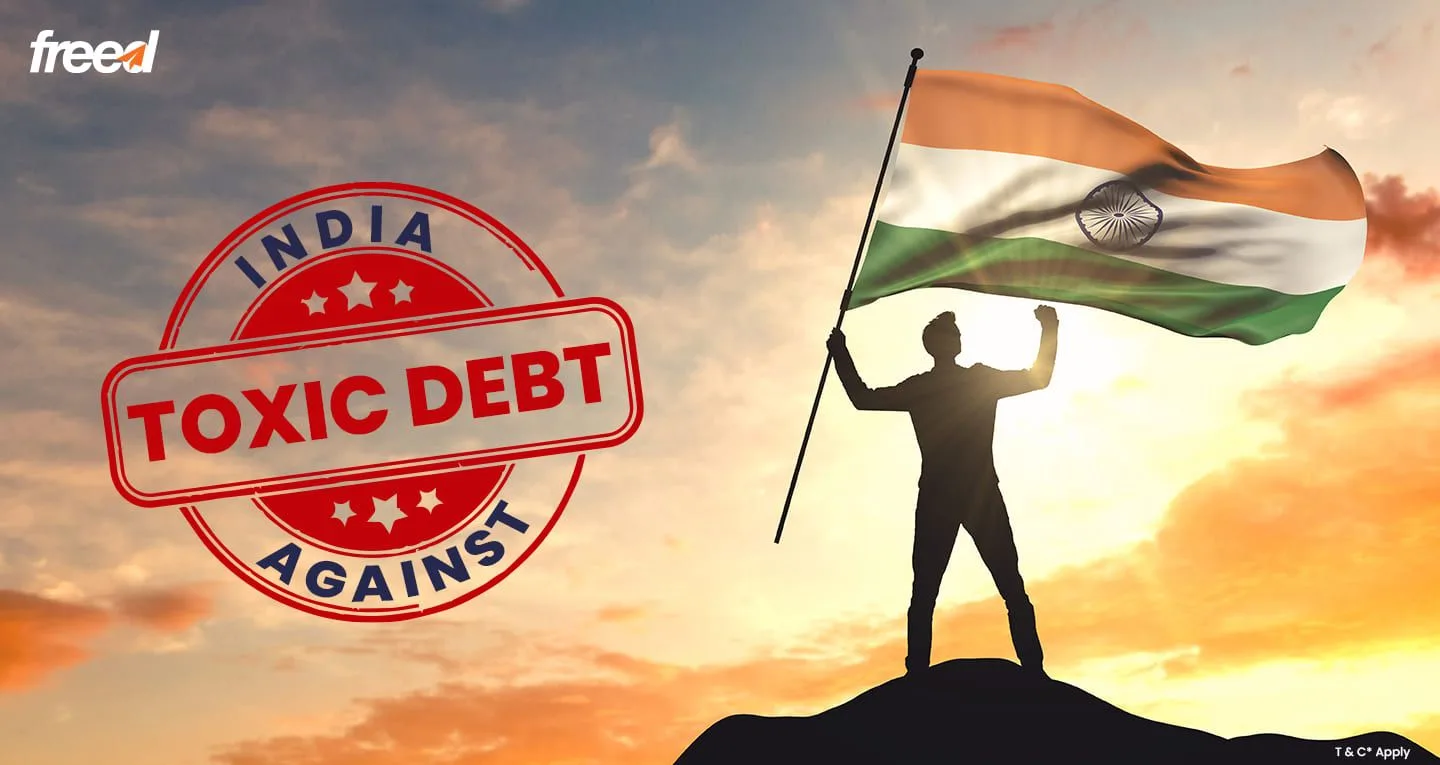
India Against Toxic Debt-Trap! Powered by Freed!
Instead, FREED has launched a debt relief program under which it guides and helps you save your money, which will help you get out of toxic debt forever.
Mohit Juneja
Reviewed by FREED India, Debt Resolution Specialists
 4.7/5
4.7/5 ₹3,200Cr+
 20,000+
 20,00,000+4.7/5₹3,200Cr+20,000+20,00,000+
Key Takeaways

India's unsecured retail lending grew dramatically over the last decade, putting credit cards, personal loans, and BNPL into the hands of tens of millions of people who had no prior formal credit access and no financial literacy infrastructure to support responsible use.
The result is a debt trap that is systemic rather than personal: millions of ordinary, hardworking Indians in debt that has grown beyond what their income can manage, not because they were irresponsible, but because the system extended credit without adequate support, education, or resolution options.
FREED was built specifically to fill this gap: India's first comprehensive debt relief platform, combining debt settlement, debt consolidation, credit score rebuilding, and harassment protection into one structured programme.
FREED's approach is built on three values: empathy, passion, and service. Every person who contacts FREED is treated as a person first, a borrower second, and a case number never.
More than 60,000 Indians have used FREED to get out of debt. The mission is to reach every Indian who needs this help.
The Scale of India's Unsecured Debt Problem
India's retail credit market expanded at a pace in the decade from 2010 to 2020 that had no parallel in the country's financial history. Credit cards reached tens of millions of new users. Personal loan disbursements grew by double digits annually. BNPL and digital lending apps reached people in Tier 2 and Tier 3 cities who had never before had formal credit access.
This expansion was, in significant part, genuinely beneficial. Credit access enables medical emergencies to be handled without selling assets. It allows businesses to fund working capital. It supports education and skill development. These are real goods.
But the expansion also had a shadow side that is now visible in the NPA data. Gross NPAs in unsecured retail lending have risen sharply. Millions of accounts are in default. Recovery calls and legal notices are a daily reality for a significant and growing proportion of the Indian middle class.
The debt trap, the dynamic where monthly debt obligations consume so much of income that new credit must be taken to service existing obligations, which increases total obligations, which requires more credit, is not a marginal phenomenon. It is one of the defining financial experiences of a generation of Indians.
Who Is Actually Affected and Why
The picture of who is caught in India's debt trap is not what most people expect.
It is not primarily people who borrowed recklessly or irresponsibly. It is people who responded rationally to the circumstances they were in.
A Rs. 25,000 medical bill that insurance did not cover. A month of reduced salary during a company restructuring. A personal loan taken for a sibling's wedding because the family expected it and there was no other way. A credit card used for daily expenses during a job transition that lasted longer than expected. A business venture that did not survive the COVID-19 disruption.
Each of these is a rational, understandable response to a real life event. The debt trap forms when these reasonable individual decisions accumulate faster than income can absorb them, particularly when the credit extended carries interest rates of 36% to 42% that compound aggressively during any period of difficulty.
The people FREED works with are not financial failures. They are ordinary Indians who encountered difficult circumstances in a financial system that was better equipped to extend credit than to help people manage when that credit became unmanageable.

FREED Expert Tip
FREED was founded in August 2020, in the immediate aftermath of COVID-19, when the scale of India's retail debt crisis became undeniable. The pandemic triggered mass job losses and business closures that pushed millions of previously manageable debt situations into default simultaneously. What became clear was not just that people needed help, but that no adequate help existed. FREED was built to be that help.
Talk to FREED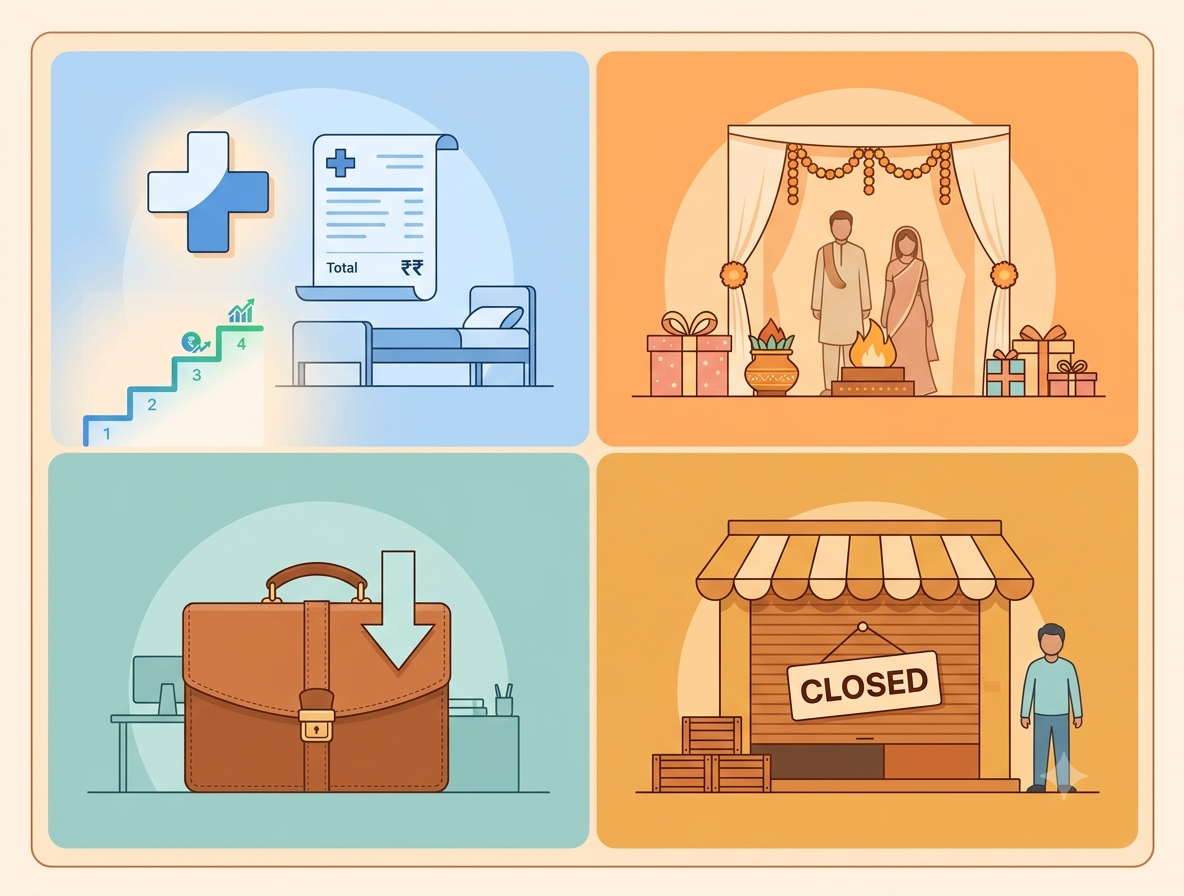
Why the Debt Trap Is Systemic, Not Personal
Understanding the systemic nature of the debt trap is important because it changes how the problem is addressed.
If the debt trap were primarily a personal failure, the solution would be financial education and better individual decision-making. These are necessary and FREED provides both. But they are not sufficient.
The systemic dimensions are structural. Credit was extended at scale to people who had no financial literacy infrastructure to help them understand what they were taking on. The interest rate on unsecured credit in India, 36% to 42% on credit cards, 18% to 26% on personal loans, is among the highest in the world relative to income levels. The regulatory framework for consumer debt resolution was incomplete: no formal consumer bankruptcy process, limited debt restructuring options available to retail borrowers, and a recovery and collection ecosystem that prioritised lender recovery over borrower rehabilitation.
Into this environment, millions of people took the credit that was offered to them, used it for genuine needs, and found that when circumstances changed, the system that had extended credit had no comparable mechanism to help them exit it.
FREED was built in recognition of this systemic gap. A single person trying to negotiate a settlement with a major bank, without knowledge of realistic settlement percentages, without understanding of their legal rights, without access to the documentation and process that makes settlement negotiations work, is structurally disadvantaged. FREED changes that structural disadvantage by placing institutional knowledge and professional advocacy on the borrower's side.
What Was Missing Before FREED
Before FREED, the options available to an Indian borrower whose unsecured debt had become unmanageable were effectively three.
The first was continuing to pay, often through minimum payments that did not reduce principal, while interest compounded and the situation gradually worsened.
The second was defaulting entirely, facing recovery harassment, CIBIL score damage, and the ongoing stress of unresolved debt with no defined path to resolution.
The third was attempting to negotiate directly with the bank, without knowledge of what the bank was likely to accept, without the documentation that makes a hardship case credible, and without any institutional leverage.
None of these options produced a good outcome. The first was expensive and slow. The second was damaging and indefinite. The third was accessible only to those with the knowledge and confidence to navigate a complex institutional process alone, which most people in financial distress do not have.
What was missing was a professional advocate that sat on the borrower's side of the table: someone with institutional knowledge of what banks accept in settlement, the capacity to build and document a hardship case correctly, and the ongoing support to manage the process through to completion.
This is what FREED provides.
How FREED Is Built to Address This
FREED's approach to the debt trap is comprehensive, covering every dimension of the experience.
Honest assessment, free of charge. Every FREED engagement begins with a free consultation that maps the full financial situation: income, total outstanding, all obligations, which accounts are current and which are delinquent. The outcome of this assessment is a specific, honest recommendation, including, where appropriate, the honest answer that FREED's programme is not the right fit.
Debt Resolution for genuine hardship. For people whose total outstanding genuinely exceeds what income can repay, FREED's Debt Resolution Programme negotiates with creditors to settle for less than the full outstanding. FREED's negotiators know the realistic settlement percentages for each major bank, the documentation that moves negotiations forward, and the point in the default timeline at which each lender is most receptive.
Debt Consolidation for structural improvement. For people who can repay in full but need a better structure, FREED's Debt Consolidation Programme combines multiple high-interest obligations into one lower monthly payment, reducing FOIR and making consistent repayment manageable.
FREED Shield for harassment protection. Recovery harassment is one of the most damaging dimensions of the debt experience in India. FREED Shield takes over all creditor and recovery agent communications from the moment of enrolment, manages and documents harassment, and escalates to the RBI Banking Ombudsman where conduct violates regulatory guidelines.
Credit score rebuilding. FREED Credit Insights provides free credit score monitoring. FREED assists with bureau dispute for incorrectly reported settled accounts. FREED's relationship managers provide specific, sequenced guidance on the rebuilding steps that produce the fastest score recovery after resolution.
Special Purpose Account. The financial mechanism of the Debt Resolution Programme, the Special Purpose Account managed by a regulated trusteeship firm, ensures that the borrower's funds are held securely and released only upon the borrower's explicit authorisation for each settlement payment. The money is always the borrower's. FREED does not have direct access to it.

Legal Note
FREED operates fully within the Indian legal and regulatory framework. All negotiations are conducted on the basis of voluntary settlement under RBI guidelines for NPA resolution. FREED does not make claims about guaranteed outcomes. Service fees apply only on successful resolution of each enrolled account.
Know your rights as a borrower working with a debt relief platform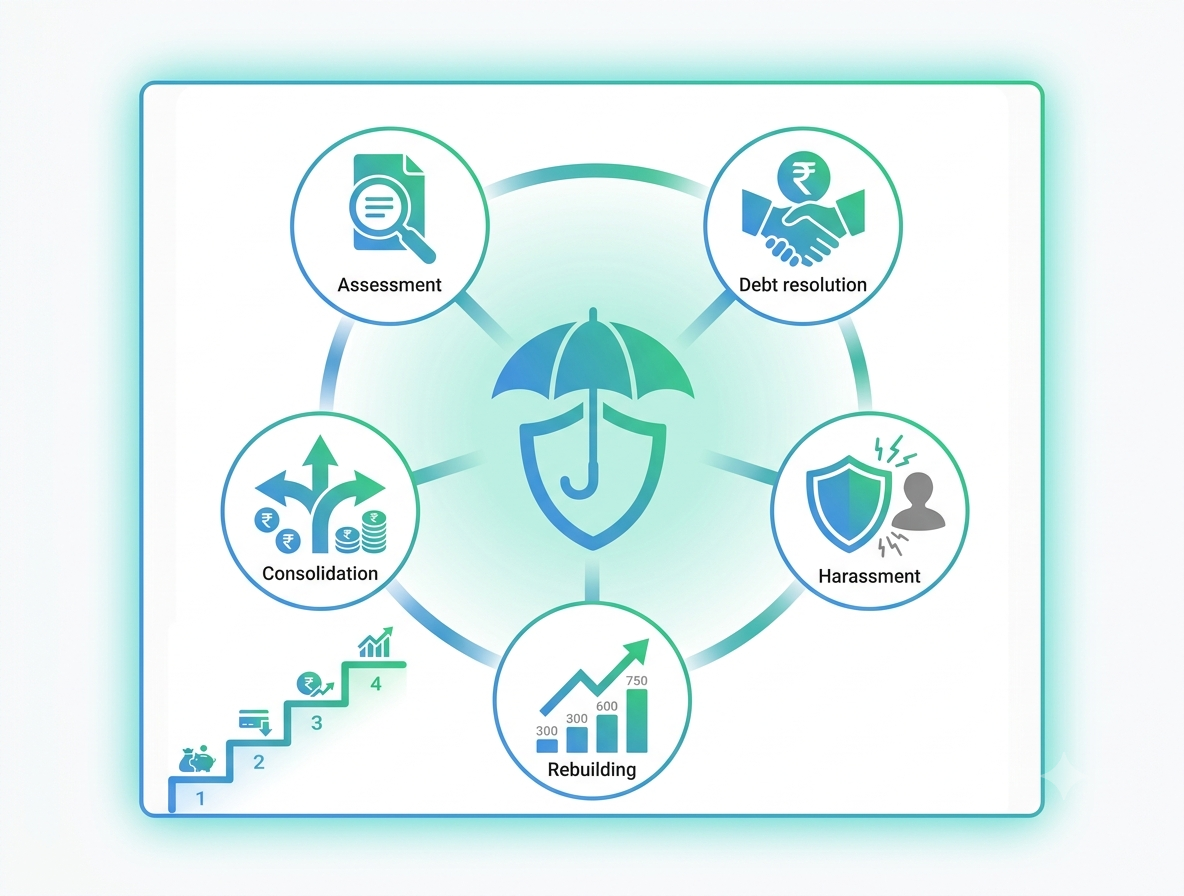
What Being Powered by FREED Actually Means for a Borrower
For the person who has been carrying debt alone, fielding recovery calls, avoiding statements, and feeling the weight of a situation that feels permanent, what FREED provides is not just a financial service.
It is the experience of not being alone in it anymore.
The first FREED call is, for many clients, the first time they have said the full, accurate number out loud to another human being. The counsellor who responds without judgment, with specific information about what options exist and what is realistic, changes the emotional landscape of the situation. The problem has not changed. But the person facing it now has someone standing with them.
That experience, being accompanied rather than abandoned, continues through the programme. The relationship manager is available. The process is transparent. Progress is communicated. When settlements are completed, one by one, the accounts that were sources of dread become sources of relief. The future, which felt closed, begins to open.
This is what being powered by FREED means in practice. Not just the mechanics of settlement, but the experience of being supported through a difficult situation by people who understand it, take it seriously, and are committed to the outcome.
The Mission: India Against the Toxic Debt Trap
FREED's mission, expressed in the slug that gave this article its title, is not modest. India against the toxic debt trap. Powered by FREED.
The toxic debt trap is not a marginal problem. It affects millions of ordinary Indian households. It suppresses consumption, limits life choices, and produces documented harm to physical and mental health. It is one of the most consequential, least discussed financial realities of contemporary India.
The answer to a systemic problem requires a systemic response. FREED's response is to provide every Indian who needs debt relief with access to the professional support, the institutional knowledge, and the structured process that makes resolution possible.
Over 60,000 Indians have used FREED to become debt-free. Over 20 lakh have been counselled. Over Rs. 3,200 crore in debt has been managed through the platform. These are not small numbers. But they are a starting point, not a destination.
The mission continues: one conversation at a time, one settlement at a time, one person freed from debt at a time, until the scale of FREED's reach matches the scale of India's need.
Are You in a Loan Trap? Quick Check
Move the slider to your total EMIs as a % of monthly salary. See your debt stress level instantly.
EMIs as % of Monthly Salary

Mohit Juneja
Mohit Juneja writes educational content at FREED on debt management, credit scores, loan repayment, and borrowing best practices. His content is shaped by expert insights and industry knowledge, helping readers better understand their financial options and make informed decisions.
mohit.juneja@freed.care

FREED is India's trusted loan management platform. Founded in 2020 and headquartered in Gurugram, FREED has counselled 20 lakh+ people on personal loans, credit cards, and app loans. FREED charges fees only on successful settlement, not upfront. FREED does not handle secured loans (home loans, car loans, gold loans).
Media Mentions