Good Loan vs Bad Loan: Understanding Debt's Double-Edged Nature
Not all debt is the enemy. Some debt builds wealth, funds education, and creates opportunities that would otherwise be unavailable. Other debt quietly destroys wealth, funds consumption, and compounds into a problem that takes years to resolve. Knowing the difference before borrowing is one of the most valuable financial skills an Indian household can develop.
Mohit Juneja
Reviewed by FREED India, Debt Resolution Specialists
 4.7/5
4.7/5 ₹3,200Cr+
 20,000+
 20,00,000+4.7/5₹3,200Cr+20,000+20,00,000+
Key Takeaways

Debt is neither inherently good nor inherently bad. It is a tool, and like any tool, its value depends entirely on what it is used for, at what cost, and whether the user can sustainably manage it.
A good loan funds something that builds value, increases earning capacity, or creates an asset that appreciates over time, at an interest rate the borrower can sustain.
A bad loan funds consumption, depreciating assets, or lifestyle spending, at a high interest rate that costs significantly more than any benefit the spending provides.
The distinction is not always clean. The same loan type can be good or bad depending on the amount borrowed, the interest rate, the FOIR impact, and the borrower's genuine repayment capacity.
If bad loans have already accumulated into an unmanageable situation, FREED can help find a structured path to resolution.
Why Debt Is Double-Edged
The Sanskrit word for debt, "rina," carries connotations of obligation and burden that have shaped how Indian culture treats borrowing. The common cultural position is that debt is bad, that borrowing is to be avoided, that a debt-free life is the financially virtuous one.
This position is understandable. It is also incomplete.
A person who refuses all debt pays cash for everything but is unable to buy a home until their 50s, if ever, because property prices in most Indian cities have made cash purchase impossible for most income levels. The same person watches a colleague take a home loan at 30, build equity in an appreciating asset for 20 years, and retire owning a property worth several times the total interest paid on the loan. The debt-avoider has integrity. The borrower has wealth.
On the other side, a person who borrows freely, funding lifestyle upgrades with personal loans and credit card balances, using BNPL for every discretionary purchase, and carrying balances that compound at 36% to 42% annually, is using debt as a consumption accelerant. The purchases are finite. The interest is not. By the time the full cost of the borrowing is visible, years of income have been transferred to lenders as interest on spending that provided no lasting value.
The truth is between these two positions. Debt is double-edged. Used well, it is one of the most powerful wealth-building tools available. Used poorly, it is one of the most efficient wealth-destroying mechanisms in personal finance. The difference lies in three things: what the money is used for, what the borrowing costs, and whether the repayment fits genuinely within the borrower's income.
What Makes a Loan Good
A good loan has three characteristics working together.
The first is purpose. The borrowed money funds something that builds value, increases the borrower's earning capacity, or provides access to an asset that appreciates over time. A home loan funds a property that typically appreciates in most Indian urban markets. An education loan funds qualifications that typically increase lifetime earning capacity. A small business loan funds expansion that generates revenue above the cost of the loan.
The second is cost. The interest rate is low enough that the total interest paid over the loan tenure is a reasonable price for the value generated. A home loan at 9% annually on a property that appreciates at 7% to 10% annually has a net cost that is minimal or even negative in real terms. An education loan at 10% that funds a qualification generating a 40% salary increase pays for itself many times over.
The third is serviceability. The monthly EMI fits within the borrower's income with a comfortable margin, meaning the FOIR including the new loan remains below 40% to 50%, there is room for savings and unexpected expenses, and the obligation does not create fragility.
When all three are present simultaneously, the loan is doing what debt is designed to do: enabling access to something of lasting value that would otherwise be unavailable.
What Makes a Loan Bad
A bad loan fails on one or more of the three criteria above, and the failure of any one of them converts a financial tool into a financial problem.
A loan is bad on purpose when the borrowed money funds consumption, not creation. A personal loan for a vacation. Credit card debt for discretionary shopping. BNPL for fashion purchases. The purchases are real and provide real, if brief, enjoyment. But when the enjoyment is over, the debt remains. And the interest on debt taken for consumption is a pure cost, producing no future value.
A loan is bad on cost when the interest rate is so high that the total repayment significantly exceeds the value received. Credit card debt at 40% annually is almost always a bad loan because no reasonable consumer purchase generates a 40% return that offsets the interest. A personal loan at 24% for something that could have been saved for within a year is bad because the time premium paid in interest is disproportionate to the benefit of having it now rather than later.
A loan is bad on serviceability when the FOIR it produces, combined with existing obligations, leaves the borrower fragile. An income disruption, a medical event, or any unexpected expense then creates immediate default risk. The loan that was individually affordable becomes part of a system of obligations that cannot absorb any variability.
Are You in a Loan Trap? Quick Check
Move the slider to your total EMIs as a % of monthly salary. See your debt stress level instantly.
EMIs as % of Monthly Salary
Good Loan Examples in the Indian Context
Home loan: Typically 9% to 11% interest, secured against an appreciating asset, with an EMI that fits within income for most structured borrowers. Tax-deductible interest under Section 24(b) further reduces the effective cost. The asset purchased typically builds equity over the loan tenure. For most Indian households, a home loan is the most productive use of debt available.
Education loan: 8% to 15% interest, funding qualifications that increase lifetime earning capacity. The moratorium period allows repayment to begin after employment, aligning repayment with the income the loan generated. Well-calibrated to the expected post-qualification salary, an education loan pays for itself in income premium within a few years of graduation.
Business loan for revenue-generating investment: A loan funding equipment, working capital, or expansion that generates demonstrably higher revenue than the loan cost is productive debt. The test is whether the revenue generated exceeds the interest paid, producing a net positive cash flow from the borrowed capital.
Gold loan for a short-term need with a clear repayment source: A gold loan at 12% to 18% for 6 to 12 months, with a known repayment source (a fixed deposit maturing, a receivable coming in), is productive short-term debt that avoids selling a family asset. The key is the defined repayment source. Without it, the loan risks becoming a problem when the tenure ends.

FREED Expert Tip
Before any borrowing decision, calculate the total repayment, not just the monthly EMI. Multiply the EMI by the number of months in the tenure and add any fees. Subtract the original loan amount. The result is the total interest cost. Compare this to what the borrowed money will actually produce. If the loan is for a vacation, the total interest is a pure additional cost on top of the holiday price. If the loan is for a home, it is the price of accessing an appreciating asset earlier than cash purchase would allow. This comparison, made explicitly, changes how most loan decisions feel.
Talk to a FREED CounsellorBad Loan Examples in the Indian Context
Credit card balances carried from month to month: At 36% to 42% annual interest, a credit card balance that is not cleared in full each billing cycle is almost always bad debt. The purchases funded typically depreciate immediately. The interest cost compounds indefinitely. A Rs. 50,000 credit card balance managed through minimum payments for two years costs Rs. 25,000 to Rs. 30,000 in interest while the principal barely reduces.
Personal loans for weddings or lifestyle events: A personal loan at 18% to 22% to fund a wedding that could have been scaled differently, or a vacation that could have been saved for, is bad debt. The event ends. The EMI continues for 2 to 5 years, consuming income that could have been saved or invested.
BNPL accumulation for discretionary purchases: Individually small, collectively significant. Multiple BNPL obligations for clothing, gadgets, and food delivery accumulate into Rs. 15,000 to Rs. 25,000 of monthly fixed obligations that feel like not-debt until the aggregate is calculated. The interest rate on missed BNPL payments is high, and the products funded depreciate immediately.
Personal loans to repay personal loans: The clearest signal of bad debt in a cycle. Taking on new high-interest debt to service existing high-interest debt does not reduce the total. It increases it while delaying the reckoning.

Legal Note
Under RBI guidelines on responsible lending, banks and NBFCs are required to assess repayment capacity before extending credit. If credit was extended without adequate assessment of income and existing obligations, this may constitute irresponsible lending. You can raise a complaint with the RBI Banking Ombudsman at bankingombudsman.rbi.org.in if you believe credit was extended without appropriate due diligence on your repayment capacity.
Know your rights as a borrowerThe Grey Zone: Loans That Can Go Either Way
Some loan types are neither inherently good nor bad. Their quality depends on the specific circumstances of use.
Vehicle loan: A vehicle loan for a vehicle needed for work, for commuting, or for essential family transport is closer to good debt, particularly at a reasonable interest rate on a modest vehicle. A vehicle loan for a premium upgrade that was not needed, funded at 15% over 7 years on a vehicle that depreciates 15% to 20% in the first year, is bad debt.
Personal loan for medical emergency: A personal loan at 18% to cover a medical emergency for which no other option exists is necessary debt. It is not good in the sense of generating future value, but it is responsible borrowing for a genuine need. The focus should be on clearing it as fast as possible once the emergency is resolved.
Personal loan for debt consolidation: Potentially good, potentially neutral. Taking a personal loan at 15% to clear credit card debt at 40% saves Rs. 25% annually on the consolidated amount, which is a genuine financial improvement. But if the credit card is then used again to accumulate a new balance alongside the personal loan, the consolidation has doubled the debt rather than resolved it.
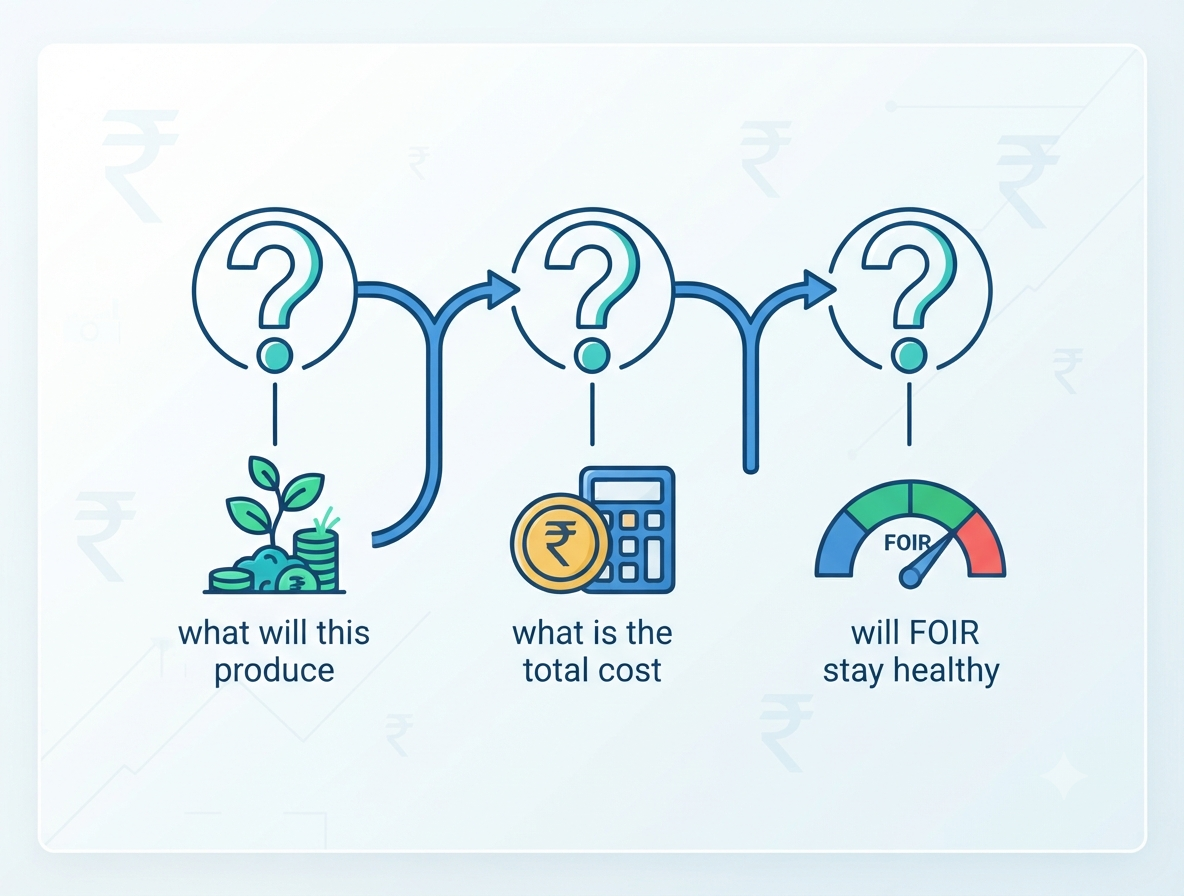
The Real Test: Three Questions Before Any Borrowing
Before any loan or credit product is taken, three questions reveal whether the debt is likely to be good or bad.
One: What will this money produce? If the answer is a depreciating asset, a one-time experience, or consumption that leaves no lasting value, the loan is likely bad. If the answer is an appreciating asset, increased earning capacity, or a productive investment, it is potentially good.
Two: What is the total cost? EMI multiplied by months of tenure, plus fees, minus original loan amount. This is what the borrowing actually costs. Compare this explicitly to what the money will produce. If the cost exceeds the value, the loan is bad regardless of how the monthly EMI feels.
Three: Will the FOIR remain below 45% after this loan? If adding this loan's EMI to existing obligations takes the FOIR above 45% to 50%, the loan creates fragility even if the other two tests are passed. Serviceability is the necessary third condition.
When a Good Loan Turns Bad
A good loan at inception can become a bad loan through changed circumstances.
A home loan taken at a manageable FOIR at one income level becomes bad if income drops significantly and the FOIR crosses 60%. The loan did not change. The borrower's capacity to manage it did.
An education loan becomes bad if the qualification does not produce the expected income increase, and the EMI consumes a disproportionate share of what is actually earned rather than what was projected.
A business loan becomes bad if the revenue it was meant to generate does not materialise, and the obligation now competes with basic operating costs.
These are not moral failures. They are the consequence of circumstances changing after borrowing. The response is not shame but action: approaching the lender for restructuring, assessing whether consolidation or professional resolution is the appropriate path, and addressing the situation before it deteriorates further.
FREED helps people in situations where good-loan-turned-bad is part of the picture, not just discretionary bad borrowing. The free consultation addresses the situation as it is, not as it was supposed to be.

Mohit Juneja
Mohit Juneja writes educational content at FREED on debt management, credit scores, loan repayment, and borrowing best practices. His content is shaped by expert insights and industry knowledge, helping readers better understand their financial options and make informed decisions.
mohit.juneja@freed.care

FREED is India's trusted loan management platform. Founded in 2020 and headquartered in Gurugram, FREED has counselled 20 lakh+ people on personal loans, credit cards, and app loans. FREED charges fees only on successful settlement, not upfront. FREED does not handle secured loans (home loans, car loans, gold loans).
Media Mentions











