Spend Smart- Ways To Control Overspending This Diwali
Diwali spending adds up fast, shopping, gifts, decor, and celebrations, and credit cards make it easy to overspend without noticing. Here are practical, realistic ways to enjoy the festival while keeping your spending under control this year.

Mohit Juneja
Reviewed by FREED India, Debt Resolution Specialists
 4.7/5
4.7/5 ₹3,200Cr+
 20,000+
 20,00,000+4.7/5₹3,200Cr+20,000+20,00,000+
Key Takeaways

Diwali overspending is rarely one large purchase. It is usually many small purchases across clothing, gifts, decor, and celebrations that individually feel reasonable but combine into a large total.
Setting a total Diwali budget before shopping begins, and breaking it into specific categories, is the single most effective way to prevent overspending.
Credit card offers and BNPL plans during the festive season are designed to reduce the friction of spending. Using cash or debit for discretionary purchases restores that friction deliberately.
If overspending has already happened, the priority is understanding the actual total, not panicking, and building a specific repayment plan for anything put on credit.
If Diwali spending has revealed a larger, ongoing pattern of credit dependency, FREED can help address the underlying debt.
Why Diwali Spending Gets Out of Control So Easily
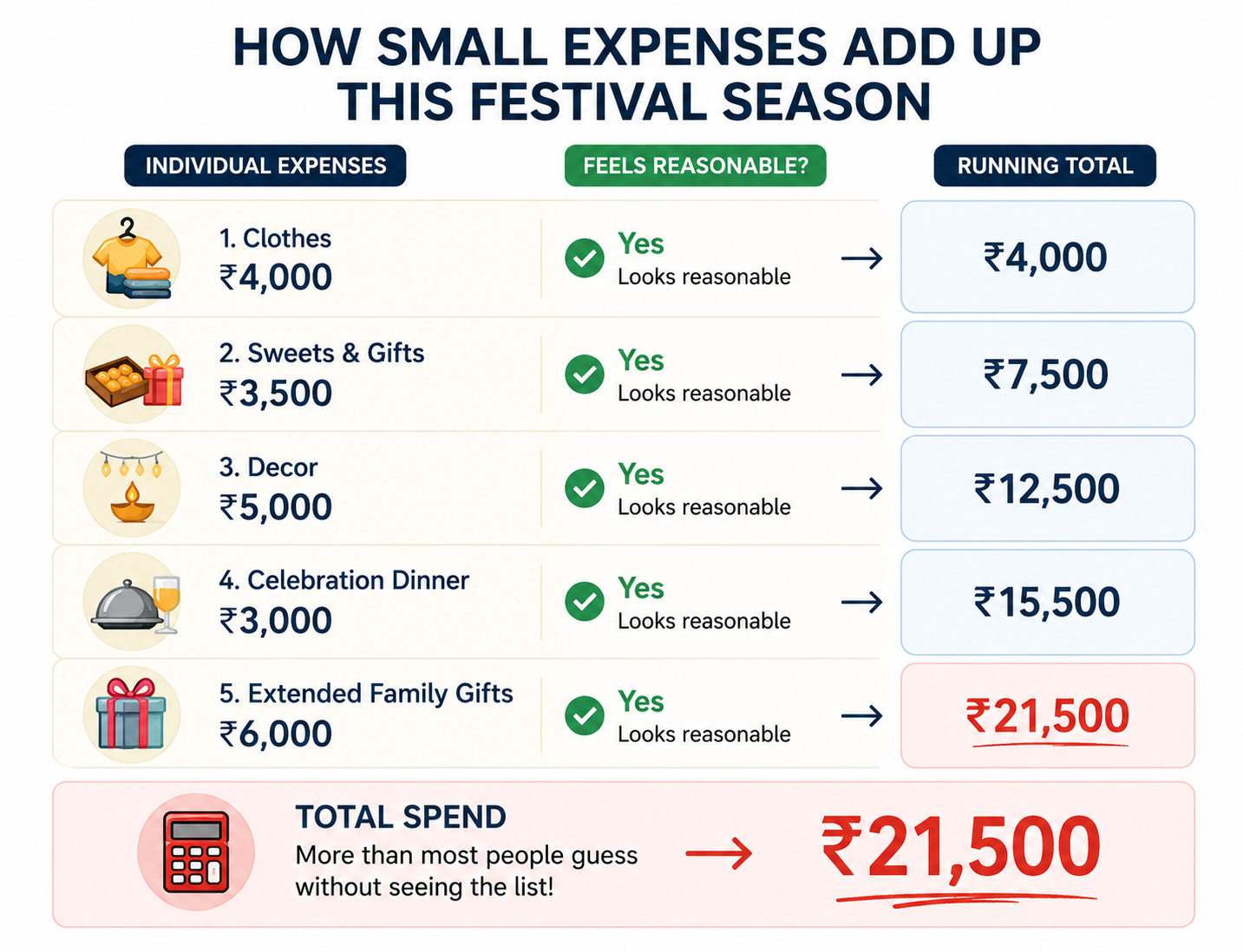
Diwali spending rarely goes wrong because of one large, deliberate purchase. It goes wrong because of dozens of smaller purchases, each one reasonable in isolation, that accumulate faster than they are tracked.
New clothes for the family. Sweets and dry fruits for gifting. Decor and lighting for the home. Gifts for extended family, friends, and colleagues. A celebratory dinner or two. Each of these feels like a normal, expected part of the festival, and each one is usually paid for separately, often on a credit card, without anyone adding up the running total until the statement arrives.
The festive season also coincides with heavy retail promotion, sales, discounts, cashback offers, and credit card deals specifically designed to encourage spending. None of this is inherently wrong, but it does mean that the natural friction that normally slows down spending decisions is deliberately reduced during this period.
Understanding this pattern, many small purchases rather than one large one, is the first step to controlling it, because it points directly to the solution: track the total, not just each individual purchase.
The Real Cost of "Just This Once" Thinking
A specific mental pattern drives much of Diwali overspending: treating each purchase as a one time exception, justified by the festival, without connecting it to the other exceptions already made that same week.
Rs 3,000 on new clothes feels justified because it is Diwali. Rs 2,000 on sweets and gifts feels justified for the same reason. Rs 5,000 on home decor and lighting feels justified too. Individually, each decision seems reasonable. Collectively, without anyone tracking it, the total can reach Rs 25,000 to Rs 40,000 or more, often placed on a credit card that then carries an outstanding balance into the new year at 36 to 42% interest.
The fix is not to eliminate festive spending, which would defeat the purpose of the celebration. The fix is to make the total visible before it happens, rather than discovering it afterwards.
Step 1: Set a Total Diwali Budget Before the Shopping Starts
Before any festive shopping begins, decide on one number, the total amount you are comfortable spending across the entire Diwali season, and write it down.
This number should come from your actual monthly budget, not from what feels appropriate for the festival in the moment. A reasonable starting point is to look at your discretionary spending capacity for the month and decide what portion of it can reasonably go towards Diwali without affecting essential expenses or existing EMI payments.
Once this number exists, every subsequent purchase decision has a reference point. Without it, every purchase is evaluated in isolation, which is exactly how the total grows unnoticed
Step 2: Break the Budget Into Categories
A single total budget number is a good start, but it becomes far more useful when broken into specific categories: clothing, gifts, decor, celebrations and dining, and sweets or hampers.
Assign a specific amount to each category based on your priorities. If gifting extended family matters more to you than new decor this year, allocate accordingly. This step converts a single abstract number into several concrete spending limits that are easier to track in the moment, at the point of purchase, rather than only in hindsight.
Step 3: Separate Needs From Impulse Purchases
Within each category, a further useful distinction is separating planned purchases from impulse ones.
A planned purchase is something you identified as needed before entering the store or opening the shopping app, new clothes for a specific family member, a gift for a specific colleague. An impulse purchase is something that catches your attention in the moment, an attractive discount, a display near the billing counter, an app notification about a flash sale.
Impulse purchases are not inherently bad, and a small allowance for them within the budget is reasonable. The problem arises when impulse purchases are not tracked against the budget at all, quietly consuming money that was allocated for planned, more meaningful purchases.
Step 4: Use Cash or Debit for Discretionary Spending
Credit cards create a specific kind of distance between spending and consequence. The purchase happens immediately, but the financial impact is deferred to the statement, weeks later. This distance is precisely what makes it easy for Diwali spending to accumulate unnoticed.
Using cash or debit for discretionary festive purchases, clothing, decor, gifting, restores the natural friction that credit removes. Watching a bank balance decrease, or physically handing over cash, creates a more immediate connection between the purchase and its cost than a card swipe does.
This does not mean avoiding credit cards entirely, they remain useful for planned, budgeted purchases where the full amount can be cleared before the due date. It means being deliberate about which spending category uses which payment method.
Step 5: Be Careful With Credit Card Offers and BNPL During Diwali
The festive season brings a concentrated wave of credit card discounts, cashback offers, and BNPL promotions, specifically timed to coincide with peak shopping activity.
These offers are not inherently harmful, a genuine discount on a planned purchase is a real benefit. The risk is when an attractive offer becomes the reason for a purchase that would not otherwise have happened, "I am saving 10%" often overshadows the more relevant fact that the purchase itself was not planned or budgeted.
Before using any Diwali specific credit card offer or BNPL plan, ask one question: would I be making this purchase anyway, at this price, without the offer? If yes, the offer is a genuine bonus. If no, the offer is likely driving spending that was not part of the original plan.

FREED Expert Tip
If you do use BNPL for Diwali purchases, treat each one as a fixed, non-negotiable line item in your budget with a specific repayment date, exactly like an EMI. The most common Diwali related debt problem is not a single large BNPL purchase, it is three or four smaller ones, each forgotten about individually, that together create an unexpected repayment burden in the weeks after the festival ends.
Talk to FREEDStep 6: Watch Out for Festive Sale Psychology
Retailers use specific, well tested techniques during festive sales that are worth recognising, because recognising them reduces their effect.
Artificial urgency, countdown timers, limited stock warnings, and "sale ends tonight" messaging create pressure to decide quickly, which reduces the natural pause that normally allows for reconsidering a purchase.
Anchoring, showing a high original price next to a discounted price, makes the discounted price feel like a good decision, even if the discounted price is still higher than what the item would reasonably cost outside the sale period.
Bundling, encouraging the addition of extra items to reach a bundle discount or free shipping threshold, often results in spending more in total than the discount saves.
None of these techniques are illegal, and recognising them does not mean avoiding festive sales altogether. It means pausing before a purchase driven primarily by these cues, and checking it against your category budget before proceeding.
Step 7: Plan Gifting Separately, and Set a Per-Person Limit
Gifting is often the single largest and least tracked category of Diwali spending, because it involves multiple individual decisions, spread across friends, family, and colleagues, each one feeling small in isolation.
Make a specific list of everyone you intend to gift, and set a per-person amount before you begin buying, rather than deciding on the spot for each person as the occasion arises. This prevents the common pattern where an early, generous gift for one person becomes a reference point that inflates spending on everyone else, out of a sense of fairness or comparison.
A clear, pre-decided gifting list with amounts attached is one of the most effective single changes for controlling the largest category of festive overspending.

What the Law Says
Under RBI's digital lending and Fair Practices Code guidelines, all festive credit offers, including credit card discounts and BNPL promotions, must clearly disclose any applicable fees, interest rates for extended payment plans, and the terms of the offer before you commit to a purchase. If a festive offer's terms were not clearly disclosed at the point of purchase, you have the right to request this information from the lender or platform, and to dispute charges that were not properly disclosed.
Know your credit rightsHow to Recover if You Have Already Overspent
If Diwali spending has already exceeded what was planned, the most useful next step is an honest total, not guilt or avoidance.
Add up everything spent across all categories, including anything placed on a credit card or BNPL plan that has not yet been repaid. Seeing the actual number, rather than a vague sense of having overspent, is what allows for a specific plan.
If the amount is on a credit card, prioritise paying it off before the next statement due date wherever possible, to avoid interest at 36 to 42% turning a festive purchase into a significantly more expensive one. If paying the full amount immediately is not possible, pay as much above the minimum due as you can, and set a specific target date to clear the remainder.
If multiple BNPL purchases were made across the festive period, list them out with their individual due dates, and treat each one with the same priority as a fixed monthly bill.
When Diwali Spending Reveals a Bigger Debt Problem
For most people, a Diwali overspend is a temporary, recoverable event, a few months of tighter budgeting brings things back on track.
For some, though, the festive season overspend is not an isolated event. It is a visible symptom of a broader pattern, credit cards already carrying a balance before Diwali began, multiple BNPL commitments already active, or a monthly budget that had little room for festive spending in the first place.
If this describes your situation, the useful response is not simply budgeting more carefully next Diwali. It is addressing the underlying debt directly.
FREED's Debt Consolidation Program combines multiple high interest debts, including any festive season credit card or BNPL balances, into one lower interest loan with a single monthly EMI.
FREED's Debt Resolution Program negotiates a reduced settlement for outstanding debt that cannot realistically be repaid in full, on average 56% less than the original outstanding.
A free consultation can assess your full financial picture honestly and tell you whether this year's festive spending is a one time event to recover from, or a signal pointing to something that needs a more structural solution.
Are You in a Loan Trap? Quick Check
Move the slider to your total EMIs as a % of monthly salary. See your debt stress level instantly.
EMIs as % of Monthly Salary

Mohit Juneja
Mohit Juneja writes educational content at FREED on debt management, credit scores, loan repayment, and borrowing best practices. His content is shaped by expert insights and industry knowledge, helping readers better understand their financial options and make informed decisions.
mohit.juneja@freed.care

FREED is India's trusted loan management platform. Founded in 2020 and headquartered in Gurugram, FREED has counselled 20 lakh+ people on personal loans, credit cards, and app loans. FREED charges fees only on successful settlement, not upfront. FREED does not handle secured loans (home loans, car loans, gold loans).
Media Mentions